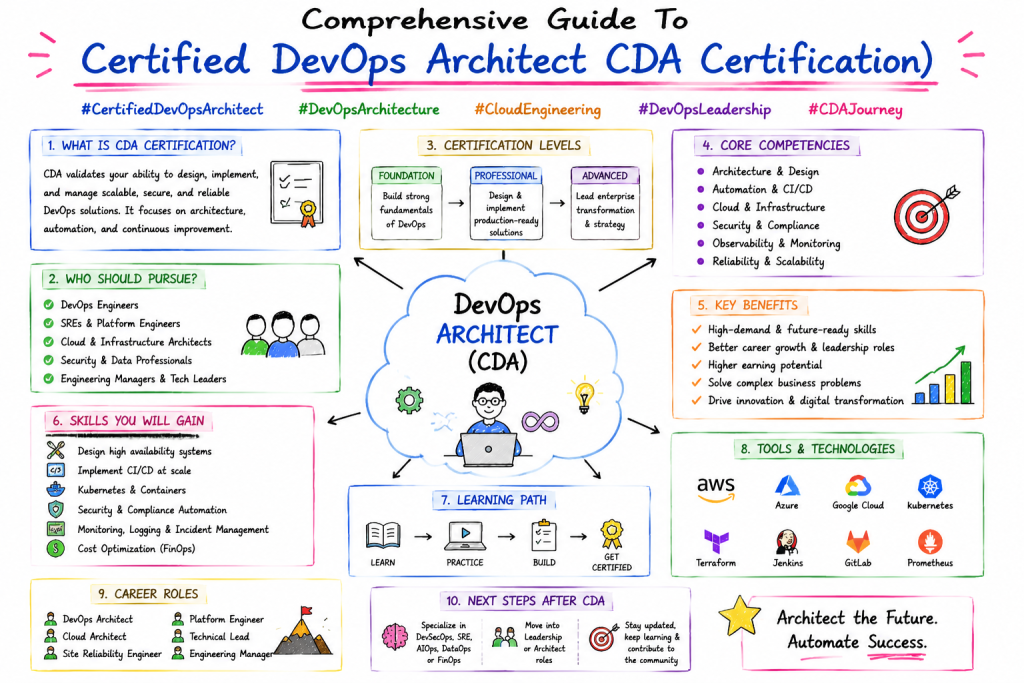
Introduction
The Certified DevOps Architect (CDA) is a professional validation designed for those who want to bridge the gap between high-level system design and daily operational execution. This guide is created for engineers and technical leaders who are ready to move beyond simple tool automation and start designing resilient, scalable, and secure enterprise systems. In today’s world of cloud-native environments and complex platform engineering, having a certificate like this serves as a roadmap for career growth and technical excellence.
Understanding the depth of this program helps professionals make better decisions about where to invest their learning time and energy. It is not just about passing an exam; it is about mastering the architectural patterns that allow large organizations to ship code faster and more reliably. By following this guide, you will understand how this certification fits into the broader landscape of DevOps, SRE, and modern infrastructure management.
What is the Certified DevOps Architect (CDA)?
The Certified DevOps Architect (CDA) represents a shift from being a practitioner who implements tools to being a designer who creates the frameworks those tools live in. It exists to address the growing need for professionals who can oversee the entire software delivery lifecycle from a structural perspective. This program emphasizes real-world applications and production-focused learning, moving away from purely theoretical concepts that often fail in high-traffic environments.
When you pursue this certification, you are looking at how to align modern engineering workflows with established enterprise practices. It covers how to build systems that are not only automated but also observable, secure, and cost-effective. The CDA is built to ensure that an architect can handle the complexities of multi-cloud strategies and microservices architectures while maintaining a focus on business value and operational stability.
Who Should Pursue Certified DevOps Architect (CDA)?
This certification is highly beneficial for a wide range of technical roles, particularly those looking to step into leadership or high-level design positions. Software engineers who want to understand the infrastructure side, as well as SREs and cloud professionals, will find the curriculum directly applicable to their daily challenges. It is also designed for security and data professionals who need to integrate their specialized domains into a unified DevOps architectural framework.
Whether you are a beginner looking for a clear path forward or an experienced engineer aiming to formalize your knowledge, the CDA offers significant value. It is particularly relevant for those working in India’s booming tech hubs and for professionals in global markets who need to adhere to international engineering standards. Managers and technical leaders also pursue this to better understand the technical hurdles their teams face and to make more informed procurement and architectural decisions.
Why Certified DevOps Architect (CDA)
As we move further into 2026, the demand for high-level architectural oversight has never been higher due to the sheer volume of enterprise cloud adoption. Organizations are moving away from simple “lift and shift” migrations and are now focusing on cloud-native redesigns that require a deep understanding of DevOps architecture. The CDA ensures that professionals stay relevant even as specific tools change, by teaching the core principles that govern all successful infrastructure designs.
The longevity of this certification comes from its focus on patterns and logic rather than just specific command-line syntax. Investing time in this program provides a high return on career investment because it prepares you for the “Day 2” operations that most basic courses ignore. As enterprises continue to automate their entire stacks, the role of the architect becomes the central point of contact for ensuring that automation remains sustainable and secure over the long term.
Certified DevOps Architect (CDA) Certification Overview
The Certified DevOps Architect (CDA) program is delivered through the official curriculum found at and is hosted on the devopsschool platform. The assessment approach is designed to be practical, focusing on the candidate’s ability to solve architectural puzzles and design end-to-end delivery pipelines. It is structured to provide a clear progression from foundational knowledge to expert-level system design.
The ownership and maintenance of the curriculum ensure that it stays updated with the latest industry shifts, such as the rise of platform engineering and GitOps. Candidates are evaluated on their ability to integrate various domains like security, monitoring, and cost management into a cohesive strategy. This practical orientation makes the CDA a respected credential among hiring managers who look for hands-on expertise rather than just book-learning.
Certified DevOps Architect (CDA) Certification Tracks & Levels
The certification is organized into three distinct levels: Foundation, Professional, and Advanced, allowing learners to enter at a stage that matches their current experience. The foundation level focuses on the basic building blocks of DevOps architecture and common CI/CD patterns. As you move to the professional level, the focus shifts to scaling, high availability, and managing complex, distributed systems across different cloud providers.
Specialization tracks within the program allow professionals to lean into specific areas like SRE, FinOps, or DevSecOps while maintaining the core architect title. These tracks show how the levels align with career progression, moving from an individual contributor to a lead engineer and eventually a principal architect. This tiered approach ensures that you are always challenged and have a clear “next step” in your professional development journey.
Complete Certified DevOps Architect (CDA) Certification Table
| Track | Level | Who it’s for | Prerequisites | Skills Covered | Recommended Order |
| Core Architecture | Foundation | Junior Engineers | Basic Linux/Git | CI/CD, Container Basics | 1st |
| System Design | Professional | Mid-level Engineers | Foundation Cert | Scaling, Multi-cloud | 2nd |
| Enterprise Ops | Advanced | Senior/Lead Eng | Professional Cert | Governance, FinOps | 3rd |
| Reliability | SRE Track | SRE/Platform Eng | Prof. Experience | SLOs, Error Budgets | Optional |
| Security | DevSecOps | Security Analysts | Core Architecture | Shift-left, Compliance | Optional |
Detailed Guide for Each Certified DevOps Architect (CDA) Certification
Certified DevOps Architect (CDA) – Foundation Level
What it is
This level validates your understanding of the basic principles of DevOps architecture and the ability to design simple, automated pipelines. It serves as the entry point for anyone transitioning from traditional IT or development into a modern architectural role.
Who should take it
This is suitable for junior developers, system administrators, or recent graduates who want to build a strong theoretical and practical base. It is intended for those who have a basic understanding of coding and infrastructure but need a structured way to combine them.
Skills you’ll gain
- Understanding the Software Development Lifecycle (SDLC) from an architectural view.
- Designing basic CI/CD pipelines for web applications.
- Implementing containerization using Docker and basic orchestration logic.
- Managing version control strategies for large team collaborations.
Real-world projects you should be able to do
- Create a fully automated build and deploy pipeline for a microservice.
- Design a containerized environment that can be replicated across dev and test stages.
- Implement a basic centralized logging system for a distributed application.
Preparation plan
- 7–14 days: Focus on core concepts like Git workflows, CI/CD terminology, and the philosophy of DevOps culture.
- 30 days: Start building local labs using Jenkins or GitHub Actions to automate small projects and understand tool integration.
- 60 days: Deep dive into containerization and take practice exams to identify gaps in architectural logic and terminology.
Common mistakes
- Focusing too much on a single tool rather than the overall process flow.
- Ignoring the cultural and communication aspects that are vital for architectural success.
Best next certification after this
- Same-track option: Certified DevOps Architect (CDA) – Professional Level
- Cross-track option: Certified Kubernetes Administrator (CKA)
- Leadership option: Technical Lead Foundation
Certified DevOps Architect (CDA) – Professional Level
What it is
This certification validates the ability to design complex, scalable, and highly available systems that can handle production-grade traffic. It moves beyond a single pipeline and looks at the interaction between dozens of services and data layers.
Who should take it
Designed for mid-level engineers or consultants who are responsible for maintaining production environments. It is for those who need to make decisions about cloud providers, database scaling, and global traffic management.
Skills you’ll gain
- Designing multi-region and multi-cloud infrastructure strategies.
- Implementing advanced monitoring, observability, and alerting frameworks.
- Managing Infrastructure as Code (IaC) at scale using tools like Terraform or Pulumi.
- Designing automated rollback and canary deployment strategies.
Real-world projects you should be able to do
- Architect a zero-downtime deployment system for a global enterprise application.
- Design a self-healing infrastructure that automatically recovers from cloud provider outages.
- Implement a comprehensive observability stack that tracks metrics, logs, and traces.
Preparation plan
- 7–14 days: Review advanced networking concepts, VPC peering, and cloud security groups within an architectural context.
- 30 days: Practice writing complex IaC modules that handle state management and resource dependencies across multiple environments.
- 60 days: Focus on disaster recovery scenarios and high-availability design patterns through hands-on lab exercises.
Common mistakes
- Over-engineering solutions by adding unnecessary complexity that becomes hard to maintain.
- Failing to consider the cost implications of high-availability architectural choices.
Best next certification after this
- Same-track option: Certified DevOps Architect (CDA) – Expert Level
- Cross-track option: Certified DevSecOps Professional
- Leadership option: Engineering Manager Roadmap
Certified DevOps Architect (CDA) – Expert Level
What it is
The Expert level validates your ability to lead large-scale digital transformations and manage the governance of enterprise-wide DevOps platforms. It focuses on the intersection of technical excellence, cost management, and organizational policy.
Who should take it
Suitable for senior architects, principal engineers, and technical directors who oversee multiple teams and large budgets. It is for leaders who need to align technical debt reduction with business growth goals.
Skills you’ll gain
- Creating enterprise-level governance and compliance policies for cloud usage.
- Implementing FinOps practices to optimize cloud spending across the organization.
- Leading cultural shifts toward SRE and Platform Engineering models.
- Designing complex security architectures that follow “Zero Trust” principles.
Real-world projects you should be able to do
- Design a “Golden Path” platform for an organization with hundreds of developers.
- Implement a cross-departmental cost-saving initiative through automated resource scheduling.
- Architect a compliance-as-code framework that automatically audits all infrastructure changes.
Preparation plan
- 7–14 days: Study organizational change management frameworks and large-scale governance models.
- 30 days: Analyze case studies of successful (and failed) DevOps transformations in large enterprises to learn from real failures.
- 60 days: Develop a comprehensive “Architectural Decision Record” (ADR) system and practice presenting technical strategies to executive stakeholders.
Common mistakes
- Losing touch with the technical implementation details while focusing only on high-level strategy.
- Underestimating the time required to change long-standing organizational habits and silos.
Best next certification after this
- Same-track option: Specialized Masterclasses in AIOps or MLOps
- Cross-track option: Certified Cloud Security Professional (CCSP)
- Leadership option: CTO or VPE Certification Tracks
Choose Your Learning Path
DevOps Path
The DevOps path focuses on the seamless integration of development and operations through automation and architectural patterns. It is ideal for those who want to master the “how” of software delivery, ensuring that code moves from a developer’s machine to production without friction. You will learn to design systems that prioritize speed and agility without sacrificing the quality of the final product. This path is the backbone of the CDA program and provides the most versatile skill set for the current job market.
DevSecOps Path
In the DevSecOps path, the focus shifts to integrating security directly into the architectural design from the very beginning. Instead of treating security as a final check, you learn how to automate vulnerability scanning, compliance auditing, and identity management within the pipeline. This is a critical path for those working in regulated industries like finance or healthcare. It ensures that the speed of DevOps does not create new security risks for the organization.
SRE Path
The Site Reliability Engineering (SRE) path is all about maintaining the stability and performance of systems once they are in production. You will learn how to design for reliability using concepts like Service Level Objectives (SLOs) and Error Budgets. This path teaches you how to balance the need for new features with the requirement for a stable user experience. It is a highly analytical path that uses data and software engineering to solve complex operational problems.
AIOps / MLOps Path
This path is designed for architects who need to support artificial intelligence and machine learning workloads at scale. It covers the unique challenges of managing data pipelines, model versioning, and the massive compute resources required for modern AI applications. You will learn how to build “Model Factories” that allow data scientists to deploy and monitor their models with the same rigor as traditional software. This is a forward-looking path that is becoming increasingly valuable as AI integrates into every enterprise.
DataOps Path
DataOps focuses on the architectural requirements for managing large-scale data environments and analytics pipelines. It applies DevOps principles like automation and continuous integration to the world of data engineering. You will learn how to design systems that ensure data quality, privacy, and availability across complex distributed networks. This path is essential for organizations that rely on real-time data to make business decisions and need a reliable way to manage their data assets.
FinOps Path
The FinOps path addresses the financial side of cloud architecture, teaching you how to build cost-efficient systems. You will learn how to track spending, allocate costs to specific teams, and design infrastructure that automatically scales down when not in use. As cloud bills become a major expense for many companies, the ability to architect for cost is a highly sought-after skill. This path bridges the gap between the engineering team and the finance department, ensuring everyone is aligned on budget goals.
Role → Recommended Certified DevOps Architect (CDA) Certifications
| Role | Recommended Certifications |
| DevOps Engineer | CDA Foundation + Professional Level |
| SRE | CDA Professional + SRE Specialized Track |
| Platform Engineer | CDA Professional + Advanced Level |
| Cloud Engineer | CDA Foundation + Professional Level |
| Security Engineer | CDA Foundation + DevSecOps Track |
| Data Engineer | CDA Foundation + DataOps Track |
| FinOps Practitioner | CDA Foundation + FinOps Track |
| Engineering Manager | CDA Foundation + Expert Level |
Next Certifications to Take After Certified DevOps Architect (CDA)
Same Track Progression
Deep specialization within the DevOps Architect domain involves moving toward expert-level certifications that focus on niche enterprise challenges. This includes focusing on advanced container orchestration or becoming a master in a specific cloud provider’s architectural suite. By staying in the same track, you become the “go-to” person for high-level technical decisions and long-term infrastructure planning.
Cross-Track Expansion
Skill broadening allows you to take your architectural knowledge and apply it to adjacent fields like Security or Data Science. For example, a CDA professional might pursue a DevSecOps certification to ensure they can lead security-focused initiatives. This makes you a “T-shaped” professional, where you have deep knowledge in one area but a broad understanding of how other domains function within the ecosystem.
Leadership & Management Track
For those looking to transition away from hands-on keyboard work, the leadership track focuses on the people and process side of engineering. This involves learning about team dynamics, project management, and strategic business alignment. A Certified DevOps Architect (CDA) is uniquely positioned for this move because they already understand the technical hurdles that their teams will face on a daily basis.
Training & Certification Support Providers for Certified DevOps Architect (CDA)
DevOpsSchool
As the primary platform for this certification, DevOpsSchool provides a comprehensive ecosystem of learning materials and hands-on labs. They focus on real-world scenarios and provide a community-driven approach where students can interact with experienced instructors. Their curriculum is frequently updated to reflect the latest changes in the industry, making it a reliable source for up-to-date information. They offer both self-paced and instructor-led training to accommodate different learning styles and professional schedules, ensuring that every candidate has the tools they need to succeed in the CDA exam and beyond.
Cotocus
Cotocus specializes in high-end consulting and training for enterprise-level DevOps and SRE practices, making them a strong support provider for the CDA. They often provide deep-dive workshops that focus on specific architectural challenges like multi-cloud migration and Kubernetes at scale. Their trainers are usually active practitioners who bring recent field experience into the classroom, offering students insights that go beyond standard textbooks. By focusing on the practical application of architectural principles, Cotocus helps professionals prepare for the rigorous demands of senior technical roles in global markets.
Scmgalaxy
Scmgalaxy is a long-standing community and training hub that focuses on Software Configuration Management and DevOps automation. They provide a wealth of free resources, tutorials, and forums that are invaluable for candidates preparing for the CDA foundation and professional levels. Their approach is very community-centric, encouraging learners to share their experiences and help each other solve complex technical problems. For many engineers, Scmgalaxy serves as a constant reference point for technical guides and best practices that support their ongoing architectural journey and professional growth.
BestDevOps
BestDevOps focuses on providing curated training paths for professionals who want to accelerate their careers in the DevOps space. They offer targeted coaching for the CDA certification, helping candidates identify their weak spots and focus their study efforts effectively. Their training programs are designed to be intensive and result-oriented, often including mock exams and project-based assessments that mirror the actual certification process. By prioritizing quality over quantity, BestDevOps has built a reputation for helping engineers transition into high-paying architectural roles with confidence and proven skill sets.
devsecopsschool
This provider is the go-to resource for anyone looking to specialize in the security aspects of DevOps architecture. They offer specific modules that align with the DevSecOps track of the CDA program, focusing on automated security testing and compliance. Their curriculum is designed to help architects build “secure by design” systems, covering everything from container security to cloud identity management. As security becomes a top priority for organizations worldwide, the specialized training provided here is a vital component for any architect looking to round out their professional credentials.
sreschool
Sreschool focuses entirely on the reliability and stability aspects of infrastructure architecture, making it the perfect partner for the SRE track. They teach the mathematical and cultural foundations of reliability engineering, helping architects design systems that can meet strict service level agreements. Their training often includes simulations of production outages, teaching students how to handle high-pressure situations and design self-healing systems. For those who want to master the art of keeping complex systems running 24/7, sreschool provides the specialized knowledge required to excel in that demanding field.
aiopsschool
With the rapid rise of machine learning, aiopsschool provides the necessary support for architects looking to master the AIOps and MLOps tracks. They focus on the unique infrastructure requirements of AI workloads, such as GPU management and large-scale data processing pipelines. Their training programs help CDA candidates understand how to bridge the gap between data science and operational excellence. As more companies integrate AI into their core products, the architectural skills taught at aiopsschool are becoming essential for senior engineers who want to stay at the forefront of technology.
dataopsschool
Dataopsschool specializes in the intersection of big data and DevOps, providing training that supports the DataOps track of the CDA. They focus on how to build resilient data pipelines and manage the lifecycle of data assets within a modern cloud environment. Their curriculum covers everything from data lakes and warehouses to real-time stream processing architecture. For architects who need to manage the flow of information across large organizations, dataopsschool offers the technical depth needed to ensure that data remains accessible, accurate, and secure throughout its journey.
finopsschool
Finopsschool addresses the growing need for financial accountability in cloud architecture, supporting the FinOps track of the CDA. They provide training on how to monitor, manage, and optimize cloud spending without sacrificing performance or innovation. Their courses teach architects how to build cost-awareness into their designs and communicate the value of their technical decisions to the finance and executive teams. In an era where cloud costs are under constant scrutiny, the specialized knowledge from finopsschool is a major asset for any architect looking to demonstrate business impact.
Frequently Asked Questions (General)
How difficult is the CDA certification for a working professional?
The difficulty is moderate to high, as it requires both a broad understanding of many tools and a deep understanding of architectural logic. However, for a professional who is already working in the field, much of the material will feel like a formalization of their existing experience.
What is the average time required to prepare for the exam?
Most candidates spend between 30 and 60 days preparing, depending on their starting experience level and the amount of hands-on practice they do. Those attempting the Expert level may need more time to study organizational governance and large-scale strategy.
Are there any strict prerequisites for the Foundation level?
There are no formal prerequisites for the foundation level, but a basic understanding of Linux, Git, and at least one programming language is highly recommended. Having some exposure to cloud environments like AWS or Azure will also make the learning process much smoother.
How does this certification help with salary negotiations?
Architectural certifications are generally associated with higher-level roles like Lead Engineer or Architect, which naturally come with higher salary bands. It provides a third-party validation of your skills, making it easier to justify a higher compensation package during reviews or interviews.
Is the exam focused on a specific cloud provider like AWS?
The CDA is designed to be cloud-agnostic, focusing on principles that apply across all major providers. While you might use AWS or Azure in your labs, the exam questions test your understanding of architectural patterns that are universal.
Can I skip the Foundation level if I have many years of experience?
While you can technically enter at the Professional level, it is often recommended to review the Foundation material to ensure you are familiar with the specific terminology used in the program. Many experienced engineers find that the foundation level clears up misconceptions they have held for years.
What is the passing score for the CDA exams?
The passing score typically ranges around 70%, but this can vary slightly depending on the specific level and version of the exam. The focus is on demonstrating a consistent understanding across all the key domains of the curriculum.
Does the certification expire after a certain period?
Yes, like most professional IT certifications, it usually requires renewal every two or more years. This ensures that architects stay current with the rapidly changing landscape of tools, security threats, and best practices.
Are the exams proctored or can I take them at home?
Most versions of the exam are available through online proctored platforms, allowing you to take them from the comfort of your home or office. You will need a stable internet connection and a webcam to ensure the integrity of the testing environment.
Is there a community or forum for CDA candidates?
Yes, platforms like Scmgalaxy and DevOpsSchool host active communities where candidates can ask questions and share study tips. Engaging with these communities is highly recommended as it provides different perspectives on complex architectural problems.
How many attempts do I get to pass the exam?
Usually, your registration includes one attempt, with the option to purchase retakes at a discounted rate if you do not pass the first time. It is always best to check the current policy on the devopsschool website for the most accurate information.
What kind of questions should I expect—multiple choice or lab-based?
The exam is usually a mix of multiple-choice questions that test theoretical knowledge and scenario-based questions that test your architectural decision-making. Some levels may also include a hands-on lab component where you must solve a specific design problem.
FAQs on Certified DevOps Architect (CDA)
How does CDA differ from a standard DevOps Engineer certification?
While an engineer certification focuses on the “how” of using tools like Jenkins or Docker, the CDA focuses on the “why” and the overall design of the system. An architect decides which tools to use and how they should interact to meet business goals.
Does this certification cover Kubernetes and container orchestration in depth?
Yes, container orchestration is a core pillar of the CDA because it is the foundation of most modern DevOps architectures. You will learn how to design clusters that are scalable, secure, and resilient to failure.
Is there a focus on legacy system migration in the CDA?
The program includes strategies for “strangling” legacy systems and moving them toward a microservices architecture. This is a vital skill for architects working in established enterprises that cannot simply rewrite their entire codebases overnight.
How much coding knowledge is required for the CDA?
While you don’t need to be a full-stack developer, you should be comfortable reading and writing scripts and understanding the logic of application code. Architecture requires you to understand how the code behaves so you can build a system that supports it.
Does the CDA cover “Soft Skills” like leadership and communication?
Yes, especially at the Advanced and Expert levels, there is a strong focus on how to lead teams and communicate technical strategies to non-technical stakeholders. Architecture is as much about people as it is about technology.
How does the CDA address the rise of Platform Engineering?
The CDA curriculum has been updated to include the principles of Platform Engineering, focusing on building internal developer platforms (IDPs). This allows architects to create self-service environments that empower developers while maintaining governance.
Is FinOps a mandatory part of the architectural curriculum?
Basic cost management is covered in all levels, but the deep-dive FinOps practices are part of a specialized track. Every architect should understand the cost implications of their designs to be effective in a modern business.
What is the most challenging part of the CDA exam for most people?
Most candidates find the scenario-based questions the most difficult, as they require you to balance competing priorities like speed, security, and cost. There is often no “perfect” answer, only the “best” answer for a given set of constraints.
Final Thoughts: Is Certified DevOps Architect (CDA) Worth It?
When you look at the landscape of modern IT, the role of the architect is becoming the most critical link in the software delivery chain. The Certified DevOps Architect (CDA) is a rigorous but rewarding path for anyone who wants to be more than just a tool operator. It forces you to think about systems as a whole, considering everything from the first line of code to the final cost of the cloud bill.
If you are looking for a way to future-proof your career and move into high-level leadership, this certification provides the structure and the validation you need. It is an investment in your ability to solve complex problems and lead organizations through the challenges of digital transformation. For the dedicated professional, the CDA is not just a certificate on the wall; it is a mindset that will serve you throughout your entire career.
