Introduction
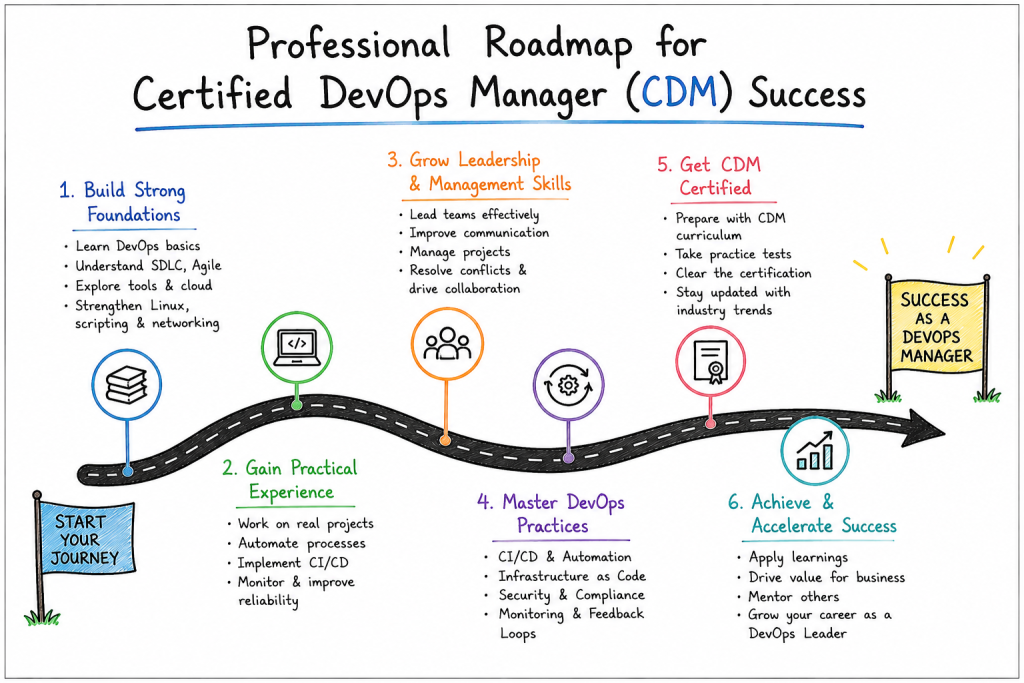
The transition from a technical individual contributor to a leadership role is one of the most challenging shifts in the software industry. The Certified DevOps Manager (CDM) program is designed specifically to bridge this gap by focusing on the intersection of engineering excellence and strategic management. This guide serves as a comprehensive roadmap for professionals who want to lead high-performing teams in a cloud-native world.
Whether you are currently a senior engineer, a team lead, or an aspiring manager, understanding the nuances of the CDM is vital for your growth. We live in an era where platform engineering and SRE principles are the backbone of enterprise stability. This guide will help you navigate the various certification levels and decide if this path aligns with your long-term career goals in DevOps and beyond.
What is the Certified DevOps Manager (CDM)?
The Certified DevOps Manager (CDM) is a professional credential that validates a person’s ability to oversee and optimize the entire software delivery lifecycle. Unlike purely technical certifications that focus on a single tool, the CDM emphasizes production-focused learning and high-level orchestration of people, processes, and technology. It exists to ensure that leadership can speak the language of engineers while meeting business objectives.
In modern engineering workflows, a manager must understand how to implement CI/CD at scale, manage cloud costs, and foster a culture of shared responsibility. The CDM aligns with these enterprise practices by teaching candidates how to build resilient systems and efficient teams. It is about moving beyond theory and applying DevOps principles to solve real-world organizational bottlenecks.
Who Should Pursue Certified DevOps Manager (CDM)?
This certification is highly beneficial for a wide range of professionals across the IT spectrum. Senior software engineers and SREs who want to take on more responsibility will find the leadership modules particularly useful. Cloud professionals and security specialists looking to move into “SecOps” leadership roles can also use this as a foundation for managing cross-functional units.
For those in India and global markets, the demand for technical leaders who understand both legacy infrastructure (like VMware or Windows environments) and modern cloud-native stacks is peaking. Beginners with a strong interest in management and experienced engineering managers who need to formalize their DevOps knowledge will both find immense value here. It is a bridge between deep technical execution and executive-level strategy.
Why Certified DevOps Manager (CDM)
As we move through 2026, the complexity of enterprise IT environments continues to grow, making the role of a DevOps manager more critical than ever. Organizations are no longer just looking for people who can write scripts; they need leaders who can manage AIOps integrations, FinOps budgets, and complex supply chains. The CDM provides the longevity needed to stay relevant as individual tools evolve or disappear.
The return on time and career investment is significant because it shifts your value proposition from “what you can do” to “what you can lead.” As companies adopt platform engineering as a standard, the ability to manage these platforms effectively becomes a top-tier skill. Pursuing this path ensures you remain an indispensable part of the leadership team, regardless of which cloud provider or automation tool becomes the next industry standard.
Certified DevOps Manager (CDM) Certification Overview
The CDM program is a structured curriculum delivered via the Certified DevOps Manager official program and is hosted on devopsschool. The program is designed to be practical, focusing on the actual challenges faced by managers in the field rather than rote memorization of definitions. It covers everything from cultural transformation to technical governance.
The assessment approach is designed to test both your strategic thinking and your understanding of technical workflows. The ownership of the program lies with industry experts who have built and scaled DevOps practices in large enterprises. This ensures that the structure of the certification remains grounded in reality, providing a clear path from foundational knowledge to expert-level leadership capabilities.
Certified DevOps Manager (CDM) Certification Tracks & Levels
The certification is divided into three primary levels: Foundation, Professional, and Advanced/Expert. The Foundation level introduces the core concepts of DevOps leadership and the cultural shifts required for success. The Professional level dives deeper into metrics, governance, and toolchain orchestration, while the Advanced level focuses on enterprise-wide scaling and strategic innovation.
Specialization tracks allow candidates to align their certification with their specific career interests, such as SRE-focused management or FinOps leadership. These levels are designed to match your career progression, moving you from managing a single squad to overseeing entire departments. By following this tiered approach, professionals can build their skills incrementally and demonstrate continuous growth to employers.
Complete Certified DevOps Manager (CDM) Certification Table
| Track | Level | Who it’s for | Prerequisites | Skills Covered | Recommended Order |
| CDM Core | Foundation | Aspiring Leads | Basic IT Knowledge | Cultural Change, CI/CD Basics | 1st |
| CDM Strategy | Professional | Current Managers | 3+ Years IT Exp | Metrics, ROI, Governance | 2nd |
| CDM Leadership | Advanced | Directors/VPs | 5+ Years Lead Exp | Scaling, Budgeting, Org Design | 3rd |
| SRE Management | Specialist | SRE Leads | SRE Foundation | Reliability, SLIs/SLOs | Optional |
| SecOps Lead | Specialist | Security Leads | DevSecOps Basics | Compliance, Risk Management | Optional |
Detailed Guide for Each Certified DevOps Manager (CDM) Certification
Certified DevOps Manager (CDM) – Foundation Level
What it is
This certification validates a professional’s understanding of the core tenets of DevOps from a supervisory perspective. It confirms you know how to break down silos and initiate cultural change within a team.
Who should take it
Ideal for senior engineers, junior team leads, and project managers who are new to the DevOps philosophy. It is designed for those looking to build a solid base for their leadership career.
Skills you’ll gain
- Understanding the Three Ways of DevOps.
- Ability to identify and eliminate waste in delivery pipelines.
- Knowledge of core DevOps metrics like DORA.
- Skills in fostering collaborative team environments.
Real-world projects you should be able to do
- Designing a basic CI/CD workflow for a small team.
- Conducting a value stream mapping exercise for a specific product.
- Implementing a feedback loop between Dev and Ops teams.
Preparation plan
- 7–14 Days: Focus on reading the “Phoenix Project” and “DevOps Handbook” to understand the cultural context.
- 30 Days: Enroll in the foundational course on devopsschool and complete the practice labs on pipeline orchestration.
- 60 Days: Review case studies of successful DevOps transformations and take mock assessments to verify your strategic understanding.
Common mistakes
- Focusing too much on specific tools (like Jenkins) rather than the management process.
- Underestimating the importance of the cultural and “people” aspect of the exam.
Best next certification after this
- Same-track option: CDM Professional Level.
- Cross-track option: SRE Foundation.
- Leadership option: Certified Scrum Master (CSM).
Certified DevOps Manager (CDM) – Professional Level
What it is
This level validates your ability to manage complex DevOps environments and optimize technical operations for business value. It focuses on governance, security integration, and data-driven decision-making.
Who should take it
This is meant for established DevOps Leads and Engineering Managers who oversee multiple teams. It is for those who need to justify ROI and manage stakeholders effectively.
Skills you’ll gain
- Advanced governance and compliance in automated environments.
- Budget management and cloud cost optimization (FinOps).
- Implementing DevSecOps at the managerial level.
- Strategic toolchain selection and vendor management.
Real-world projects you should be able to do
- Leading a migration from monolithic to microservices architecture.
- Developing a comprehensive dashboard for tracking organizational DORA metrics.
- Creating a disaster recovery and business continuity plan for cloud-native apps.
Preparation plan
- 7–14 Days: Review advanced CI/CD patterns and security compliance frameworks (SOC2, HIPAA).
- 30 Days: Deep dive into the Professional level modules on the devopsschool platform, focusing on the ROI of automation.
- 60 Days: Draft a mock “DevOps Transformation Roadmap” for a mid-sized company to practice your strategic planning skills.
Common mistakes
- Neglecting the financial aspects of DevOps, such as cloud spend and resource allocation.
- Failing to understand how to integrate security into the management lifecycle.
Best next certification after this
- Same-track option: CDM Advanced Level.
- Cross-track option: Certified DevSecOps Professional.
- Leadership option: ITIL Leader (Digital & IT Strategy).
Certified DevOps Manager (CDM) – Advanced Level
What it is
The Advanced CDM validates your expertise in enterprise-scale DevOps leadership. It proves you can lead thousands of engineers and align technical strategy with board-level business goals.
Who should take it
Suitable for Directors of Engineering, VPs of Infrastructure, and CTOs of growing startups. It is for high-level leaders who define the technical direction of an entire organization.
Skills you’ll gain
- Large-scale organizational design for DevOps.
- Leadership in AIOps and MLOps implementation strategies.
- Executive communication and change management at scale.
- Managing global, distributed engineering teams.
Real-world projects you should be able to do
- Designing a Global Platform Engineering team structure.
- Authoring an enterprise-wide “AI for DevOps” adoption strategy.
- Leading a total cultural overhaul of a traditional IT department.
Preparation plan
- 7–14 Days: Study executive leadership principles and high-level organizational psychology.
- 30 Days: Work through the advanced leadership labs and simulations provided by devopsschool.
- 60 Days: Engage in peer-to-peer mentoring and review executive-level whitepapers on digital transformation.
Common mistakes
- Getting bogged down in low-level technical details during the strategy assessment.
- Ignoring the human elements of large-scale change management.
Best next certification after this
- Same-track option: Post-Graduate Program in Cloud Computing.
- Cross-track option: Certified DataOps Professional.
- Leadership option: MBA or Executive Leadership Program.
Choose Your Learning Path
DevOps Path
The traditional DevOps path focuses on the lifecycle of software development and operations. For a manager, this means mastering CI/CD, automation, and the cultural shifts required to speed up delivery. You will learn how to balance the need for speed with the need for stability. This path is ideal for those coming from a generic systems administration or development background.
DevSecOps Path
The DevSecOps path is for managers who want to prioritize security without slowing down the development team. It involves learning how to integrate security gates into the automated pipeline and managing risk at every stage. You will focus on compliance as code and vulnerability management. This is the right choice for leaders in regulated industries like finance or healthcare.
SRE Path
The Site Reliability Engineering (SRE) path focuses on the operational health and reliability of services. As an SRE manager, your focus shifts to error budgets, SLIs, and SLOs. You will learn how to manage technical debt and ensure that the system remains resilient under load. This path is perfect for leaders who are obsessed with uptime and performance.
AIOps / MLOps Path
This modern path is for leaders who are integrating artificial intelligence and machine learning into their operations. AIOps focuses on using AI to monitor and fix systems, while MLOps focuses on the delivery of ML models. As a manager, you will learn how to oversee these complex, data-driven pipelines. This is a forward-looking path for tech-heavy organizations.
DataOps Path
DataOps is all about the management of data pipelines and ensuring data quality for the organization. For a manager, this involves coordinating between data engineers, scientists, and the operations team. You will focus on the speed and accuracy of data delivery. This path is essential for leaders in companies where data is the primary product.
FinOps Path
The FinOps path focuses on the financial management of the cloud. As a manager, you will learn how to bring accountability to cloud spend and optimize resource usage. You will bridge the gap between the finance department and the engineering teams. This path is increasingly popular as cloud bills become a major part of corporate budgets.
Role → Recommended Certified DevOps Manager (CDM) Certifications
| Role | Recommended Certifications |
| DevOps Engineer | CDM Foundation, Jenkins Certified Engineer |
| SRE | CDM Foundation, SRE Practitioner |
| Platform Engineer | CDM Professional, Kubernetes Administrator (CKA) |
| Cloud Engineer | CDM Foundation, AWS/Azure Solutions Architect |
| Security Engineer | CDM Professional, Certified DevSecOps Professional |
| Data Engineer | CDM Foundation, DataOps Specialist |
| FinOps Practitioner | CDM Professional, FinOps Certified Professional |
| Engineering Manager | CDM Advanced, ITIL 4 Foundation |
Next Certifications to Take After Certified DevOps Manager (CDM)
Same Track Progression
Once you have completed the core levels of CDM, the next logical step is to dive into deep specializations within the same management framework. This could include getting certified in specific platform engineering strategies or advanced cultural transformation methodologies. Staying within the track allows you to become a recognized authority in DevOps leadership, capable of handling the most complex organizational structures.
Cross-Track Expansion
If you have mastered DevOps management, broadening your skills into SRE or DevSecOps leadership provides a more holistic view of the engineering ecosystem. For example, a DevOps manager who understands the intricacies of SRE can better manage reliability-focused teams. This cross-training makes you a more versatile leader, capable of stepping into various roles within a modern tech organization.
Leadership & Management Track
For those looking to move into the C-suite or high-level executive roles, the CDM serves as a technical foundation. The next steps would involve certifications in broader business management or digital strategy. Moving into this track often involves learning about corporate finance, strategic marketing, and global business operations. It marks the transition from leading technical teams to leading entire companies.
Training & Certification Support Providers for Certified DevOps Manager (CDM)
DevOpsSchool is a premier platform for those seeking to master the CDM curriculum. They offer extensive, instructor-led training and self-paced modules that focus on the practical application of management principles. Their content is designed by industry veterans who understand the nuances of the Indian and global IT markets. With a strong emphasis on real-world projects and peer-to-peer learning, they ensure that every candidate is ready to lead a DevOps team from day one. Their support system and vast library of resources make them a top choice for professionals worldwide.
Cotocus provides specialized consulting and training services that help professionals navigate the complexities of modern engineering leadership. They focus heavily on the integration of tools and people, offering hands-on labs that simulate real enterprise environments. Their trainers are known for their ability to simplify complex concepts, making the CDM path accessible to everyone from team leads to senior directors. Cotocus is particularly well-regarded for its focus on emerging technologies like AIOps and cloud-native architecture, ensuring that their students stay ahead of the industry curve.
Scmgalaxy is a long-standing community and training provider that focuses on the core principles of Software Configuration Management and DevOps. They provide a wealth of free resources, tutorials, and premium training programs tailored to the CDM certification. Their approach is deeply rooted in the technical realities of the delivery pipeline, making them a favorite for those who want to understand the “how” behind the “why.” By offering a mix of community support and expert-led sessions, Scmgalaxy helps managers build a robust technical foundation for their leadership journey.
BestDevOps offers a curated approach to certification, focusing on the most relevant skills needed in the current job market. Their training for the CDM program is streamlined and efficient, designed for busy professionals who need to gain high-value skills in a short timeframe. They emphasize the ROI of certification, providing candidates with the tools they need to prove their value to their organizations immediately. Their practical workshops and exam-focused preparation materials make them a reliable partner for anyone looking to advance their career in DevOps management.
devsecopsschool is the leading destination for managers who want to integrate security into their leadership style. They provide deep dives into compliance as code, automated security testing, and risk management within a DevOps framework. Their training for the CDM path includes specific modules on how to lead secure engineering teams without sacrificing speed. For leaders in highly regulated sectors, this provider offers the specialized knowledge required to navigate complex security landscapes while maintaining an agile delivery pipeline and a culture of safety.
sreschool focuses exclusively on the principles of Site Reliability Engineering and how they apply to leadership. Their CDM support includes specialized training on managing error budgets, incident response, and service level objectives. They help managers understand how to build and lead teams that prioritize reliability and resilience. By focusing on the operational health of services, SREschool prepares leaders to handle the high-pressure environments of modern cloud-scale applications, ensuring that their systems remain stable and performant under any conditions.
aiopsschool is dedicated to the future of automated operations, providing training on how to lead teams that use AI and machine learning to optimize IT services. Their contribution to the CDM program focuses on the strategic implementation of AIOps tools and the management of data-driven operational workflows. They help leaders understand how to transition from reactive monitoring to proactive, AI-driven management. This provider is essential for any manager looking to lead in an era where automation and intelligence are the keys to competitive advantage.
dataopsschool addresses the growing need for leadership in the world of data engineering and analytics. Their training for CDM candidates focuses on managing the flow of data through the organization and ensuring its quality and accessibility. They teach managers how to bridge the gap between data scientists and operations teams, creating a unified approach to data delivery. By focusing on the agility of data pipelines, DataOpsSchool ensures that technical leaders can support the data-driven decision-making needs of the modern enterprise with speed and precision.
finopsschool provides the financial acumen that modern DevOps managers need to succeed in a cloud-first world. Their CDM support includes modules on cloud cost optimization, budgeting, and financial accountability within engineering teams. They help leaders understand the economic impact of their technical decisions and how to communicate that value to stakeholders. By teaching the language of finance alongside the language of DevOps, FinOpsSchool prepares managers to oversee large-scale cloud environments efficiently, ensuring that innovation remains sustainable and cost-effective for the business.
Frequently Asked Questions (General)
1. How difficult is the Certified DevOps Manager (CDM) exam?
The exam is moderately difficult as it tests strategic application rather than just technical facts. It requires a solid understanding of both leadership and DevOps workflows.
2. How much time does it take to get certified?
Most professionals complete the certification within 30 to 60 days, depending on their prior experience and the intensity of their study plan.
3. Are there any prerequisites for the CDM Foundation level?
No strict prerequisites exist for the Foundation level, though a basic understanding of IT operations and software development is highly recommended.
4. What is the ROI of getting a CDM certification?
The ROI is high, as it qualifies you for senior leadership roles which typically offer higher compensation and more strategic influence within an organization.
5. Can I skip the Foundation level and go straight to Professional?
It is generally recommended to follow the sequence, but those with significant verified management experience in DevOps may sometimes apply for an override.
6. Is the CDM certification recognized globally?
Yes, the CDM is recognized by major enterprises worldwide as a standard for DevOps leadership and management excellence.
7. How often do I need to renew my certification?
The certification typically remains valid for two to three years, after which you may need to complete a refresher or move to the next level.
8. Does the program cover specific tools like AWS or Azure?
While it mentions cloud providers, the focus is on the management and orchestration of these environments rather than specific vendor-click-ops.
9. Is there a community for CDM professionals?
Yes, providers like devopsschool offer access to exclusive communities and alumni networks for networking and support.
10. What is the format of the CDM assessment?
The assessment usually consists of a mix of multiple-choice questions and case-study-based scenarios that test your decision-making skills.
11. How much does the CDM certification cost?
Costs vary based on the provider and the level of training included, but it is generally priced competitively with other professional IT certifications.
12. Can I take the training online?
Yes, most providers offer fully online, self-paced, or instructor-led virtual training options to accommodate working professionals globally.
FAQs on Certified DevOps Manager (CDM)
Does the CDM focus more on culture or tools?
The CDM focuses heavily on culture and process, as these are the primary responsibilities of a manager. While tools are covered, the emphasis is on how to lead teams that use them effectively. What is the difference between a DevOps Engineer and a DevOps Manager? An engineer focuses on building and maintaining the pipeline, while a manager focuses on the strategy, team health, ROI, and organizational alignment of those pipelines. How does CDM help with career growth? It transitions you from a technical expert to a strategic leader, opening doors to Director and VP-level roles. Is CDM suitable for project managers? Yes, it is an excellent way for project managers to gain the technical context needed to lead DevOps-oriented projects. Will this certification help me in India? Yes, India has a massive demand for DevOps leaders who can manage large-scale digital transformations in the enterprise sector. Does CDM cover FinOps? Yes, the Professional and Advanced levels include modules on managing cloud costs and financial accountability. What is the passing score? Typically, a score of 70% or higher is required to pass the assessment. Can I use this for SRE leadership? Absolutely, the principles of CDM are highly applicable to managing SRE teams.
Final Thoughts: Is Certified DevOps Manager (CDM) Worth It?
When you look at the landscape of modern IT, the need for skilled leadership has never been greater. The Certified DevOps Manager (CDM) is not just another badge; it is a signal to the industry that you understand how to deliver value at scale. It moves you away from the “firefighting” of daily operations and into the “architecting” of high-performance teams.
If you are looking for an honest assessment, the CDM is worth it if you are serious about a career in management. It provides the structure, the language, and the framework needed to lead in a complex, cloud-native world. It is a practical investment in your future that pays off through better career opportunities and the ability to drive real change in your organization.
