Introduction
The MLOps Certified Professional (MLOCP) is a specialized program designed to bridge the gap between machine learning development and operational excellence. This guide is written for software engineers, data professionals, and platform architects who want to master the lifecycle of machine learning models in production environments. As organizations scale their artificial intelligence initiatives, the need for standardized operations becomes critical for maintaining performance and reliability.
This roadmap helps professionals navigate the complexities of model deployment, monitoring, and automated retraining. By following this guide, you will understand how to position yourself within the evolving landscape of DevOps, cloud-native architecture, and platform engineering. Whether you are looking to advance at your current company or exploring new opportunities on platforms like aiopsschool, these insights will help you make informed decisions about your technical education and career trajectory.
What is the MLOps Certified Professional (MLOCP)?
The MLOps Certified Professional (MLOCP) represents a standard of excellence for engineering machine learning systems that are reliable, scalable, and maintainable. Unlike theoretical data science courses, this certification focuses heavily on the “Ops” side of the equation, emphasizing production-grade workflows. It exists to solve the common problem of “model rot” and the difficulty of moving experimental code into a live enterprise environment.
The program aligns with modern engineering practices by treating machine learning models as software artifacts that require versioning, testing, and continuous integration. Professionals learn to apply standard DevOps principles to the unique challenges of data and model management. This ensures that the enterprise can trust the outputs of their AI systems while maintaining high velocity in their development cycles.
Who Should Pursue MLOps Certified Professional (MLOCP)?
This certification is ideal for various roles, including DevOps engineers, Site Reliability Engineers (SREs), and cloud architects who are increasingly managing AI workloads. Security professionals and data engineers also find significant value here, as they must ensure the integrity and privacy of the data pipelines feeding the models. It is tailored for those who want to move beyond manual model deployment to fully automated systems.
For beginners, it provides a structured entry point into a high-growth field, while experienced engineers use it to validate their expertise in managing complex distributed systems. Managers and technical leaders benefit by gaining a framework for building and leading high-performing MLOps teams. Given the rapid digital transformation in global markets, including India, this certification provides a competitive edge in any technical economy.
Why MLOps Certified Professional (MLOCP)
The demand for MLOps expertise is growing as companies move from AI experimentation to full-scale adoption. Professionals who understand the operational side of machine learning are more likely to enjoy career longevity because their skills are tied to core business outcomes and infrastructure stability. As tools evolve, the underlying principles of automation and monitoring covered in this program remain constant and relevant.
Enterprises are shifting toward standardized platforms to reduce the overhead of managing fragmented data science projects. By earning this certification, you demonstrate the ability to implement these standards, which leads to a significant return on your time and career investment. It allows you to stay ahead of the curve as organizations integrate intelligence into every layer of their technology stack.
MLOps Certified Professional (MLOCP) Certification Overview
The MLOps Certified Professional (MLOCP) program is delivered through specialized curriculum providers and is hosted on the devopsschool platform. The program is structured to provide a logical progression from foundational concepts to advanced architectural strategies. It utilizes a practical assessment approach, requiring candidates to demonstrate their knowledge through real-world scenarios rather than rote memorization of facts.
The certification is owned and maintained by industry experts who ensure the content stays aligned with current enterprise practices. The structure includes various modules covering CI/CD for machine learning, data versioning, model monitoring, and governance. This practical focus ensures that once you are certified, you have the immediate capability to contribute to production environments and improve delivery pipelines.
MLOps Certified Professional (MLOCP) Certification Tracks & Levels
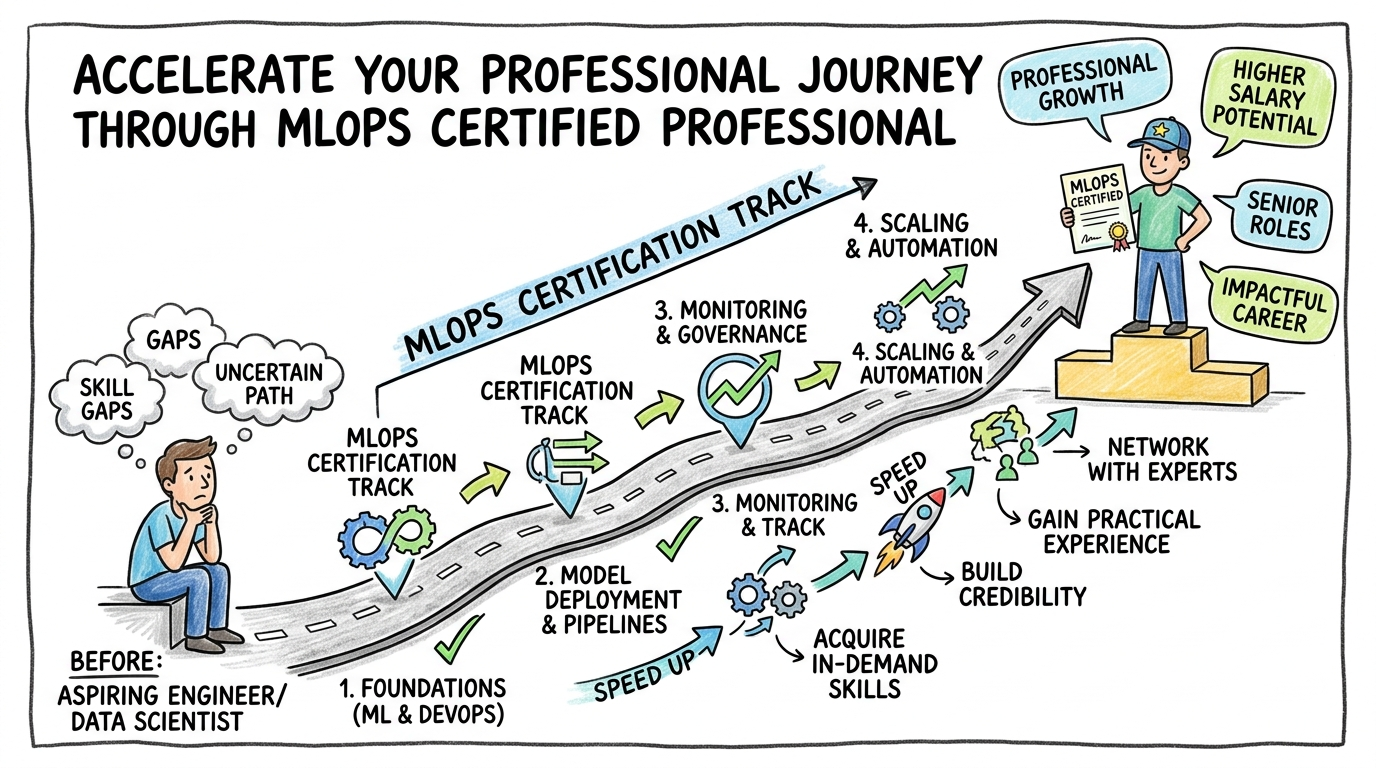
The certification is organized into three primary levels to accommodate professionals at different stages of their careers. The Foundation level introduces the core vocabulary and concepts of MLOps, ensuring everyone on a team has a shared understanding of the goals. It is the perfect starting point for those new to the intersection of data science and operations.
The Professional and Advanced levels offer deeper specializations into specific tracks such as automation engineering, security, and financial operations within the AI context. These levels align with career progression from an individual contributor to a lead architect. Specialization tracks allow you to tailor your learning to your specific job function, whether that involves building the platform or managing the cost of cloud resources.
Complete MLOps Certified Professional (MLOCP) Certification Table
| Track | Level | Who it’s for | Prerequisites | Skills Covered | Recommended Order |
| Core MLOps | Foundation | Beginners, Managers | Basic IT knowledge | MLOps terms, Lifecycle | 1 |
| Implementation | Professional | DevOps Engineers | Foundation level | CI/CD, Model Registry | 2 |
| Architecture | Advanced | Senior Architects | Professional level | Scalability, Governance | 3 |
| Data Engineering | Specialist | Data Engineers | Python basics | Data Pipelines, Versioning | 2 (Parallel) |
| Security | Specialist | SecOps Engineers | Basic Security | Model Privacy, Compliance | 3 (Parallel) |
Detailed Guide for Each MLOps Certified Professional (MLOCP) Certification
MLOps Certified Professional (MLOCP) – Foundation Level
What it is
This certification validates a candidate’s understanding of the fundamental principles of MLOps and the lifecycle of machine learning models. It ensures the professional can communicate effectively across data science and operations teams.
Who should take it
It is designed for entry-level engineers, project managers, and business analysts who need to understand how machine learning fits into the broader operational strategy of the company.
Skills you’ll gain
- Understanding the MLOps lifecycle from data ingestion to monitoring.
- Knowledge of core terminology and common tools in the ecosystem.
- Ability to identify bottlenecks in manual machine learning workflows.
Real-world projects you should be able to do
- Documenting a high-level MLOps workflow for a development team.
- Auditing existing manual processes for automation opportunities.
Preparation plan
- 7-14 Days: Focus on learning the core vocabulary and the different stages of the ML lifecycle.
- 30 Days: Study the interaction between data scientists and DevOps engineers and review common case studies.
- 60 Days: Engage with introductory labs and practice exams to solidify your conceptual understanding.
Common mistakes
- Focusing too much on specific machine learning algorithms instead of the operational workflow.
- Underestimating the importance of communication between diverse technical teams.
Best next certification after this
- Same-track option: MLOCP Professional Level.
- Cross-track option: DataOps Certified Professional.
- Leadership option: Certified MLOps Manager.
MLOps Certified Professional (MLOCP) – Professional Level
What it is
This level focuses on the practical implementation of MLOps pipelines. It validates that the professional can build and maintain automated systems for model training, testing, and deployment.
Who should take it
Suitable for DevOps engineers, software developers, and data scientists who are responsible for the technical execution of ML projects in a production environment.
Skills you’ll gain
- Implementing CI/CD pipelines specifically tailored for machine learning.
- Managing model registries and versioning both code and data.
- Configuring automated monitoring and alerting for model performance.
Real-world projects you should be able to do
- Building a fully automated pipeline that triggers model retraining when data drift is detected.
- Deploying a model as a scalable microservice with integrated logging.
Preparation plan
- 7-14 Days: Review advanced CI/CD concepts and containerization specifically for ML workloads.
- 30 Days: Practice setting up model registries and automated testing frameworks in a lab environment.
- 60 Days: Work on end-to-end projects that simulate real-world production failures and recovery.
Common mistakes
- Neglecting the data versioning aspect and only focusing on code versioning.
- Overcomplicating the pipeline for simple models that don’t require high-frequency updates.
Best next certification after this
- Same-track option: MLOCP Advanced Level.
- Cross-track option: DevSecOps Certified Professional.
- Leadership option: Principal MLOps Architect.
Choose Your Learning Path
DevOps Path
This path is for engineers who want to apply their existing automation skills to the machine learning domain. It focuses on integrating ML workflows into standard CI/CD tools and managing the infrastructure required for training and inference. Professionals on this path will learn to treat models as software artifacts that follow the same rigorous testing and deployment standards as any other application.
DevSecOps Path
The security path emphasizes the protection of the model and the data it processes. It covers topics like model inversion attacks, data privacy compliance, and securing the supply chain of ML libraries. Engineers here ensure that the automated pipelines are not only fast but also resilient against emerging threats and meet regulatory standards.
SRE Path
Site Reliability Engineers focus on the availability and performance of the machine learning systems. This path teaches how to manage service level objectives (SLOs) for models and how to handle incidents when a model’s prediction accuracy drops. It is about ensuring the system stays healthy and reliable even under heavy load or changing data patterns.
AIOps Path
The AIOps path focuses on using artificial intelligence to improve general IT operations. While related to MLOps, it specifically looks at how to apply machine learning to log analysis, anomaly detection in infrastructure, and automated incident response. It is ideal for those who want to build the “self-healing” data centers of the future.
MLOps Path
The MLOps path is the direct route to becoming an expert in the machine learning lifecycle. It concentrates on the unique challenges of model management, such as feature stores, model drift, and retraining loops. This path is essential for anyone who wants to lead the effort of making AI a sustainable part of the enterprise software ecosystem.
DataOps Path
DataOps focuses on the delivery of high-quality data to the machine learning models. This path teaches how to automate data pipelines and ensure data quality through every step of the process. Without solid DataOps, MLOps cannot succeed, making this a critical area for those interested in the underlying data infrastructure.
FinOps Path
The FinOps path deals with the financial management of machine learning in the cloud. Training large models can be extremely expensive, and this track teaches how to monitor, forecast, and optimize those costs. It is highly valuable for organizations that need to scale their AI efforts without breaking their cloud budget.
Role → Recommended MLOps Certified Professional (MLOCP) Certifications
| Role | Recommended Certifications |
| DevOps Engineer | MLOCP Professional, CI/CD Specialist |
| SRE | MLOCP Advanced, Monitoring Expert |
| Platform Engineer | MLOCP Implementation, Cloud Architect |
| Cloud Engineer | MLOCP Foundation, Infrastructure Specialist |
| Security Engineer | MLOCP SecOps, Compliance Specialist |
| Data Engineer | MLOCP Data Track, Pipeline Specialist |
| FinOps Practitioner | MLOCP FinOps, Cost Optimizer |
| Engineering Manager | MLOCP Foundation, Leadership Track |
Next Certifications to Take After MLOps Certified Professional (MLOCP)
Same Track Progression
Once you have mastered the Professional level, the natural progression is to the Advanced or Expert levels. These certifications deal with multi-cloud architectures and enterprise-wide governance of machine learning models. This track is for those who want to become the primary technical authority for MLOps within their organization.
Cross-Track Expansion
If you have a strong grasp of operations, expanding into DataOps or DevSecOps is a logical next step. Understanding how security and data quality impact the machine learning lifecycle makes you a more versatile engineer. This cross-training allows you to bridge the gap between different departments and solve complex, multi-disciplinary problems.
Leadership & Management Track
For those looking to move into management, pursuing certifications focused on technical leadership and AI strategy is recommended. These programs help you transition from hands-on implementation to managing teams, budgets, and long-term technology roadmaps. It prepares you for roles like Head of MLOps or Director of Engineering.
Training & Certification Support Providers for MLOps Certified Professional (MLOCP)
DevOpsSchool
This provider offers extensive resources and structured training programs specifically designed for those seeking the MLOCP designation. They focus on practical labs and real-world scenarios to ensure that candidates are not just exam-ready but also job-ready. Their curriculum is updated frequently to reflect the latest changes in the MLOps landscape.
Cotocus
This organization specializes in cloud-native training and provides deep-dive modules into containerization and orchestration as they relate to MLOps. Their approach is highly technical and aimed at engineers who want to master the underlying infrastructure that supports machine learning pipelines. They provide excellent support for those moving from traditional roles into the AI space.
Scmgalaxy
As a community-driven platform, this provider offers a wealth of knowledge shared by practitioners in the field. They focus on the tools and technologies that make MLOps possible, providing tutorials and guides that are easy to follow. It is an excellent resource for staying updated on the latest open-source developments in the industry.
BestDevOps
This provider is known for its high-quality certification prep materials and focused training tracks. They simplify complex topics into digestible lessons, making it easier for professionals to balance their learning with a full-time job. Their focus is on efficiency and ensuring a high success rate for their students.
devsecopsschool
This provider focuses specifically on the security aspects of the operational lifecycle. For the MLOCP track, they offer specialized modules on how to secure machine learning models and the data pipelines that feed them. Their training is essential for anyone working in regulated industries like finance or healthcare.
sreschool
Focusing on reliability and performance, this provider helps engineers master the skills needed to keep MLOps systems running smoothly. They emphasize monitoring, alerting, and incident response, which are critical components of the MLOCP professional level. Their courses are designed for those who value system stability above all else.
aiopsschool
This provider bridges the gap between traditional operations and artificial intelligence. They offer specific training on how to use AI to improve IT workflows, which complements the MLOCP certification perfectly. Their courses are forward-looking and help engineers prepare for the next generation of automated systems.
dataopsschool
This organization focuses on the data side of the equation, ensuring that the input for machine learning models is of the highest quality. Their training tracks cover data versioning, automated testing of data, and pipeline management. This is a crucial support provider for anyone looking to specialize in the DataOps aspect of MLOps.
finopsschool
This provider addresses the growing need for cost management in cloud-based machine learning. Their training teaches professionals how to align their technical decisions with business value and budget constraints. As AI costs continue to rise, the expertise provided by this organization is becoming increasingly valuable to enterprises.
Frequently Asked Questions (General)
- How difficult is the MLOps Certified Professional (MLOCP) exam?The difficulty is moderate to high, as it requires a mix of theoretical knowledge and practical experience with automation tools. It is not an exam you can pass by just reading a book; hands-on practice is required.
- How much time does it take to prepare for this certification?Depending on your starting point, it typically takes between 30 and 60 days of consistent study and lab work to feel fully prepared for the professional level.
- Are there any prerequisites for taking the Foundation level?There are no formal prerequisites, but a basic understanding of software development and IT infrastructure will help you grasp the concepts much faster.
- Is this certification recognized globally?Yes, the skills taught in this program are based on industry standards that are used by enterprises all over the world, from India to Silicon Valley.
- Does this certification expire?Most certifications in this field recommend a renewal or update every two to three years to ensure you are up to date with the latest technological advancements.
- Can a manager benefit from the MLOCP program?Absolutely. The Foundation level is specifically designed to help managers understand the workflow and the resources needed to build successful MLOps teams.
- How does this differ from a standard Data Science certification?Standard Data Science certifications focus on building models and algorithms, while MLOCP focuses on the operational infrastructure required to run those models in production.
- What is the return on investment for this certification?The ROI is high because it qualifies you for specialized roles that often command higher salaries and offer better job security in a competitive market.
- What tools will I learn to use during the training?You will be exposed to a variety of tools for CI/CD, containerization, model versioning, and monitoring, depending on the specific track you choose.
- Is there a community or forum for MLOCP candidates?Yes, providers like devopsschool and Scmgalaxy host active communities where you can ask questions, share experiences, and network with other professionals.
- Do I need to know how to code to pass this certification?For the Professional and Advanced levels, a working knowledge of Python and scripting is essential. The Foundation level is less focused on coding.
- Can I take the exam online?Yes, most providers offer proctored online exams that you can take from the comfort of your home or office.
FAQs on MLOps Certified Professional (MLOCP)
Is the MLOCP certification focused on any specific cloud provider?
The certification is designed to be cloud-agnostic, focusing on the principles and tools that can be applied to AWS, Azure, Google Cloud, or on-premises environments. This ensures your skills are portable across different companies and technology stacks.
How does MLOCP address the issue of model drift?
The curriculum includes specific modules on monitoring model performance in real-time. You will learn how to set up automated triggers that detect when a model’s accuracy is declining and initiate a retraining pipeline to fix the issue.
What role does containerization play in this certification?
Containerization is a core component of the program. You will learn how to package machine learning models into containers to ensure they run consistently across development, testing, and production environments.
Is data versioning covered in the MLOCP program?
Yes, understanding how to version data is just as important as versioning code in MLOps. The program teaches you how to keep track of the specific datasets used to train every version of your model.
Does the certification cover ethical AI and governance?
The Advanced tracks include sections on model governance, ensuring that the automated pipelines adhere to ethical guidelines and legal requirements regarding data usage and model transparency.
What is the difference between MLOps and AIOps in this context?
MLOps is about the operations of machine learning models themselves. AIOps is about using machine learning to improve the operations of IT infrastructure. Both are covered as complementary tracks in the broader ecosystem.
How practical are the assessments for MLOCP?
The assessments are designed to be very practical, often requiring you to solve problems in a simulated environment that mirrors the challenges you would face in a real enterprise job.
Can I transition from a traditional DevOps role to MLOps using this certification?
Yes, this is one of the most common career paths. The certification provides the specific machine learning context you need to apply your existing DevOps skills to AI workloads effectively.
Final Thoughts: Is MLOps Certified Professional (MLOCP) Worth It?
Investing in the MLOps Certified Professional (MLOCP) certification is a strategic move for any engineer or manager looking to secure their future in the tech industry. As machine learning becomes a standard part of the enterprise software stack, the ability to manage these models at scale is becoming a mandatory skill rather than a niche specialty. It moves you away from the manual, error-prone processes of the past and toward a future of automated, reliable, and observable systems.
The program offers a clear, structured path to mastery, regardless of whether you are just starting out or are a veteran engineer. By focusing on production-grade skills and real-world outcomes, it provides a level of practical value that is hard to find in purely academic or theoretical courses. If you are looking for a way to differentiate yourself and contribute to high-impact projects, this certification is an excellent choice.
