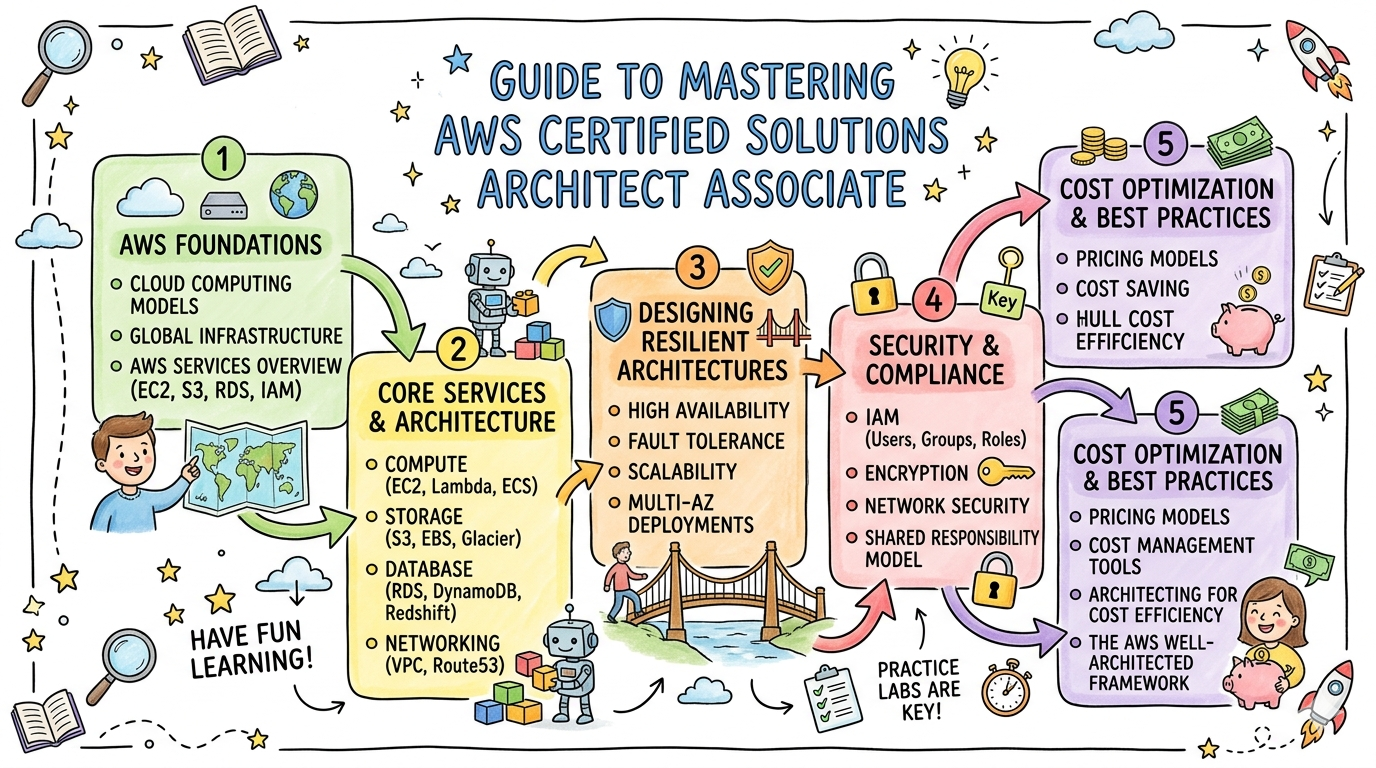
Introduction
The demand for skilled cloud architects is higher than it has ever been as businesses move away from traditional data centers toward agile cloud environments. The AWS Certified Solutions Architect – Associate is widely recognized as the gold standard for validating a professional’s ability to design and deploy scalable, highly available, and fault-tolerant systems on Amazon Web Services. This guide is specifically designed for working professionals who want to understand how this certification fits into the broader ecosystem of DevOps, Site Reliability Engineering, and platform engineering.
Whether you are an engineer looking to upgrade your skills or a manager trying to build a cloud-literate team, this resource provides the clarity needed to make an informed decision. By following this path through devopsschool, you gain access to structured learning that translates directly to real-world production environments. Understanding these architectural principles is also essential for those branching into specialized domains found on platforms like aiopsschool, where AI and operations intersect. This guide helps you navigate the complexity of cloud architecture so you can accelerate your career growth with confidence and technical authority.
What is the AWS Certified Solutions Architect – Associate?
The AWS Certified Solutions Architect – Associate is a professional-level credential that focuses on the core pillars of the AWS Well-Architected Framework. It is not just a theoretical exam but a validation of your ability to solve complex business problems using cloud-native services. It represents a shift from simply managing servers to designing entire ecosystems that can handle millions of users while remaining cost-effective and secure.
In modern engineering workflows, this certification acts as a bridge between development and operations by ensuring that the underlying infrastructure is robust. It covers everything from network configuration and identity management to data storage strategies and compute scaling. Enterprise practices today require architects who understand how to integrate legacy systems with modern cloud services, and this program provides the blueprint for doing exactly that in a production-focused manner.
Who Should Pursue AWS Certified Solutions Architect – Associate?
This certification is ideal for software engineers, systems administrators, and SREs who are currently working with or planning to move to the cloud. It is particularly beneficial for those in platform engineering roles who need to build internal developer platforms that are both secure and scalable. Security professionals will also find value here as it provides deep insights into VPC design, IAM policies, and data encryption at rest and in transit.
While the guide is tailored for experienced engineers, beginners with a strong interest in infrastructure can use it as a rigorous starting point. Managers and technical leaders should pursue this to better understand the trade-offs in cloud spending and architectural decisions. On a global scale, and specifically within the growing tech hubs in India, this certification is often a prerequisite for senior roles in multinational corporations and high-growth startups alike.
Why AWS Certified Solutions Architect – Associate
The longevity of this certification stems from its focus on fundamental architectural patterns rather than just specific tool features. While cloud services may update their interfaces or names, the core concepts of load balancing, decoupling, and high availability remain constant. This makes the certification a long-term investment that protects your career against the rapid turnover of specific software versions.
Enterprises are increasingly adopting multi-cloud or hybrid-cloud strategies, and AWS remains the market leader in this space. By mastering AWS architecture, you are learning the industry standard that other providers often follow. The return on time and career investment is significant, as architects often command higher salaries and have a more direct influence on the technical direction of their organizations compared to generalist roles.
AWS Certified Solutions Architect – Associate Certification Overview
The program is delivered via the official training path at devopsschool and is hosted on the devopsschool platform. The assessment approach is designed to test your decision-making skills through scenario-based questions that mimic real-world challenges. It moves beyond simple “true or false” queries and asks you to select the most cost-effective or highest-performing solution for a given problem.
The structure of the certification is divided into domains such as design for resilient architectures, high-performing architectures, secure applications, and cost-optimized architectures. Ownership of these concepts is essential for any engineer who wants to move away from manual troubleshooting and toward high-level system design. The practical nature of the program ensures that once you pass the exam, you are ready to apply these skills immediately to your company’s AWS environment.
AWS Certified Solutions Architect – Associate Certification Tracks & Levels
The AWS certification ecosystem begins with the foundation level, which is suitable for those new to the cloud. This provides the basic vocabulary and understanding of cloud concepts. Moving up to the Associate level, which includes the Solutions Architect, SysOps Administrator, and Developer tracks, allows professionals to specialize based on their daily tasks. The Associate level is the most common entry point for those already working in the industry.
For those seeking to reach the peak of their career, the Professional and Specialty levels offer deep dives into advanced architecture, security, networking, and data analytics. These levels align with career progression from a Senior Engineer to a Lead Architect or Principal Engineer. By following these tracks, an engineer can transition from managing a single application to overseeing the entire cloud strategy for a global enterprise.
Complete AWS Certified Solutions Architect – Associate Certification Table
| Track | Level | Who it’s for | Prerequisites | Skills Covered | Recommended Order |
|---|---|---|---|---|---|
| Cloud Architecture | Foundation | Non-technical staff / Beginners | None | Basic Cloud Concepts | 1 |
| Solutions Architect | Associate | Engineers / SREs / Managers | Basic IT Knowledge | System Design & Scaling | 2 |
| Developer | Associate | Software Developers | Programming Knowledge | Serverless & SDKs | 3 |
| SysOps Admin | Associate | Systems Administrators | Linux/Windows Admin | Deployment & Operations | 4 |
| Solutions Architect | Professional | Senior Architects | Associate Level | Complex Org Design | 5 |
| DevOps Engineer | Professional | DevOps & SRE Leads | Associate Level | Automation & CI/CD | 6 |
| Security | Specialty | Security Engineers | Associate Level | Encryption & Compliance | 7 |
Export to Sheets
Detailed Guide for Each AWS Certified Solutions Architect – Associate Certification
AWS Certified Solutions Architect – Associate – Associate Level
What it is
This certification validates your ability to define a solution using architectural design principles based on customer requirements. It confirms you can provide implementation guidance based on best practices throughout the life cycle of a project.
Who should take it
Suitable for individuals with at least one year of hands-on experience designing available, cost-efficient, fault-tolerant, and scalable distributed systems on AWS. It is intended for those who want to prove their expertise in high-level infrastructure design.
Skills you’ll gain
- Designing resilient architectures using multi-AZ deployments and Auto Scaling.
- Implementing secure applications using Identity and Access Management and VPC security groups.
- Selecting the right storage solutions based on performance and cost requirements.
- Managing data migration and hybrid cloud connectivity.
- Optimizing costs through effective use of Reserved Instances and Spot Instances.
Real-world projects you should be able to do
- Build a three-tier web application that remains available during a regional outage.
- Migrate a large on-premises database to Amazon RDS with minimal downtime.
- Create a serverless backend using Lambda, API Gateway, and DynamoDB.
- Set up a global content delivery network using CloudFront and Route 53.
Preparation plan
- 7–14 days: Focus on reviewing the official exam guide and whitepapers. Take initial practice tests to identify your weak spots in the core services like EC2, S3, and VPC.
- 30 days: Spend significant time in the AWS console. Build out the architectures described in the whitepapers. Review FAQ pages for each major service to understand specific limitations and features.
- 60 days: Deep dive into complex scenarios involving hybrid networking and cross-region replication. Take multiple full-length practice exams to build stamina and improve your speed in answering scenario questions.
Common mistakes
- Relying only on theoretical study without hands-on practice in the AWS console.
- Ignoring the “cost-effective” requirement in exam questions and always picking the highest performance option.
- Underestimating the importance of networking and VPC peering details.
Best next certification after this
- Same-track option: AWS Certified Solutions Architect – Professional.
- Cross-track option: AWS Certified Security – Specialty.
- Leadership option: AWS Certified DevOps Engineer – Professional.
AWS Certified Solutions Architect – Associate – Professional Level
What it is
This certification validates advanced technical skills and experience in designing distributed applications and systems on the AWS platform. It covers complex multi-account environments and sophisticated architectural patterns.
Who should take it
Designed for individuals who have two or more years of hands-on experience designing and deploying cloud architecture on AWS. It is for the senior engineer who manages entire organizational structures in the cloud.
Skills you’ll gain
- Designing for organizational complexity using AWS Organizations and Control Tower.
- Implementing complex migration strategies for large-scale enterprise environments.
- Architecting for cost optimization at scale across hundreds of accounts.
- Advanced network design including Transit Gateway and Direct Connect.
Real-world projects you should be able to do
- Design a multi-region disaster recovery plan with a low RTO and RPO.
- Implement a centralized logging and monitoring solution for a global enterprise.
- Architect a large-scale data lake with fine-grained access controls.
Preparation plan
- 7–14 days: Review the professional exam blueprint and identify advanced services you may not use daily, such as AWS Organizations or Service Catalog.
- 30 days: Perform deep-dive labs on hybrid connectivity and advanced database sharding. Read case studies on large-scale enterprise migrations.
- 60 days: Focus on time management with professional-level practice exams. These questions are longer and require more intense analysis than the associate level.
Common mistakes
- Not reading the full question, which often contains a tiny detail that changes the correct answer.
- Failing to understand the integration between multiple advanced services.
- Overlooking the governance and compliance aspects of the professional exam.
Best next certification after this
- Same-track option: Specialized certifications like Advanced Networking.
- Cross-track option: AWS Certified Data Analytics – Specialty.
- Leadership option: Transitioning into an Enterprise Architect or CTO role.
Choose Your Learning Path
DevOps Path
The DevOps path focuses on the automation of code deployments and infrastructure management. By integrating architectural knowledge with CI/CD tools, you learn how to build pipelines that are not only fast but also secure and scalable. This path is essential for those who want to reduce the friction between development and operations teams. It emphasizes the use of infrastructure as code to ensure that environments are consistent and reproducible.
DevSecOps Path
In the DevSecOps path, security is integrated into every stage of the development lifecycle. You will learn how to use AWS-native security tools to scan code, manage secrets, and monitor for threats in real-time. This path is critical for organizations that handle sensitive data and must comply with strict regulatory requirements. It transforms security from a final checkpoint into a continuous process that empowers developers to write more secure code.
SRE Path
The Site Reliability Engineering path is centered on maintaining the balance between releasing new features and ensuring system stability. You will focus on monitoring, incident response, and the use of service level objectives to guide architectural decisions. This path teaches you how to design self-healing systems that can automatically recover from failures without human intervention. It is the bridge that ensures high-scale systems remain reliable under heavy load.
AIOps Path
The AIOps path explores how machine learning can be used to improve IT operations. You will learn how to feed system logs and metrics into AI models to predict outages before they happen and automate root cause analysis. This path is the future of managing complex cloud environments where the volume of data is too large for humans to monitor manually. It helps in reducing “noise” in alerting systems and focuses your attention on the most critical issues.
MLOps Path
The MLOps path is designed for those who need to deploy and manage machine learning models in production. It covers the entire lifecycle from data preparation and model training to deployment and monitoring for model drift. By applying DevOps principles to machine learning, you ensure that your AI initiatives are scalable and maintainable. This path is vital for companies that want to turn their data science experiments into reliable business products.
DataOps Path
The DataOps path focuses on the automated, policy-oriented management of data throughout its lifecycle. You will learn how to build data pipelines that are reliable, fast, and secure, ensuring that data is available to those who need it without compromising quality. This path addresses the challenges of big data and real-time processing, making it essential for data-driven organizations. It emphasizes the collaboration between data engineers, data scientists, and operations teams.
FinOps Path
The FinOps path brings financial accountability to the variable spend model of the cloud. You will learn how to track cloud costs, allocate them to specific projects, and optimize spending through architectural changes. This path is crucial for ensuring that cloud adoption remains profitable and that engineering decisions are aligned with business goals. It fosters a culture where every engineer understands the financial impact of the resources they deploy.
Role → Recommended AWS Certified Solutions Architect – Associate Certifications
| Role | Recommended Certifications |
|---|---|
| DevOps Engineer | Associate Architect + Professional DevOps |
| SRE | Associate Architect + SysOps Administrator |
| Platform Engineer | Associate Architect + Advanced Networking |
| Cloud Engineer | Associate Architect + Developer Associate |
| Security Engineer | Associate Architect + Security Specialty |
| Data Engineer | Associate Architect + Data Analytics Specialty |
| FinOps Practitioner | Associate Architect + Cloud Practitioner |
| Engineering Manager | Cloud Practitioner + Associate Architect |
Export to Sheets
Next Certifications to Take After AWS Certified Solutions Architect – Associate
Same Track Progression
After completing the Associate level, the most logical step is to move toward the Professional level. This deepens your understanding of enterprise-scale architecture and prepares you for high-level consulting or lead architect roles. It demonstrates a mastery of the platform that very few professionals achieve, making you a highly valuable asset to any organization using AWS.
Cross-Track Expansion
If you want to broaden your skills, consider moving into the Security or Networking specialties. These certifications complement the Solutions Architect knowledge by adding a layer of deep technical expertise in critical areas. Understanding how to secure a network or design complex hybrid connections makes you a more versatile engineer who can handle more than just general architecture.
Leadership & Management Track
For those looking to move into management, the focus should shift toward understanding the business value of technical decisions. Following up with the Cloud Practitioner or even certifications in FinOps can help you speak the language of both engineers and executives. This transition allows you to lead large teams and make strategic decisions that impact the entire company’s bottom line.
Training & Certification Support Providers for AWS Certified Solutions Architect – Associate
DevOpsSchool This provider is a leader in technical training, offering comprehensive programs that focus on hands-on learning. Their curriculum is designed by industry experts who understand the challenges of modern production environments. Students benefit from real-world labs and personalized mentoring that goes beyond just passing the exam. They provide a supportive environment where engineers can master complex cloud concepts and apply them to their daily work. Their reputation in the industry makes their certification support highly sought after by professionals across the globe.
Cotocus This organization focuses on consulting-led training, ensuring that the skills you learn are directly applicable to enterprise challenges. They specialize in helping teams transition to the cloud by providing deep insights into architectural best practices. Their trainers are active consultants who bring current, real-world examples into the classroom. This approach helps students understand the “why” behind technical decisions, not just the “how.” They are a preferred partner for companies looking to upskill their entire engineering department in a short amount of time.
Scmgalaxy As a community-driven resource, this provider offers a wealth of technical content and practical guides for cloud professionals. They focus on the tools and techniques that make DevOps and cloud architecture work in the real world. Their platform is a hub for engineers to share knowledge and stay updated on the latest industry trends. By providing accessible and high-quality training materials, they help thousands of professionals stay relevant in a fast-paced market. Their commitment to open knowledge sharing makes them a valuable resource for any aspiring cloud architect.
BestDevOps This provider specializes in certification preparation, offering targeted courses that help students pass their exams on the first attempt. They focus on exam patterns, practice tests, and identifying the key areas where candidates often struggle. Their streamlined approach is perfect for busy professionals who need to get certified quickly without sacrificing depth of understanding. They provide a clear roadmap for success, ensuring that students are confident and well-prepared when they sit for their assessment. Their high success rate is a testament to their effective teaching methods.
DevSecOpsSchool With a primary focus on the intersection of security and operations, this provider is essential for anyone looking to master cloud security. They offer specialized training that teaches engineers how to build security into their cloud architecture from day one. Their courses cover everything from automated compliance to threat modeling in the cloud. By emphasizing a security-first mindset, they prepare professionals to handle the growing threats in today’s digital landscape. They are the go-to resource for teams that prioritize data protection and regulatory compliance.
Sreschool This provider focuses specifically on the principles of Site Reliability Engineering, teaching students how to build and maintain highly reliable systems. Their training covers monitoring, incident management, and the cultural aspects of SRE. They help engineers understand how architectural decisions impact the long-term stability of an application. By providing practical tools and frameworks, they empower teams to reduce downtime and improve the user experience. Their specialized curriculum is ideal for those who want to transition from traditional operations to a reliability-focused role.
Aiopsschool Focusing on the future of operations, this provider offers training in the use of artificial intelligence for IT management. They teach students how to leverage machine learning to automate routine tasks and predict system failures. Their courses are designed for forward-thinking engineers who want to stay ahead of the curve in a data-driven world. By bridging the gap between AI and operations, they provide a unique perspective that is increasingly valuable to modern enterprises. They are a leader in preparing the next generation of IT professionals for the challenges of scale.
Dataopsschool This organization specializes in the management of data pipelines and big data architecture. They offer training that helps data engineers and architects build reliable systems for processing and analyzing large volumes of information. Their curriculum focuses on automation, quality control, and the collaboration between data and operations teams. By providing a structured approach to data management, they help companies turn their raw data into actionable insights. Their expertise is vital for any organization that relies on data to drive its business decisions.
Finopsschool As cloud costs become a major concern for businesses, this provider offers essential training in cloud financial management. They teach engineers and managers how to track, allocate, and optimize their cloud spend. Their courses help teams build a culture of financial accountability, ensuring that cloud adoption remains sustainable. By providing practical strategies for cost reduction, they help organizations maximize the value they get from their cloud investment. They are a critical partner for any company looking to gain better control over its IT budget.
Frequently Asked Questions (General)
- How difficult is the AWS architecture exam for a working professional?
The exam is moderately difficult and requires a good balance of theoretical knowledge and hands-on experience. It tests your ability to apply concepts to real scenarios rather than just memorizing facts. - How much time should I dedicate to studying each week?
Most professionals find success by dedicating 10 to 15 hours per week over a period of two to three months. Consistency is more important than cramming, as it helps you retain complex architectural concepts. - Are there any specific prerequisites before taking the associate exam?
There are no formal prerequisites, but having a year of experience with AWS or a basic understanding of networking and server management is highly recommended. - Is the return on investment for this certification worth the cost?
Yes, it is often cited as one of the highest-paying certifications in the IT industry. It opens doors to senior roles and provides a level of professional credibility that is hard to achieve through experience alone. - Can I take the exam remotely or do I need to visit a center?
AWS offers the option to take the exam via online proctoring from your home or office, as well as at traditional testing centers. Both options provide a secure environment for the assessment. - How long is the certification valid for before it expires?
The certification is valid for three years. After that, you will need to recertify by taking the current version of the exam or moving up to a professional-level certification. - Does this certification help with getting a job in India specifically?
Absolutely. India has a massive demand for cloud professionals, and this certification is a key differentiator for candidates applying to top-tier tech companies and global service providers. - Which is better: the Developer Associate or the Solutions Architect Associate?
It depends on your career goals. If you want to design infrastructure and systems, go for Solutions Architect. If you want to focus on writing code for cloud-native applications, choose Developer. - Do I need to be an expert in coding to pass this exam?
No, you do not need to be a programmer, but you should understand how applications interact with infrastructure. Knowing a bit of Python or JSON for configuration can be very helpful. - What are the most important services to focus on during study?
You should have a deep understanding of EC2, S3, VPC, IAM, and RDS. These are the core building blocks that appear in almost every architectural scenario on the exam. - How many questions are on the exam and what is the passing score?
The exam usually consists of 65 questions, and the passing score is 720 out of 1000. The questions are a mix of multiple-choice and multiple-response formats. - Can this certification help me move into a management role?
Yes, it provides the technical foundation needed to make strategic decisions. Managers who understand cloud architecture are much better equipped to lead technical teams and manage budgets.
FAQs on AWS Certified Solutions Architect – Associate
How does this certification address high availability?
The program teaches you how to design systems that span multiple Availability Zones to ensure they remain online even if one data center fails. You will learn to use Load Balancers and Auto Scaling groups to manage traffic and maintain system health automatically.
What role does security play in the architectural design?
Security is a core pillar of the exam. You will learn how to implement the principle of least privilege using IAM, how to secure network traffic with VPCs, and how to protect data using encryption.
Is cost optimization a major part of the curriculum?
Yes, you are expected to know how to select the most cost-effective services for a given task. This includes understanding the pricing models for different storage classes and compute instances to avoid unnecessary spending.
How does the exam test real-world application?
The questions are scenario-based, meaning they describe a business problem and ask you to choose the best solution. This requires you to think like an architect and weigh different factors like cost, performance, and reliability.
What is the benefit of the Well-Architected Framework?
It provides a consistent set of best practices for evaluating architectures. By learning this framework, you can ensure that your designs are secure, high-performing, resilient, and efficient.
Does the certification cover hybrid cloud environments?
Yes, you will learn how to connect on-premises data centers to the AWS cloud using tools like VPNs and Direct Connect. This is a critical skill for many enterprises that are in the middle of a migration.
How important is database selection in the exam?
Extremely important. You must know when to use a relational database like RDS versus a NoSQL database like DynamoDB. Choosing the wrong database can lead to performance issues and higher costs.
Are serverless technologies included in the architect associate level?
Yes, you will need to understand the basics of serverless computing with AWS Lambda and how it can be used to build scalable applications without managing servers.
Final Thoughts: Is AWS Certified Solutions Architect – Associate Worth It?
When looking at the current landscape of technology, it is clear that cloud architecture is no longer a niche skill. It is the foundation upon which almost all modern software is built. For a professional, earning this certification is more than just adding a line to a resume; it is about proving that you have the discipline and the knowledge to build the systems of the future.
My advice to anyone considering this path is to focus on the “why” behind every service. Don’t just learn how to click buttons in the console; understand the business problems that those services were designed to solve. This certification is worth every hour of study because it changes the way you think about technology. It moves you from being a person who follows instructions to a person who designs the path forward. In a field that changes every day, that is the most valuable asset you can have.
