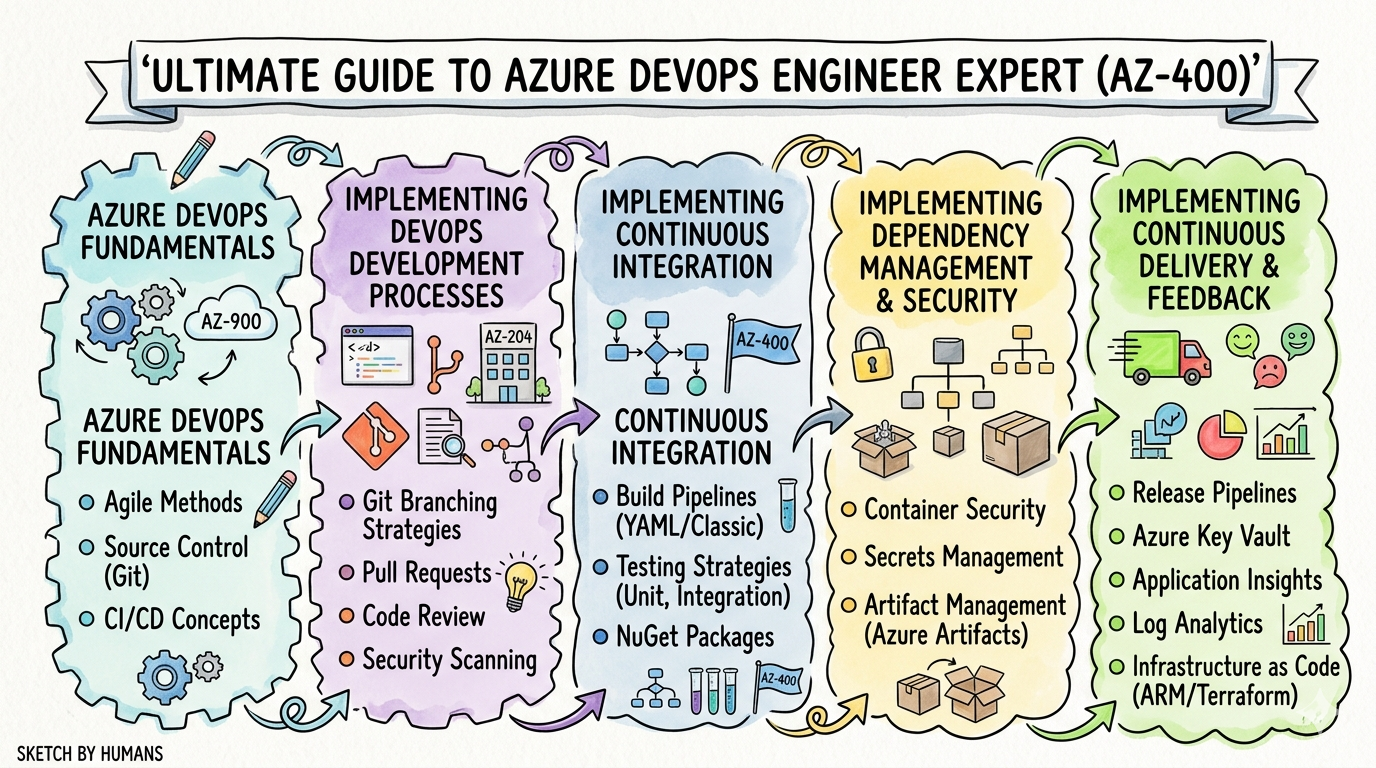
Introduction
The enterprise landscape demands seamless delivery pipelines and absolute cloud reliability. Achieving the Azure DevOps Engineer Expert (AZ-400) credential sets a definitive benchmark for professionals navigating these complex systems. This comprehensive guide is tailored for engineering leaders, cloud practitioners, and systems administrators aiming to solidify their technical expertise.
Navigating modern platform architecture requires a solid grasp of continuous integration, delivery mechanisms, and robust automated workflows. By focusing on practical engineering methodologies, this roadmap helps professionals evaluate their career trajectories, bridge existing skill gaps, and make informed choices. Whether your long-term goal is aligned with core infrastructure or specialized domains establishing a foundation in Azure practices is essential.
What is the Azure DevOps Engineer Expert (AZ-400)?
The certification represents the pinnacle of Microsoft’s cloud operational validation, focusing heavily on modern engineering practices. Rather than simple theoretical testing, it emphasizes the practical design and implementation of production-grade automation workflows. It serves as a comprehensive validation of an engineer’s ability to coordinate people, processes, and technologies for continuous value delivery.
Modern enterprises rely heavily on automated infrastructure and declarative configuration management to ensure stability. This program aligns directly with real-world enterprise environments, requiring candidates to demonstrate mastery over version control, compliance, and instrumentation. It proves you can manage end-to-end lifecycles within complex cloud ecosystems.
Who Should Pursue Azure DevOps Engineer Expert (AZ-400)?
This certification is ideal for systems engineers, cloud architects, and site reliability specialists looking to formalize their automation skills. It provides a direct path for traditional administrators to transition into advanced infrastructure and configuration roles. Engineering managers also benefit significantly by gaining the technical vocabulary needed to guide complex engineering projects.
The program holds massive relevance across both global markets and the rapidly expanding tech infrastructure hubs in India. For beginners with foundational cloud knowledge, it outlines a clear, structured path toward senior technical responsibilities. Experienced professionals use it to validate their advanced architectural capabilities to global enterprises.
Why Azure DevOps Engineer Expert (AZ-400)
Enterprise adoption of cloud infrastructure continues to scale rapidly, driving unprecedented demand for qualified operations engineers. This credential ensures long-term professional longevity by focusing on core operational philosophies rather than temporary tool trends. It teaches scalable principles that remain relevant even as underlying technologies shift.
Investing time and effort into this certification delivers a definitive return on career progression and technical capability. Organizations actively prioritize professionals who can minimize deployment cycles and optimize infrastructure expenditures. It transitions your professional profile from a routine administrator to a strategic engineering asset.
Azure DevOps Engineer Expert (AZ-400) Certification Overview
The complete preparation program is delivered via the devopsschool educational platform to support systematic professional learning. The certification utilizes a rigorous, performance-based assessment approach that tests actual implementation skills under practical scenarios. Microsoft owns and maintains the framework to ensure alignment with current cloud infrastructure developments.
The structural framework requires candidates to pass a comprehensive exam focusing on real-world engineering scenarios. It evaluates your capacity to design a secure instrumentation strategy and implement continuous integration pipelines. This practical architecture ensures that certified individuals can immediately contribute to live corporate infrastructure.
Azure DevOps Engineer Expert (AZ-400) Certification Tracks & Levels
The structural journey begins with prerequisite associate levels before advancing to the expert operational tier. Candidates typically choose between the administrator track or the developer track to build their foundational cloud capabilities. This tiered structure ensures every professional possesses basic implementation skills before tackling advanced orchestration.
As engineers progress, the framework branches into specialized workflows including site reliability and security operations. It maps perfectly to modern organizational hierarchies, allowing professionals to scale their responsibilities naturally over time. Achieving the expert status marks your readiness for enterprise-level architectural leadership.
Complete Azure DevOps Engineer Expert (AZ-400) Certification Table
| Track | Level | Who it’s for | Prerequisites | Skills Covered | Recommended Order |
|---|---|---|---|---|---|
| Operations Track | Associate | Systems Administrators | Basic Cloud Knowledge | Infrastructure Management, Governance, Security | First Step |
| Development Track | Associate | Software Engineers | Coding Fundamentals | Cloud Development, SDKs, App Deployment | Alternative First Step |
| DevOps Expert Track | Expert | Senior Engineers and SREs | Associate Certification | CI/CD, Instrumentation, Site Reliability, Automation | Final Mastery Tier |
Export to Sheets
Detailed Guide for Each Azure DevOps Engineer Expert (AZ-400) Certification
Azure DevOps Engineer Expert (AZ-400) – Azure Administrator Associate
What it is
This certification validates foundational expertise in implementing, managing, and monitoring identity, governance, storage, compute, and virtual networks in cloud environments. It serves as a primary technical prerequisite for advanced cloud architecture roles.
Who should take it
Systems administrators, operational engineers, and support professionals who manage core infrastructure assets daily should pursue this program to formalize their cloud management capabilities.
Skills you’ll gain
- Managing active directory domain services and role-based access control policies.
- Configuring scalable virtual networks and load balancing mechanisms.
- Implementing robust backup solutions and monitoring enterprise compute infrastructure.
Real-world projects you should be able to do
- Build a multi-region virtual network with private endpoints and secure routing tables.
- Deploy an automated virtual machine scale set integrated with centralized storage assets.
Preparation plan
- 7–14 days: Review official documentation modules focusing on core virtual networking concepts and resource manager templates.
- 30 days: Complete guided lab exercises on storage configuration, access control management, and cloud monitoring tools.
- 60 days: Conduct extensive mock examinations and perform full infrastructure deployment scenarios via the command-line interface.
Common mistakes
- Underestimating the depth of virtual networking rules and subnets.
- Failing to spend sufficient time practicing direct resource management in a live sandbox environment.
Best next certification after this
- Same-track option: Azure DevOps Engineer Expert (AZ-400)
- Cross-track option: Azure Developer Associate
- Leadership option: Azure Solutions Architect Expert
Azure DevOps Engineer Expert (AZ-400) – Azure Developer Associate
What it is
This certification measures your ability to design, build, test, and maintain secure cloud applications and services. It focuses heavily on software construction, container deployment, and software-driven optimization strategies.
Who should take it
Application developers, software engineers, and technical analysts who build cloud-native applications and want to integrate their code seamlessly with modern automation systems.
Skills you’ll gain
- Developing scalable compute solutions using container instances and serverless functions.
- Implementing comprehensive user authentication mechanisms and secure application properties.
- Optimizing application performance through distributed caching and telemetry tracking instrumentation.
Real-world projects you should be able to do
- Create a serverless API ecosystem utilizing managed databases and event-driven computing architectures.
- Deploy a secure multi-container web application integrated with centralized key management systems.
Preparation plan
- 7–14 days: Study application development kits, software tools, and serverless compute models within official guides.
- 30 days: Build active code deployments using managed identity systems and container registries in practice environments.
- 60 days: Troubleshoot complex telemetry code structures and complete comprehensive application mock exams systematically.
Common mistakes
- Focusing exclusively on basic scripting while neglecting deep security token implementation details.
- Skipping direct hands-on practice with specialized developer software development kits and command tools.
Best next certification after this
- Same-track option: Azure DevOps Engineer Expert (AZ-400)
- Cross-track option: Azure Administrator Associate
- Leadership option: Azure Solutions Architect Expert
Azure DevOps Engineer Expert (AZ-400) – Azure DevOps Engineer Expert
What it is
This advanced credential validates elite proficiency in designing and implementing comprehensive automation strategies, continuous integration pipelines, and robust site reliability engineering workflows.
Who should take it
Senior cloud engineers, continuous delivery specialists, and site reliability leads looking to demonstrate comprehensive mastery of enterprise operations management frameworks.
Skills you’ll gain
- Designing scalable version control strategies and automated deployment pipelines across environments.
- Implementing continuous compliance, security scanning mechanisms, and configuration automation tools.
- Configuring continuous feedback systems, application monitoring metrics, and status tracking strategies.
Real-world projects you should be able to do
- Build an automated multi-stage continuous deployment pipeline featuring automated rollback capabilities.
- Construct a declarative infrastructure-as-code deployment pipeline with integrated static analysis scanning.
Preparation plan
- 7–14 days: Deeply analyze instrumentation design strategies, version control structures, and pipeline configuration schemas.
- 30 days: Configure real-world continuous delivery environments featuring automated testing and multi-stage release gates.
- 60 days: Review advanced enterprise compliance architecture patterns and complete thorough exam simulations regularly.
Common mistakes
- Memorizing pipeline configurations without understanding underlying infrastructure-as-code and configuration practices.
- Overlooking the critical configuration aspects of modern artifact management and release governance pipelines.
Best next certification after this
- Same-track option: Advanced Cloud Security Specialization
- Cross-track option: Enterprise Data Engineering Mastery
- Leadership option: Principal Cloud Delivery Director
Choose Your Learning Path
DevOps Path
This path focuses entirely on building seamless software delivery mechanisms and eliminating operational silos. Professionals learn to design end-to-end continuous integration pipelines that accelerate application deployment velocities safely. It prioritizes infrastructure-as-code practices to ensure configuration environments remain predictable and easily reproducible. Choosing this trajectory prepares engineers to handle complex application deployment lifecycles across large enterprise systems.
DevSecOps Path
This specialized trajectory integrates strict compliance and security practices directly into early software lifecycles. Engineers learn to embed automated vulnerability scanning and policy checks into active delivery workflows. It shifts focus from manual audit practices to continuous security validation and automated remediation routines. Following this track ensures your organization mitigates risks while maintaining rapid deployment frequencies.
SRE Path
This methodology applies software engineering principles directly to solve complex operational and infrastructure challenges. It focuses heavily on maximizing system availability, designing reliable telemetry, and defining accurate error budgets. Professionals learn to automate incident response systems to drastically minimize mean time to resolution. This path prepares engineers to maintain massive, highly resilient production environments under heavy load.
AIOps Path
This cutting-edge framework introduces intelligent analytics and pattern matching into modern operational monitoring systems. Engineers focus on leveraging advanced algorithmic data processing to isolate root causes of performance degradations. It helps operations teams move from reactive firefighting to predictive systemic health management across systems. Pursuing this line of work builds deep expertise in managing high-volume telemetry tracking architectures.
MLOps Path
This specialized track bridges the distinct operational gap between machine learning models and production infrastructure. Professionals focus on building reproducible training pipelines and orchestrating automated continuous deployment for analytical models. It manages unique challenges like data drift tracking and model versioning across cloud environments. This path is essential for scaling artificial intelligence initiatives efficiently within enterprise architectures.
DataOps Path
This framework brings distinct automation and continuous delivery practices to complex enterprise data pipelines. Engineers design automated quality checks and orchestration routines to guarantee continuous data availability and hygiene. It minimizes structural delivery errors across distributed analytics processing engines and central data lakes. Opting for this roadmap transforms traditional data infrastructure into an agile, highly reliable asset.
FinOps Path
This practical discipline combines financial accountability with cloud infrastructure management to optimize overall enterprise expenditures. Professionals learn to implement real-time cost tracking, budget alerts, and automated resource optimization schedules. It establishes shared visibility between engineering teams and financial departments to drive efficient cloud usage. Following this track empowers technical leaders to maximize business value per unit of infrastructure investment.
Role → Recommended Azure DevOps Engineer Expert (AZ-400) Certifications
| Role | Recommended Certifications |
|---|---|
| DevOps Engineer | Azure DevOps Engineer Expert (AZ-400) |
| SRE | Azure DevOps Engineer Expert with SRE Electives |
| Platform Engineer | Azure DevOps Engineer Expert and Solutions Architect |
| Cloud Engineer | Azure Administrator Associate and Azure DevOps Expert |
| Security Engineer | Azure Security Engineer Associate and DevOps Expert |
| Data Engineer | Azure Data Engineer Associate and DevOps Foundations |
| FinOps Practitioner | Azure Administrator Associate and FinOps Core Credentials |
| Engineering Manager | Azure DevOps Expert and Cloud Governance Frameworks |
Export to Sheets
Next Certifications to Take After Azure DevOps Engineer Expert (AZ-400)
Same Track Progression
Deep specialization within Microsoft operational systems involves pursuing advanced cloud security and networking credentials. These specialized tracks ensure you can secure automation identities and configure complex hybrid connectivity models seamlessly. This establishes your profile as a comprehensive subject matter expert capable of handling elite engineering tasks.
Cross-Track Expansion
Skill broadening involves exploring alternative cloud architectural environments and multi-cloud infrastructure orchestration tools. Gaining fluency across diverse platform landscapes increases your adaptability when consulting for complex enterprise operations. This cross-training guarantees you can bridge architectural gaps in modern multi-cloud software ecosystems effortlessly.
Leadership & Management Track
Transitioning into engineering leadership requires focusing on strategic governance frameworks, financial management, and team architecture. This expansion shifts your daily focus from executing technical configurations to driving high-level organizational delivery. It prepares experienced engineers to lead large-scale transformation initiatives and manage enterprise-wide technology portfolios.
Training & Certification Support Providers for Azure DevOps Engineer Expert (AZ-400)
DevOpsSchool This premium training platform provides deep, production-grade learning programs designed by seasoned cloud deployment specialists. Their structured educational modules focus intensely on real-world application delivery scenarios, ensuring that candidates do not merely memorize exam contents but master actual system architecture. By offering extensive hands-on laboratory exercises and comprehensive live mentor support, they effectively bridge the structural gap between basic cloud theory and advanced enterprise infrastructure operations. Professionals looking to secure top-tier engineering positions choose this provider to cultivate verified, industry-aligned expertise that meets the operational demands of global organizations. The curriculum is regularly updated to reflect current engineering methodologies and tools.
Cotocus This enterprise enablement provider specializes in accelerating technical capabilities through highly focused engineering training solutions. Their comprehensive learning methodology combines structured cloud architecture deep-dives with collaborative, team-oriented problem-solving challenges. They emphasize declarative infrastructure management and advanced container orchestration, making them an excellent choice for organizations undergoing large-scale digital transformations. Candidates gain access to simulated live production environments where they can experiment with complex automation systems safely under expert supervision. This rigorous approach ensures that all training participants emerge with robust execution capabilities that immediately translate into improved enterprise delivery velocities and system reliability.
Scmgalaxy This technical resource community and training provider focuses heavily on configuration management, version control strategy, and automated build engineering. They offer a vast library of practical tutorials, deployment blueprints, and specialized workshops curated by industry veterans. Their educational philosophy emphasizes the foundational mechanics of continuous integration, ensuring that engineers understand the underlying file structures and deployment hooks completely. By participating in their practical training courses, professionals develop deep expertise in version control strategies, artifact repositories, and secure software delivery mechanisms. It remains an essential destination for individuals looking to master technical automation from the ground up.
BestDevOps This educational platform delivers targeted learning paths dedicated exclusively to mastering cloud automation and modern deployment strategies. Their streamlined curriculum cuts through unnecessary theoretical details to focus entirely on the core tools and workflows used by principal cloud architects. They provide step-by-step guidance on constructing scalable delivery systems, configuring continuous infrastructure validation, and managing enterprise release governance frameworks. With a heavy emphasis on short, impact-driven learning modules and intensive practical laboratory exercises, they ensure that busy software professionals can rapidly acquire advanced technical skills without disrupting their demanding daily delivery schedules.
devsecopsschool This specialized training destination prioritizes the seamless integration of comprehensive security practices directly into automated engineering lifecycles. Their core curriculum guides candidates through the complex process of embedding automated vulnerability scanning, compliance checks, and threat modeling routines into continuous delivery frameworks. By teaching engineers how to build automated guardrails that prevent insecure code from reaching production, they address a critical skill gap in the modern tech industry. Professionals who complete their training emerge with the specialized ability to balance rapid feature deployment velocity with absolute infrastructure security and corporate compliance standard enforcement.
sreschool This focused educational initiative addresses the growing enterprise demand for highly resilient systems and scalable cloud infrastructure management. Their specialized training modules are built entirely around the core pillars of site reliability engineering, including error budgets, incident response automation, and distributed telemetry tracking. Students learn how to apply strict software engineering principles directly to clear up persistent operational challenges and optimize resource availability. By focusing heavily on system architectural durability and automated recovery techniques under heavy traffic conditions, they prepare engineers to manage the most demanding enterprise production workloads successfully.
aiopsschool This forward-looking educational platform focuses exclusively on introducing intelligent analytical algorithms and data-driven automation into modern system operations. Their advanced training tracks teach cloud engineers how to aggregate massive volumes of system telemetry and apply predictive analytical frameworks to isolate performance anomalies. By guiding students through the process of building self-healing infrastructure patterns and automated alert triage workflows, they prepare technical professionals for upcoming technological shifts. It is an ideal training partner for senior operations specialists looking to lead the transition from manual infrastructure troubleshooting to automated operations.
dataopsschool This niche training provider addresses the unique operational challenges of managing large-scale distributed data architectures and analytical pipelines. Their curriculum adapts traditional continuous delivery and automation principles specifically for complex data engineering workflows, including automated quality validation and pipeline orchestration. Students gain extensive hands-on experience building reproducible data integration environments and automating database schema deployments without causing operational downtime. This highly specialized focus ensures that data professionals and operations engineers can collaborate effectively to deliver clean, highly reliable analytical assets to enterprise decision-makers continuously.
finopsschool This essential training organization combines rigorous cloud infrastructure management with structured financial accountability practices to maximize corporate efficiency. Their courses teach engineers and technology managers how to implement real-time cost transparency systems, configure automated budget enforcement actions, and optimize cloud infrastructure purchasing strategies. By establishing a unified language between technical engineering teams and corporate financial planners, they help organizations eliminate systemic cloud waste and optimize operational margins. Professionals trained by this group understand how to align technical architecture decisions directly with high-level corporate financial performance objectives.
Frequently Asked Questions (General)
- How difficult is the Azure DevOps Engineer Expert certification exam? The exam is highly challenging because it requires a combination of deep infrastructure knowledge and practical application development experience. Candidates must understand both code configuration and cloud architecture to pass successfully.
- What are the official prerequisites for the AZ-400 certification exam? Candidates must hold either the Azure Administrator Associate or the Azure Developer Associate credential before they can earn the expert status. This ensures a strong baseline capability.
- How long does it typically take to prepare for this expert level exam? For experienced professionals, a timeline of thirty to sixty days of structured study is generally sufficient to cover all exam objectives. Beginners may require several months of consistent practice.
- What is the financial return on investment for getting certified? Certified professionals experience significant career advancement opportunities and higher average compensation packages globally. Enterprises actively seek out certified individuals to lead complex digital transformations.
- Can I take the AZ-400 exam before passing the prerequisite associate exams? Yes, you can sit for the exam in any order, but the expert certification will not be awarded until all prerequisites are completed. It is highly recommended to follow the official sequence.
- How long remains the certification valid after successfully passing the exam? The certification remains valid for exactly one year, after which Microsoft requires a free online renewal assessment to maintain active status. This ensures your skills stay current.
- Does this certification cover multi-cloud engineering concepts or only Azure? The curriculum focuses primarily on native tools, but it heavily covers open-source solutions like Git, Terraform, and Docker that apply directly across multi-cloud environments.
- What types of questions should I expect on the actual examination? The test features a mix of multiple-choice questions, case studies, drag-and-drop scenarios, and performance-based lab tasks evaluating practical configuration decisions.
- Is coding experience mandatory to clear this specific track? A basic understanding of scripting languages and declarative configuration file formats is essential, though deep software development experience is not strictly required for the operational aspects.
- How does this certification differ from standard cloud architect paths? Architect paths focus heavily on high-level infrastructure design and component selection, while this track focuses intensely on execution, automation pipelines, and continuous application delivery.
- Are there hands-on laboratory tasks included in the testing environment? Yes, many exam iterations include live interface tasks where candidates must configure actual pipelines or security properties within a simulated cloud environment.
- What is the best approach to handling failing test scores? Review the detailed performance report provided at completion to identify specific weak domains, then spend two weeks focused entirely on hands-on laboratory exercises in those areas.
FAQs on Azure DevOps Engineer Expert (AZ-400)
- Which specific automation tools are emphasized most within the AZ-400 curriculum? The training program places massive emphasis on boards, pipelines, repositories, artifacts, and test plans to manage end-to-end continuous deployment workflows.
- How does the exam evaluate infrastructure-as-code capabilities? Candidates are tested thoroughly on designing and troubleshooting declarative configuration templates, including resource manager blueprints and cross-platform template tools.
- What instrumentation strategies must a candidate master for this track? You must know how to design log analytics workspaces, configure system telemetry tracking, and implement continuous alert rules across complex applications.
- How are containerization and microservices delivery handled in this certification? The material covers secure container registry management and automated application deployment configurations to managed container instances and cluster environments.
- What security practices are verified under the configuration management domain? The exam validates your ability to manage secure pipeline tokens, integrate automated compliance scanning tools, and handle secrets configuration seamlessly.
- How does this certification handle branch management and version control policies? It expects comprehensive knowledge of Git branching models, pull request workflows, code review governance structures, and large file storage strategies.
- What dependency management concepts are tested in the artifact section? Candidates must demonstrate how to configure secure package feeds, manage package versioning rules, and integrate third-party package frameworks into delivery pipelines.
- How does the program address continuous feedback and user analysis mechanisms? It verifies your capacity to configure user telemetry tools, analyze crash reports, and integrate automated monitoring loops back into development queues.
Final Thoughts: Is Azure DevOps Engineer Expert (AZ-400) Worth It?
Earning the expert level credential requires significant dedication, but the career impact is undeniably concrete. It shifts your professional positioning from a standard technician to an engineer capable of structuring modern enterprise systems. The curriculum matches actual industry needs, making the time investment highly practical.
For professionals committed to mastering infrastructure automation, continuous delivery, and scalable cloud systems, this track is highly worthwhile. It provides the structured baseline necessary to adapt as enterprise workflows evolve. Approach the preparation with an emphasis on production execution, and the validation will naturally follow.
