Introduction
Mention Goa to most travelers, and their minds instantly drift to neon-lit beach shacks, crowded electronic music festivals, and sunburned coastlines. But if you only chase the typical, overcrowded mainstream vacation spots, you miss the true soul of this coastal paradise. Beyond the commercial glare lies an older, quieter Goa—a land carved out of weathered red laterite stone and shaped by centuries of global empires colliding.
The real magic of Goa is found when you leave the neon behind and head up into the cliffs. Here, ancient fortresses stand like silent sentinels looking out over the Arabian Sea. These structures offer a deep, authentic connection to a vibrant past where Indian dynasties and Portuguese explorers fought for control of wealthy spice routes. Exploring these ruins connects you directly to the regional culture, far away from the standard tourist crowds.
Why Goa is a Must Visit Region
Goa is much more than a simple beach getaway; it is a vital chapter in global maritime history. Positioned perfectly on the West Coast of India, this tiny region became a prime target for the Kadamba dynasty, the Adil Shahi sultanate, and eventually the Portuguese Empire, who ruled here for over 450 years. This intense mixing of cultures created a unique blend of architecture, language, and food found nowhere else on earth.
Navigating this historical landscape is surprisingly straightforward. Goa features excellent on-ground infrastructure, with the modern Manohar International Airport (Mopa) in the north, Dabolim Airport in the center, and a reliable network of national highways and rail lines like the Konkan Railway. Whether you are a solo backpacker on a rented scooter, a couple looking for romantic sunset vistas, or a family exploring regional heritage, the local travel circuit smoothly transitions from bustling beach towns to quiet historical sanctuaries.
| Region of Goa | Primary Architectural Influence | Key Access Hubs | Best Exploration Mode |
| North Goa | Military Portuguese & Maratha | Panaji, Mapusa, Thivim Railway | Two-Wheeler / Self-Drive Cars |
| South Goa | Early Portuguese & Pre-Colonial | Margao, Vasco da Gama, Canacona | Chauffeur Cabs / Private Rentals |
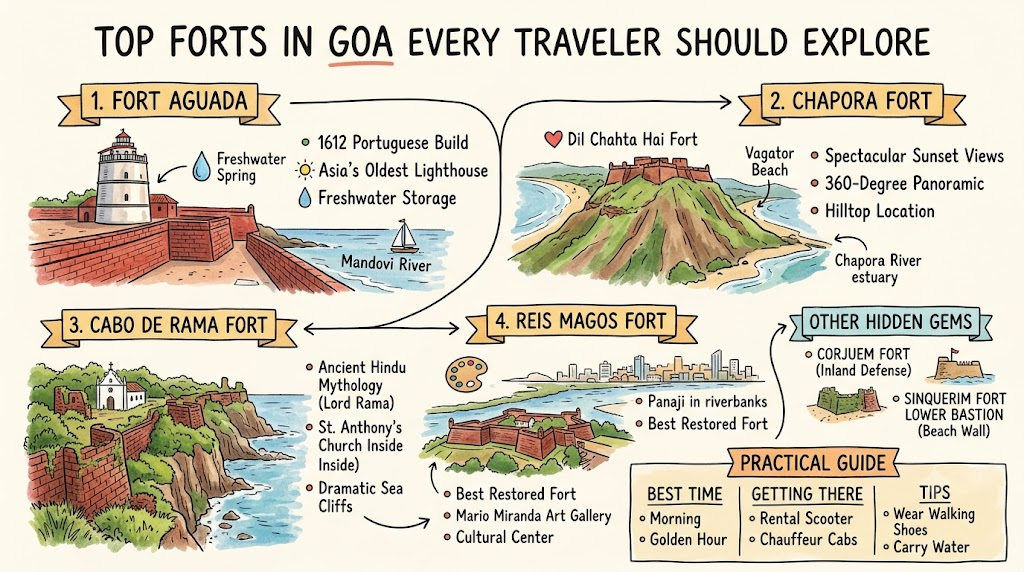
Top Forts in Goa Every Traveler Should Explore
Fort Aguada
Fort Aguada is the undisputed granddaddy of Goan fortresses. Built by the Portuguese in 1612 to guard against Dutch and Maratha invaders, this massive laterite complex features a soaring, four-story lighthouse that is the oldest of its kind in Asia. The fort’s name translates to “Watering Place,” a nod to the massive freshwater spring hidden within its walls that could hold over 2.3 million gallons of water to resupply passing ships.
Walking through the lower fortifications, you can feel the sheer scale of early 17th-century military engineering. The upper fort features a dry moat and thick, sweeping walls that offer unobstructed views of the Mandovi River meeting the Arabian Sea. It is a striking reminder of how Goa served as the crown jewel of Portugal’s eastern empire.
- Location: Candolim, North Goa; roughly 15 kilometers from the capital city of Panaji.
- Why it is worth visiting: It is the most intact and architecturally impressive Portuguese fort in India, complete with a historic freshwater storage system and a unique four-story lighthouse.
- Best things to do: Explore the massive central courtyard, photograph the ancient lighthouse structure, and walk the lower ramparts near the beachfront for dramatic wave views.
- Best time to visit: Early morning between 7:00 AM and 9:00 AM to beat the heavy crowds and intense afternoon heat.
- Ideal for whom: History buffs, architecture students, and families looking for clean, structured walking paths.
- Travel tip: The upper and lower sections are managed differently; ensure you wear comfortable walking shoes as the laterite stone paths can get incredibly hot under the midday sun.
Chapora Fort
Perched high on a steep hill overlooking the wide sweep of the Vagator coastline, Chapora Fort is famously known across India as the “Dil Chahta Hai” fort, thanks to its starring role in iconic Bollywood cinema. However, its history goes much deeper than pop culture. Originally built by Muslim ruler Adil Shah and later rebuilt by the Portuguese in 1717, this fort changed hands multiple times between European colonizers and fierce Maratha warriors.
Today, mostly the outer ramparts remain, but what the fort lacks in intact buildings, it more than makes up for in atmosphere. The real draw here is the jaw-dropping, 360-degree panoramic view. Standing on the crumbling walls, you can watch the Chapora River empty into the sea while the red cliffs of Vagator stretch out far below you.
- Location: Vagator, North Goa; approximately 22 kilometers from Panaji.
- Why it is worth visiting: It offers the most spectacular sunset views in North Goa, looking out over both river estuaries and open sea.
- Best things to do: Sit on the western rampart wall for sunset, explore the natural laterite rock pathways, and spot the traditional fishing boats crossing the Chapora river mouth.
- Best time to visit: Late afternoon around 4:30 PM to 6:00 PM to catch the golden hour light playing across the red stone walls.
- Ideal for whom: Backpackers, friend groups, photographers, and Bollywood movie fans.
- Travel tip: The climb up from the parking lot is quite steep and lined with loose gravel; wear sturdy sneakers rather than flip-flops to avoid slipping.
Cabo de Rama Fort
Stepping into Cabo de Rama Fort feels like venturing to the absolute edge of the world. Located in the far south of Goa, this sprawling 180,000-square-meter citadel is wrapped in ancient Hindu mythology. Legend says that Lord Rama took refuge here with his wife Sita during his years of exile, long before the Portuguese modernized the walls with heavy cannon bastions.
The atmosphere here is wild, overgrown, and deeply romantic. A small, whitewashed colonial church, St. Anthony’s, still stands inside the moody ruins, creating a sharp contrast against the dark laterite stone. The cliffs plunge sharply into a pristine, isolated cove below, making this fort feel completely detached from the busy commercial zones of northern Goa.
- Location: Canacona, South Goa; roughly 25 kilometers south of Margao.
- Why it is worth visiting: It offers a rare mix of ancient Hindu lore and Portuguese ruins, set against some of the highest, most dramatic sea cliffs in the state.
- Best things to do: Visit the functioning St. Anthony’s church inside the walls, hike down the steep hidden trail to the secret beach below, and marvel at the old iron cannons left on the western bastions.
- Best time to visit: Between 2:00 PM and 5:30 PM to combine historical exploration with a sunset drive through rural South Goa.
- Ideal for whom: Intrepid explorers, couples seeking quiet romance, and nature lovers.
- Travel tip: This fort is vast and largely unmonitored; stay well clear of the cliff edges as there are no safety railings or guard barriers.
Reis Magos Fort
Reis Magos Fort is a masterclass in modern heritage preservation. Built in 1551 at the narrowest point of the Mandovi River mouth, this boutique fortress served as an essential first line of defense for the old capital of Old Goa. Over the centuries, it transformed from a military bastion into a residence for high-ranking Portuguese officials, a prison during the war for Goan liberation, and finally a abandoned ruin before a full restoration brought it back to life.
Unlike Goa’s more wild, open ruins, Reis Magos is beautifully preserved as a cultural arts center. The interiors feature clean exhibitions, historic sketches, and galleries dedicated to famous Goan artist Mario Miranda. The view from the top looks out across the river directly at the modern capital of Panaji, bridging the gap between old and new Goa.
- Location: Verem, North Goa; just 7 kilometers across the river from Panaji.
- Why it is worth visiting: It is the best-restored fort in Goa, featuring interactive museum galleries and highly informative historical displays.
- Best things to do: Walk through the Mario Miranda art gallery inside, explore the old underground jail cells, and photograph the cylindrical watchtowers overlooking the river traffic.
- Best time to visit: Late morning around 10:30 AM when the indoor galleries provide a cool escape from the outdoor heat.
- Ideal for whom: Art lovers, families traveling with children, and senior citizens who need well-maintained pathways.
- Travel tip: The fort is closed on Mondays; plan your itinerary accordingly to avoid a wasted trip across the river.
Tiracol Fort
Tiracol Fort stands as a lonely outpost on the absolute northernmost tip of Goa. To reach it, you must drive to the edge of the state and cross the scenic Tiracol River on a traditional flatbed car ferry. This isolated geography made it a highly contested prize; it was originally built by the Bhonsle Rajas of Sawantwadi before being seized by the Portuguese in a bloody battle in 1746.
Today, the fort has been converted into a luxury boutique heritage hotel, but the outer courtyard and the stunning Church of St. Anthony remain open to visitors. Standing on the northern terrace, you get a spectacular look down at the completely untouched sands of Keri Beach, where the river currents mix into the open ocean.
- Location: Tiracol, Extreme North Goa; roughly 42 kilometers from Panaji.
- Why it is worth visiting: The journey itself—incorporating a rural ferry crossing—is an offbeat adventure that leads to an incredibly well-preserved northern bastion.
- Best things to do: Take the car ferry across the estuary, enjoy an iced coffee on the luxury hotel terrace overlooking the sea, and view the classic Iberian architecture of the inner church.
- Best time to visit: Mid-day for an elevated lunch stop during a broader exploration of the far northern beaches.
- Ideal for whom: Luxury travelers, off-beat road-trippers, and history buffs looking for quiet spaces.
- Travel tip: You don’t need to stay at the hotel to visit the courtyard, but booking a table for a meal guarantees the absolute best view on the upper deck.
Offbeat Exploration: Hidden Gems Tourists Miss
Corjuem Fort
Tucked away deep within the lush, green island of Aldona, Corjuem Fort is one of only two surviving inland fortresses in Goa. It is significantly smaller than the coastal giants, built as a square mud-and-stone outpost to defend against interior land attacks from the Marathas. Walking across its grassy interior feels completely intimate; it is completely surrounded by quiet backwaters, swaying coconut groves, and traditional Goan village life.
Sinquerim Fort Lower Bastion
While millions of tourists visit the main upper complex of Fort Aguada, very few realize that its lower wall extends all the way down onto the sands of Sinquerim Beach. This low laterite wall cuts directly into the surf, creating an old stone barrier against the waves. Walking out onto this lower bastion during a calm low tide puts you right on the water, with the old stone wall on one side and the open Arabian Sea on the other.
Detailed Practical Guidance for Travelers
To help you coordinate your route, here is a breakdown of the entry requirements, hours, and nearby highlights for Goa’s top fortifications:
| Destination | Standard Entry Fee | General Timings | Best Local Food Options Nearby | Recommended Nearby Attractions |
| Fort Aguada | ₹25 (Indians) / ₹300 (Foreigners) | 9:00 AM – 6:00 PM | Kokni Kanteen (Panaji) | Sinquerim Beach, Reis Magos Fort |
| Chapora Fort | Free Entry | 24 Hours (Sunset Recommended) | Burger Factory (Anjuna) | Vagator Beach, Ozran Viewpoint |
| Cabo de Rama | Free Entry | 9:00 AM – 5:30 PM | The Cape Goa (Cliffside Dining) | Agonda Beach, Palolem Beach |
| Reis Magos Fort | ₹50 per person | 9:30 AM – 5:30 PM (Closed Mon) | Bhatti Village (Nerul) | Coco Beach, Salim Ali Bird Sanctuary |
| Tiracol Fort | Free (Courtyard access only) | 9:00 AM – 7:00 PM | Fort Tiracol Restaurant | Keri Beach, Arambol Sweet Lake |
Logistics & On-Ground Navigation
Local Transport Options
- Self-Drive Car & Bike Rentals: The most flexible way to visit the forts. Black-and-yellow registered rental scooters cost roughly ₹400–₹600 per day, while self-drive hatchbacks run ₹1,500–₹2,500 per day.
- Chauffeur-Driven Tourist Cabs: Ideal for families visiting South Goa spots like Cabo de Rama. It is best to book fixed-rate, full-day packages through official Goa Miles app or hotel desks to ensure transparent pricing.
- Local Auto-Rickshaws: Readily available around urban hubs like Panaji and Mapusa, but ensure you agree on a fixed price before stepping in, as meters are rarely used.
Budget Planning
- Backpacker / Solo Tier (₹1,500 – ₹2,500 per day): Includes renting a basic scooter, eating at authentic village bars or local dhabas, staying in social hostels, and sticking to the free-entry forts.
- Mid-Range Comfort Tier (₹4,500 – ₹7,500 per day): Includes renting an air-conditioned hatchback, dining at nicer beachside cafes or heritage restaurants, paying ticket fees, and staying in boutique ancestral homestays.
Safety and Inclusivity Tips
- For Families: Stick to Reis Magos and Fort Aguada. They have clearer paths, less climbing, and working bathroom facilities.
- For Couples: Cabo de Rama and Chapora offer incredible romantic views, but avoid staying long after dark as lighting in these remote ruins is non-existent.
- General Safety: Never climb onto crumbling laterite walls for photos. This rock is highly porous and can easily snap or give way under weight, especially during or after the monsoon season.
Strategic Travel Planning Guardrails
Travel Planning Tips for Goa
- Cash is King at Rural Outposts: While beach towns accept digital payments easily, remote spots like Tiracol or Cabo de Rama have weak cellular networks, making cash essential for parking and local vendors.
- Pre-Monsoon Inspection: If visiting between June and September, check local weather updates; heavy rains can make steep clay paths near Chapora incredibly slick.
- Respect Functioning Religious Spaces: Forts like Cabo de Rama and Tiracol contain active Christian chapels; always dress modestly when stepping inside.
- Pack Hydration: None of these heritage sites have indoor air conditioning, and coastal humidity can be intense. Always carry at least two liters of water per person.
- Download Offline Maps: Cellular signals drop off significantly as you drive through the dense, hilly forests of South Goa toward the cliffs.
Common Mistakes to Avoid
- Rushing the Climb: Racing up the gravel paths at Chapora or Aguada in the midday sun without a hat is a recipe for quick heat exhaustion.
- Forgetting Bug Spray: Abandoned, overgrown laterite structures are natural havens for mosquitoes, especially around sunset.
- Assuming All Forts Have Facilities: Most of these fortresses are wild, preserved ruins with zero public restrooms, drinking water stations, or snack stalls inside.
- Renting Underpowered Scooters: If you plan to head up the steep hills to Chapora with a passenger, avoid basic 110cc scooters; opt for a more powerful 125cc or 150cc model instead.
- Ignoring the Early Closing Times: Many tourists assume fort gates stay open past dark; places like Reis Magos and Aguada will strictly ask you to leave by 5:30 PM to 6:00 PM.
Suggested Itinerary Blueprints
1. One-Day Quick Dash (The Northern Military Loop)
Designed for travelers short on time who want to see maximum history in a single day.
- 09:00 AM: Arrive at Reis Magos Fort for an indoor history lesson and art viewing.
- 12:00 PM: Head up to the massive ramparts of Fort Aguada to explore the lighthouse.
- 03:30 PM: Enjoy a traditional Goan fish thali lunch in nearby Mapusa or Candolim.
- 05:00 PM: Finish your day climbing up Chapora Fort to watch the sunset over Vagator.
2. Two-Day Deep-Dive (The North vs. South Circuit)
An ideal split that lets you experience the distinct vibes of both halves of the state.
- Day 1 (The Wild North): Take the morning ferry across to Tiracol Fort, spend the afternoon winding down through rural villages, and finish with a sunset walk at Chapora Fort.
- Day 2 (The Heritage South): Take a scenic morning drive down south to Cabo de Rama Fort, explore the hidden beach trail, and enjoy a cliffside lunch overlooking the sea.
3. Complete Weekend Travel Plan (The Grand Coastal Exploration)
A comprehensive three-day loop covering the best coastal architecture in Goa.
- Friday: Explore the cultural exhibits at Reis Magos, followed by an evening walk along the Mandovi riverfront in Panaji.
- Saturday: Take an intensive tour of Fort Aguada, hunt for the hidden lower bastion on Sinquerim Beach, and catch sunset from the walls of Chapora.
- Sunday: Dedicate the day to the south, driving out to Cabo de Rama, visiting its old colonial church, and winding down with fresh seafood on Palolem Beach.
Common Tourist Mistakes to Avoid
- Geographic Blunders: Do not attempt to visit Chapora Fort and Cabo de Rama Fort on the same day. They are located in opposite halves of the state, and you will spend over three hours fighting heavy traffic instead of enjoying the sites.
- Commercial Traps: Avoid wasting your afternoon hours inside the heavily commercialized shopping markets of Calangute or Baga. Spend that time exploring the peaceful, green village roads around inland fortresses like Corjuem.
- Neglecting Alternative Zones: Don’t just stick to the coastal walls; take time to explore the quiet, artistic, and cafe-centric historic neighborhoods of Panaji, like Fontainhas, which highlight Goa’s architectural heritage.
- Transport Overpayment: Never accept the first price quoted by roadside taxi stands near major forts. Always cross-reference fares using the official Goa Miles app to see the standard government-approved rate for your route.
- Luxury Dining Bias: Skipping the tiny, family-run village taverns (bhakhis) near the forts means missing out on the true culinary heart of Goa. That is where you will find the best authentic Xacuti and fresh fried fish.
Frequently Asked Questions
1. Which fort in Goa is the best choice for sunset photography?
Chapora Fort is widely considered the absolute best choice for sunset photography. Because it sits on a high laterite ridge, it gives you a completely unobstructed view of the sun dipping into the Arabian Sea, while simultaneously framing the wide curve of Vagator Beach and the mouth of the Chapora River below.
2. Are there any entry fees for visiting Chapora Fort or Cabo de Rama?
No, both Chapora Fort and Cabo de Rama Fort are completely free to enter. You do not need to purchase any tickets, though you may need to pay a small cash parking fee (usually around ₹20 to ₹40) to local operators managing the lots at the base of the access paths.
3. Can senior citizens easily access Fort Aguada and Reis Magos Fort?
Reis Magos Fort is highly accessible, featuring smoothly paved walkways, clear ramps, and well-maintained indoor galleries. Fort Aguada’s upper complex is also reasonably flat once you are inside, but the long walk from the parking lot under the hot sun can be tiring for seniors, so visiting during cooler early morning hours is highly recommended.
4. How do I reach Tiracol Fort, and do I need a special permit?
No special permits are required to visit Tiracol Fort. To get there, you simply drive to the Keri ferry ramp in North Goa and drive your vehicle onto the government-run flatbed ferry. The ferry takes about 10 minutes to cross the river to Tiracol, and it runs smoothly throughout the day for a nominal fee.
5. Is it safe to hike down to the beach below Cabo de Rama Fort?
Yes, it is generally safe, but only if you are in good physical shape and wearing proper shoes. The path down the cliffside is a primitive, unmaintained dirt trail with loose rocks and steep drops. Avoid attempting this hike entirely during heavy monsoon rains, as the mud becomes incredibly slick and dangerous.
6. What are the operational timings for Reis Magos Fort?
Reis Magos Fort is open to the public from 9:30 AM to 5:30 PM. Crucially, the fort is strictly closed on Mondays, so make sure to plan your travel itinerary around this schedule to avoid arriving to locked gates.
7. Why is Chapora Fort called the Dil Chahta Hai fort by locals?
It earned that nickname after a famous scene in the 2001 Bollywood cult-classic movie Dil Chahta Hai, where the three main characters sit on the fort’s stone walls looking out at the sea while reflecting on life. The scene became so famous that it transformed the quiet ruin into a major cultural pilgrimage spot for Indian travelers.
8. Which Goan forts are located in South Goa?
The primary fortress in South Goa is Cabo de Rama Fort, located in the Canacona district. Most of the other well-known forts, such as Aguada, Chapora, Reis Magos, Corjuem, and Tiracol, are located in the northern half of the state.
9. Can we go inside the lighthouse located at Fort Aguada?
The historic, four-story Portuguese lighthouse inside the main upper courtyard of Fort Aguada is safely sealed and closed to the public for climbing. However, you can walk directly up to its base to admire its unique stone architecture and take photographs.
10. What should I wear when planning a day exploring Goan forts?
Wear lightweight, breathable cotton clothing to stay comfortable in the intense coastal humidity, and always wear sturdy sneakers with good grip for walking on loose gravel and uneven laterite stones. If you plan to step inside the historic chapels inside the forts, ensure your shoulders and knees are covered out of respect.
11. Are there clean public toilets and food stalls inside Cabo de Rama Fort?
No, Cabo de Rama is an open, semi-wild heritage site with no modern public restrooms or running water stations inside the walls. There are small local shacks selling bottled water and tender coconut near the main parking area outside, but it is best to use facilities before arriving.
12. Is it worth visiting Corjuem Fort if it is located inland?
Yes, absolutely. If you want to experience an offbeat side of Goa away from any coastal tourist crowds, Corjuem Fort is wonderful. The drive through the traditional, leafy village of Aldona and across the cable bridge to reach this unique, small island outpost is one of the most scenic interior journeys you can take in Goa.
Conclusion
Choosing to explore the ancient laterite forts of Goa over a standard, predictable beach vacation rewards you with something far more valuable than a simple suntan. Standing on these weathered stones—where the hot sea breeze carries echoes of old battles, ancient empires, and deep cross-cultural history—gives you a profound sense of place. It transforms Goa from a simple resort playground into a living, breathing landscape of human endurance. When you step off the crowded beaches and climb up into these silent, cliffside bastions, you aren’t just taking a trip; you are uncovering the true, timeless spirit of the Goan coast.
