Introduction
When most travelers think of an idyllic getaway, their minds drift to over-commercialized resort strips and hyper-crowded beach boardwalks where you fight for a square inch of sand. Goa breaks that predictable mold if you know exactly where to look. Beyond the neon signs of party strips lies a coastal wonderland steeped in deep Konkani roots, centuries of Portuguese-Indian convergence, and an unmatched geological variety of dramatic cliffs and tidal estuaries.
Catching a sunset in Goa is not just a casual end to your day; it is a profound cultural ritual. The entire state seems to collectively slow down as the sky morphs into a canvas of liquid amber, deep violet, and fiery orange. Whether you are perched on the crumbling crimson brickwork of a 17th-century fortress or sitting quietly on a remote southern cove, these sunset vistas connect you to the true, untamed soul of India’s sunshine state.
Why Goa is a must visit city
Goa holds an irreplaceable macro-level weight in global travel history, serving for centuries as a vital maritime trading hub where Eastern and Western cultures tightly intertwined. Geographically pinned between the rugged Western Ghats mountain range and the vast Arabian Sea, its landscape shifts dramatically from sheer volcanic cliffs in the north to wide, pristine crescent bays in the south. This unique terrain makes its coastline an endless series of perfect, natural viewing platforms for the setting sun.
Navigating this coastal paradise is incredibly seamless for every archetype of traveler. The state is highly accessible via two operational airports (Manohar International Airport in Mopa and Dabolim Airport), an extensive rail network spanning the Konkan Railway line, and smooth national highways connecting it to neighboring states. Whether you are a backpacker renting a nimble gearless scooter or a luxury traveler hiring private chauffeurs, the infrastructure makes moving between coastal sub-regions effortless.
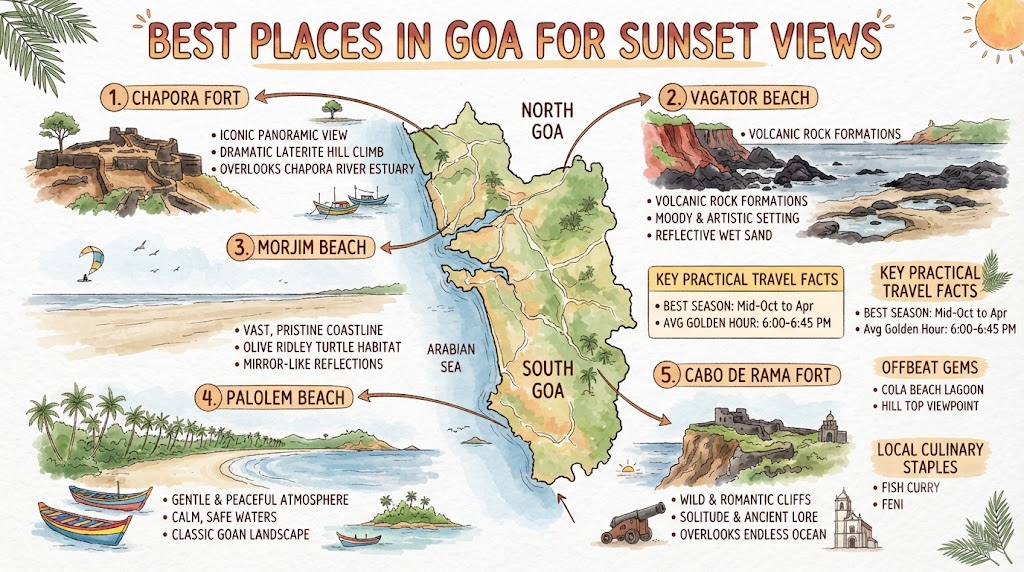
The general travel circuit naturally splits into two distinct personalities: the vibrant, historic, and cliff-dominated North Goa, and the serene, slow-paced, and ecologically pristine South Goa.
| Regional Metric | Key Practical Travel Facts |
| Best Travel Season | Mid-October to April (Dry winter and spring months) |
| Primary Highway Arteries | NH-66 (Connecting North to South Goa smoothly) |
| Major Rail Hubs | Madgaon (South) and Thivim (North) |
| Average Golden Hour Time | 6:00 PM to 6:45 PM IST |
| Local Culinary Staples | Goan Fish Curry, Bebinca, Poi (local bread), Feni |
Best Places for Sunset Views
Chapora Fort
Perched majestically atop a high laterite hill, Chapora Fort offers an iconic elevated vantage point where the Chapora River gracefully meets the roaring Arabian Sea. Built originally by Adil Shah and later reconstructed by the Portuguese in 1717, this ancient stronghold features rugged red stone walls that glow with an intense, fiery brilliance as the late afternoon sun hits them. The panoramic view from the top allows you to track the sun dipping directly into the horizon line while watching the distant fishing boats sail home.
The climb up the stone path can be a bit steep and loose, but the reward at the summit is an expansive, unobstructed 360-degree view. You can see the long stretch of Vagator Beach curving below on one side and the quiet Morjim riverbanks on the other. It is a place where history feels alive, underscored by the constant, rhythmic crashing of the waves against the cliffs far below.
- Location: North Goa; Bardez district, approximately 22 kilometers from the capital city of Panaji.
- Why it is worth visiting: It combines rich colonial military history with an unparalleled, high-elevation panoramic view of the North Goan coastline and river estuary.
- Best things to do: Walk along the uneven old ramparts, locate the hidden stone gateway facing the sea, and photograph the dramatic silhouettes of lone thorn trees against the golden sky.
- Best time to visit: October to May; arrive by 4:45 PM to complete the hill climb before the peak golden hour begins.
- Ideal for whom: History buffs, landscape photographers, couples, and groups of friends.
- Travel tip: Wear sturdy sports shoes with good grip, as the descending gravel path is highly slippery after dark, and carry a flashlight.
Vagator Beach
Vagator Beach is a visually spectacular coastal stretch defined by its dramatic black volcanic rocks contrasting sharply with fine white sand. The beach is split into Big Vagator and Little Vagator by a seaside headland, both offering distinct moods for watching the dusk settle in. The towering red cliffs lined with swaying coconut palms provide a theatrical backdrop as the sky shifts from pale yellow to deep shades of magenta.
As the sun descends, the wet sand transforms into a massive mirror, reflecting the brilliant sky colors and creating a mesmerizing double-image effect. The rocky tide pools along the shoreline catch the last light of day, offering intimate spots to sit away from the main sands.
- Location: North Goa; located just below Chapora Fort, roughly 21 kilometers from Panaji.
- Why it is worth visiting: The striking geological contrast of dark volcanic rock formations against the crashing surf creates a moody, artistic sunset setting.
- Best things to do: Explore the rocky tide pools at the base of the cliffs, sit on the smooth boulder formations, and enjoy live ambient music from nearby cliffside shacks.
- Best time to visit: November to March; perfect from 5:15 PM onwards to catch the changing colors of the tide pools.
- Ideal for whom: Bohemian travelers, couples, music enthusiasts, and artists.
- Travel tip: Be cautious when walking on the dark sea rocks; they are covered in slick moss and sharp barnacles that can cause injuries.
Cabo de Rama Fort
Tucked away in the far south of the state, Cabo de Rama Fort is a wild, romantic, and deeply atmospheric cliffside ruin steeped in ancient lore. Legend says Lord Rama sought refuge here during his long exile, and the laterite fort walls have stood watch over the lonely southern coast for centuries. The fort sits on a massive cape that juts out deep into the sea, providing a sensation of standing at the literal edge of the earth.
The interior of the fort is overgrown with wild vegetation, adding to its mysterious, forgotten charm. A small, whitewashed church stands in stark contrast to the dark, weathered stone of the surrounding ruins. Walking out to the westernmost tip of the cliff gives you a completely solitary view of the sun plunging into an endless ocean horizon.
- Location: South Goa; Canacona taluka, roughly 60 kilometers south of Panaji and 30 kilometers from Margao.
- Why it is worth visiting: It is one of the most remote and visually dramatic cliff structures in India, offering a peaceful sunset completely removed from tourist crowds.
- Best things to do: Explore the ruins of the old Portuguese cannons, visit the pristine white St. Antonio Church inside, and walk the narrow dirt trail leading to the absolute edge of the bluff.
- Best time to visit: Year-round; best between 4:30 PM and 6:30 PM to explore the vast grounds before the sun goes down.
- Ideal for whom: Solitude seekers, history enthusiasts, intrepid road-trippers, and romantic couples.
- Travel tip: The fort grounds close strictly at 5:30 PM or 6:00 PM depending on the season, so secure a spot just outside the main gate on the cliffside path for the final sunset drop.
Palolem Beach
Palolem Beach is a stunning, semi-circular crescent bay lined with a dense, leaning forest of coconut palms that almost touch the water. Known for its calm, wave-free waters due to the protective headlands on either side, it offers a tranquil and safe beach environment. At the northern end lies a small estuarine island that becomes accessible by wading through shallow waters at low tide.
The sunset here is soft and peaceful, with the sun casting long, elegant shadows of the coconut trees across the wide sand flats. Colorful wooden fishing boats line the shore, providing a classic, timeless Goan landscape as the sky glows in pastel hues.
- Location: South Goa; Canacona district, roughly 70 kilometers from Dabolim Airport.
- Why it is worth visiting: The perfect crescent shape of the bay creates a beautifully framed, gentle sunset view framed by overhanging palm trees.
- Best things to do: Take a late afternoon kayak trip into the calm bay, walk across the shallow stream to the northern monkey island, and sit at a low-lit beach shack right at the water’s edge.
- Best time to visit: November to April; ideal from 5:00 PM to experience the transition from bright blue to warm twilight.
- Ideal for whom: Families with young children, solo travelers, kayakers, and wellness tourists.
- Travel tip: Book a sunset boat trip from local fishermen right from the beach to see the dolphins playing in the golden water.
Morjim Beach
Morjim Beach is a vast, pristine expanse of flat sand located at the mouth of the quiet Olive Ridley sea turtle nesting habitat of the Chapora River. Because it is an environmentally protected zone, the beach remains remarkably wide, clean, and free of noisy commercial activities. The sunset here is an expansive experience, as the flat sand holds a thin layer of receding water that reflects the entire sky like a massive mirror.
The northern breeze blows continuously across the open flats, making it a favorite spot for kite-surfers. Watching these massive, colorful kites dance across a sky turned deep orange and crimson is a breathtaking sight.
- Location: North Goa; Pernem district, about 28 kilometers north of Panaji.
- Why it is worth visiting: The open river-mouth geography offers an incredibly wide horizon and a serene atmosphere protected by local environmental conservation laws.
- Best things to do: Watch the local fishermen pull in their traditional shore nets, spot migratory birds near the river mouth, and photograph the kite-surfers catching the evening wind.
- Best time to visit: December to March; arrive by 5:15 PM to walk down to the quietest sand spit near the river opening.
- Ideal for whom: Birdwatchers, eco-tourists, peace seekers, and long-distance beach walkers.
- Travel tip: Strictly avoid entering the clearly marked turtle nesting fences at the southern end, and do not use bright flash photography after dark.
Offbeat Exploration: Hidden Gems Tourists Miss
Cola Beach Lagoon
Hidden down an incredibly steep, unpaved dirt track through a dense jungle plateau lies Cola Beach, an extraordinary destination where a fresh, emerald-green water lagoon sits just meters away from the crashing waves of the Arabian Sea. The silent, palm-fringed lagoon reflects the golden sunset light beautifully, creating a peaceful, tropical oasis atmosphere. You can swim in the cool, still fresh water while watching the sun set over the salty ocean waves right across the sand bank.
Hill Top Viewpoint (Behind Arambol)
While most tourists crowd onto the main sands of Arambol Beach, a narrow dirt path climbs up the rocky headland directly behind the famous sweet water lake. This trail opens up onto a high, grassy plateau known to locals as the Hill Top Viewpoint. Sitting up here allows you to look down on the entire northern coastline from a bird’s-eye perspective, completely free from the beach crowds, accompanied only by paragliders landing softly on the cliffs.
Chorla Ghat Vistas
For those willing to leave the coast behind, the winding mountain roads of Chorla Ghat on the Goa-Karnataka-Maharashtra border offer an entirely different sunset perspective. At specific clearing curves along the highway, you can look westward over the entire state of Goa, watching the sun sink behind the distant, misty blue ridges of the Western Ghats forest canopy.
Detailed Practical Guidance for Travelers
| Destination | Standard Entry Fee | General Timings | Best Local Food Options Nearby | Recommended Nearby Attractions |
| Chapora Fort | Free | 8:00 AM – 6:00 PM | Fish Thali at local joints down the hill | Vagator Beach, Ozran Beach |
| Vagator Beach | Free | Open 24 Hours | Pork Vindaloo and fresh seafood at cliff shacks | Chapora Fort, Anjuna Flea Market |
| Cabo de Rama Fort | Free | 9:00 AM – 5:30 PM | Traditional Goan Poi bread and prawn curry | Cabo de Rama Beach, Agonda Beach |
| Palolem Beach | Free | Open 24 Hours | Butter Garlic Squid, local Bebinca dessert | Butterfly Beach, Patnem Beach |
| Morjim Beach | Free | Open 24 Hours | Russian-inspired café dishes, fresh juice | Mandrem Beach, Ashwem Beach |
Logistics & On-Ground Navigation
Local Transport Options
- Two-Wheeler Rentals: This is the most popular and practical way to navigate Goa. You can rent gearless scooters (like Activas) or motorcycles for around ₹350 to ₹800 per day depending on the season. Always ensure the vehicle has a black-and-yellow commercial license plate.
- Self-Drive Cars: Ideal for families or groups, self-drive hatchbacks and SUVs can be rented starting from ₹1,500 per day. They offer great comfort for long cross-regional drives between North and South Goa.
- Local Taxis: Goa does not use standard ride-sharing apps like Uber or Ola. Instead, use the state-backed Goamiles app or negotiate directly with local taxi drivers at designated beach stands. Always clarify the final fare before getting in.
- Auto-Rickshaws: Available readily in major towns like Panaji, Mapusa, and Margao, but less common directly on the remote beach strips. They operate on fixed or negotiated rates.
Budget Planning
- Backpacker / Budget Tier (₹1,500 – ₹2,500 per day): Includes a bed in a social hostel dorm, a rented scooter, meals at local village dhabas or small beach shacks, and visiting free entry nature sites and public fort ruins.
- Mid-Range / Comfort Tier (₹4,500 – ₹8,000 per day): Includes a private AC room in a boutique guest house or beach resort, a self-drive car or app-based taxis, dining at upscale heritage restaurants, and enjoying paid water sports or sunset boat cruises.
Safety and Inclusivity Tips
- For Families: Stick to the wider, flatter beaches like Palolem or Morjim where the waters are calm, and lifeguard towers are clearly visible. Avoid climbing remote fort ruins after sunset as paths lack artificial lighting.
- For Couples: Seek out the quieter southern coves like Agonda or Cabo de Rama for privacy. Avoid isolated beach stretches late at night and always use authorized transport vehicles.
- General Safety: Never swim after consuming alcohol or after the lifeguards sound their evening whistles (usually at 6:00 PM). The Arabian Sea has powerful rip currents that can pull even strong swimmers out rapidly.
Strategic Travel Planning Guardrails
Travel Planning Tips for Goa
- Book Accommodations Early: If planning a trip between December 15 and January 5, book stays at least 3 months in advance as prices double and availability plummets.
- Carry Cash: While UPI digital payments are widely accepted in towns, remote beach shacks, parking attendants, and local fuel stalls often require hard cash due to spotty cellular networks.
- Respect Local Etiquette: Dress appropriately when stepping away from the beach into local villages or religious shrines; cover your shoulders and knees when visiting old temples or churches.
- Sun Protection is Essential: The afternoon sun is intense even in winter. Wear broad-spectrum SPF 50 sunscreen, a wide-brimmed hat, and polarized sunglasses.
- Check Vehicle Documents: When renting a scooter, check the insurance validity and registration papers thoroughly, and always wear a helmet to avoid steep traffic fines.
Common Mistakes to Avoid
- Over-packing Itineraries: Do not try to see North Goa and South Goa in a single weekend; you will waste your entire holiday sitting in highway traffic.
- Ignoring Sub-Region Personalities: Choosing a hotel in crowded Baga when you actually want a quiet, relaxing nature holiday is a common mistake. Research the neighborhood vibe carefully first.
- Assuming Cheap Taxi Fares: Expecting low-cost on-demand taxis will disrupt your budget; transport is one of the highest expenses in Goa, making scooter rentals highly efficient.
- Skipping Local Konkani Cuisine: Sticking only to continental or North Indian hotel buffets deprives you of experiencing authentic local flavors like Xacuti or Cafreal.
- Overpaying at Flea Markets: Accepting the very first price quoted at tourist markets like Anjuna or Calangute is a mistake; polite bargaining can often lower prices by 40-50%.
Suggested Itinerary Blueprints
1. 1-Day Quick Dash (The Sunset & Fortress Loop)
Designed for travelers with very limited time who want to experience the absolute highlights of North Goa’s dramatic topography.
- 09:00 AM: Start with a traditional Goan breakfast of Patal Bhaji and Poi in Panaji city.
- 11:00 AM: Explore the historic, colorful Latin Quarter of Fontainhas.
- 02:00 PM: Drive north to a quiet lunch spot along the Chapora River.
- 04:30 PM: Begin the scenic walk up the red laterite path of Chapora Fort.
- 05:30 PM – 06:30 PM: Secure a spot on the western wall of Chapora Fort to watch the golden sunset over the estuary.
2. 2-Day Deep-Dive (North vs. South Contrast Route)
Perfect for travelers who want to feel the distinct differences between the energetic north and the slow, serene south over 48 hours.
- Day 1 (The Bohemian North): Spend your afternoon exploring the dark volcanic rocks and vibrant vibe of Vagator Beach. Head up to the rocky tide pools around 5:00 PM for a spectacular sunset reflection, followed by live music at a cliffside venue.
- Day 2 (The Heritage South): Drive down the smooth NH-66 to the historic Cabo de Rama Fort. Spend the late afternoon walking through the old Portuguese ruins, and watch a dramatic, solitary sunset from the cliff tip overlooking the open sea.
3. Complete Weekend Travel Plan (The Ultimate Coastal Escape)
A complete, well-paced weekend loop that balances coastal exploration, local food, and diverse sunset vantage points.
- Friday: Arrive and settle into North Goa. Spend the late afternoon on the wide, mirror-like sands of Morjim Beach. Watch the kite-surfers silhouetted against a brilliant orange sky as the river meets the sea.
- Saturday: Head inland for a morning spice plantation tour and an authentic Goan fish thali lunch. By 4:30 PM, make your way to Chapora Fort to catch the iconic, panoramic sunset over the northern coastline.
- Sunday: Journey south to the beautiful crescent bay of Palolem Beach. Rent a sea kayak at 5:00 PM and paddle out into the calm, protected waters to watch your final holiday sunset from the ocean, looking back at the palm-lined shore.
Common Tourist Mistakes to Avoid
Geographic Blunders
The most frequent mistake travelers make is attempting to watch a sunrise in South Goa and a sunset in North Goa on the exact same afternoon. The distance between these regions can take over two hours of driving through congested city choke points like Porvorim or the Panaji bridges, turning a relaxing holiday into a stressful commute.
Commercial Traps
Many tourists spend their precious evening hours trapped inside modernized shopping malls or generic souvenir complexes in Calangute or Panaji. These spaces offer nothing unique; your time is far better spent sitting on a quiet beach hill or walking through an old village neighborhood as the daylight fades.
Neglecting Modern/Alternative Zones
Travelers often completely overlook the quieter, artistic inland expansions of Goa, such as Assagao or Aldona. These beautiful residential neighborhoods are filled with beautifully restored Indo-Portuguese villas, contemporary art spaces, and innovative garden cafes that offer a deeply authentic look into modern Goan lifestyle.
Transport Overpayment
Unknowing tourists often step out of hotels and take the very first unmetered taxi waiting at the gate, leading to massive overpayment. Always use the state-authorized Goamiles mobile app to cross-reference standard travel rates, or negotiate clearly using established local distance charts.
Luxury Dining Bias
Dining exclusively inside high-end, air-conditioned luxury resorts often means missing out on the true culinary heart of the state. The real soul of Goan food lives in the humble, family-run village eateries (called Anandas or Kiosks) where the fish is caught fresh daily and the coconut masalas are ground by hand on stone slabs.
Frequently Asked Questions
1. What is the absolute best month to see clear sunsets in Goa?
The best months for clear, unobstructed sunsets are November through February. During this winter period, the monsoon clouds have completely cleared out, the humidity is low, and the sky is consistently crisp, offering long golden hours.
2. Is there any entry fee to visit Chapora Fort or Cabo de Rama Fort?
No, both Chapora Fort and Cabo de Rama Fort are completely free to enter for the public. You only need to pay small local vehicle parking fees (usually ₹20 to ₹50) at the base of the access paths.
3. Can we safely swim in the sea during sunset hours in Goa?
No, swimming after sunset is highly discouraged and unsafe. The official beach lifeguards wrap up their duty shifts around 6:00 PM or dusk, and changing evening tides can create unpredictable undercurrents that are difficult to navigate in the dark.
4. How do I get to the remote Cabo de Rama Fort in South Goa?
The most reliable way to reach Cabo de Rama is by renting a self-drive car or a powerful geared motorcycle. The route follows the NH-66 highway south towards Canacona, followed by a clearly signposted, scenic interior road that cuts through local villages and coastal hills.
5. Are there public restroom facilities available at all sunset viewpoints?
Major developed beaches like Palolem and Vagator have readily available restroom facilities inside the beach shacks and restaurants lining the coast. However, historic fort sites like Chapora and Cabo de Rama are rugged ruins and do not have public restrooms on the hilltops.
6. Which sunset spot in Goa is the least crowded for solo travelers?
Cabo de Rama Fort in the south and the open sand spit at the river-mouth of Morjim Beach in the north are the least crowded spots. They provide ample open space to sit quietly away from the loud tourist groups.
7. Can we rent sea kayaks at Palolem Beach for sunset paddling?
Yes, local operators line the sands of Palolem Beach offering sea kayak rentals by the hour (ranging from ₹300 to ₹500). It is highly recommended to rent one around 5:00 PM to safely paddle out and watch the sun drop from the water.
8. What should I wear when visiting historic forts for sunset?
Wear lightweight, breathable clothing but prioritize sturdy closed-toe sports shoes or hiking sandals. The trails leading up to spots like Chapora Fort consist of smooth laterite stones and loose gravel, which are highly slippery to walk on in flip-flops.
9. Do local beach shacks accept credit cards for evening dining?
Major upscale shacks accept credit and debit cards, but smaller beach establishments and independent drink stalls often struggle with card machines due to poor network connectivity on the sand. It is always smart to keep a few hundred rupees in cash handy.
10. Is it safe for solo female travelers to watch sunsets at remote spots?
Yes, Goa is generally one of the safest states in India for solo female travelers. However, practical safety is important: ensure you descend from elevated fort ruins or isolated hills while there is still ambient twilight left, and have your scooter or transport arranged before it gets dark.
11. What is the significance of the rocks at Vagator Beach?
The dark rocks at Vagator are ancient black volcanic formations. They create stunning, dark rocky tide pools that trap the receding sea water, creating beautiful natural mirrors that reflect the changing sunset colors brilliantly for photography.
12. Are drones allowed to be flown at Goan forts and beaches for sunset shots?
Flying drones is strictly prohibited near government installations, defense zones (like Dabolim Airport surroundings), and specific historical monuments managed by the Archaeological Survey of India (ASI). Always check for local warning signs and request permission from local authorities before launching a drone.
Conclusion
Choosing to step away from the predictable, commercialized tourist routes to seek out Goa’s true sunset viewpoints is a deeply rewarding travel experience. Standing on an ancient, weathered laterite wall or sitting quietly on a remote southern cove provides a sense of peace that standard resort holidays simply cannot match. As you watch the golden sun slide quietly beneath the vast Arabian Sea horizon, you feel a deep, unforgettable connection to the history, geography, and timeless cultural soul of this beautiful coastal paradise.
