Introduction
Modern organizations depend entirely on real-time data feeds, automated reporting, and predictive analytics to make sound business decisions every day. When manual releases trigger broken downstream dashboards, productivity grinds to a halt and executive trust collapses instantly. Bridging this operational gap requires DataOps, an agile framework that unites engineers, analysts, and operators through systemic automation and shared operational standards. For newcomers seeking to understand what modern data teams do differently, the discipline applies battle-tested software engineering rigor directly to data workflows. This deep dive unpacks fundamental architectural concepts, core toolchains, and hands-on professional certifications, alongside real-world enterprise consulting strategies. Platforms such as DataOpsSchool helpfully support this journey by providing practical training curriculums, structured technical tutorials, and advisory services for teams establishing reliable operational foundations.
What Is DataOps?
At its heart, DataOps adapts agile development, automated testing, and DevOps deployment patterns specifically for complex, multi-layered data management pipelines. Rather than treating pipelines as static, isolated script directories maintained by siloed analysts, this operational paradigm automates pipeline delivery from source extraction to analytical consumption. The methodology aligns data engineering, quality assurance, system operations, and analytics squads so they collaborate under one shared, automated software deployment lifecycle. Traditional teams manually write custom SQL, run ad-hoc scripts on local machines, and copy transformed CSVs across staging systems without testing. In a modern automated framework, engineers commit versioned code changes to Git repositories, triggering automated unit, linting, and regression tests that deploy verified pipelines automatically.
Why DataOps Matters for Modern Data Teams
Exploding data volumes, disparate cloud lakehouses, and fragmented analytical sources have outpaced the handling capacity of traditional, manually maintained enterprise scripts. Data teams face persistent production outages, silent schema drifts, unnotified missing fields, and sluggish release cycles that degrade overall organizational confidence. Applying automated operational practices provides technical teams with continuous observability, predictable deployment intervals, and automated schema enforcement across distributed cloud data estates. From an executive perspective, this reliability translates to lower infrastructure maintenance expenses, strict regulatory compliance adherence, and significantly faster delivery of reliable metrics. Business units gain reliable, self-healing analytics while platform engineers spend less time resolving midnight fire drills and more time building strategic assets.
How Does DataOps Work?
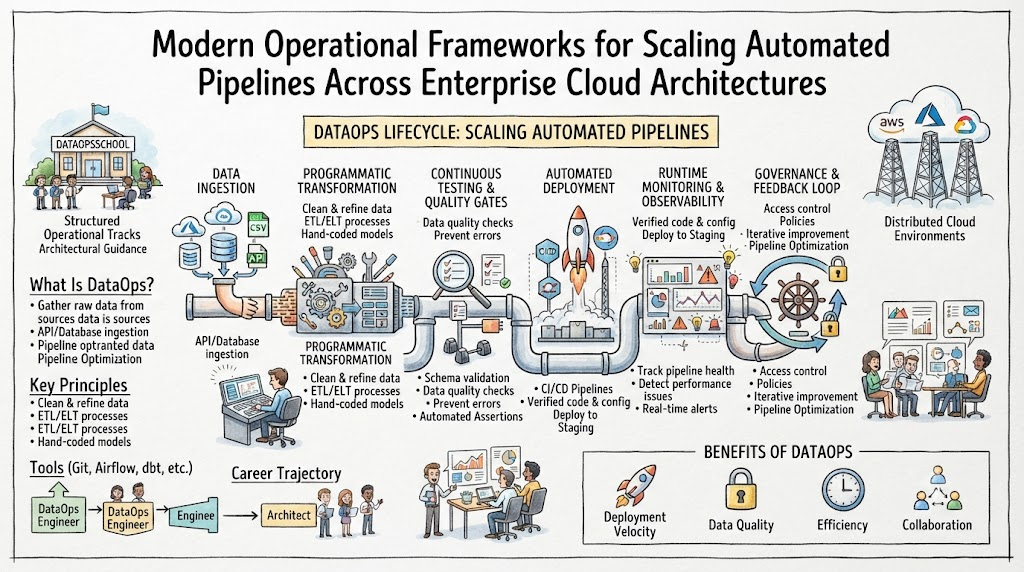
An operational data workflow guides raw information safely through ingestion, processing, automated validation, testing, deployment, and ongoing runtime monitoring cycles. Source ingestion begins the sequence, immediately passing incoming datasets into transformation layers orchestrated by automated schedulers alongside strict schema validation checks. Engineers commit operational code changes into centralized version control systems, which automatically trigger integrated testing suites verifying syntax, business calculations, and data freshness. Once continuous integration checks succeed, deployment automation packages and provisions the updated pipeline logic into cloud production environments without manual intervention. Downstream observability platforms actively monitor data lineage, job latencies, and output distributions, feeding anomaly signals directly into automated issue-tracking boards.
DataOps Lifecycle
The operational lifecycle operates as an interconnected, continuous loop rather than an isolated, linear project with a rigid beginning and end. Each distinct phase introduces mechanical quality gates, infrastructure automation, and team feedback loops to preserve data integrity across enterprise analytics pipelines. Organizations must recognize that adopting this discipline does not require buying a single magic software product or proprietary enterprise box. Instead, the framework represents an end-to-end operational operating model realized through mature team discipline, integrated toolchains, and automated quality controls.
| Stage | What Happens | Example |
| Data Ingestion | Data enters the platform | API and database event streaming |
| Processing | Data is transformed | Automated dbt SQL and Spark transformations |
| Testing | Data and pipelines are tested | Pre-merge schema and metric assertions |
| Deployment | Changes are released | GitHub Actions deploying containerized jobs |
| Monitoring | Pipeline health is tracked | Automated freshness and null-rate alerts |
| Governance | Data access and policies are managed | Role-based column masking and lineage cataloging |
| Feedback | Issues and improvements are identified | Incident retrospectives optimizing compute pipelines |
Key Principles of DataOps
Operational maturity hinges on foundational principles that transform ad-hoc engineering scripts into enterprise-grade, highly reproducible data products for business end-users. Automation drives the entire discipline forward, eliminating tedious manual data handoffs while continuous integration suites automatically run unit and regression checks on every pull request. Observability, automated testing, and data profiling work together as early warning tripwires, instantly identifying null spikes, duplicate rows, or structural deviations before analytics consumers notice. Strict version control for both pipeline code and infrastructure configuration guarantees reproducible development workspaces and rapid rollbacks whenever production incidents arise. Above all, continuous improvement processes empower cross-functional teams to examine pipeline runtimes, optimize expensive cloud queries, and steadily refine deployment reliability through iterative collaboration.
DataOps Tools
Enterprise engineering teams never rely on a single, all-in-one product to govern their entire architecture, opting instead for integrated, best-of-breed software toolchains. Modern practitioners compose custom, modular stacks by thoughtfully pairing code repositories, automated workflow orchestrators, transformation engines, container platforms, and data observability solutions. Technical leaders select specific tools according to their data volumes, engineering expertise, regulatory controls, query latencies, and multi-cloud architectural constraints. Maintaining strict decoupling between execution engines, orchestrators, and governance layers prevents expensive vendor lock-in while keeping the overall enterprise data stack flexible and resilient.
| DataOps Function | Example Tools/Technologies | Purpose |
| Version Control | Git | Track pipeline logic changes systematically |
| CI/CD | GitHub Actions, GitLab CI, Jenkins | Automate deployment and integration testing |
| Orchestration | Apache Airflow, Dagster, Prefect | Schedule and manage pipeline dependencies |
| Transformation | dbt, Apache Spark | Transform and curate structured data assets |
| Containers | Docker, Kubernetes | Standardize development and runtime environments |
| Data Quality | Great Expectations, Soda Core | Enforce schema assertions and column tests |
| Observability | Monte Carlo, Acceldata | Track data lineage and metric anomalies |
| Cloud Data | AWS, Azure, Google Cloud | Provide elastic compute and storage layers |
| Monitoring | Prometheus, Grafana | Monitor infrastructure utilization and job metrics |
| Databases | PostgreSQL, Snowflake, BigQuery | Persist operational stores and lakehouses |
DataOps vs DevOps vs Data Engineering
Understanding how these engineering practices intersect prevents costly architectural misunderstandings and helps growing teams define clear technical roles and responsibilities. While classical software operations emphasize reliable web applications and infrastructure provisioning, data-centric operations focus specifically on managing the continuous, unpredictable flow of dynamic information. Data engineering constructs the underlying lakehouse pipelines, storage layers, and transformation scripts that move assets across systems, establishing the technical foundation. Operational data practices supercharge that foundation, wrapping pipelines in automated testing frameworks, deployment gates, and continuous observability monitors so business systems remain consistently healthy.
| Area | DataOps | DevOps | Data Engineering |
| Main Focus | Reliable, continuous data operations | Reliable application delivery and uptime | Building data pipelines and platforms |
| Automation | End-to-end data pipelines and validations | Software infrastructure and server builds | Extraction and transformation workflows |
| Testing | Business logic, schema, and statistical drift | Unit, integration, and security code tests | Transformation logic and query efficiency |
| Monitoring | Freshness, volume, lineage, and anomalies | Server uptime, CPU usage, and network load | Job run durations and execution status |
| CI/CD | Continuous data pipeline integration | Continuous software code deployments | Ad-hoc or orchestrated pipeline rollouts |
Benefits of Implementing DataOps
Adopting disciplined operational data practices yields substantial, measurable returns for technical engineering departments and strategic business units alike. Engineering velocity accelerates noticeably because automated continuous integration checks instantly validate code updates, removing the dread and manual friction typically associated with deployments. Data quality improves steadily across the board, reducing embarrassing dashboard discrepancies, missing metrics, and silent data corruptions that erode internal stakeholder trust. Mean time to detect and resolve operational pipeline failures plummets, as deep observability and clear lineage mapping pinpoint failed jobs in minutes. The overall environment becomes considerably more predictable, sustainable, and scalable, shielding technical teams from burnout while delivering reliable analytical insights to business leaders.
Real-Life DataOps Scenarios and Industry Experience
A major financial services enterprise struggled with conflicting regulatory risk reports because analysts repeatedly executed disparate, unversioned transformation scripts directly in production environments. The platform engineering team restructured their operational workflow, placing all analytical logic into version-controlled repositories backed by automated schema assertions and staging environments. Consequently, audit-readiness became completely automated, pipeline release lead times dropped from weeks to hours, and unnotified metric anomalies disappeared entirely from executive oversight dashboards.
A fast-growing e-commerce platform experienced frequent data warehouse crashes during flash sales because unexpected upstream payload alterations consistently broke fragile extraction pipelines. Engineers implemented containerized ingestion workers, continuous integration testing using synthetic event payloads, and automated alerts to catch schema deviations before ingestion. When marketing introduced new event tracking, automated testing pipelines captured missing fields in pull-request reviews rather than during live promotional sales campaigns. The infrastructure supported peak holiday transaction volumes seamlessly, proving that rigorous operational testing shields data teams from catastrophic downtime.
A multinational healthcare provider faced strict data privacy compliance audits, requiring comprehensive data lineage tracing and stringent role-based masking across distributed cloud platforms. Engineering leaders introduced an automated operational platform that applied automated column-level masking rules, integrated permission validations into deployment pipelines, and monitored usage continuously. This deployment setup allowed clinical researchers to access de-identified patient data rapidly without introducing accidental privacy exposures or compliance violations. The organization successfully passed rigorous multi-jurisdictional health audits while boosting analytics delivery speeds, demonstrating how automated governance accelerates research rather than hindering it.
How to Implement DataOps in an Organization
Assess the Current Data Environment
Before installing complex software frameworks, thoroughly inspect your existing data landscape, mapping out legacy extraction jobs, manual batch workflows, and hidden failure points. Document every disparate data source, custom script, and operational dependency, interviewing analytics consumers to understand recurring reporting delays and systemic friction points. Cataloging manual handoffs and pipeline bottlenecks establishes clear baseline operational metrics that your engineering modernization initiatives can measurably improve over time.
Define Data Quality Standards
Work closely with technical stakeholders and business units to establish unambiguous, measurable criteria defining the completeness, accuracy, freshness, and structural validity of every asset. Construct explicit mathematical thresholds for acceptable null value percentages, acceptable variance windows, permissible duplicate limits, and expected table delivery schedules. Turning vague business expectations into concrete statistical boundaries provides clear programmatic targets for your automated continuous testing pipelines to validate.
Introduce Version Control
Transition every aspect of your data stack—including transformation SQL queries, pipeline orchestrator configurations, machine learning models, and underlying infrastructure scripts—into a unified Git repository. Mandate clear commit conventions, branch protection rules, and structured code review processes across engineering squads to eliminate accidental, unvetted edits in production environments. Version control establishes reproducible pipeline configurations, empowers teams to audit every logical adjustment, and provides instant rollback mechanisms whenever unexpected defects emerge.
Automate Testing
Build a multi-layered testing strategy incorporating unit tests for individual transformation algorithms, integration tests for multi-stage pipelines, and rigorous structural schema checks for incoming payloads. Implement programmatic assertion suites that run automatically whenever engineers update pipeline code or pull-request branches, catching subtle bugs before production rollouts occur. Combining code checks with statistical data validations ensures that both the transformation processing logic and the incoming data stream meet operational standards.
Introduce CI/CD
Deploy automated continuous integration and continuous deployment pipelines that systematically build environments, run integration test matrices, and provision cloud pipeline assets automatically upon code approval. Use automated release triggers to deploy validated pipeline artifacts through isolated development, staging, and production environments, eliminating manual, error-prone human interactions. Consistent deployment pipelines guarantee uniform testing across every development stage, preventing mysterious, environment-specific pipeline bugs from corrupting downstream operational dashboards.
Add Monitoring and Observability
Incorporate continuous observability mechanisms that continuously evaluate pipeline execution latencies, resource consumption metrics, query costs, and dataset distribution shifts across your ecosystem. Configure automated alert engines to immediately notify engineering squads whenever ingestion volumes drop unexpectedly, schema structures drift, or execution times spike past normal parameters. Comprehensive operational visibility helps engineers diagnose root causes within complex data lineages swiftly, resolving unexpected incidents long before executive consumers notice dashboard anomalies.
Improve Governance
Establish programmatic data governance protocols that systematically enforce fine-grained access permissions, sensitive column encryption, dataset lineage tracking, and regulatory audit logging across all environments. Document data asset descriptions, pipeline ownership contacts, and business dictionary definitions directly within accessible, automatically synchronized catalog platforms to foster organizational visibility. Automating governance tasks protects your organization from damaging compliance violations while helping analysts discover, trust, and utilize data assets with absolute confidence.
Continuously Improve
Recognize that building operational data maturity represents an ongoing, iterative cultural commitment rather than a static project with an arbitrary final deadline. Regularly conduct blameless incident retrospectives following operational pipeline failures, identifying underlying procedural gaps and adding automated regression tests to prevent identical recurrences. Continually audit infrastructure query expenditures, pipeline throughput speeds, and analytical query performance, refining your operational architecture as business demands evolve.
DataOps Training and DataOps Course
Transitioning to modern operational data practices requires substantial upskilling for data engineers, platform architects, DevOps practitioners, and system administrators accustomed to traditional infrastructure workflows. A practical, comprehensive training course must prioritize real-world, hands-on lab environments over purely theoretical lectures, teaching students to build resilient, automated data delivery pipelines from scratch. Learners need structured exposure to containerization techniques, automated orchestration tools, continuous deployment frameworks, and declarative data quality assertions applied across live cloud infrastructures. Engaging in structured learning programs, such as those available through educational platforms like DataOpsSchool, equips professionals with practical implementation skills that immediately improve organizational data reliability.
DataOps Certification
Earning an industry-recognized technical certification helps engineers systematically validate their hands-on competency across automation frameworks, distributed architectures, and automated testing paradigms. These structured examinations establish formal, objective benchmarks for operational excellence, demonstrating that a practitioner understands both high-level design philosophies and practical, line-by-line configuration techniques. Professionals who complete certification curriculums demonstrate an ability to construct self-healing data pipelines, implement continuous integration suites, and enforce automated platform governance. While theoretical credentials can never replace hands-on troubleshooting experience, structured certifications give hiring managers verifiable proof of an engineer’s technical capabilities.
Certified DataOps Engineer
A Certified DataOps Engineer focuses on designing, building, and maintaining automated data integration pipelines, continuous validation suites, and deployment workflows across cloud platforms. These technical specialists possess deep expertise in orchestrating workflows, writing declarative quality assertions, managing containerized execution environments, and configuring continuous delivery pipelines. Software developers, system engineers, and traditional data builders leverage this focused credential to transition smoothly into high-demand platform automation and engineering roles. Dedicated educational platforms like DataOpsSchool supply targeted courses, practical labs, and realistic examination preparation tracks designed specifically for ambitious engineers seeking this certification.
Certified DataOps Architect
A Certified DataOps Architect operates at a higher enterprise level, designing scalable platform blueprints, resilient multi-cloud architectures, comprehensive governance frameworks, and automated disaster recovery plans. These senior leaders evaluate complex infrastructure trade-offs, select cohesive toolchain components, and establish technical automation standards that span multiple independent engineering squads. While implementation engineers concentrate on building individual pipelines and monitoring specific test suites, platform architects ensure the entire enterprise data ecosystem remains reliable, secure, and cost-efficient. Earning this credential confirms an experienced professional’s ability to drive complex organizational migrations, unify disconnected data silos, and foster an enduring culture of engineering excellence.
DataOps Tutorial: Where Should Beginners Start?
Beginning practitioners should approach operational data management systematically, grounding themselves in foundational concepts before attempting to navigate complex multi-cloud distributed platform frameworks. Focus initially on grasping fundamental data engineering and pipeline concepts, learning how diverse database engines ingest, transform, and store analytical data. Master Git version control workflows, command-line scripting, and container basics using Docker to build uniform, reproducible local development workspaces. Progress systematically toward workflow orchestration engines, automated deployment pipelines, continuous data quality assertions, and cloud platform monitoring by steadily completing the following technical steps:
- Master data engineering basics, core ETL/ELT pipeline mechanics, and relational modeling strategies.
- Learn Git version control, branch management, collaborative code review protocols, and pull request workflows.
- Practice system administration fundamentals, shell scripting, and containerizing software services using Docker.
- Implement structured data transformation pipelines using modern development frameworks such as dbt and SQL.
- Master workflow orchestration platforms such as Apache Airflow to schedule, automate, and monitor interdependent pipeline tasks.
- Configure continuous integration pipelines using GitHub Actions to automatically run linter checks and unit tests.
- Write automated data quality and schema assertions using frameworks like Great Expectations or Soda.
- Deploy continuous observability tools to monitor pipeline freshness, track volume anomalies, and map complete data lineage.
- Build an end-to-end operational portfolio project that ingests public datasets, validates schemas, and deploys updates automatically.
- Study advanced operational architecture concepts and pursue industry credentials to validate your production expertise.
DataOps Consulting and DataOps Services
Enterprise organizations regularly discover that their internal teams lack the specialized expertise, bandwidth, or proven architectural blueprints needed to modernize legacy data infrastructures alone. Engaging specialized consulting and advisory services becomes crucial when brittle data pipelines cause frequent downtime, manual deployments create unacceptable operational risks, or sudden scaling requirements break current architectures. Professional consulting groups evaluate existing technical bottlenecks, build tailored continuous deployment workflows, implement automated testing frameworks, and configure deep platform observability solutions. Combining structured educational offerings with expert professional services, DataOpsSchool assists modern enterprises in overcoming technical debt, automating pipelines, and constructing resilient, self-healing platforms.
Common Mistakes to Avoid in DataOps
- Treating DataOps as a Software Tool: Purchasing modern platform tools without altering underlying engineering practices, collaboration habits, or manual workflows will fail to deliver operational reliability.
- Skipping Automated Data Quality Checks: Focusing solely on infrastructure uptime while neglecting automated data validations allows corrupted, inaccurate metrics to reach downstream analytics dashboards undetected.
- Neglecting Version Control for Transformations: Leaving data manipulation SQL queries, notebook scripts, and orchestrator configurations outside centralized Git repositories introduces severe configuration drift and deployment errors.
- Over-Engineering the Platform Stack: Implementing overly complicated, distributed streaming and orchestration frameworks for modest, simple analytical workloads drives up cloud expenses and maintenance complexity unnecessarily.
- Isolating Engineering and Analytics Teams: Allowing data engineering, operations, and analytical teams to work in isolated silos reintroduces painful delivery delays, finger-pointing, and missed requirements.
- Relying on Reactive Pipeline Monitoring: Waiting for business executives to report broken dashboard visualizations instead of configuring proactive, automated threshold alerts cripples stakeholder trust across the enterprise.
- Ignoring Data Governance and Access Security: Delaying identity management, regulatory compliance checks, and sensitive field masking until late in the development cycle introduces major legal and security liabilities.
- Failing to Create Isolated Staging Environments: Running untested pipeline modifications, schema alterations, or transformation logic directly in production databases invariably triggers catastrophic system downtime and data corruption.
How to Choose the Right DataOps Approach
Selecting an appropriate operational framework requires a balanced, candid evaluation of your organization’s size, technical engineering maturity, regulatory constraints, and long-term analytical roadmap. Smaller organizations with lean technical squads should prioritize lightweight, managed cloud services, modular orchestrators, and declarative transformation tools that deliver automation without heavy infrastructure overhead. Conversely, large enterprises handling sensitive, multi-terabyte datasets across regulated jurisdictions require robust, highly scalable architectures featuring advanced lineage tracking, fine-grained access governance, and comprehensive observability suites. Avoid blindly mimicking the massive, complex infrastructure stacks of prominent tech giants; instead, systematically implement tools that directly resolve your team’s specific pipeline bottlenecks and operational pain points.
Who Should Learn DataOps?
Acquiring operational data management capabilities provides massive career advantages across numerous technical engineering, architectural, and analytical roles throughout the modern digital economy. Data engineers, DevOps professionals, and site reliability specialists can leverage their existing system administration, coding, or cloud architecture backgrounds to build highly resilient data platforms. Analytics engineers and data scientists gain complete autonomy by mastering automated testing and deployment patterns, allowing them to release models and metrics safely without relying on infrastructure teams. Technical leads, platform architects, and engineering managers gain the organizational insight required to streamline release lifecycles, eliminate operational waste, and lead high-performing teams.
- Data Engineers: Elevate existing pipeline construction skills by incorporating automated testing frameworks, CI/CD deployment routines, and continuous observability monitors.
- DevOps and Cloud Engineers: Apply proven infrastructure provisioning, container orchestration, and continuous integration methodologies to specialized, high-scale data workflows.
- Site Reliability Engineers: Extend platform availability, system latency monitoring, and automated incident response practices directly to mission-critical business data pipelines.
- Analytics Engineers: Learn to safely deploy version-controlled SQL transformations, declarative schema validations, and automated regression tests into production environments.
- Data Architects: Design resilient, scalable enterprise data lakehouse blueprints that integrate automated governance, disaster recovery, and operational quality gates.
- Engineering Managers: Modernize organizational delivery lifecycles, eliminate cross-team dependencies, and establish sustainable, high-velocity engineering workflows that prevent team burnout.
Why DataOpsSchool Can Be a Useful Resource
Navigating the rapid convergence of cloud data engineering, automated operations, and analytical governance can be challenging for both independent professionals and growing technical enterprises. DataOpsSchool provides a dedicated learning and professional platform focused exclusively on mastering modern, automated data operations. Learners can explore comprehensive educational curriculums covering foundational concepts, practical tutorials, real-world project labs, and specialized preparation tracks for both engineer and architect certification paths. Simultaneously, organizations facing brittle legacy pipelines, recurring data discrepancies, or chaotic release cycles can leverage the platform’s consulting and advisory services to implement automated continuous integration, resilient orchestration, and comprehensive observability. By balancing practical technical education with enterprise consulting, the platform empowers teams to build scalable, reliable data platforms that deliver dependable business value.
Frequently Asked Questions
1. What is the fundamental difference between DataOps and traditional data engineering?
Traditional data engineering focuses primarily on writing transformation logic, constructing storage tables, and scheduling batch extraction pipelines to move enterprise data between disparate sources. DataOps adds a layer of operational software engineering rigor around those pipelines through automated version control, continuous testing, CI/CD deployments, and continuous platform monitoring. This discipline transforms fragile, manually maintained data scripts into automated, resilient, and continuously monitored production software assets.
2. Is DataOps a specific software product that my company can purchase?
No, DataOps is an operational methodology, culture, and engineering framework rather than a single software product or proprietary off-the-shelf application. Organizations implement the approach by combining collaborative team habits and established engineering processes with various interoperable tools, including Git repositories, container platforms, pipeline orchestrators, and automated testing engines. Buying new software tools without changing collaborative processes and automation standards will fail to deliver operational reliability.
3. How does implementing automated data testing prevent production dashboard failures?
Automated testing operates as an essential quality gate, systematically evaluating incoming data payloads, table structures, and analytical metrics against predefined operational constraints. By running programmatic assertions across isolated staging environments before changes merge into production, these suites instantly catch null values, duplicate records, and schema drifts. Catching data errors early in the pipeline prevents corrupt or incomplete metrics from reaching executive dashboards.
4. Can an organization adopt modern DataOps practices while using legacy databases?
Yes, organizations can successfully apply core operational principles to traditional relational database engines and legacy on-premises data warehouse environments. While modern cloud lakehouses simplify elastic scaling and containerized deployments, teams can easily connect legacy systems to Git repositories, automated testing scripts, and CI/CD pipelines. The core principles of automation, version control, and continuous monitoring deliver immense value regardless of the underlying storage hardware.
5. Why is version control so critical for modern enterprise data pipelines?
Version control provides a centralized, audited history of every modification made to transformation queries, orchestrator schedules, infrastructure configurations, and analytical metric definitions over time. It allows distributed engineering teams to collaborate safely through peer code reviews, isolate experimental features on separate branches, and quickly roll back buggy changes during production emergencies. Managing pipeline logic in version-controlled repositories eliminates the chaos and confusion of untracked manual edits.
6. What role does data observability play across an automated pipeline lifecycle?
Data observability extends basic pipeline monitoring by tracking complete data lineage, health metrics, and statistical distributions across distributed cloud processing environments. When upstream systems unexpectedly modify data formats or drop extraction volumes, observability tools automatically flag the issue and trace the blast radius to affected downstream dashboards. This deep structural visibility enables platform engineers to pinpoint, troubleshoot, and resolve complex data incidents before business stakeholders notice discrepancies.
7. How long does it typically take an organization to implement DataOps?
Transitioning to a mature operational data posture is an incremental, continuous engineering evolution that generally requires several months to establish effectively. Teams should avoid attempting a massive, all-at-once platform rewrite; instead, they should incrementally introduce version control, basic schema testing, and deployment automation to their most critical pipelines first. Developing sustainable engineering habits and reliable automated safeguards takes time, but early iterations yield immediate improvements in operational stability.
8. Do I need extensive software development experience to learn DataOps?
While an extensive software engineering background is not strictly required, having a solid grasp of foundational programming concepts makes the overall learning journey much smoother. Beginners should be comfortable writing standard SQL queries, working with basic command-line interfaces, writing simple Python scripts, and managing code within Git repositories. As you progress into intermediate topics, you will naturally develop the containerization, orchestration, and continuous integration skills needed for modern data platform operations.
9. How does an automated data platform support regulatory compliance and governance?
An automated operational framework incorporates compliance controls directly into delivery pipelines, automating access permissions, column-level data masking, and audit logging across every environment. Centralized version control repositories track every logic adjustment, while automated data lineage systems show auditors precisely how sensitive raw records move and transform across the enterprise. Automating governance checks prevents data breaches and helps organizations pass complex compliance audits without slowing down technical delivery.
10. What is the practical difference between a DataOps engineer and architect?
A DataOps engineer focuses on building, testing, and maintaining automated data pipelines, writing unit assertions, configuring CI/CD jobs, and monitoring production workloads daily. Conversely, an enterprise architect operates at a higher strategic level, designing scalable infrastructure blueprints, selecting integrated toolchains, and establishing organizational automation policies. While engineers ensure individual pipelines execute reliably, architects design resilient, secure, and cost-effective enterprise environments that support multiple autonomous development teams.
11. Can small startups benefit from DataOps or is it solely for large enterprises?
Startups and smaller engineering teams benefit tremendously from implementing lightweight, practical operational disciplines early in their organizational development lifecycles. Instituting version-controlled repositories, automated testing assertions, and continuous integration workflows prevents technical debt from accumulating as the company and its data volume scale. Establishing disciplined operational foundations early allows lean startup teams to deploy updates rapidly, preserve data accuracy, and scale their infrastructure without burning out engineers.
12. What distinguishes the educational resources and consulting available at DataOpsSchool?
DataOpsSchool balances practical, hands-on technical education with enterprise consulting services tailored to modern data engineering and operational challenges. Rather than focusing solely on abstract theory, its courses, tutorials, and certification preparation programs guide students through realistic lab exercises that mirror production environments. Simultaneously, its consulting services help growing organizations assess legacy pipelines, design robust deployment automation, and build resilient, observable, enterprise-grade data platforms.
Conclusion
Understanding what modern data operations entails begins with recognizing that reliable data delivery requires treating pipelines with the exact same engineering rigor, version control, and continuous testing that traditional software applications enjoy. Implementing this operational framework matters immensely today because enterprise data volumes, cloud migrations, and executive demands for real-time, trustworthy analytics have completely overwhelmed brittle, manual extraction scripts. Organizations can successfully adopt these practices by establishing foundational version control standards, deploying continuous testing suites, orchestrating automated CI/CD releases, and embedding proactive observability across their ecosystems. Technical professionals can accelerate their careers by engaging in structured educational curriculums, building hands-on portfolio projects, and earning industry credentials that validate their platform expertise. Educational and advisory platforms like DataOpsSchool play a pivotal role in this transformation, providing the practical courses, certifications, and consulting services teams need to master modern workflows. Ultimately, technical leaders and practitioners must prioritize real-world reliability, comprehensive automation, and resilient data quality over simply accumulating vanity certifications or disconnected software tools.
