Introduction
Modern software engineering is evolving at an unprecedented pace as organizations face rising architectural complexity, escalating customer expectations, and intense competitive pressures. Today, business success requires unifying artificial intelligence, cloud architectures, DevOps, site reliability engineering, internal developer platforms, scalable SaaS products, and comprehensive digital transformation initiatives. Many engineering teams struggle with fragmented toolchains, legacy technical debt, production instability, and scarce technical talent across these multidisciplinary domains. This comprehensive guide provides a practical architectural foundation for CTOs, product managers, and software engineers seeking to modernize systems effectively. Along the way, we explore how specialized technology consultants, including teams like Cotocus, assist organizations in closing technical capability gaps, modernizing workflows, and building resilient, intelligent production platforms without falling into the trap of unsustainable software delivery practices.
What Is Modern Software Engineering?
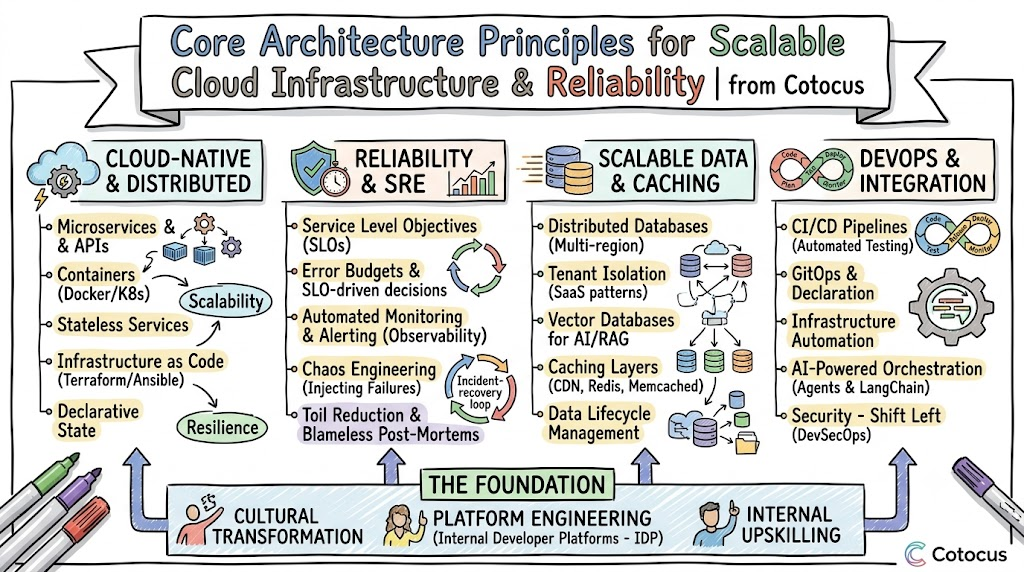
Modern software engineering represents a holistic discipline that integrates distributed system design, automated continuous delivery, dynamic cloud infrastructures, intelligent algorithms, and developer enablement. Unlike traditional monolithic software development marked by quarterly releases and rigid siloed handoffs, modern engineering emphasizes rapid feedback loops, declarative infrastructure, immutable deployments, and continuous operational visibility. Core technologies power this paradigm, including cloud-native microservices, containerization with Kubernetes, real-time observability pipelines, automated security scanning, and machine learning models embedded directly into core workflows. This shift transforms software engineering from a slow, ticket-driven cost center into an adaptable, resilient ecosystem capable of safely shipping software updates to production multiple times per day.
Why Businesses Are Moving Toward AI-Powered Software
Organizations are shifting toward intelligent software architectures because deterministic code alone can no longer handle unstructured data, complex customer interactions, or dynamic prediction requirements. Practical use cases driving adoption include automated document extraction, natural-language customer support, real-time recommendation engines, anomaly detection, predictive equipment maintenance, and intelligent semantic search interfaces. However, introducing artificial intelligence also introduces real-world limitations such as probabilistic model outputs, inference latency, data drift, hallucinations, and substantial computational costs. For this reason, modern engineering teams treat artificial intelligence not as a universal cure for every software problem, but rather as an augmenting capability designed to solve specific operational bottlenecks alongside robust deterministic systems.
What Are Generative AI Development Services?
Generative AI development services encompass the end-to-end engineering required to build, evaluate, secure, and deploy production-grade applications powered by large language models, autonomous agents, and foundation algorithms. A resilient production architecture typically integrates retrieval-augmented generation pipelines, vector databases for domain search, orchestrators for agentic execution, structured model evaluation suites, real-time observability, and stringent guardrails preventing sensitive data leakage. For instance, an enterprise application parsing complex internal insurance claims uses semantic retrieval to ground model context, validates accuracy against strict deterministic rules, monitors latency metrics, and prevents private records from leaking into model providers. Developing these solutions demands deep architectural rigor across context routing, prompt management, rate limiting, and zero-trust data protection policies.
AI Software Development Company — What Should You Expect?
Selecting an experienced AI development partner requires moving past basic API wrappers and examining an organization’s proficiency in end-to-end enterprise data and model architecture. Competent firms deliver production-grade LLM integrations, robust data preprocessing pipelines, private cloud deployments, strict role-based access controls, continuous model evaluation against drift, and comprehensive cost governance models. Key partner evaluation criteria include:
- Demonstrated experience deploying production retrieval-augmented generation architectures and autonomous agent workflows.
- Rigorous data engineering pipelines capable of sanitizing, embedding, and indexing proprietary enterprise datasets safely.
- Strong security governance including prompt-injection mitigations, personally identifiable information scrubbing, and regulatory compliance standards.
- Comprehensive operational monitoring spanning token consumption, context window latency, hallucination tracking, and inference cost optimization.
- Practical knowledge of private fine-tuning, parameter-efficient adaptation, and open-source foundation model hosting on dedicated cloud infrastructure.
Custom Software Development — When Is It Necessary?
Custom software development is essential when commercial off-the-shelf software cannot satisfy proprietary business workflows, unique competitive advantages, complex third-party integrations, or stringent data sovereignty mandates. Engineering teams build bespoke web applications, mobile interfaces, enterprise API gateways, and custom internal back-office tools when ready-made software restricts feature iteration or imposes exorbitant per-seat licensing costs. However, custom software requires continuous investment in maintenance, security patching, infrastructure hosting, and architectural evolution. A prudent engineering strategy therefore balances custom software development for core competitive capabilities against stable commercial off-the-shelf platforms for commodity business functions like accounting, email delivery, and routine human resource tracking.
SaaS Product Development — From Idea to Scalable Product
Building a scalable software-as-a-service platform demands a disciplined lifecycle spanning ideation, market validation, user experience prototyping, minimal viable product development, multi-tenant cloud architecture, automated testing, and continuous deployment. Crucial architectural requirements include scalable multi-tenant isolation, unified subscription and billing management, robust identity authentication, granular role-based permissions, public API rate limiting, and end-to-end distributed tracing. As platforms scale, teams frequently encounter architectural challenges such as cross-tenant resource contention, noisy neighbor database performance degradation, cascading third-party webhook failures, and complex schema migration across active production databases. Addressing these hurdles early through partitioned data layers, message-driven asynchronous microservices, and automated tenant provisioning ensures long-term operational sustainability and customer retention.
Cloud Consulting Services and Modern Infrastructure
Cloud consulting services guide enterprises across AWS, Microsoft Azure, and Google Cloud to design, modernize, optimize, and secure distributed infrastructure environments. Organizations must distinguish between basic cloud migration—often executing a simple lift-and-shift of legacy virtual machines—and cloud modernization, which re-architects workloads using containerized microservices, managed serverless compute, event-driven pipelines, and declarative Infrastructure as Code. For example, moving a legacy database to a managed cloud database reduces administrative burden, but decoupling that application into serverless functions and containerized workers fundamentally unlocks dynamic scaling and fault isolation. Mature cloud consulting engagements systematically address multi-region disaster recovery, automated cost governance, network topology hardening, and fine-grained cloud identity and access management.
DevOps Consulting Services — Improving Software Delivery
DevOps consulting services help engineering organizations replace manual handoffs, sporadic release cycles, and fragile infrastructure configurations with continuous integration, automated continuous deployment, and collaborative operational workflows. Simply purchasing modern CI/CD orchestration tools, git-based platforms, or container clusters does not establish organizational DevOps maturity without automated test coverage, standardized artifact promotion, declarative GitOps workflows, and integrated application performance monitoring. True DevOps delivery maturity aligns product engineers, quality assurance, and operations teams around unified delivery metrics, shared code ownership, automated infrastructure provisioning, and continuous security testing embedded directly within the software deployment pipeline.
Traditional vs Modern DevOps
| Area | Traditional Approach | Modern DevOps Approach |
| Deployment | Manual server updates, maintenance windows, and ad-hoc scripts | Automated GitOps pipelines, blue-green releases, and canary deployments |
| Infrastructure | Manually configured physical servers and static virtual machines | Declarative Infrastructure as Code managed via automated pull requests |
| Testing | Manual testing phases executed at the end of quarterly delivery cycles | Automated unit, integration, and security testing run on every commit |
| Releases | High-risk, infrequent release batches with heavy change boards | Low-risk, continuous delivery shipping multiple small releases daily |
| Monitoring | Reactive server uptime checks and manual server log inspection | Proactive distributed tracing, real-time telemetry, and automated alerting |
| Collaboration | Siloed development and operations teams communicating via tickets | Shared operational responsibility, cross-functional teams, and blameless cultures |
| Security | Audits conducted as a final gatekeeper stage before production launch | DevSecOps with automated static and dynamic vulnerability scanning in CI/CD |
| Recovery | Manual triage, undocumented recovery procedures, and prolonged outages | Automated failover, immutable infrastructure rollbacks, and validated backups |
SRE Consulting Services — Making Reliability Measurable
Site reliability engineering consulting services apply rigorous software engineering principles to operational challenges, transforming system reliability from an ambiguous aspiration into a quantifiable business discipline. SRE teams define Service Level Indicators to measure real-world performance, establish Service Level Objectives to set clear operational targets, negotiate Service Level Agreements with stakeholders, and use error budgets to balance rapid feature release velocity against production stability. Rather than scrambling during unexpected service degradations, reliability engineers institute automated capacity planning, actionable alerting, proactive disaster recovery rehearsals, and blameless post-incident reviews. Engineering resilience, chaos experiments, and graceful failure degradation into software architectures before catastrophic production outages happen protects business continuity, customer trust, and operational revenue.
Platform Engineering Services and Developer Productivity
Platform engineering services focus on designing, building, and operating Internal Developer Platforms that reduce cognitive load for application developers through self-service golden paths. Traditional DevOps models often overwhelm development squads by expecting every engineer to master complex cloud networking, Kubernetes manifests, container security policies, and deployment pipeline configuration. In contrast, platform engineering teams treat the delivery infrastructure as a curated product, providing standardized application templates, automated infrastructure provisioning, unified observability dashboards, and baked-in security controls through simple interfaces or APIs. This clear separation of concerns eliminates delivery friction, enforces organizational compliance standards by default, and empowers product developers to ship features safely without managing raw cloud primitives.
How DevOps, SRE and Platform Engineering Work Together
Modern digital delivery relies on the symbiotic integration of multiple specialized engineering disciplines across the entire software development and deployment lifecycle. Platform engineering builds the standardized self-service infrastructure portals and continuous delivery pipelines that operationalize core DevOps philosophies. Concurrently, SRE enforces operational guardrails, error budget policies, and distributed telemetry tracking across those platforms, while cloud engineering maintains the foundational virtual networks, storage tiers, and managed cluster nodes. Furthermore, DevSecOps injects automated compliance policies, secret management, and vulnerability scanning directly into the platform, and MLOps establishes reproducible model deployment and tracking pipelines. Unifying these distinct functions prevents organizational silos, stabilizes release cadence, and secures continuous software delivery across complex enterprise environments.
Technology Discipline Comparison
| Discipline | Primary Focus | Typical Outcome |
| DevOps | Cultural alignment, CI/CD automation, and fast delivery cycles | Accelerated deployment frequency and reduced change failure rates |
| SRE | Production reliability, error budget management, and operational automation | Scalable system availability and rapid, documented incident recovery |
| Platform Engineering | Internal Developer Platforms, self-service tools, and developer experience | Minimized cognitive friction and standardized enterprise engineering workflows |
| Cloud Engineering | Cloud architecture, network topologies, and managed resource provisioning | Secure, cost-optimized, and highly available multi-region cloud infrastructure |
| DevSecOps | Automated security scanning, governance, and vulnerability mitigation | Early vulnerability detection and continuous regulatory compliance across pipelines |
| MLOps | Machine learning lifecycle, model deployment, and training automation | Stable production model releases with automated drift detection and retraining |
Digital Transformation Consulting
Digital transformation consulting represents an overarching strategic endeavor that aligns enterprise operational processes, organizational culture, customer experience channels, and technology architectures with modern market demands. True transformation extends far beyond replacing outdated legacy software systems; it requires rethinking how an organization captures data, automates internal workflows, empowers technical staff, and delivers continuous value to end users. Organizations must evaluate what processes generate friction, why existing systems fail to scale, and how modular modern architectures, automated data platforms, and decoupled services can systematically replace brittle legacy operational bottlenecks. Successfully executing these shifts demands close collaboration between executive leadership, business line owners, and engineering architects to ensure technical modernization delivers measurable commercial outcomes.
Corporate DevOps Training
Corporate DevOps training equips internal engineering teams with the practical competencies necessary to maintain, modernize, and scale complex cloud environments independently over the long term. Effective enterprise training programs transcend abstract theory by providing hands-on, scenario-driven laboratory exercises centered on an organization’s specific technology stack, deployment pipelines, and architectural constraints. Upskilling developers, system administrators, and quality engineers across container orchestration, infrastructure automation, telemetry analysis, cloud-native security, and platform engineering prevents reliance on external consultants for routine updates. By aligning educational curricula directly with active production architectures, enterprises systematically reduce delivery bottlenecks, improve developer retention, accelerate onboarding, and cultivate an adaptable engineering culture capable of embracing continuous technological evolution.
Real-Life Scenarios / Experiences
Engineering leadership across diverse industries frequently confronts critical delivery thresholds where architectural choices dictate market survivability and enterprise scalability. Below are realistic technical scenarios illustrating how organizations navigate modernization:
- A high-volume financial technology scale-up experienced recurrent database deadlocks and slow API responses during peak transaction windows due to a monolithic legacy codebase. By decoupling transaction processing into event-driven asynchronous microservices managed via containerized clusters, introducing caching tiers, and establishing SRE error budget tracking, the team slashed latency by 65% while maintaining four nines of service availability.
- An enterprise logistics provider struggled with protracted, two-week deployment cycles marked by manual configuration scripts and frequent deployment rollbacks across regional depots. Implementing an internal developer platform with automated infrastructure self-service, standardized GitOps pipelines, and embedded automated integration tests reduced release lead times to under thirty minutes while eliminating manual configuration discrepancies.
- A healthcare software provider sought to introduce intelligent medical report summarization but faced stringent regulatory data privacy and inference cost constraints. Engineering an isolated retrieval-augmented generation pipeline using fine-tuned open-source language models hosted inside a private cloud cluster allowed secure document processing without exposing patient records to external third-party model endpoints.
How to Choose the Right Technology Partner
Selecting an engineering partner requires assessing whether an external consulting firm possesses real-world production experience, architectural depth, and cultural alignment with your technical organization. Decision-makers must evaluate candidate firms across cloud architectural certifications, practical DevOps delivery maturity, production artificial intelligence capabilities, secure coding standards, clear documentation practices, and long-term knowledge transfer methodologies. Essential evaluation questions to pose include:
- Can you share concrete examples of how your team engineered distributed systems to handle multi-tenant scale, zero-downtime deployments, and disaster recovery?
- How does your organization enforce security scanning, credential protection, and regulatory compliance standards across your delivery pipelines?
- What specific methodologies do you employ to validate model accuracy, mitigate hallucinations, and monitor inference costs when building generative AI solutions?
- How will your engineers document architectures, establish testing frameworks, and train our internal engineering team to manage the system after handoff?
- What does your post-launch support, operational monitoring, incident response, and continuous maintenance framework look like?
Where Cotocus.cn Fits Into Modern Digital Engineering
In modern digital engineering, enterprises frequently engage specialized technical consulting firms to bridge architectural capability gaps and accelerate digital delivery initiatives. Organizations evaluating external partners often consider firms with focused domain expertise across modern engineering disciplines. Teams such as Cotocus operate within this domain, providing specialized capabilities across artificial intelligence, cloud-native infrastructure, and modern software delivery frameworks. Their service capabilities encompass:
- Custom software development for enterprise web applications, mobile platforms, microservices, and distributed API backbones.
- Generative AI engineering, intelligent search systems, autonomous agents, and model integration into production business platforms.
- Multi-tenant SaaS architecture design, subscription infrastructure setup, and high-volume cloud product engineering.
- Cloud consulting across AWS, Azure, and Google Cloud, spanning modernization, cloud migration, container orchestration, and cost optimization.
- DevOps, SRE, and platform engineering consulting to construct self-service developer platforms, automated GitOps pipelines, and measurable reliability frameworks.
- Corporate DevOps training programs delivering practical, hands-on instruction tailored to enterprise engineering stacks and operational workflows.
When Should a Business Consider These Services?
| Business Challenge | Potentially Relevant Capability |
| Integrating natural-language capabilities, document automation, or semantic search | Generative AI development services and retrieval-augmented generation pipelines |
| Outgrowing commercial off-the-shelf software or requiring proprietary workflows | Custom software development for bespoke web, mobile, and API architectures |
| Building a scalable, multi-tenant digital subscription platform from scratch | SaaS product engineering, tenant data isolation, and billing infrastructure |
| High cloud hosting bills, unoptimized infrastructure, or legacy data center footprints | Cloud consulting, multi-cloud migration, and cloud modernization architectures |
| Slow, manual deployment approvals and frequent failed production releases | DevOps consulting, CI/CD pipeline automation, and declarative GitOps workflows |
| Unpredictable production outages, missing alerting, and recurring service degradations | SRE consulting, automated incident management, and Service Level Objective tracking |
| Developers struggling with complex cloud configurations and slow onboarding | Platform engineering, self-service infrastructure portals, and golden deployment paths |
| Internal teams lacking modern skills in Kubernetes, cloud platforms, and automation | Hands-on corporate DevOps, SRE, and cloud delivery training programs |
How to Build a Practical Modernization Roadmap
Executing a successful modernization roadmap requires an incremental, value-focused methodology that balances strategic business goals against technical feasibility. Teams should follow a structured seven-step progression:
- Assess the Current Environment: Catalog existing codebases, technical debt, infrastructure configurations, deployment pipelines, operational dependencies, and team skill proficiencies to establish an objective technical baseline.
- Define Business Outcomes: Quantify specific, measurable targets such as reducing deployment cycle times, improving application availability, slashing cloud hosting overhead, or entering new digital market segments.
- Prioritize Initiatives: Map planned engineering initiatives using an impact-versus-effort matrix, selecting high-impact, manageable modernization pilot projects that demonstrate tangible value quickly.
- Establish Engineering Foundations: Build foundational core capabilities early, including automated version control, standardized continuous integration, infrastructure as code, and unified security scanning protocols.
- Modernize Selectively: Decompose brittle monolithic systems incrementally using patterns like the strangler fig application approach, refactoring business-critical components into isolated, modern services.
- Train Internal Teams: Provide hands-on training to engineering staff throughout the modernization lifecycle, ensuring developers and operations teams can confidently support new architectures.
- Measure and Improve: Track operational telemetry against established baseline metrics, continuously optimizing deployment velocity, system reliability, resource costs, and developer productivity over time.
Common Mistakes to Avoid
Enterprise modernization programs frequently encounter severe friction when architectural decisions are executed without disciplined planning and operational pragmatism. Key pitfalls to avoid include:
- Embarking on massive, multi-year legacy system rewrites from scratch rather than adopting an incremental, iterative modernization strategy.
- Purchasing advanced DevOps, cloud, or observability tools without establishing the internal collaborative culture and processes needed to utilize them effectively.
- Forcing artificial intelligence models or complex microservices architectures into software systems where simple deterministic algorithms or structured monoliths suffice.
- Overlooking continuous security scanning, secret management, and compliance automation during early delivery pipeline design, attempting to bolt on security retroactively.
- Migrating unoptimized virtual machines directly into cloud environments without modernizing architectures, leading to bloated hosting bills and poor operational elasticity.
- Neglecting comprehensive developer documentation, clear architectural decision records, and automated test suites, resulting in high cognitive load and delivery bottlenecks.
- Setting arbitrary reliability targets without consulting business stakeholders, thereby misallocating engineering capacity toward unneeded availability margins.
- Failing to invest in internal developer training, which leaves engineering squads dependent on external consulting teams for routine production updates.
Frequently Asked Questions
1. What is the fundamental difference between DevOps and platform engineering?
DevOps focuses on cultural alignment, continuous integration, automation, and shared operational responsibility across the software delivery lifecycle. Platform engineering builds on these practices by engineering dedicated Internal Developer Platforms. These self-service platforms provide application developers with pre-configured golden paths, standardized infrastructure templates, and automated compliance controls, dramatically reducing developer cognitive load and eliminating routine configuration bottlenecks.
2. Is custom software development always better than purchasing commercial off-the-shelf software?
No, custom software development is not always superior. Commercial off-the-shelf software is ideal for commodity enterprise operations like payroll, email, and standard customer relationship management. Custom development should be reserved for proprietary business capabilities, core product offerings, and unique operational workflows that provide a competitive advantage and cannot be accommodated by commercial platforms.
3. How does retrieval-augmented generation improve generative AI applications in production?
Retrieval-augmented generation grounds large language models by retrieving relevant factual context from private enterprise databases or vector search indices before generating an output. This architecture significantly mitigates model hallucinations, ensures business responses reflect real-time proprietary data, prevents sensitive context leakage, and avoids the costly, continuous fine-tuning of underlying foundation models.
4. What are the key indicators that an enterprise needs SRE consulting services?
An organization needs site reliability engineering when production outages occur frequently, release velocity stalls due to stability fears, monitoring systems generate unmanageable alert fatigue, or teams lack objective metrics to evaluate system availability. SRE establishes measurable Service Level Objectives and error budgets to align feature release speed with operational system stability.
5. Why do many cloud migration initiatives fail to achieve cost savings?
Cloud migrations often exceed projected budgets when organizations execute simple lift-and-shift migrations of legacy virtual machines without refactoring architectures for dynamic scaling. Without implementing automated resource rightsizing, auto-scaling policies, managed cloud-native services, and disciplined FinOps governance, running unoptimized legacy architectures in cloud environments frequently costs more than on-premises infrastructure.
6. Can generative AI models completely replace human software developers?
Generative AI models function as powerful productivity accelerators rather than complete replacements for skilled engineers. While AI tools excel at boilerplate generation, code explanations, refactoring assistance, and test authoring, human engineers remain essential for complex architectural design, domain logic validation, edge-case analysis, distributed systems resilience, and overall system security governance.
7. What makes multi-tenant SaaS architecture difficult to design and maintain?
Multi-tenant SaaS architectures require balancing scalable resource sharing with strict tenant isolation, data security, and fair performance allocation. Engineers must design robust data partitioning schemas, prevent noisy neighbors from degrading cluster resources, manage tenant-specific configuration variations, and implement automated tenant provisioning without inflating operational complexity or infrastructure expenditure.
8. How long does a typical enterprise digital transformation initiative take?
Digital transformation is an ongoing operational evolution rather than a finite project with an arbitrary end date. However, organizations typically achieve meaningful initial milestones—such as automated deployment pipelines, modernized pilot services, and improved operational observability—within six to twelve months when initiatives are scoped incrementally and focused on measurable commercial outcomes.
9. What should be included in a corporate DevOps training curriculum?
A practical corporate training program must reflect an organization’s active tech stack, combining architectural fundamentals with hands-on scenario labs. Key topics should span containerization with Docker and Kubernetes, declarative Infrastructure as Code using Terraform, automated CI/CD pipelines, GitOps workflows, distributed systems observability, cloud security, and site reliability engineering practices.
10. When should an engineering team decompose a monolithic application into microservices?
A team should decompose a monolith only when organizational scale demands it—such as when multiple engineering squads encounter delivery bottlenecks working on a single codebase, or specific system components require independent scaling and distinct fault isolation. Splitting a monolith prematurely introduces significant distributed systems networking, tracing, and operational complexity.
11. How do Service Level Objectives help balance feature development with reliability?
Service Level Objectives establish a quantitative agreement between engineering and product teams regarding acceptable system performance. The difference between an SLO target and 100% availability forms an error budget. When the budget is healthy, teams ship features rapidly; when the budget is depleted by outages, development shifts toward reliability and infrastructure stabilization.
12. What primary security considerations arise when deploying large language models?
Deploying LLMs requires mitigating prompt injection vulnerabilities, preventing model output hallucinations from executing unauthorized downstream actions, scrubbing personally identifiable information from training and inference context, and enforcing role-based access control. Additionally, organizations must implement token rate limiting, robust inference monitoring, and clear data retention policies to maintain regulatory compliance.
Conclusion
Modern software engineering requires harmonizing cloud architectures, artificial intelligence, automated continuous delivery, disciplined reliability engineering, internal platforms, and organizational transformation into an adaptable, cohesive ecosystem. Navigating these interconnected disciplines requires technical curiosity, hands-on practice, and structured ongoing education; engineering leaders frequently rely on in-depth technical guides, platform architecture resources, and specialized publications like blendz.com to reinforce foundational concepts and track shifting industry methodologies. While many businesses successfully build core proficiencies internally, partnering selectively with experienced technology consultants and modern engineering teams like Cotocus provides the outside architectural guidance and delivery acceleration needed to overcome complex production hurdles. Ultimately, maintaining a competitive, resilient digital platform is an ongoing discipline grounded in continuous learning, iterative experimentation, robust engineering standards, and an unwavering commitment to operational excellence.
