Introduction
Modern software delivery continues to grow increasingly complex as engineering teams balance rapid deployment schedules against strict infrastructure stability requirements. Organizations regularly struggle with slow deployment pipelines, manual cloud provisioning, critical security blind spots, sprawling cloud bills, and unexpected production downtime that directly hurts customer retention. Navigating these interconnected operational challenges requires structured DevOps consulting to realign engineering workflows around sustainable delivery patterns. Successful organizational transformation never relies on tooling alone; it demands a unified strategy that connects engineering culture, automated workflows, resilient system architectures, comprehensive security governance, and quantitative business metrics. By addressing these foundational delivery gaps systematically across the development lifecycle, specialized partners like Cotocus help organizations transition from reactive troubleshooting to predictable, automated delivery ecosystems spanning cloud modernization, platform engineering, and enterprise reliability.
What Are DevOps Consulting Services?
Professional DevOps consulting services evaluate an enterprise’s software delivery lifecycle to identify operational friction, bridge departmental silos, and build automated release paths that support sustainable organizational agility. Rather than merely installing modern automation tools, seasoned technical consultants assess your existing deployment pipelines, Infrastructure as Code frameworks, public cloud environments, container orchestration strategies, release procedures, and developer workflows to reveal systemic constraints. For example, a financial enterprise experiencing delayed monthly deployments might assume its developers need faster build servers, whereas an objective technical audit reveals that manual, multi-team security sign-offs and unversioned test environments are the true bottlenecks stalling progress. By targeting systemic root causes rather than surface symptoms, strategic consulting engagements deliver resilient delivery pipelines, consistent cloud environments, automated compliance checks, reduced lead times, and an improved developer experience that empowers engineers to ship features safely and continuously.
Why Do Businesses Need DevOps Consulting?
Enterprise technology ecosystems inevitably accumulate operational drag as legacy codebases, distributed development groups, and multi-cloud architectures expand without unified delivery standards. Engineering leaders frequently wrestle with error-prone manual deployments, sluggish multi-week release cycles, inconsistent staging environments, and poor observability that leaves production incidents unresolved for hours. Concurrently, unmanaged tool sprawl, steep Kubernetes learning curves, shifting compliance requirements, and acute internal skills shortages compound system instability while dramatically increasing release friction. Expert consulting intervenes directly within these high-risk areas by auditing operational bottlenecks, establishing robust deployment automation, enforcing immutable cloud architecture patterns, and standardizing toolsets across business units. This comprehensive structural guidance prevents costly technical debt, reduces organizational friction, minimizes production risk, and allows internal software engineering teams to focus their creative energy on building business value rather than firefighting operational instability.
How Does a DevOps Consulting Engagement Work?
Step: Assess the Current Environment
The engagement begins with an exhaustive assessment of your software delivery pipeline, technical architecture, team structures, and operational tooling to establish an objective baseline of maturity. Consultants interview lead engineers, inspect Git repositories, evaluate cloud provisioning scripts, examine security practices, and review deployment logs to understand how software moves from code commit to customer environments. This discovery phase documents technical debt, operational blind spots, tool sprawl, and communication silos across development, security, and operations groups. By understanding how work actually travels through the pipeline, consultants uncover hidden inefficiencies that internal teams often overlook during daily sprints.
Step: Identify Delivery Bottlenecks
Once the engineering environment is fully mapped, technical consultants analyze cycle data to locate the exact operational bottlenecks that delay software releases and degrade system reliability. Instead of treating visible symptoms, this diagnostic phase uncovers underlying friction points such as prolonged manual approval chains, flaky automated test suites, unmanaged configuration drift, and brittle deployment scripts. Consultants rigorously quantify pipeline friction against critical delivery metrics, measuring deployment frequency, lead time for changes, change failure rates, mean time to recovery, overall platform availability, build duration, and cloud environment provisioning latency. Pinpointing these constraints ensures remediation budgets target high-impact areas that directly unblock engineers.
Step: Create a DevOps Roadmap
Armed with clear diagnostic performance metrics, consultants design a phased, pragmatic transformation roadmap tailored to your organizational goals, compliance needs, and engineering capacity. This strategic roadmap groups recommended initiatives into achievable implementation sprints, prioritizing high-value structural quick wins alongside strategic investments in automated testing, container platforms, and self-service cloud infrastructure. Every proposed technical initiative pairs with realistic operational objectives, resource allocations, architectural designs, and measurable delivery key performance indicators. Technology leaders gain an actionable executive plan that systematically modernizes delivery workflows while preventing operational disruption to ongoing business initiatives.
Step: Implement Improvements
During the execution phase, consultants partner closely with your internal development, operations, and security engineers to build, test, and roll out the planned operational improvements. This collaborative phase involves writing reusable Infrastructure as Code modules, implementing resilient continuous integration and continuous deployment pipelines, containerizing legacy applications, configuring production observability platforms, and setting up automated security scans. Rather than working in isolation, consultants pair directly with internal staff to ensure knowledge transfer occurs alongside infrastructure modernizations. This practical, hands-on implementation ensures your engineering teams thoroughly understand their new platforms and feel completely confident managing automated workflows long after the consulting engagement concludes.
Step: Measure Results
The final phase validates the business impact of technical implementations by benchmarking newly captured operational telemetry directly against the pre-engagement baseline. Engineering leaders track core metrics including shortened build durations, accelerated code commit-to-production lead times, increased deployment frequency, decreased change failure percentages, and dramatically reduced mean time to recovery during unexpected production incidents. Continuous feedback loops ensure that automated infrastructure, monitoring alerts, and self-service deployment workflows consistently adapt to real-world operational strains and evolving feature sets. This deliberate focus on objective measurement confirms that technical upgrades produce concrete business value, superior system reliability, and an elevated daily engineering experience.
Managed DevOps Services: What Do They Cover?
While strategic consulting engagements identify delivery gaps and implement modern platform architectures, managed DevOps services deliver round-the-clock operational support for growing enterprises that lack the specialized internal engineering capacity to manage complex cloud environments continuously. These specialized engagements assume end-to-end responsibility for infrastructure health, automated deployment pipelines, proactive system monitoring, security patch management, and emergency production incident response. Transferring complex infrastructure operations to an experienced managed partner eliminates operational burnout for internal development teams, guarantees round-the-clock reliability, enforces consistent cloud governance, and ensures mission-critical platform components receive dedicated maintenance.
| Operational Area | Typical Responsibility |
| CI/CD Pipelines | Continuous maintenance, build runner optimization, pipeline security, and failure triage |
| Infrastructure | Automated provisioning, configuration drift prevention, and routine patch management |
| Monitoring & Observability | Telemetry collection, alert tuning, dashboard maintenance, and proactive capacity tracking |
| Deployment Operations | Release orchestration, automated rollback verification, and canary deployment execution |
| Cloud Governance | Cost tracking, architecture audits, multi-region resilience, and resource right-sizing |
| Incident Response | 24/7 on-call triage, automated failover execution, and post-mortem facilitation |
| Automation Engineering | Infrastructure as Code module updates, automated backup validations, and workflow scripting |
| Security Management | Continuous container scanning, secrets rotation, vulnerability remediation, and access control audits |
Cloud Consulting Services: Building the Right Foundation
Strategic cloud consulting services help enterprises architect, secure, and optimize environments across Amazon Web Services, Microsoft Azure, and Google Cloud Platform to unlock elastic computing power without accumulating unmanageable costs or security vulnerabilities. A common pitfall among rapidly scaling organizations is treating public cloud environments as an unmanaged virtual data center, leading to sprawling IAM permission sets, brittle networking topologies, and unbudgeted resource allocations. Consequently, experienced consultants examine cloud architectures by asking one core operational question: What business outcome should the cloud architecture improve? Answering this question helps leaders prioritize whether their cloud investments should drive faster international expansion, lower cost per transaction, or achieve fault-tolerant multi-region disaster recovery, ensuring every Infrastructure as Code module, identity boundary, and network policy directly advances the company’s strategic roadmap.
Cloud Migration Services: Moving Without Creating New Problems
Executing an enterprise cloud migration requires methodical planning across discovery, dependency mapping, workload classification, target architecture design, and comprehensive security staging before moving a single production database. Engineering teams must carefully categorize workloads across the classic migration paths: rehosting legacy monolithic servers via lift-and-shift to quickly exit aging physical data centers, replatforming applications with managed cloud databases to minimize maintenance overhead without altering application code, or refactoring business-critical services into cloud-native distributed microservices for elastic scalability. Conducting thorough pre-migration dependency assessments, staging rigorous performance tests, executing dry-run cutovers, and implementing continuous cost-optimization guardrails ensures legacy systems transition smoothly to modern public cloud infrastructure without service interruptions or surprising cloud bills.
Real-Life Cloud Migration Scenario
An established logistics provider operated a mission-critical fleet tracking platform across an on-premises data center, suffering from severe database connection limits and hardware failures during seasonal peak shipping windows. The operational problem worsened because scaling physical compute capacity required lengthy procurement cycles, while unplanned weekend outages continuously breached client service agreements. Detailed architectural investigation revealed tightly coupled backend services that depended heavily on hard-coded local IP addresses, unindexed database queries, and unmanaged shared network filesystems that choked data throughput. The technical team modernized the architecture by replatforming the core application to run within containerized cloud compute pools, migrating the brittle database to a fully managed elastic cloud database, and replacing the manual disk mounts with automated cloud object storage. This structured modernization completely eliminated seasonal downtime, enabled the platform to handle three times normal transaction volumes without human intervention, cut infrastructure maintenance costs significantly, and gave internal software developers the ability to spin up isolated testing environments in minutes.
Kubernetes Consulting Services: Managing Containers at Scale
Adopting Kubernetes allows engineering organizations to standardize application packaging, achieve automated self-healing, and dynamically scale compute resources across managed services like Amazon EKS, Azure AKS, and Google Cloud GKE. However, experienced Kubernetes consultants emphasize that container orchestration platforms introduce significant operational complexity that is entirely unnecessary for simple, monolithic architectures with predictable, low-volume traffic patterns. When container orchestration is genuinely justified, consultants build hardened cluster topologies, configure performant container networking interfaces, implement resilient persistent storage solutions, enforce strict role-based access controls, and automate multi-cluster deployments. Incorporating autoscaling policies, cluster observability, and workload right-sizing transforms complex container engines into cost-effective, self-healing platforms that support continuous application delivery at scale.
DevSecOps Consulting Services: Making Security Part of Delivery
Modern DevSecOps consulting shifts security practices directly into daily software development cycles, replacing reactive annual vulnerability audits with continuous, automated security verification embedded inside continuous integration pipelines. By integrating automated static code analysis, software composition analysis for third-party open-source dependencies, container image scanning, and automated secrets detection directly into early build stages, engineering teams identify and remediate security flaws long before code enters production. Furthermore, automating Infrastructure as Code security checks and compliance validation policies prevents misconfigured storage buckets, unencrypted databases, and overly permissive firewall rules from ever being provisioned. This collaborative shift-left security model removes traditional deployment roadblocks, empowering developers to maintain rapid release velocities while protecting corporate data assets.
SRE Consulting Services: Improving Reliability
Site Reliability Engineering applies software engineering disciplines directly to infrastructure and operations problems, helping organizations balance aggressive feature release velocity against strict system availability requirements. SRE practices establish clear Service Level Indicators to track real-time user experiences, define realistic Service Level Objectives to set clear performance targets, and implement Error Budgets to manage technical risk collaboratively between product and engineering groups. Consider an e-commerce platform that repeatedly experiences checkout outages during sudden traffic surges; traditional teams scramble to add server capacity reactively, treating only surface symptoms. An SRE engagement identifies root-cause database connection pool exhaustion, implements automated circuit breakers, establishes actionable observability alerts, and introduces automated chaos testing to prevent future cascading failures, thereby safeguarding platform reliability and user trust.
Platform Engineering Consulting Services
Platform engineering addresses cognitive overload among software engineers by building unified Internal Developer Platforms and standardized golden paths that abstract away underlying cloud and container infrastructure. Instead of forcing application developers to write complex deployment manifests, configure virtual networks, or manage database access credentials individually, platform teams create self-service infrastructure templates with built-in security guardrails, logging integrations, and CI/CD pipelines. For instance, when a developer needs an isolated microservice environment, they execute a simple command-line prompt or select a catalog entry inside an internal web portal, automatically provisioning fully compliant infrastructure in minutes. This self-service paradigm eliminates cross-team ticket queues, standardizes organizational architecture standards, and frees developers to spend their time writing feature logic.
Corporate DevOps Training
Building resilient software delivery operations requires skilled engineers who thoroughly understand modern tools, automated design patterns, and collaborative operational mindsets. High-impact corporate DevOps training programs go beyond basic theoretical lectures, immersing enterprise teams in interactive hands-on laboratories, real-world troubleshooting drills, continuous integration pipeline builds, and live infrastructure deployments. By structuring practical training modules around an organization’s exact tech stack—spanning container orchestration, cloud management, DevSecOps automation, and SRE methodologies—engineers gain actionable operational experience solving realistic engineering problems. Investing in tailored technical education upskills internal personnel, builds engineering confidence, breaks down functional silos, and accelerates long-term technical modernization initiatives across the enterprise.
Comparison of DevOps Services
Selecting the most effective technical delivery strategy requires matching your organization’s immediate operational challenges with the specific capabilities of modern enterprise engineering practices.
| Service | Primary Goal | Best Suited For |
| DevOps Consulting Services | Audit delivery workflows, eliminate release bottlenecks, and build automated pipelines | Organizations facing slow deployment cycles, unmanaged technical debt, and delivery silos |
| Managed DevOps Services | Provide continuous 24/7 infrastructure management, monitoring, and incident triage | Companies lacking dedicated internal operations teams to maintain cloud infrastructure |
| Cloud Consulting Services | Design resilient, secure, and cost-optimized multi-cloud system architectures | Businesses planning cloud adoption, multi-cloud expansions, or major infrastructure re-architectures |
| Cloud Migration Services | Relocate legacy workloads to modern cloud platforms safely and methodically | Enterprises operating aging on-premises data centers with high maintenance overheads |
| Kubernetes Consulting Services | Architect, secure, scale, and manage container platforms across EKS, AKS, and GKE | Engineering groups running microservices that require automated scaling and self-healing |
| DevSecOps Consulting Services | Integrate automated security scanning, policy compliance, and vulnerability checks into CI/CD | Organizations subject to strict regulatory frameworks or facing software supply-chain risks |
| SRE Consulting Services | Establish SLOs, error budgets, telemetry monitoring, and automated incident resilience | Platforms experiencing unacceptable downtime, latency degradation, or production outages |
| Platform Engineering Consulting Services | Build self-service Internal Developer Platforms and standardized golden paths | Mid-sized to large engineering groups suffering from developer cognitive overload and ticket delays |
| DevOps Outsourcing Services | Augment internal delivery teams with experienced cloud, reliability, and platform engineers | Fast-growing businesses needing rapid engineering scaling without lengthy hiring cycles |
| Corporate DevOps Training | Upskill internal development and operations teams through practical, hands-on workshops | Organizations seeking to modernize engineering culture, methodologies, and technical skills internally |
How to Choose the Right DevOps Approach
Every organization maintains a distinct operational reality, meaning your technical roadmap must reflect your team’s specific architectural complexity, budget, and business priorities rather than industry trends. Engineering leaders dealing with slow releases should prioritize CI/CD automation, while groups transitioning away from aging physical servers must focus first on cloud migration services. Similarly, organizations facing microservice sprawl require Kubernetes and platform engineering support, whereas teams dealing with frequent outages benefit most from SRE frameworks. Technology executives must evaluate their internal operational maturity, compliance constraints, and long-term business goals, strategically selecting the specific engagement model that addresses their most pressing delivery bottleneck first.
About Cotocus
Cotocus provides specialized enterprise technology consulting designed to help businesses navigate complex digital transformation initiatives, modernize cloud infrastructure, and establish reliable software delivery workflows. The company delivers end-to-end technical expertise spanning strategic DevOps consulting, ongoing managed operations, multi-cloud architecture design, safe application migration, enterprise Kubernetes management, and comprehensive DevSecOps pipeline automation. Furthermore, their experienced consultants support organizations with Site Reliability Engineering, platform engineering implementations, targeted engineering team augmentation, and hands-on corporate technical training programs. By focusing on sustainable operational improvements, automated system reliability, and practical knowledge transfer, Cotocus enables engineering organizations to overcome architectural bottlenecks and maintain efficient, scalable software delivery environments.
What Should a Business Expect From a DevOps Roadmap?
A practical engineering roadmap translates overarching business objectives into prioritized technical deliverables that systematically reduce operational drag while validating business value through objective metrics. Rather than producing static architecture diagrams, an effective roadmap defines incremental milestones that progressively automate manual processes, isolate failure domains, and eliminate developer bottlenecks across your software delivery lifecycle. Tracking quantitative engineering telemetry across every rollout phase ensures technology investments directly improve deployment velocity, platform uptime, and operational efficiency.
| Business Challenge | Technical Response | Potential Measurement |
| Slow Releases | Automated CI/CD pipelines, automated testing, and trunk-based development | Lead time for changes reduced from weeks to hours |
| Frequent Outages | SRE observability, automated circuit breakers, and canary release strategies | 50% reduction in Mean Time to Recovery and zero-downtime releases |
| Manual Infrastructure | Declarative Infrastructure as Code and immutable environment configurations | Environment provisioning time cut from days to minutes |
| Security Delays | Automated SAST, DAST, secrets scanning, and vulnerability container checks | Zero critical vulnerabilities reaching production environments |
| Cloud Complexity | Standardized cloud architecture, automated tagging, and resource right-sizing | 20-30% reduction in monthly cloud infrastructure spend |
| Developer Bottlenecks | Internal Developer Platforms, self-service infrastructure, and golden paths | 80% decrease in cross-team infrastructure provisioning tickets |
| Skills Shortages | Hands-on corporate engineering workshops, mentoring, and team augmentation | Accelerated project delivery timelines and internal promotion rates |
| Container Complexity | Managed Kubernetes clusters, GitOps deployment models, and service meshes | 99.95% cluster availability and seamless automated scaling |
Real-Life Scenarios / Experiences
A high-growth fintech startup struggled with multi-day production release delays because their development, operations, and compliance teams worked in complete isolation, passing manual deployment spreadsheets between departments. Technical consultants restructured their delivery architecture by designing unified automated pipelines that executed automated integration tests, compliance policy validations, and security scans with every pull request. This collaborative automation eliminated manual approval bottlenecks, allowing the engineering organization to increase their deployment frequency from a single stressful monthly release to multiple reliable production updates every week.
In another practical scenario, a healthcare technology provider faced persistent performance degradation and database lockups across their patient scheduling portal during morning appointment rushes. An SRE assessment uncovered that their legacy monolith lacked telemetry, causing engineers to restart application servers blindly whenever customers reported slowness. The consulting team implemented distributed tracing, established meaningful Service Level Objectives, and decoupled background notification processing through asynchronous message queues. These reliability improvements stabilized user response times during peak hours, provided complete visibility into database transactions, and reduced mean time to recovery from several hours to under ten minutes.
Common Mistakes to Avoid
- Focusing Exclusively on Tooling: Adopting popular software delivery tools without changing internal team collaboration, operational processes, and engineering culture consistently leads to expensive failure.
- Treating Cloud as a Data Center: Lifting and shifting legacy servers directly into cloud environments without modernizing architectures creates unmanageable monthly infrastructure bills.
- Overcomplicating Initial Architectures: Deploying complex distributed microservices and advanced Kubernetes clusters for simple, low-traffic web applications burdens small teams with unnecessary cognitive load.
- Neglecting Early Security Integration: Postponing security reviews until the final deployment phase introduces severe delivery delays, project bottlenecks, and preventable vulnerabilities.
- Operating Without Reliable Telemetry: Implementing automated continuous deployment pipelines without robust distributed tracing and observability leaves teams blind during critical production failures.
- Building Without Developer Feedback: Constructing Internal Developer Platforms in isolation without understanding the actual daily workflows of development teams produces low adoption.
- Underestimating Operational Training: Introducing modern cloud platforms without educating internal engineers creates crippling reliance on external contractors for daily maintenance.
- Ignoring Objective Success Metrics: Embarking on expensive digital transformation initiatives without tracking baseline delivery metrics prevents leaders from validating engineering returns on investment.
How Do DevOps, Cloud, Kubernetes, and SRE Work Together?
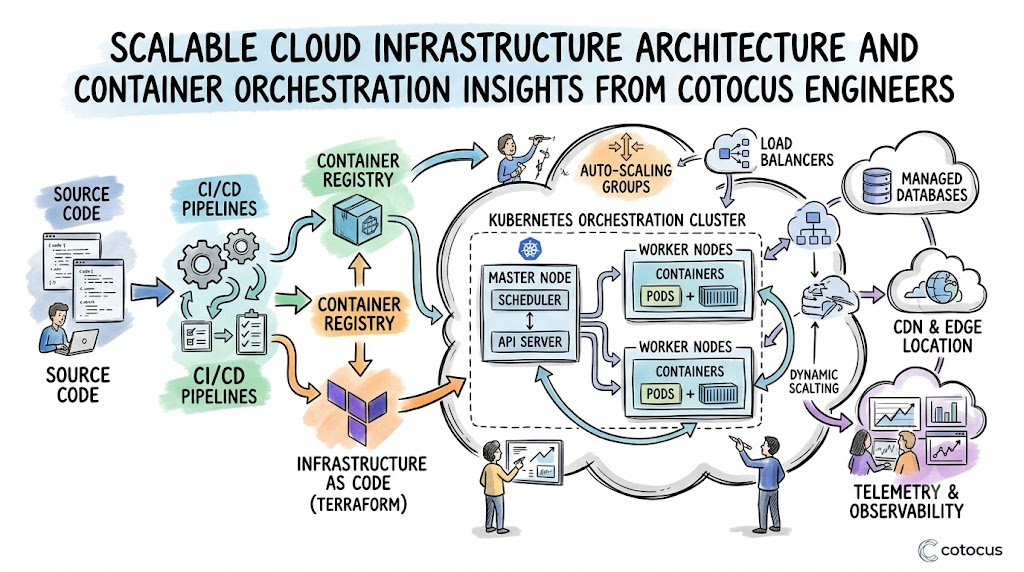
Modern software delivery achieves maximum resilience and velocity when cloud infrastructure, container orchestration, automated release pipelines, and site reliability disciplines operate as a cohesive technical ecosystem. Public cloud providers deliver elastic compute, storage, and networking primitives that Infrastructure as Code tools provision dynamically to eliminate manual environment configurations. Kubernetes sits on top of this cloud foundation, orchestrating application containers, managing network routes, and handling automatic scaling across distributed node pools. DevOps automation ties this architecture directly to the codebase through automated pipelines that test, secure, and deploy applications continuously, while SRE practices establish observability guardrails, error budgets, and self-healing mechanisms to ensure services remain reliable and performant under heavy customer workloads.
How Can Cotocus Support Your Modern Engineering Journey?
Navigating enterprise cloud transformations, container migrations, and automated delivery initiatives requires experienced technical mentors who understand how to design scalable architectures while guiding engineering teams through cultural change. Cotocus partners directly with engineering organizations to diagnose delivery friction, design robust cloud architectures, implement secure release pipelines, and optimize operational spend across complex multi-cloud environments. Whether your business requires strategic guidance to architect an Internal Developer Platform, dedicated managed services to maintain around-the-clock reliability, or hands-on corporate workshops to upskill internal staff, their consultants provide the practical expertise needed to achieve sustainable operational excellence.
Frequently Asked Questions
1. What is the difference between DevOps consulting and managed DevOps services?
DevOps consulting focuses on auditing current workflows, identifying delivery bottlenecks, and designing automated pipelines, whereas managed DevOps services provide continuous, daily operational support to maintain infrastructure, monitor production, and triage incidents.
2. How long does an enterprise DevOps consulting engagement usually take?
A typical consulting engagement ranges from six to twelve weeks for the initial assessment, architecture design, and pipeline implementation, followed by phased roadmap executions tailored to organizational size and technical complexity.
3. When should an organization adopt Kubernetes instead of standard cloud hosting?
Kubernetes makes sense when managing complex microservice architectures requiring elastic autoscaling, high container density, and multi-cloud portability, but it is often unnecessary overhead for simple applications with predictable traffic patterns.
4. What are the most critical metrics used to measure DevOps success?
The most reliable metrics include deployment frequency, lead time for changes, change failure rate, mean time to recovery during outages, overall system availability, build durations, and infrastructure provisioning times.
5. How does DevSecOps help organizations improve their overall software security?
DevSecOps embeds automated security checks, code analysis, container scanning, and secrets detection directly into early pipeline stages, allowing engineering teams to remediate vulnerabilities quickly before code ever reaches production.
6. Why is platform engineering becoming essential for growing software development teams?
Platform engineering reduces developer cognitive overload by building self-service Internal Developer Platforms with pre-approved templates and golden paths, eliminating cross-team infrastructure tickets and speeding up daily feature delivery.
7. What role do error budgets play within Site Reliability Engineering?
Error budgets define the acceptable amount of system unreliability an application can accumulate, creating an objective, data-driven balance between rapid feature releases and strict platform stability requirements.
8. How does Infrastructure as Code prevent configuration drift across cloud environments?
Infrastructure as Code defines servers, networks, and cloud resources in version-controlled configuration files, ensuring staging, testing, and production environments are consistently provisioned without manual configuration discrepancies.
9. When does it make sense for a business to outsource DevOps operations?
Outsourcing makes sense when internal engineering teams lack specialized cloud or container expertise, need immediate operational support, or want their primary developers focused entirely on core product features.
10. Can legacy monolithic applications benefit from modern DevOps consulting practices?
Yes, legacy applications benefit significantly from automated testing suites, containerization, Infrastructure as Code, and standardized deployment pipelines, which stabilize operations before any major architectural refactoring begins.
11. What should engineering leaders look for when choosing a DevOps consulting partner?
Leaders should look for practical industry experience, strong cloud and container expertise, a focus on cultural knowledge transfer, transparent delivery roadmaps, and a clear emphasis on business outcomes over tooling trends.
12. How does corporate DevOps training accelerate enterprise digital transformation initiatives?
Corporate training provides engineering teams with hands-on practice using modern tools on realistic architectures, breaking down departmental silos, building technical confidence, and ensuring long-term self-sufficiency across the enterprise.
CONCLUSION
Modernizing enterprise software delivery requires a balanced, sustained commitment to refining internal engineering culture, adopting scalable cloud architectures, automating deployment pipelines, and upholding rigorous reliability standards. Transitioning away from fragmented manual workflows toward unified practices like DevSecOps, SRE, and platform engineering allows organizations to release software rapidly without compromising system stability or security posture. Mastering these advanced operational disciplines demands continuous hands-on practice, iterative architectural refinement, and a dedication to collaborative knowledge sharing across every department. Leveraging comprehensive technical ebooks and structured documentation further empowers development teams to master modern operational principles independently over time. Ultimately, committing to ongoing technical learning and engineering excellence ensures your software delivery capability remains a resilient, competitive advantage in an ever-evolving digital landscape.
