Introduction
While the standard tourist brochure confines Goa to buzzing beach shacks and neon-lit party strips, its true character lies embedded within weathered laterite walls, gilded baroque altars, and centuries-old Latin quarters. Beyond the bustling shorelines rests a coastal enclave whose soil preserves an intricate blend of Mediterranean ethos and Konkani spirit.
Choosing to explore Goa through its Portuguese heritage shifts your perspective from generic seaside leisure to deep cultural immersion. Walking beneath azulejo-tiled balconies and arched basalt doorways reveals an authentic chapter of world history, where the sound of chapel bells mingles with the breeze of the Arabian Sea.
Why Goa is a must-visit city
Goa served for 451 years as the maritime capital of the Portuguese Estado da Índia, establishing a distinctive cultural imprint that distinguishes it from any other region in South Asia. This era created a living synthesis of European Mannerist and Baroque architecture executed using indigenous red laterite stone and oyster-shell windowpanes. The resulting monuments are architectural milestones of transcontinental commerce, religious history, and colonial planning.
Beyond the weight of its history, Goa remains exceptionally accessible for travelers across all comfort levels. The state is served by modern international airports at Dabolim (GOI) and Manohar International Airport at Mopa (GOX), alongside the Konkan Railway network with major halts at Margao and Thivim. Smooth state highways and well-managed rental hubs enable heritage travelers, architecture buffs, and cultural explorers to traverse inland villages and coastal ramparts with ease.
The Portuguese heritage circuit generally divides into two primary zones: the historic core of Ilhas (Old Goa and Panaji) and the defensive maritime bastions along Bardez in the north, alongside the stately aristocratic estates scattered throughout Salcete in the south.
| Key Fact | Specification |
|---|---|
| Colonial Era Span | 1510 to 1961 (451 years under Portuguese administration) |
| Architectural Style | Portuguese Baroque, Mannerist, Manueline, and Goan Indo-Portuguese |
| UNESCO Recognition | Churches and Convents of Velha Goa (designated in 1986) |
| Ideal Exploration Season | Late October to March (mild humidity, sunny mornings) |
| Primary Circuit Hubs | Panaji, Velha Goa, Bardez, and Salcete |
| Signature Local Material | Red laterite stone, jali woodcraft, oyster-shell (carepas) windowpanes |
Best Places or Experiences
Laterite facade of Basilica of Bom Jesus.
Color-washed heritage villas in Fontainhas
Historic lighthouse at Fort Aguada.
Restored bastions of Reis Magos Fort.
Basilica of Bom Jesus
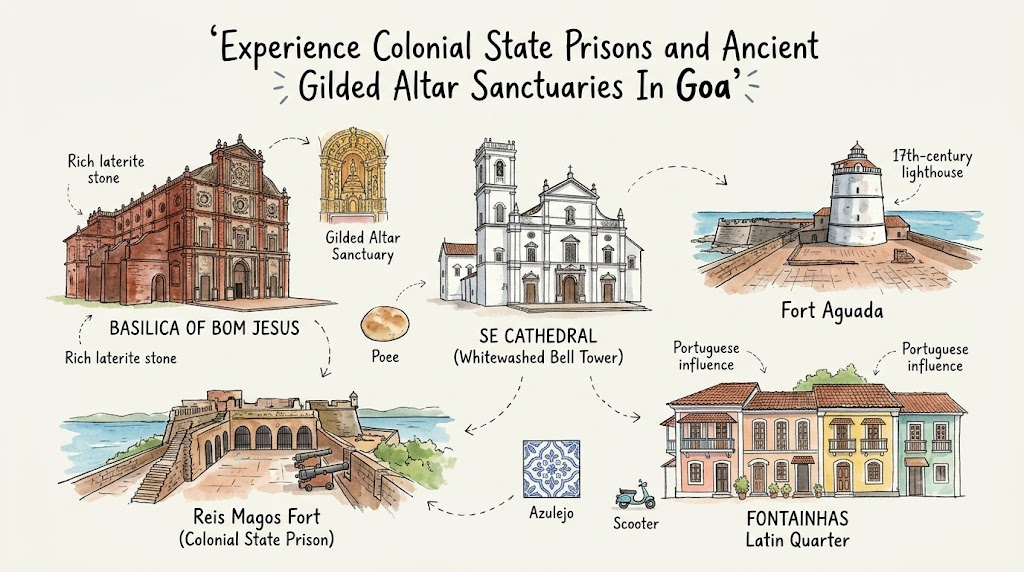
Completed in 1605, the Basilica of Bom Jesus stands as one of the finest exemplars of Jesuit architecture across the globe. Unlike most colonial churches in Goa that were repeatedly whitewashed with slaked lime, the exterior plaster of the Basilica was stripped in the mid-20th century, revealing the earthy, porous red laterite block construction that gives the edifice its iconic solemnity.
Inside the quiet sanctuary lies the silver reliquary housing the sacred mortal remains of Saint Francis Xavier, patron saint of the Indies. The interior balances austere basalt pillars with an opulent, three-tiered gilded altar honoring the infant Jesus under the Jesuit monogram. The delicate floral woodwork showcases the craftsmanship of local Konkani artisans working under European design directions.
- Location: Old Goa (Velha Goa), North Goa; 10 km east of Panaji.
- Why it is worth visiting: A UNESCO World Heritage masterpiece that houses the sacred relic of St. Francis Xavier and features the sole unplastered laterite facade in the region.
- Best things to do: Admire the 17th-century Florentine mausoleum gifted by Cosimo III de’ Medici, study the gilded main altar carving, and visit the sacristy art gallery.
- Best time to visit: Early morning between 9:00 AM and 10:30 AM before tourist buses arrive.
- Ideal for whom: History buffs, architecture lovers, and spiritual travelers.
- Travel tip: Strict modesty rules apply; ensure your shoulders and knees are covered before stepping into the main nave.
Fontainhas Latin Quarter
Nestled between the Altinho hillside and the Ourem Creek in Panaji, Fontainhas represents the oldest preserved Latin Quarter in Asia. Established in the late 18th century after plague outbreaks forced the administrative capital to move from Old Goa, this historic neighborhood mirrors the urban texture of classical Lisbon.
The narrow, winding alleys are bordered by brightly painted colonial townhouses finished in bright ochre, cobalt blue, terracotta red, and emerald green. These distinctive colors were mandated by Portuguese municipal law and renewed annually using natural mineral pigments. Wrought-iron balconies, overhanging roofs, and hand-painted ceramic street signs (azulejos) lend the quarter an old-world Mediterranean charm.
- Location: Panaji city center, North Goa; 28 km from Dabolim International Airport.
- Why it is worth visiting: Asia’s best-preserved residential Latin Quarter, showcasing authentic Indo-Portuguese living heritage and colorful streetscapes.
- Best things to do: Embark on an early morning architectural photography walk, savor traditional pasteis de nata at a heritage bakery, and view original hand-painted tiles at local art studios.
- Best time to visit: 7:30 AM to 10:00 AM for soft morning light and quiet pedestrian lanes.
- Ideal for whom: Solo walkers, photographers, cultural storytellers, and couples.
- Travel tip: Fontainhas is an active residential neighborhood, so please respect local privacy and refrain from taking photographs into open home windows.
Se Cathedral (Sé Catedral de Santa Catarina)
Commissioned to commemorate Afonso de Albuquerque’s victory over the Adil Shahi army in 1510 on the feast of Saint Catherine, Se Cathedral is among the largest religious structures in Asia. Construction commenced in 1562 and spanned nearly a century, resulting in a monumental facade that fuses Tuscan and Corinthian architectural orders.
The cathedral originally featured twin bell towers, but the southern tower collapsed after a lightning strike in 1776, giving the structure its asymmetrical appearance. The remaining northern belfry houses the renowned “Golden Bell,” whose deep acoustic resonance has carried across the Mandovi basin for centuries. Inside, eight chapels flank the central nave, leading up to a gilded main altarpiece depicting scenes from the life of Saint Catherine of Alexandria.
- Location: Old Goa, directly opposite the Basilica of Bom Jesus; 10 km from Panaji.
- Why it is worth visiting: Remarkable scale, magnificent Portuguese-Gothic barrel vaulting, and home to the famous Golden Bell.
- Best things to do: Stand beneath the barrel-vaulted ceiling to experience the church acoustics, inspect the intricate altarpiece carvings, and see the miraculous Cross of Miracles.
- Best time to visit: Mid-morning (10:00 AM to 11:30 AM) when the sun illuminates the high clerestory windows.
- Ideal for whom: Architecture scholars, history enthusiasts, and families.
- Travel tip: Photography is permitted, but tripods and loud mobile phone rings are prohibited inside the sanctuary.
Fort Aguada and Maritime Lighthouse
Constructed between 1609 and 1612 on the Sinquerim headland, Fort Aguada served as the primary naval barrier guarding the mouth of the Mandovi River against Dutch galleons and Maratha warships. Its massive dry stone ramparts, carved directly from the coastal laterite bedrock, form a defensive redoubt with views across the Arabian Sea.
The fort derived its name from the Portuguese word água (water), referencing the natural freshwater spring within its walls that replenished passing merchant vessels. In 1864, an iconic four-tiered circular lighthouse was erected on the upper fortress grounds, making it one of the earliest ocean lighthouses operational in Asia.
- Location: Sinquerim headland, Candolim, North Goa; roughly 16 km west of Panaji.
- Why it is worth visiting: The most expansive surviving Portuguese sea fort in Goa, featuring a historic four-tier lighthouse and sweeping ocean panoramas.
- Best things to do: Walk along the upper citadel perimeter, observe the internal freshwater reservoir, and catch the sunset over Sinquerim bay.
- Best time to visit: 4:00 PM to 6:00 PM to take advantage of cooler afternoon sea breezes and sunset lighting.
- Ideal for whom: Maritime history enthusiasts, landscape photographers, and casual explorers.
- Travel tip: Wear shoes with reliable traction; the ancient laterite paving blocks on the rampart walkways can become slick when damp.
Reis Magos Fort
Erected in 1551 on a steep laterite bluff opposite Panaji, Reis Magos Fort (named for the biblical Three Wise Men) guarded the narrowest choke point of the Mandovi estuary. Initially established as an outpost, it was expanded in 1707 into a citadel complete with gun loops, defensive bastions, and subterranean ammunition magazines.
The fort served diverse functions over its lifetime, transitioning from a strategic military stronghold to a temporary residence for arriving viceroys, and later a state prison during the mid-20th century. After falling into ruin, the property was meticulously restored through the collaborative efforts of the INTACH heritage trust and the State Government, reopening as a cultural and arts exhibition center.
- Location: Verem, Bardez, North Goa; 8 km from Panaji across the Mandovi bridge.
- Why it is worth visiting: A beautifully restored coastal fortress offering accessible exhibits, historic cannons, and views of Panaji’s skyline.
- Best things to do: Walk through the restored jail cells, explore the permanent gallery displaying Mario Miranda’s satirical Goan sketches, and examine the cannons along the upper terrace.
- Best time to visit: 10:00 AM to 12:30 PM for quiet exhibition halls and clear views across the Mandovi.
- Ideal for whom: Cultural travelers, families with children, and art collectors.
- Travel tip: Buy tickets at the lower entrance kiosk; an electric buggy is available for a small fee if climbing the steep stone entry ramp is challenging.
Offbeat Exploration: Hidden Gems Tourists Miss
The Tower of St. Augustine
Hidden behind forest growth in Old Goa stands the lone 46-meter-high belfry of the Church of St. Augustine, built in 1602 by Augustinian friars. Abandoned in 1835 following royal decrees suppressing religious orders in Portugal, the vast complex gradually collapsed into the jungle. Standing beside the remaining four-story laterite arch delivers a moody, evocative encounter with the impermanence of colonial empires.
Church of Our Lady of the Mount
Perched atop a forested hill roughly two kilometers east of Old Goa’s main square, this white-washed 16th-century chapel provides the finest viewpoint in the state. From its quiet front terrace, you can look down across the entire Mandovi River basin, the surrounding islands of Chorao and Divar, and the monumental domes of the cathedrals below.
Cabo de Rama Fort & Chapel
Located in the far south of the Canacona coastline, Cabo de Rama is an ancient headland fort captured by the Portuguese in 1763 from the Raja of Soonda. Within its ruined perimeter walls sits the operational white Chapel of Saint Anthony, framing empty cliffside vistas where the emerald coastal forest drops into the Arabian Sea.
Detailed Practical Guidance for Travelers
| Destination | Standard Entry Fee | General Timings | Best Local Food Options Nearby | Recommended Nearby Attractions |
|---|---|---|---|---|
| Basilica of Bom Jesus | Free (₹5 for art museum) | 9:00 AM – 6:30 PM (Mon-Sat); 10:30 AM – 6:30 PM (Sun) | Local tea and cashew snack stalls near the plaza | Se Cathedral, Church of St. Francis of Assisi |
| Fontainhas Latin Quarter | Free | Accessible 24 Hours (Daylight recommended) | Confeitaria 31 De Janeiro, Viva Panjim | Church of Our Lady of the Immaculate Conception |
| Se Cathedral | Free | 7:30 AM – 6:00 PM Daily | Heritage cafeteria across the central lawn | Archaeological Museum of Goa, Chapel of St. Catherine |
| Fort Aguada | ₹25 (Indian nationals) / ₹300 (Foreign nationals) | 9:30 AM – 6:00 PM Daily | Kokum Kitchen, nearby Candolim beach cafes | Lower Aguada Jail Museum, Sinquerim Beach |
| Reis Magos Fort | ₹50 (Adults) / ₹25 (Students) | 9:30 AM – 5:00 PM (Closed on Mondays) | Babaji Classic, local riverfront bakeries in Verem | Reis Magos Church, Coco Beach |
Logistics & On-Ground Navigation
Local Transport Options
- Self-Drive Scooters and Motorcycles: The most efficient method for navigating coastal roads and narrow village lanes. Daily rental rates run from ₹350 to ₹600. Keep your valid driving license on hand and wear a certified helmet at all times.
- Self-Drive and Chauffeur-Driven Cars: Recommended for multi-passenger families traversing between North and South circuits. Daily car hire averages ₹1,500 to ₹3,000 depending on vehicle class.
- Pilot Taxis (Motorcycle Taxis): A distinctive, cost-effective Goan transit option where licensed motorcycle riders carry single passengers on short town routes for nominal fees.
- Kadamba State Transport Buses: The regional white-and-blue government buses provide reliable connections between major central terminals like Panaji, Margao, Mapusa, and Vasco (fares run from ₹15 to ₹50).
Budget Planning
- Backpacker & Heritage Enthusiast Tier (₹1,500 – ₹2,500 per day): Dormitory bed in a characterful heritage hostel (₹700–₹1,200), daily scooter hire and fuel (₹450), and dining at family-run Konkani-Portuguese tavernas (₹500–₹800).
- Mid-Range & Comfort Tier (₹4,500 – ₹8,500 per day): Private room in a restored Indo-Portuguese estate or boutique river lodge (₹3,000–₹5,500), regional taxi or compact rental car (₹1,500), and multi-course meals featuring traditional vindaloo and seafood (₹1,500–₹2,500).
Safety and Inclusivity Tips
- For Families: Historical ruins frequently have steep laterite steps and unrailed ramparts. Keep close watch over young children at Fort Aguada and Cabo de Rama.
- For Couples: Early morning explorations of Fontainhas or peaceful sunsets at Church of the Mount provide tranquil settings away from coastal party hubs.
- General Safety: Coastal humidity accelerates dehydration during afternoon walking tours. Carry water, use sun protection, and avoid walking alone along unlit, rural fort trails after dusk.
Strategic Travel Planning Guardrails
Travel Planning Tips for Goa
- Time Your Visits for the Morning: Monastic complexes and residential quarters become uncomfortably warm by midday; schedule tours between 8:00 AM and 11:00 AM.
- Carry Small Cash Denominations: While digital payments (UPI) are common, smaller ticket booths, parking attendants, and rural bakeries prefer currency notes of ₹50 and ₹100.
- Respect Active Religious Sanctuaries: Several colonial-era sites remain active houses of worship. Dress respectfully by covering knees and shoulders, and remove hats upon entry.
- Wear Supportive Walking Shoes: Uneven colonial cobblestones and coarse laterite steps demand sturdy, non-slip footwear rather than beach sandals.
- Carry Monsoon Gear in Shoulder Months: Early October and late May occasionally bring sudden coastal downpours; carry a lightweight rain shell or compact umbrella.
Common Mistakes to Avoid
- Treating All of Goa as a Single Unified Neighborhood: Trying to cross from north beach towns to southern heritage mansions in a single afternoon burns hours in traffic.
- Neglecting Village Culinary Specialties: Confining your dining to generic beach shack fare skips essential dishes like sorpotel, recheado, and wood-fired poee.
- Assuming Taxi Fares Run on Meters: Private tourist taxis rarely run meters; always agree upon the journey fare with the driver before stepping inside.
- Ignoring Siesta Culture: Family-run boutiques and local heritage eateries in residential sectors frequently shutter between 1:30 PM and 4:00 PM for the traditional susegad rest.
- Overlooking Conservation Etiquette: Do not touch fragile gilded woodcarvings, peel away aging lime wash, or climb on weathered historic masonry.
Suggested Itinerary Blueprints
1. Day Quick Dash (The Imperial Hub: Panaji & Old Goa)
- Target Audience: Travelers on limited schedules wanting essential cultural immersion.
- Morning (8:30 AM – 12:30 PM): Arrive at Old Goa to explore the Basilica of Bom Jesus, walk across the road to Se Cathedral, and view the Augustinian tower ruins.
- Lunch (1:00 PM – 2:30 PM): Return to Panaji for an authentic Goan fish curry thali at a heritage dining room.
- Afternoon (3:00 PM – 5:30 PM): Stroll through the shaded alleyways of the Fontainhas Latin Quarter and sample fresh cakes at Confeitaria 31 De Janeiro.
2. Day Deep-Dive (North-Shore Strongholds & Riverside Heritage)
- Day 1 (The Old Capital & Creative Enclaves): Spend the morning immersed in Old Goa’s grand basilicas. In the afternoon, cross the Mandovi on the car ferry to explore Divar Island’s quiet, tree-shaded Portuguese village lanes.
- Day 2 (Coastal Bastions & Artistic Forts): Start with an 8:30 AM morning hike through Fort Aguada’s upper ramparts. Follow with an afternoon tour of the galleries at Reis Magos Fort, concluding with sunset drinks along the Mandovi riverfront.
3. Complete Weekend Travel Plan (Comprehensive North-to-South Loop)
- Friday (The Living Capital): Check into a heritage boutique guesthouse in Fontainhas. Spend the afternoon exploring Panaji’s historical churches, art galleries, and riverside promenades.
- Saturday (Monuments of Empire & Naval Defense): Dedicate your morning to Old Goa and the elevated scenic grounds of Our Lady of the Mount. Move north in the late afternoon to tour Reis Magos Fort and dine in the garden cafes of Assagao.
- Sunday (The Aristocratic South): Drive south to the lush Salcete district. Explore the grand 450-year-old Bragança Pereira Mansion in Chandor, stop by the market town of Margao, and finish with a quiet cliffside sunset at Cabo de Rama.
Common Tourist Mistakes to Avoid
- Geographic Blunders: Combining North Goa’s coastal forts and South Goa’s rural manors on the same day forces you onto congested arterial highways, leaving minimal time for actual exploration.
- Commercial Traps: Spending hours in busy commercial shopping complexes instead of wandering the authentic, slow-paced streets of Panaji, Aldona, or Rachol.
- Neglecting Modern and Alternative Zones: Overlooking the revitalized creative spaces of Bardez, where restored colonial properties now house design studios, independent bookshops, and artisanal roasteries.
- Transport Overpayment: Accepting the first quoted price from private taxi stands near major landmarks; compare with pre-fixed government counter rates or local pilot services.
- Luxury Dining Bias: Restricting your meals to hotel resort buffets, which misses out on the complex culinary flavors found at family-owned neighborhood taverns.
Frequently Asked Questions
1. What distinguishes Portuguese architecture in Goa from European styles?
Goan colonial architecture thoughtfully blends southern European Renaissance and Baroque design with local coastal adaptations. Builders utilized indigenous red laterite stone bonded with lime mortar, fitted delicate oyster-shell (carepas) windowpanes to diffuse bright tropical sunlight, and added wide, covered wrap-around verandas suited for heavy monsoon rainfall.
2. Are entry fees charged at Old Goa’s historical churches?
Entry into the primary religious sanctuaries of Old Goa, including the Basilica of Bom Jesus and Se Cathedral, is completely free of charge. However, small conservation fees ranging from ₹5 to ₹25 are required to enter the adjacent Christian Art Museum and archaeological galleries.
3. What is the appropriate dress code for visiting heritage religious sites?
Because these historic structures remain active spiritual centers, visitors should wear modest attire. Both men and women must cover their shoulders and knees, and hats, caps, and beachwear are not permitted within the church sanctuaries.
4. How does one get from Panaji to Old Goa using public transit?
Frequent and affordable state-run Kadamba buses depart directly from the central Panaji bus terminus for Old Goa every 15 minutes. The transit journey takes approximately 20 to 25 minutes, with one-way fares costing around ₹20 to ₹30.
5. Why are the houses in Fontainhas painted in such bright colors?
Under historic Portuguese administrative regulations, residents were legally mandated to whitewash and paint their home exteriors every year following the monsoon season. Homeowners utilized mineral and organic pigments—including yellow ochre, terracotta red, and indigo—creating the quarter’s distinctive colorful aesthetic.
6. Can visitors tour the interior of preserved Goan-Portuguese mansions?
Yes, select historic private estates welcome visitors for guided tours, most notably the Casa Araujo Alvares and the Bragança Mansion in Chandor, alongside the Figueiredo House in Loutolim. Some estates request a small voluntary donation or nominal entry fee to help fund ongoing structural restoration.
7. Is hiring a local heritage guide worthwhile in Old Goa?
Hiring an accredited government heritage guide at the church entrance adds meaningful context to your visit. Professional guides point out architectural symbolism, hidden crypts, and historical nuances that are easily overlooked when exploring the large complex independently.
8. What authentic Indo-Portuguese dishes should cultural travelers try?
Make sure to sample traditional dishes like Pork Vindaloo (derived from the Portuguese carne de vinha d’alhos), Chicken Xacuti made with roasted spices, spiced Sorpotel, fresh Chouriço sausages, and the multi-layered steamed dessert Bebinca.
9. When is the best time of year to explore heritage trails comfortably?
The most pleasant period spans from November through February, when coastal humidity drops and temperatures remain mild. Exploring outdoors during morning hours allows you to beat the peak afternoon tropical heat.
10. Do I need cash for heritage site visits or are digital payments accepted?
Major entry gates like Fort Aguada accept digital payments via UPI and credit cards. However, having ₹500 to ₹1,000 in physical cash is recommended for small rural bakeries, donations, and local transport options.
11. Which historical fort in Goa provides the best panoramic ocean view?
Fort Aguada on the Sinquerim headland and Chapora Fort overlooking Vagator deliver expansive 360-degree ocean views. For a quieter coastal setting, Cabo de Rama in South Goa offers dramatic cliff-edge panoramas over the Arabian Sea.
12. Are heritage sites in Goa accessible for travelers with limited mobility?
Accessibility varies across locations. While Se Cathedral and the Basilica of Bom Jesus have level stone approaches and entry ramps, ancient hillside strongholds like Chapora and upper Fort Aguada feature steep, uneven paths that require careful footing.
Conclusion
Exploring Goa’s Portuguese heritage reconnects you with a slower, richer coastal travel narrative. Standing beneath the towering barrel vault of Se Cathedral or watching afternoon light filter through a balcony in Fontainhas offers an intellectual and spiritual grounding that noisy resort strips cannot replicate. It invites you to pause, listen to centuries of coastal history, and uncover an enduring cultural legacy that continues to define the soul of this land.
