



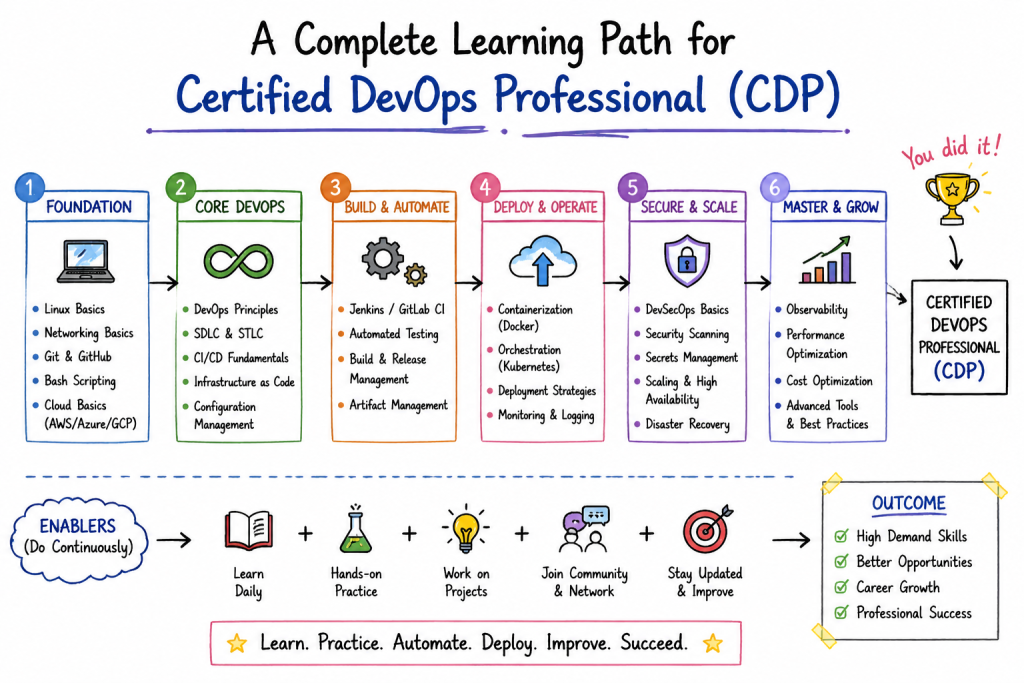
\
Introduction
The Certified DevOps Professional (CDP) is designed for engineers who want to move beyond basic tooling and understand how modern software delivery actually works in production. This guide is for working professionals—DevOps engineers, SREs, cloud engineers, and even managers—who want clarity before investing time and money into certification.
In today’s cloud-native world, DevOps is not just about CI/CD pipelines; it’s about reliability, automation, scalability, and business alignment. CDP sits at the intersection of these disciplines and focuses on real-world implementation rather than theory.
This guide helps you evaluate whether Certified DevOps Professional (CDP) fits your career path, how difficult it is, what skills you gain, and how it aligns with long-term growth in DevOps, SRE, and platform engineering.
What is the Certified DevOps Professional (CDP)?
Certified DevOps Professional (CDP) is a career-focused certification that validates your ability to design, implement, and manage DevOps practices in real production environments. It emphasizes automation, CI/CD, infrastructure as code, monitoring, and collaboration across teams.
Unlike academic certifications, CDP is structured around practical scenarios such as deploying microservices, managing pipelines, and handling system failures. It reflects how real engineering teams operate in startups and enterprises.
The certification exists to bridge the gap between knowing tools and actually delivering value through DevOps practices. It aligns closely with modern workflows like GitOps, container orchestration, and cloud-native architectures.
For professionals, it acts as proof that you can not only build systems but also operate and scale them effectively.
Who Should Pursue Certified DevOps Professional (CDP)?
Certified DevOps Professional (CDP) is ideal for engineers already working with cloud or automation tools who want to formalize and deepen their skills. DevOps engineers, SREs, and platform engineers benefit the most because the certification aligns directly with their daily responsibilities.
Cloud engineers transitioning into DevOps roles will find it particularly useful as it connects infrastructure knowledge with automation and delivery pipelines. Security engineers and data professionals can also benefit when they need to integrate DevSecOps or DataOps practices.
For beginners, CDP can be challenging unless they have foundational knowledge of Linux, networking, and scripting. For experienced engineers, it serves as validation and structured learning.
In India and globally, companies increasingly expect engineers to handle end-to-end delivery, making CDP relevant across geographies and industries.
Why Certified DevOps Professional (CDP)
The demand for DevOps skills continues to grow as organizations adopt cloud-native and microservices architectures. Certified DevOps Professional (CDP) remains valuable because it focuses on principles and workflows rather than specific tools.
Even as tools evolve, concepts like CI/CD, observability, automation, and infrastructure as code remain constant. This makes CDP a long-term investment rather than a short-lived certification.
Enterprises are prioritizing reliability and faster delivery cycles, and CDP-certified professionals are better equipped to meet these expectations. It improves your ability to contribute to system design, not just implementation.
From a career perspective, CDP increases your chances of moving into senior roles, where decision-making and system ownership matter more than just execution.
Certified DevOps Professional (CDP) Certification Overview
The program is delivered via and hosted on devopsschool. It is structured to simulate real-world DevOps environments with hands-on labs and scenario-based assessments.
The certification typically includes practical assignments, project work, and evaluation based on real implementations rather than multiple-choice exams. This makes it more aligned with industry expectations.
Ownership lies with devopsschool, which focuses on practitioner-level training across DevOps and related domains. The structure emphasizes learning by doing, which is critical for mastering DevOps.
The certification is designed to validate both technical depth and the ability to apply DevOps practices in complex environments.
Certified DevOps Professional (CDP) Certification Tracks & Levels
Certified DevOps Professional (CDP) follows a structured progression model starting from foundational understanding to advanced implementation. The foundation level introduces basic DevOps concepts, tools, and workflows.
The professional level focuses on real-world implementations such as CI/CD pipelines, containerization, and cloud deployments. This is where most working professionals operate.
Advanced levels dive into specialized areas like SRE practices, platform engineering, and large-scale system design. These are aligned with senior and architect roles.
Specialization tracks can extend into DevSecOps, FinOps, and AIOps, allowing professionals to tailor their expertise based on career goals.
Complete Certified DevOps Professional (CDP) Certification Table
| Track | Level | Who it’s for | Prerequisites | Skills Covered | Recommended Order |
|---|---|---|---|---|---|
| DevOps | Foundation | Beginners | Basic Linux, Git | CI/CD basics, scripting | 1 |
| DevOps | Professional | Working engineers | CI/CD knowledge | Pipelines, Docker, Kubernetes | 2 |
| DevOps | Advanced | Senior engineers | Cloud + Kubernetes | Scaling, monitoring, architecture | 3 |
| SRE | Professional | SRE roles | Monitoring basics | SLIs, SLOs, reliability | After DevOps Pro |
| DevSecOps | Professional | Security engineers | DevOps basics | Secure pipelines, compliance | Parallel |
Detailed Guide for Each Certified DevOps Professional (CDP) Certification
Certified DevOps Professional (CDP) – Foundation Level
What it is
This certification validates your understanding of core DevOps concepts, including CI/CD, version control, and basic automation practices. It builds the groundwork for advanced learning.
Who should take it
Beginners, junior engineers, and professionals transitioning into DevOps roles. Ideal for those with limited hands-on experience.
Skills you’ll gain
- Understanding CI/CD pipelines
- Basic scripting and automation
- Version control with Git
- Introduction to containers
Real-world projects you should be able to do
- Build a simple CI/CD pipeline
- Deploy an application using Docker
- Automate basic tasks using scripts
Preparation plan
- 7–14 days: Focus on concepts and basic tools
- 30 days: Practice pipelines and containerization
- 60 days: Build small real-world projects
Common mistakes
- Ignoring hands-on practice
- Over-focusing on theory
- Skipping Linux fundamentals
Best next certification after this
Same-track option: Professional Level
Cross-track option: DevSecOps basics
Leadership option: Team collaboration fundamentals
Certified DevOps Professional (CDP) – Professional Level
What it is
This level validates your ability to implement DevOps practices in production environments, including CI/CD, Kubernetes, and cloud integration.
Who should take it
Mid-level engineers, DevOps professionals, and cloud engineers with practical experience.
Skills you’ll gain
- Advanced CI/CD pipeline design
- Kubernetes deployment and management
- Infrastructure as Code
- Monitoring and logging
Real-world projects you should be able to do
- Deploy microservices on Kubernetes
- Build end-to-end CI/CD pipelines
- Implement monitoring dashboards
Preparation plan
- 7–14 days: Review tools and concepts
- 30 days: Practice real deployments
- 60 days: Work on production-grade projects
Common mistakes
- Not understanding system design
- Tool-focused learning without context
- Ignoring monitoring and observability
Best next certification after this
Same-track option: Advanced Level
Cross-track option: SRE certification
Leadership option: Engineering management
Choose Your Learning Path
DevOps Path
Start with foundational concepts and gradually move toward automation and orchestration. Focus on CI/CD pipelines, containerization, and infrastructure as code. This path is ideal for engineers who want to build and deploy systems efficiently.
DevSecOps Path
Combine DevOps practices with security principles. Learn how to integrate security into pipelines and automate compliance checks. This path is critical for organizations prioritizing secure software delivery.
SRE Path
Focus on reliability, monitoring, and incident management. Learn about SLIs, SLOs, and system resilience. This path is ideal for engineers responsible for uptime and performance.
AIOps / MLOps Path
Explore automation using AI and machine learning in operations. Learn how to optimize monitoring and predictive analysis. This path is emerging and highly valuable.
DataOps Path
Focus on data pipelines, automation, and reliability. Learn how to manage data workflows efficiently. Ideal for data engineers working with large-scale systems.
FinOps Path
Understand cloud cost optimization and financial accountability. Learn how to balance performance and cost. This is increasingly important in cloud-heavy organizations.
Role → Recommended Certified DevOps Professional (CDP) Certifications
| Role | Recommended Certifications |
|---|---|
| DevOps Engineer | CDP Professional |
| SRE | CDP + SRE Track |
| Platform Engineer | CDP Advanced |
| Cloud Engineer | CDP Professional |
| Security Engineer | CDP + DevSecOps |
| Data Engineer | CDP + DataOps |
| FinOps Practitioner | CDP + FinOps |
| Engineering Manager | CDP + Leadership Track |
Next Certifications to Take After Certified DevOps Professional (CDP)
Same Track Progression
Deepen your expertise in DevOps by focusing on advanced Kubernetes, platform engineering, and large-scale system design. This helps you move into architect roles.
Cross-Track Expansion
Expand into SRE, DevSecOps, or FinOps to gain a broader skill set. This makes you more versatile and valuable in complex organizations.
Leadership & Management Track
Transition into leadership roles by learning system design, team management, and strategic decision-making. This is essential for senior positions.
Training & Certification Support Providers for Certified DevOps Professional (CDP)
DevOpsSchool
DevOpsSchool provides structured training programs focused on real-world DevOps implementation. Their courses emphasize hands-on labs and practical scenarios, helping learners build production-ready skills. They are known for covering tools like Kubernetes, Jenkins, and Terraform in depth.
Cotocus
Cotocus offers consulting-driven training with a focus on enterprise use cases. Their programs align with industry needs, making them suitable for professionals working in large organizations.
Scmgalaxy
Scmgalaxy specializes in DevOps tools and automation training. Their approach is tool-centric but practical, helping learners gain immediate hands-on experience.
BestDevOps
BestDevOps provides certification-oriented training with a focus on career advancement. Their programs include mentoring and real-world projects.
devsecopsschool
devsecopsschool focuses on integrating security into DevOps workflows. Their training is valuable for professionals working in regulated environments.
sreschool
sreschool emphasizes reliability engineering and system performance. Their programs are ideal for SRE roles.
aiopsschool
aiopsschool covers AI-driven operations and automation. Their training is aligned with emerging trends in IT operations.
dataopsschool
dataopsschool focuses on data pipeline automation and management. It is suitable for data engineers and analytics professionals.
finopsschool
finopsschool specializes in cloud cost optimization and financial operations. Their training is valuable for organizations managing large cloud budgets.
Frequently Asked Questions
Is Certified DevOps Professional (CDP) difficult?
It is moderately challenging, especially for beginners without hands-on experience.
How long does it take to prepare?
Typically 30–60 days depending on your experience level.
Do I need coding skills?
Basic scripting knowledge is required, but not advanced programming.
Is it worth the investment?
Yes, if you aim to work in DevOps or cloud-native environments.
Can beginners take it?
Yes, but they should start with foundational knowledge.
Does it focus on tools or concepts?
It balances both but emphasizes practical implementation.
Is it globally recognized?
It is gaining recognition, especially in practical training domains.
What jobs can I get after CDP?
DevOps Engineer, SRE, Cloud Engineer, Platform Engineer.
Do I need cloud knowledge?
Basic cloud understanding is highly recommended.
Is it better than vendor certifications?
It complements them by focusing on real-world skills.
How is it assessed?
Through practical assignments and projects.
Can it help in career growth?
Yes, especially for mid-level to senior transitions.
FAQs on Certified DevOps Professional (CDP)
What makes Certified DevOps Professional (CDP) different from AWS or Azure certifications?
CDP focuses on DevOps practices across tools and platforms, while AWS or Azure certifications are vendor-specific. CDP teaches how systems work together, making it more practical for real-world engineering.
Is Certified DevOps Professional (CDP) suitable for SRE roles?
Yes, because it covers monitoring, automation, and system reliability concepts that are essential for SRE responsibilities.
Can I take Certified DevOps Professional (CDP) without Kubernetes knowledge?
You can start, but Kubernetes understanding is essential for completing the certification effectively.
How practical is Certified DevOps Professional (CDP)?
It is highly practical, focusing on real-world scenarios rather than theoretical exams.
Does Certified DevOps Professional (CDP) include cloud training?
Yes, it integrates cloud concepts as part of DevOps workflows.
Will Certified DevOps Professional (CDP) help in switching careers?
Yes, especially for transitioning into DevOps or cloud roles.
Is Certified DevOps Professional (CDP) enough to get a job?
It helps significantly, but hands-on projects and experience are equally important.
What is the best way to prepare for Certified DevOps Professional (CDP)?
Focus on hands-on practice, build real projects, and understand system design concepts.
Final Thoughts: Is Certified DevOps Professional (CDP) Worth It?
Certified DevOps Professional (CDP) is worth pursuing if you are serious about working in modern engineering environments where automation, scalability, and reliability are critical. It is not a shortcut to a job, but it is a strong accelerator when combined with real-world practice. If you already work in DevOps or cloud, this certification helps structure your knowledge and validate your skills. If you are transitioning, it provides a clear roadmap of what to learn. The key is not the certificate itself, but the skills you build while preparing for it. Focus on hands-on learning, and CDP will naturally translate into career growth.

Leave a Reply
You must be logged in to post a comment.