



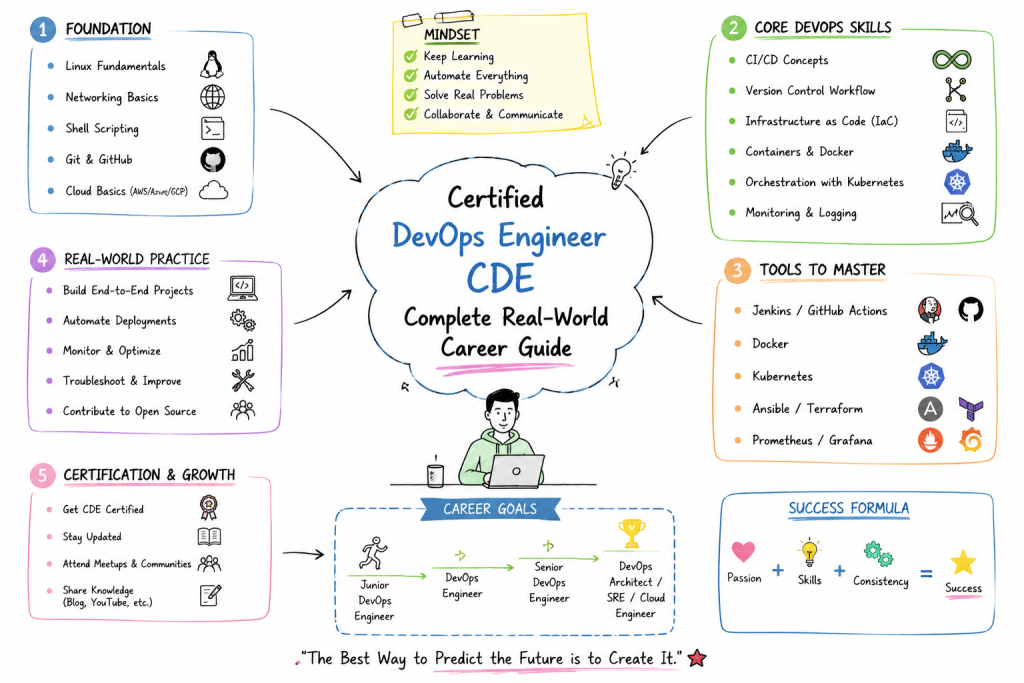
Introduction
Certified DevOps Engineer (CDE) is a structured, skills-focused certification designed to validate that you can design, build, automate, and operate modern software delivery pipelines in real-world environments. This guide is for working engineers, SREs, platform engineers, cloud and security professionals, data-focused roles, and engineering managers who want a practical, no-nonsense view of this certification. In today’s landscape of cloud-native, containers, Kubernetes, microservices, and platform engineering, DevOps is no longer optional—it is the operating model of high-performing teams. This guide will help you understand what the Certified DevOps Engineer (CDE) is, how it fits into your career, and whether it is the right investment for your time and energy.
What is the Certified DevOps Engineer (CDE)?
Certified DevOps Engineer (CDE) represents a hands-on, production-oriented certification that focuses on how modern teams deliver software safely and quickly. Instead of staying in theory, it emphasizes automation, CI/CD pipelines, observability, security integration, scalability, and reliability across the full lifecycle. The goal is to measure whether you can operate as a practical DevOps engineer on real projects, not just pass a multiple-choice exam. It aligns with current engineering workflows such as GitOps, infrastructure as code, container orchestration, and cloud-native delivery patterns. In enterprises, this kind of certification helps standardize expectations for DevOps roles and creates a common language between engineers, SREs, and managers.
Who Should Pursue Certified DevOps Engineer (CDE)?
Certified DevOps Engineer (CDE) is ideal for software engineers who want to transition into DevOps, SREs who want stronger delivery pipeline and automation skills, and platform engineers who manage internal developer platforms. Cloud engineers working with AWS, Azure, or GCP will also benefit because DevOps skills are now a baseline expectation in cloud roles. Security engineers who want to integrate DevSecOps and shift security left into pipelines, and data engineers who need reliable and automated data delivery workflows, can also gain a lot. It suits both early-career professionals who have basic Linux, Git, and scripting knowledge, and experienced engineers or managers who want to formalize and benchmark their DevOps capabilities. For India-based professionals targeting both domestic and global opportunities, Certified DevOps Engineer (CDE) maps well to the hiring language used by international companies.
Why Certified DevOps Engineer (CDE)
In 2026 and the coming years, organizations are doubling down on automation, platform engineering, and AI-assisted operations, but the fundamental need for solid DevOps foundations will not go away. Certified DevOps Engineer (CDE) remains valuable because it focuses on core, portable skills—pipelines, infrastructure as code, observability, reliability, and security—that outlast individual tools. Even as specific technologies change, hiring managers still look for engineers who can design pipelines, automate environments, handle incidents, and collaborate with developers and operations. The certification provides a structured path to stay relevant in a world where AI, containers, serverless, and multi-cloud are becoming normal. From a career perspective, it offers a strong return on time investment by making you a better fit for DevOps, SRE, and platform roles with higher responsibility and pay potential.
Certified DevOps Engineer (CDE) Certification Overview
The Certified DevOps Engineer (CDE) program is delivered via the official course page at https://www.devopsschool.com/certification/certified-devops-engineer.html and is hosted on devopsschool. The program typically covers multiple levels, from foundational understanding to advanced, architecture-level competence. It blends conceptual learning with hands-on labs and projects so that you are evaluated not just on what you know but on what you can implement. Assessments may include project work, scenario-based questions, and practical exercises that mirror production-like environments. Ownership of the program sits with devopsschool as the certification provider, which allows them to keep content aligned with real-world DevOps, SRE, and platform practices used by modern enterprises.
Certified DevOps Engineer (CDE) Certification Tracks & Levels
Certified DevOps Engineer (CDE) is best understood as a progression from foundational skills to advanced specialization. At the foundation level, you learn core DevOps concepts such as CI/CD, version control, basic automation, and configuration management. At the professional level, you dive deeper into containers, Kubernetes, observability, security integration, and scalable pipeline design. At the advanced or architect level, you focus on designing cross-team delivery platforms, governance, cost optimization, and resilience patterns. Along this journey, you can align with tracks such as DevOps, SRE, DevSecOps, AIOps/MLOps, DataOps, and FinOps, depending on your role and interests. This layered approach lets you align Certified DevOps Engineer (CDE) with your career progression—from individual contributor to technical leader.
Complete Certified DevOps Engineer (CDE) Certification Table
| Track | Level | Who it’s for | Prerequisites | Skills Covered | Recommended Order |
|---|---|---|---|---|---|
| DevOps | Foundation | Junior engineers, career switchers, testers | Basic Linux, Git, scripting basics | CI/CD basics, Git workflows, build automation, configuration management | 1st for beginners |
| DevOps | Professional | Mid-level DevOps/SRE/Cloud engineers | Foundation-level DevOps knowledge | Kubernetes, advanced CI/CD, GitOps, infra as code, observability, DevSecOps | 2nd after foundation |
| SRE | Professional | SREs, on-call engineers, reliability owners | DevOps foundation, production exposure | SLOs/SLIs, error budgets, incident response, reliability patterns, capacity | After DevOps Professional |
| DevSecOps | Professional | Security, DevOps, and platform engineers | CI/CD and basic security concepts | Secure pipelines, shift-left security, compliance, secrets and policy-as-code | Parallel to SRE track |
| AIOps/MLOps | Advanced | Senior DevOps/SRE, data and ML engineers | Strong DevOps + data/ML understanding | Monitoring at scale, AI-driven ops, ML model deployment pipelines | Later-stage specialization |
| DataOps | Professional | Data engineers, analytics engineers | SQL, data pipelines, basic DevOps | Data CI/CD, data quality, reproducible pipelines, automation for data stacks | After DevOps foundation |
| FinOps | Professional | Cloud, platform, and finance-aligned engineers | Cloud cost basics, cloud architecture | Cost visibility, optimization, tagging, right-sizing, governance in pipelines | After cloud DevOps maturity |
Detailed Guide for Each Certified DevOps Engineer (CDE) Certification
Certified DevOps Engineer (CDE) – Foundation
What it is
Certified DevOps Engineer (CDE) – Foundation validates your understanding of DevOps fundamentals and your ability to work in a modern software delivery team. It focuses on core practices like version control, basic CI/CD, automation, and collaboration between development and operations. The emphasis is on making you productive in real-world environments, not just passing an entry-level exam.
Who should take it
This level is ideal for junior software engineers, system admins moving into DevOps, QA/test engineers who want to work with automation, and career switchers coming from support or non-DevOps roles. If you have 0–3 years of experience and know basic Linux, Git, and scripting, this is a good starting point. It also suits students and freshers who want to differentiate themselves for entry-level DevOps or cloud roles.
Skills you’ll gain
- Understanding of DevOps concepts, culture, and collaboration models.
- Practical Git usage, branching, and pull request workflows.
- Basic CI/CD pipeline creation for common tech stacks.
- Configuration management fundamentals and environment consistency.
- Introductory observability concepts: logs, metrics, and alerts.
Real-world projects you should be able to do
- Set up a simple CI pipeline that builds and tests an application on every commit.
- Automate deployment of a small application to a test or staging environment.
- Create basic scripts to provision and configure development environments.
- Integrate static code analysis or basic security checks into a pipeline.
- Document and share a simple DevOps workflow for a small team.
Preparation plan
- 7–14 days: Focus on fundamentals—Linux, Git, DevOps principles, and CI/CD basics. Spend at least one hour daily building small pipelines and exploring build tools.
- 30 days: Add more hands-on practice with a sample application, implement pipelines, and experiment with a configuration management tool. Review concepts through notes and short revision sessions.
- 60 days: Work on a mini end-to-end project, from code to deployment, with some basic monitoring. Reflect on failures, fix pipeline issues, and create a small portfolio you can show in interviews or to your manager.
Common mistakes
Many candidates treat this as a purely theoretical certification and ignore hands-on practice, which hurts them later in interviews and real jobs. Some over-focus on tools and buzzwords instead of understanding core concepts like feedback loops, automation, and collaboration. Others underestimate the importance of documentation and clarity when working in teams.
Best next certification after this
For the same-track option, your natural next step is Certified DevOps Engineer (CDE) – Professional once you have some project experience. As a cross-track option, consider an SRE- or DevSecOps-focused certification to deepen reliability or security skills. For a leadership option, you can later move toward architecture or engineering management programs when you start influencing team processes and strategy.
Certified DevOps Engineer (CDE) – Professional
What it is
Certified DevOps Engineer (CDE) – Professional validates your ability to design, implement, and improve production-grade CI/CD pipelines and supporting infrastructure. It goes beyond basics to include containers, Kubernetes, infrastructure as code, observability, and security across the delivery lifecycle. This level is about owning and evolving DevOps practices for teams and products.
Who should take it
This is best for mid-level DevOps engineers, SREs, platform engineers, and cloud engineers with 2–6 years of experience who already work with automation and deployments. If you are the person others come to for pipeline issues, environment problems, or release failures, this certification matches your responsibilities. It is also suitable for experienced developers stepping into DevOps-heavy roles who want formal validation of their capabilities.
Skills you’ll gain
- Designing and managing CI/CD pipelines for complex, multi-service systems.
- Using containers and Kubernetes for deployment, scaling, and resilience.
- Implementing infrastructure as code for repeatable, versioned environments.
- Setting up observability stacks with logs, metrics, traces, and dashboards.
- Integrating DevSecOps practices such as SAST, DAST, and policy checks into pipelines.
Real-world projects you should be able to do
- Build a multi-stage CI/CD pipeline with automated testing, security scans, and approvals.
- Deploy and operate applications on Kubernetes or similar orchestration platforms.
- Implement blue-green or canary deployment strategies for safer releases.
- Set up an observability solution to monitor performance, errors, and reliability.
- Create self-service deployment workflows that developers can safely use.
Preparation plan
- 7–14 days: Review foundation concepts and focus on filling gaps in CI/CD, containers, and basic infra as code. Use this period for quick, focused practice and lab-style work.
- 30 days: Work through at least one end-to-end project, from code commit to deployment on Kubernetes with monitoring and security checks. Document your architecture and trade-offs.
- 60 days: Refine your skills by improving existing pipelines, experimenting with different deployment strategies, and simulating production incidents. Use this time to deepen your understanding of observability and resilience patterns.
Common mistakes
A common mistake is over-optimizing for tool-specific tricks while missing general patterns that apply across stacks. Some engineers avoid learning enough about application behavior and treat pipelines as isolated systems, which leads to poor troubleshooting skills. Others ignore security and cost implications, creating technically impressive but operationally expensive setups.
Best next certification after this
Same-track, the next natural move is toward an advanced or architect-level Certified DevOps Engineer (CDE) specialization, especially if you are leading teams or platforms. Cross-track, you might pursue SRE or DevSecOps certifications to broaden into reliability or security. For leadership, consider programs or paths that build skills in technical strategy, stakeholder management, and platform governance.
Certified DevOps Engineer (CDE) – SRE-Focused Level
What it is
This SRE-focused level of Certified DevOps Engineer (CDE) validates your ability to build and run reliable, highly available systems using SRE principles. The focus is on service-level objectives, error budgets, incident response, capacity planning, and toil reduction. It measures whether you can balance reliability with velocity in a real production setting.
Who should take it
It is ideal for SREs, on-call DevOps engineers, performance-focused engineers, and platform owners responsible for uptime and reliability. You should have hands-on experience with production systems, incidents, monitoring, and performance tuning. Engineering managers who lead SRE or platform teams can also benefit from understanding the practices in a structured way.
Skills you’ll gain
- Defining SLIs and SLOs that reflect real user experience.
- Using error budgets to make informed release and reliability decisions.
- Running effective incident response and post-incident reviews.
- Implementing reliability patterns like rate limiting, retries, and graceful degradation.
- Reducing toil through automation and better tooling.
Real-world projects you should be able to do
- Design SLOs, SLIs, and dashboards for a critical user-facing service.
- Implement alerting rules that are actionable and reduce noise.
- Lead end-to-end incident handling, from detection to root cause analysis and follow-up.
- Introduce resilience features into existing systems, such as circuit breakers or fallbacks.
- Build automation to remove repetitive operational work from your team.
Preparation plan
- 7–14 days: Consolidate your understanding of SRE fundamentals and review past incidents you’ve worked on, focusing on lessons learned.
- 30 days: Implement or improve SLOs, dashboards, and alerting for at least one real or lab service. Practice incident simulations and post-incident reviews.
- 60 days: Work on systemic improvements such as capacity planning processes, error budget policies, and automation projects that reduce toil. Use this time to align theory with the realities of your environment.
Common mistakes
Many candidates treat SRE as just “advanced monitoring” and ignore cultural and process aspects. Another mistake is setting unrealistic SLOs or creating noisy alerts that lead to burnout. Some focus only on tools instead of understanding how to balance business goals, user experience, and engineering capacity.
Best next certification after this
For same-track progression, you might move further into advanced or architect-level reliability and platform certifications under the broader Certified DevOps Engineer (CDE) umbrella. As a cross-track option, DevSecOps or FinOps can complement SRE by introducing security and cost perspectives. Leadership paths could include engineering management or platform leadership programs.
Certified DevOps Engineer (CDE) – DevSecOps-Focused Level
What it is
This DevSecOps-focused level of Certified DevOps Engineer (CDE) validates your ability to integrate security into every stage of the software delivery lifecycle. It emphasizes shifting security left, embedding checks into pipelines, and working closely with security teams without slowing delivery. The goal is to produce engineers who can make security a shared responsibility.
Who should take it
Security engineers collaborating with DevOps teams, DevOps and platform engineers responsible for secure delivery, and technical leads overseeing compliance-heavy systems will benefit most. It is also valuable for SREs handling security-related incidents and for managers who want a structured view of DevSecOps practices.
Skills you’ll gain
- Designing CI/CD pipelines with integrated security checks.
- Applying threat modeling and secure design principles in architectures.
- Using SAST, DAST, SCA, and secrets management in delivery workflows.
- Implementing policy-as-code and compliance automation.
- Collaborating effectively with security and compliance stakeholders.
Real-world projects you should be able to do
- Add security scanning stages to existing pipelines with meaningful gates.
- Implement secure secrets management instead of hard-coded or plain-text secrets.
- Create policy checks that ensure infrastructure and deployments meet standards.
- Work with security teams to prioritize and fix vulnerabilities efficiently.
- Document secure delivery practices for teams and auditors.
Preparation plan
- 7–14 days: Review core security concepts, common vulnerabilities, and current state of your pipelines. Identify key gaps and quick wins.
- 30 days: Implement at least one end-to-end DevSecOps enhancement in a pipeline, including scanning and policy enforcement. Test and refine it with real workloads.
- 60 days: Expand security integration across multiple services and environments, and work on processes for triage, remediation, and continuous improvement.
Common mistakes
Some engineers treat DevSecOps as adding one or two tools, without embedding security into design and culture. Others create heavy, blocking checks that frustrate developers and lead to bypasses. A frequent mistake is poor communication with security teams, which can result in duplicated work or misaligned priorities.
Best next certification after this
Same-track, you can move deeper into advanced security and architecture-focused certifications under the Certified DevOps Engineer (CDE) family. Cross-track, SRE or AIOps/MLOps can round out your operational and AI-driven capabilities. Leadership paths could involve security leadership or platform governance roles.
Certified DevOps Engineer (CDE) – AIOps/MLOps-Focused Level
What it is
This AIOps/MLOps-focused level of Certified DevOps Engineer (CDE) validates your ability to apply DevOps principles to data-intensive and machine learning systems. It looks at how you build, deploy, monitor, and operate ML models and use AI to enhance operations. The focus is on making ML and AI workloads reliable, reproducible, and scalable.
Who should take it
It is suitable for senior DevOps and SRE engineers who work closely with data and ML teams, as well as ML engineers and data scientists who need better operational practices. Platform engineers building ML platforms and engineering managers overseeing AI-driven initiatives can also benefit.
Skills you’ll gain
- Designing CI/CD/CT pipelines for ML models and data workflows.
- Implementing feature stores, model versioning, and reproducible experiments.
- Monitoring model performance, drift, and data quality in production.
- Applying AIOps concepts to reduce noise and automate incident detection.
- Collaborating with data science teams to deliver reliable ML services.
Real-world projects you should be able to do
- Build an automated pipeline that trains, tests, and deploys ML models.
- Monitor live model behavior and trigger alerts for drift or anomalies.
- Integrate data validation checks into data and ML workflows.
- Use AI or ML-based tools to improve incident detection and root cause analysis.
- Document end-to-end MLOps practices for your organization.
Preparation plan
- 7–14 days: Refresh DevOps and data fundamentals, and study key MLOps concepts and reference architectures.
- 30 days: Implement a small MLOps pipeline for a sample model, including deployment and monitoring. Iterate on design based on feedback or issues.
- 60 days: Extend your solution to handle multiple models or environments, and introduce AIOps practices for observability and incident management.
Common mistakes
Many treat MLOps as standard DevOps with a different label, ignoring the specific challenges of data, experiments, and model behavior. Another mistake is failing to monitor models properly, leading to silent failures or degraded user experience. Some teams also overlook collaboration with data scientists and try to impose DevOps practices without adaptation.
Best next certification after this
For same-track progression, you might continue with advanced AIOps or platform engineering-focused levels within Certified DevOps Engineer (CDE). Cross-track, DataOps and SRE are strong complements for broader data and reliability skills. Leadership paths involve leading AI/ML platform initiatives and cross-functional teams.
Certified DevOps Engineer (CDE) – DataOps-Focused Level
What it is
The DataOps-focused level of Certified DevOps Engineer (CDE) validates your ability to build reliable, automated, and high-quality data pipelines using DevOps thinking. It merges data engineering, automation, and operational excellence to support analytics and ML workloads. The focus is on making data delivery as disciplined as code delivery.
Who should take it
Data engineers, analytics engineers, BI developers, and DevOps engineers who look after data platforms will benefit the most. It is also relevant for SREs supporting data-intensive services and managers responsible for data-driven product teams. If you manage or depend heavily on pipelines that move and transform data, this level is a good fit.
Skills you’ll gain
- Automating data pipelines with CI/CD concepts.
- Implementing data quality checks and validation at every stage.
- Versioning data transformations and managing schemas safely.
- Monitoring pipeline health and data freshness.
- Coordinating data delivery with application and ML teams.
Real-world projects you should be able to do
- Build a CI pipeline that tests and deploys data transformation code.
- Implement data quality rules and fail fast when data is incorrect.
- Monitor end-to-end data flows and detect delays or failures early.
- Coordinate schema changes with downstream consumers.
- Document data workflows in a way that supports collaboration.
Preparation plan
- 7–14 days: Review DevOps fundamentals and understand current data pipeline pain points in your environment.
- 30 days: Implement DevOps-style controls on at least one data pipeline, including tests and monitoring. Evaluate impact and refine.
- 60 days: Scale your practices to multiple pipelines, introduce better governance, and align with ML and analytics stakeholders.
Common mistakes
A big mistake is ignoring testing and treating data pipelines as one-off scripts, leading to fragile systems. Others focus only on tooling and forget clear ownership, processes, and documentation. Some engineers also underestimate how schema changes and data quality issues can break downstream systems.
Best next certification after this
Same-track, you can deepen your expertise in data-focused Certified DevOps Engineer (CDE) or adjacent DataOps offerings. Cross-track, AIOps/MLOps is a natural complement when your pipelines feed ML systems. Leadership paths can move toward data platform leadership and cross-team coordination.
Certified DevOps Engineer (CDE)
What it is
The FinOps-focused level of Certified DevOps Engineer (CDE) validates your ability to manage and optimize cloud costs as part of delivery workflows. It combines financial thinking with DevOps and cloud engineering practices to ensure that speed and reliability do not come with uncontrolled spend. The aim is to make cost a first-class metric in your pipelines and platforms.
Who should take it
Cloud engineers, platform engineers, DevOps and SRE professionals responsible for infrastructure, and finance-aligned practitioners working with engineering teams are ideal candidates. Engineering managers who must balance budgets with technical goals will also benefit. If your organization struggles with cloud cost visibility or optimization, this level is especially relevant.
Skills you’ll gain
- Understanding core FinOps principles and cloud billing models.
- Implementing tagging and cost allocation strategies for teams and products.
- Building dashboards and reports for cost visibility and accountability.
- Integrating cost checks into CI/CD and infrastructure workflows.
- Collaborating with finance and procurement teams on cloud strategy.
Real-world projects you should be able to do
- Create cost visibility dashboards for teams and services.
- Implement tagging policies and enforce them in pipelines.
- Propose and implement cost optimization measures such as right-sizing or reserved instances.
- Align deployment and scaling strategies with cost objectives.
- Educate teams on how their design decisions impact cloud spend.
Preparation plan
- 7–14 days: Learn core FinOps concepts and analyze your current cloud cost breakdown. Identify obvious waste and missing visibility.
- 30 days: Implement tagging, dashboards, and a few initial optimization initiatives. Integrate cost awareness into infra as code and CI/CD pipelines.
- 60 days: Mature your practices with policies, reviews, and continuous optimization loops, and collaborate with finance and leadership.
Common mistakes
Some engineers treat FinOps as a one-time cost-cutting exercise rather than an ongoing practice. Others focus only on discounts or cheaper services without fixing architectural inefficiencies. A frequent mistake is not involving product and finance stakeholders, which limits impact and buy-in.
Best next certification after this
Same-track, you can deepen your FinOps specialization under the broader Certified DevOps Engineer (CDE) journey. Cross-track, DevOps Professional or SRE-focused certifications can help align cost optimization with reliability and speed. Leadership options include platform or cloud strategy-focused paths.
Choose Your Learning Path
DevOps Path
If your primary goal is to become a strong DevOps or platform engineer, start with Certified DevOps Engineer (CDE) – Foundation and move to the Professional level once you have real project experience. This path will build your skills in CI/CD, automation, containers, Kubernetes, observability, and DevSecOps. Over time, you will evolve from someone who “runs scripts” to someone who designs and improves delivery platforms. For many engineers, this is the core path that unlocks SRE, platform, or technical leadership roles in the future.
DevSecOps Path
If you care deeply about security and want to make it part of “how we work” rather than an afterthought, follow the DevSecOps-focused Certified DevOps Engineer (CDE) levels. You can start after you have a solid DevOps foundation so you understand pipelines and environments. This path will give you strong skills in secure pipelines, policy-as-code, secrets management, and collaboration with security teams. Over time, you become the person who can ship fast without compromising security or compliance.
SRE Path
If reliability, uptime, and user experience excite you, choose the SRE-focused Certified DevOps Engineer (CDE) path. This is ideal for engineers who often handle incidents, performance issues, and on-call responsibilities. After building DevOps foundations, you will learn how to define SLOs, manage error budgets, and build resilient systems. This path can move you toward senior SRE, reliability lead, or platform reliability roles.
AIOps / MLOps Path
If you work with data and machine learning teams—or want to move toward AI-powered systems—select the AIOps/MLOps-focused Certified DevOps Engineer (CDE) path. You should already be comfortable with DevOps fundamentals and be willing to learn data and ML concepts. This path prepares you to build ML pipelines, deploy models, monitor performance, and incorporate AI into operations. Over time, you become a key enabler for AI-driven products and intelligent platforms.
DataOps Path
If your work is centered on data pipelines, analytics, and BI systems, the DataOps-focused Certified DevOps Engineer (CDE) path is a strong choice. After a DevOps foundation, you’ll apply those principles to data workflows, ensuring quality, reliability, and repeatability. You’ll learn how to introduce versioning, tests, and monitoring into data stacks. This path can grow you into a data platform engineer or DataOps lead who bridges data and DevOps worlds.
FinOps Path
If you are drawn to the financial side of cloud and want to make cost a strategic lever rather than a surprise, the FinOps-focused Certified DevOps Engineer (CDE) path is for you. You’ll blend DevOps, cloud engineering, and financial management to create cost-aware platforms and pipelines. This is especially valuable if you operate large-scale environments where cloud bills are significant. Over time, you can move into roles that influence cloud strategy, budgets, and platform design.
Role → Recommended Certified DevOps Engineer (CDE) Certifications
| Role | Recommended Certifications |
|---|---|
| DevOps Engineer | CDE – Foundation, CDE – Professional, DevSecOps-focused CDE |
| SRE | CDE – Foundation, CDE – Professional, SRE-focused CDE |
| Platform Engineer | CDE – Professional, SRE-focused CDE, AIOps/MLOps-focused CDE |
| Cloud Engineer | CDE – Foundation, CDE – Professional, FinOps-focused CDE |
| Secu CDE | |
| Security Engineer E-focused CDE | |
| Data Engineer | CDE – Foundation, DataOps-focused CDE, AIOps/MLOps-focused CDE |
| FinOps Practitioner | CDE – Foundation, FinOps-focused CDE, CDE – Professional |
| Engineering Manager | CDE – Professional, SRE-focused CDE, DevSecOps-focused CDE, FinOps-focused CDE |
Next Certifications to Take After Certified DevOps Engineer (CDE)
Same Track Progression
Once you complete one level of Certified DevOps Engineer (CDE), the most natural progression is to deepen your expertise within the same track. For example, after the foundation level, you can move to professional and then advanced or architect levels. This progression helps you become the technical backbone of your team, capable of designing and evolving complex systems. Staying on the same track for a while ensures you build depth, not just collect badges.
Cross-Track Expan CDE |
| Security Engineer and horizontally into adjacent areas. A DevOps engineer can move into SRE or DevSecOps-focused Certified DevOps Engineer (CDE) levels to broaden reliability or security capabilities. A data-focused engineer can add AIOps/MLOps or FinOps to support business and AI needs. Cross-track expansion makes you more versatile and attractive for senior roles that require cross-domain thinking.
Leadership & Management Track
If you find yourself influencing strategy, mentoring others, or leading initiatives, you may want to focus on leadership-oriented growth. At this stage, Certified DevOps Engineer (CDE) certifications support you by giving you a structured framework for coaching teams and making architectural decisions. You can combine advanced CDE levels with leadership training or management-focused programs. The goal is to move from being the person who “does the work” to the person who shapes how entire teams or platforms operate.
Training & Certification Support Providers for Certified DevOps Engineer (CDE)
DevOpsSchool
DevOpsSchool is the primary provider and host for the Certified DevOps Engineer (CDE) certification program through its official course page at https://www.devopsschool.com/certification/certified-devops-engineer.html. As a dedicated DevOps, SRE, and cloud training organization, it focuses on practical, hands-on learning aligned with modern engineering practices. You can expect structured curricula, real-world project work, and guidance from trainers who understand production environments. For engineers in India and globally, DevOpsSchool offers a mix of online sessions, labs, and mentoring, helping you translate certification learning into career outcomes.
Cotocus
Cotocus operates as a consulting and training organization that supports DevOps, cloud, and transformation initiatives for enterprises. When it comes to Certified DevOps Engineer (CDE), Cotocus can play a role in helping teams adopt the practices behind the certification in real projects. They often blend training with implementation support, so engineers learn while working on live environments. This is useful for organizations that want to scale DevOps beyond a few enthusiasts. For individuals, Cotocus exposure means learning how DevOps concepts are applied in complex, real-world settings.
Scmgalaxy
Scmgalaxy is known for its focus on software configuration management, DevOps, and related tooling. In the context of Certified DevOps Engineer (CDE), it can support professionals who need deeper exposure to build, release, and configuration practices. The platform typically emphasizes practical sessions and tool ecosystems that DevOps engineers depend on. For people preparing for CDE, Scmgalaxy’s resources and training can strengthen their hands-on confidence in CI/CD, automation, and environment management. This helps bridge the gap between course content and day-to-day work.
BestDevOps
BestDevOps concentr CDE |
| Security Engineer resources around DevOps and closely related domains. For someone pursuing Certified DevOps Engineer (CDE), it can serve as a useful ecosystem for staying updated on tools, best practices, and community discussions. Articles, tutorials, and references available through BestDevOps can complement formal training from devopsschool. This combination of structured certification preparation and ongoing informal learning helps professionals remain current even after completing the exam. It is particularly helpful for self-driven engineers who like to explore beyond the classroom.
devsecopsschool
devsecopsschool focuses on integrating security with DevOps, providing education that aligns with DevSecOps-focused levels of Certified DevOps Engineer (CDE). If you are pursuing the security-oriented side of CDE, devsecopsschool can deepen your understanding of secure pipelines, threat modeling, and compliance automation. Their content and trainings are designed to make security practices workable inside fast-moving engineering teams. This helps ensure that your CDE journey includes robust, real-world security perspectives, not just theoretical coverage.
sreschool
sreschool is dedicated to Site Reliability Engineering, making it a strong companion for SRE-focused levels of Certified DevOps Engineer (CDE). It emphasizes reliability, observability, incident management, and performance engineering. If you plan to specialize in SRE after or alongside your CDE journey, sreschool can offer targeted learning that matches on-call and production responsibilities. By combining CDE’s broader DevOps coverage with sreschool’s reliability focus, you can build a powerful profile for modern reliability and platform roles.
aiopsschool
aiopsschool aims at the emerging intersection of AI and operations, supporting roles that work with AIOps and intelligent automation. For candidates following the AIOps/MLOps-focused path of Certified DevOps Engineer (CDE), aiopsschool can offer specialized content on AI-driven monitoring, anomaly detection, and automated remediation. This helps you move beyond basic dashboards into smarter, more proactive operations. By combining CDE fundamentals with aiopsschool’s niche topics, you become ready for environments where AI is central to operating large-scale systems.
dataopsschool
dataopsschool focuses on DataOps, which is essential for teams building and operating modern data platforms. If you are pursuing the DataOps-focused levels of Certified DevOps Engineer (CDE), dataopsschool can help you connect DevOps practices with data quality, lineage, and reliability. Their content emphasizes tested patterns for building robust data pipelines and working effectively with analytics and ML teams. This combination gives you the mindset and tools to handle data as a first-class asset in your DevOps journey.
finopsschool
finopsschool specializes in FinOps, the discipline that combines cloud cost management with engineering practices. For those following the FinOps-focused Certified DevOps Engineer (CDE) path, finopsschool can provide deeper insights into cost visibility, optimization strategies, and collaboration with finance teams. Their material helps you understand how design decisions and deployment strategies affect cloud bills. With this knowledge, you can position yourself as an engineer who not only builds and runs systems, but also helps keep them financially sustainable.
Frequently Asked Questions
Is Certified DevOps Engineer (CDE) only for DevOps engineers, or can developers and testers also benefit?
Certified DevOps Engineer (CDE) is not limited to people with “DevOps” in their job title. Developers, testers, system admins, and data engineers can all benefit because the certification focuses on how software is built, tested, deployed, and operated. If you work anywhere along that lifecycle, CDE can help you understand the bigger picture and improve how you collaborate with others.
How difficult is Certified DevOps Engineer (CDE) for someone with 1–2 years of experience?
The difficulty depends on your hands-on exposure rather than just years of experience. If you have basic Linux, Git, and scripting knowledge and have seen at least some form of pipeline or deployment process, the foundation level is very achievable with focused preparation. The professional and specialized levels are more demanding, but they become manageable once you have real project experience.
Do I need programming skills to succeed in Certified DevOps Engineer (CDE)?
You do not need to be a full-time application developer, but you should be comfortable reading scripts, writing small automation, and understanding how applications are built and tested. Basic scripting in languages like Bash or Python, plus familiarity with configuration files like YAML, is important. As you grow through the levels, the ability to reason about code, pipelines, and infrastructure together becomes a key strength.
How long does it usually take to prepare for Certified DevOps Engineer (CDE)?
For the foundation level, many working professionals can prepare effectively in 4–6 weeks with consistent effort. Professional and specialized levels may take 6–10 weeks depending on your starting point and how much hands-on practice you do. Instead of rushing, it is better to integrate preparation with real or lab proj CDE |
| Security Engineer
Is Certified DevOps Engineer (CDE) useful if my company is still early in its DevOps adoption?
Yes, in fact it can be even more valuable in such environments. By learning structured practices and patterns, you can become a catalyst for meaningful change instead of relying on trial-and-error. You can introduce better pipelines, automation, and collaboration patterns step by step. Over time, this often positions you as a go-to person for DevOps transformation inside your organization.
Will Certified DevOps Engineer (CDE) help me get a job abroad or in remote roles?
No certification alone guarantees a job, but Certified DevOps Engineer (CDE) signals that you understand modern practices used by global companies. When combined with strong projects, Git repositories, and communication skills, it can strengthen your profile for international or remote opportunities. Recruiters often look for clear evidence of DevOps, SRE, or platform experience, CDE |
| Security Engineer vOps Engineer (CDE) compare to cloud provider certifications?**
Cloud certifications tend to focus on a particular ecosystem like AWS, Azure, or GCP and cover a wide range of services in that platform. Certified DevOps Engineer (CDE) is more about how you design and operate delivery pipelines and platforms, regardless of which cloud you use. Ideally you should combine both: cloud certs to show platform knowledge, and CDE to prove you can run real-world delivery and operations.
Will AI and automation reduce the need for DevOps engineers, making Certified DevOps Engineer (CDE) less relevant?
AI and automation will change the day-to-day tasks of DevOps engineers, but they will not remove the need for people who understand systems end to end. In fact, the more automation you have, the more you need people who can design, govern, and improve those automated systems. Certified DevOps Engineer (CDE) focuses on those durable skills—architecture, governance, and continuous improvement—that remain important even as tools evolve.
Can managers and non-coding leaders benefit from Certified DevOps Engineer (CDE)?
Yes, especially at the professional and specialized levels that emphasize SRE, DevSecOps, AIOps, and FinOps. Managers who understand these practices can make better decisions about team structure, tooling investments, and process design. Even if you do not write pipelines yourself, knowing how they work helps you lead more effectively and ask the right questions.
Is hands-on lab work mandatory for preparing for Certified DevOps Engineer (CDE)?
In practice, yes—if you want real value from the certification, you should treat hands-on labs as mandatory. Reading concepts without applying them leaves big gaps that show up in interviews and production work. By building and breaking things in labs, you gain the confidence to handle real-world situations, which is ultimately what employers care about.
What kind of projects should I build while preparing for Certified DevOps Engineer (CDE)?
Aim for projects that cover the full lifecycle: code, build, test, deploy, monitor, and improve. For example, take a simple application, create a CI/CD pipeline, deploy it to a cloud environment or Kubernetes cluster, and add basic observability. As you advance, include security checks, cost visibility, and resilience features. These projects become great talking points in interviews and performance reviews.
How should I sequence multiple levels and tracks of Certified DevOps Engineer (CDE) over a few years?
A good sequence is to start with CDE – Foundation, then move to Professional as you gain experience, and then choose a specialization like SRE, DevSecOps, DataOps, AIOps/MLOps, or FinOps. Over 2–4 years, this lets you build both depth and breadth without getting overwhelmed. Along the way, align your choices with the roles you are playing or want to grow into, so that every certification supports a concrete career step.
FAQs on Certified DevOps Engineer (CDE)
**What makes Certified DevOps Engineer (CDE) different from other generic DevOps certificat CDE |
| Security Engineer it is designed around real-world delivery and operations challenges rather than just textbook definitions. It emphasizes production-focused skills like CI/CD design, observability, resilience, and security integration. The program also recognizes multiple tracks—such as SRE, DevSecOps, DataOps, and FinOps—so your learning can align closely with your actual role. This focus on practical specialization makes CDE more relevant to day-to-day engineering work.
How does Certified DevOps Engineer (CDE) support a long-term career path?
Certified DevOps Engineer (CDE) is structured as a journey from foundational skills to advanced and specialized roles. You start by learning how to contribute effectively in a DevOps team, then grow into designing pipelines and platforms, and eventually move toward architecture and leadership. Because the certification family spans DevOps, SRE, DevSecOps, AIOps/MLOps, DataOps, and FinOps, it can support many years of controlled growth. This makes it a strong backbone for your long-term career development.
Is Certified DevOps Engineer (CDE) suitable for freshers or should I gain experience first?
Freshers with solid fundamentals can start with the foundation level of Certified DevOps Engineer (CDE), especially if they are proactive about labs and projects. How CDE |
| Security Engineer d with at least some internship or real-world exposure. If you are brand new, it can still help you structure your learning and stand out in entry-level interviews, but you should treat it as a way to build practical skills, not just a badge.
**How does Certified DevOps Engineer (CDE) help engineering managers CDE |
| Security Engineer (CDE) provides a shared framework and vocabulary for discussing delivery, reliability, security, and cost with their teams. It helps managers understand what good pipel CDE |
| Security Engineer alistic expectations and support t CDE |
| Security Engineer earning, it also becomes easier to design career paths and competency frameworks inside their organizations. This lead CDE | | Security Engineer an I focus only on one specialized track of Certified DevOps Engineer (CDE), like SRE or FinOps?** You can focus mainly on one track, but it is still impor CDE |
| Security Engineer Ops Engineer (CDE) is designed so that the foundation and professional levels give you core skills that apply everywhere. Once you have that base, focusing on SRE, Fi CDE |
| Security Engineer verwhelming. In practice, depth in one specialization plus a solid foundatio CDE | | Security Engineer kind of salary or role improvements can Certified DevOps Engineer (CDE) realistically support?** While no certification can guarantee a specific salary, Certified DevOps Engineer (CDE) can help you qualify for roles such as DevOps engineer, SRE, platform engineer, or cloud engi CDE |
| Security Engineer higher compensation compared to purely operational or siloed positions. The real value is in helping you build the skills and confidence needed to handle complex systems, which in turn makes you a stronger candidate for promotions CDE | | Security Engineer gineer (CDE) approach tooling, given the fast-changing landscape?** Certified DevOps Engineer (CDE) focuses on core patterns and principles—like CI/CD stages, infra as code, observability, and resilience—then uses tools as examples rather than the final goal. You will work with actual tools, but the emphasis is on understanding why certain des CDE |
| Security Engineer kes your learning more future-proof, so you are not locked into one vendor or stack.
What is the best way to combine Certified DevOps Engineer (CDE) with my existing cloud or security certifications?
The best approach is to treat your existing certifications as building blocks and use Certified DevOps Engineer (CDE) to con CDE |
| Security Engineer already have a cloud certification, CDE helps you design pipelines and platforms that fully use that cloud. If you hold a security certification, CDE shows you how to integrate security into delivery rather than keeping it separate. Over time, CDE | | Security Engineer ou a more complete engineer or leader.
Final Thoughts: Is Certified DevOps Engineer (CDE) Worth CDE
| Security Engineer er (CDE) is worth it if you treat it as a structured journey, not just an exam to clear. The real ben CDE |Security Engineer thing you can, designing safer pipelines, thinking about reliability and cost, and collaborating across teams. If your goal is to grow CDE Security Engineer a clear map and a shared lang CDE Security Engineer fication alone is not magic—the impact depends on how honestly you apply what you learn in CDE

Leave a Reply
You must be logged in to post a comment.