Introduction
The DevSecOps Certified Professional (DSOCP) is a comprehensive validation designed for engineers who want to integrate security into the heart of the DevOps lifecycle. This guide is written for software professionals, cloud architects, and security enthusiasts who are ready to move beyond traditional siloed workflows. As organizations shift toward cloud-native environments and platform engineering, the ability to automate security becomes a non-negotiable skill. This guide serves as a roadmap to help you understand the landscape of secure automation and make informed decisions about your professional development in a competitive global market.
What is the DevSecOps Certified Professional (DSOCP)?
The DevSecOps Certified Professional (DSOCP) represents the evolution of modern engineering, moving away from “security as an afterthought” toward “security as code.” It is a production-focused program that prioritizes the implementation of security gates within Continuous Integration and Continuous Deployment (CI/CD) pipelines. Unlike theoretical courses, this program emphasizes real-world application, teaching you how to handle vulnerabilities in real-time without slowing down the development velocity. It aligns perfectly with enterprise practices that require high-speed delivery paired with robust compliance and risk management.
Who Should Pursue DevSecOps Certified Professional (DSOCP)?
This certification is ideal for a wide range of technical roles, particularly those based in India and other major global tech hubs where digital transformation is peaking. Software engineers looking to broaden their impact, Site Reliability Engineers (SREs) focused on system resilience, and cloud professionals managing complex infrastructures will find immense value here. It also caters to security analysts who want to learn automation and engineering managers who need to oversee secure delivery teams. Whether you are an early-career engineer or a seasoned veteran, mastering these skills ensures you can contribute to high-stakes enterprise projects.
Why DevSecOps Certified Professional (DSOCP)
As cyber threats become more sophisticated and regulatory requirements like GDPR and SOC2 become more stringent, the demand for DevSecOps expertise is skyrocketing. This certification ensures longevity in your career because it focuses on principles—automation, culture, and measurement—rather than just fleeting tools. Enterprise adoption of DevSecOps is no longer optional; it is a business necessity for survival. Investing your time in this path provides a massive return on investment by positioning you as a high-value asset capable of protecting a company’s most critical digital infrastructure.
DevSecOps Certified Professional (DSOCP) Certification Overview
The program is officially delivered through and is hosted on devopsschool. The certification is structured to be practical and evidence-based, focusing on the ability to solve architectural security problems. It is owned and governed by industry experts who ensure the curriculum stays updated with the latest container security, secret management, and compliance-as-code trends. The assessment approach moves away from simple rote memorization and instead tests your ability to apply security logic to automated workflows.
DevSecOps Certified Professional (DSOCP) Certification Tracks & Levels
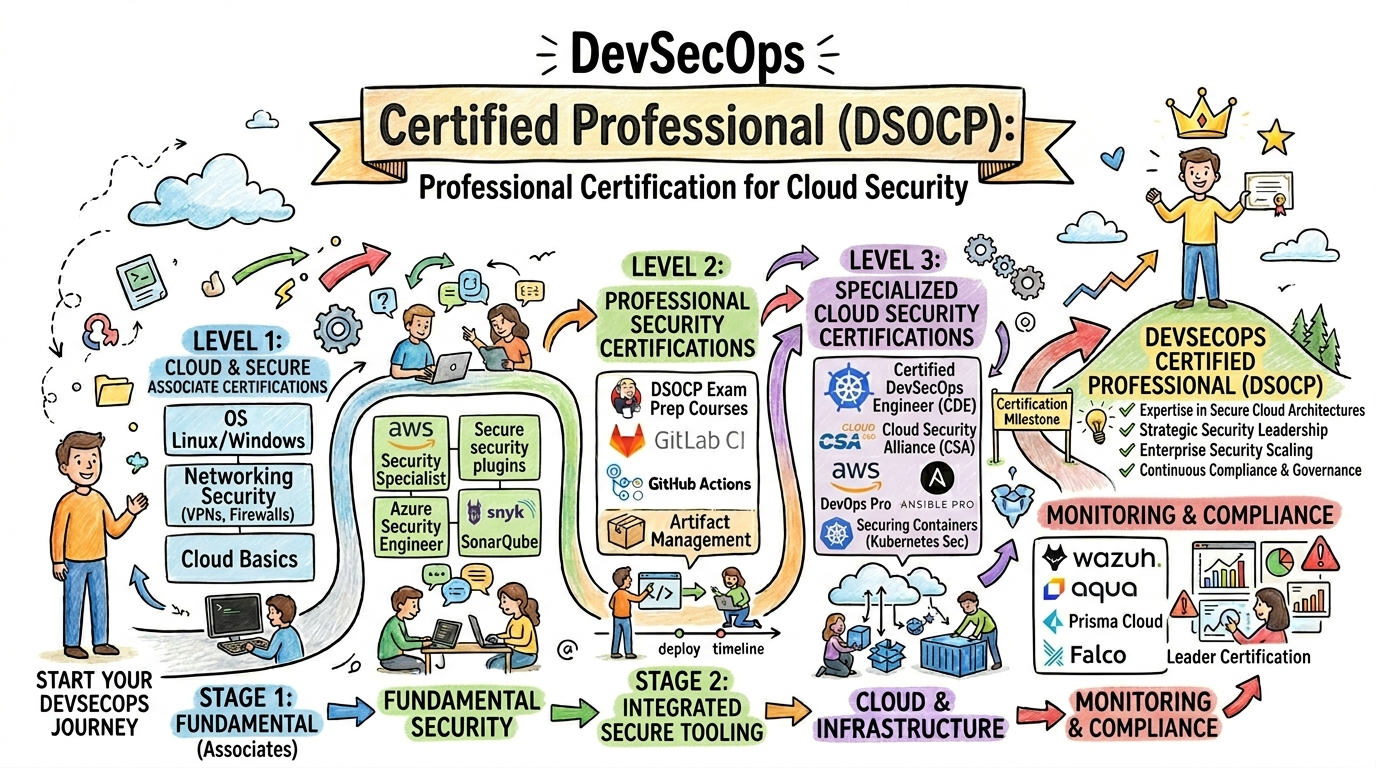
The certification structure is designed to support a professional’s growth from foundational knowledge to architectural mastery. The foundation level introduces the culture of shared responsibility, while the professional level dives deep into tool integration and pipeline security. Advanced levels are available for those aiming to lead entire departments or design complex, multi-cloud security frameworks. These tracks allow you to align your learning with your specific career goals, whether you want to remain a hands-on engineer or transition into a strategic leadership role within the SRE or FinOps domains.
Complete DevSecOps Certified Professional (DSOCP) Certification Table
| Track | Level | Who it’s for | Prerequisites | Skills Covered | Recommended Order |
| Core Security | Foundation | Beginners/Managers | Basic IT Knowledge | Cultural Shift, Basics | 1st |
| Engineering | Professional | DevOps/SREs | Linux & CI/CD | SAST, DAST, SCA | 2nd |
| Architecture | Advanced | Tech Leads | DSOCP Prof. | Policy as Code, IAAC | 3rd |
| Compliance | Specialist | Audit/Security | Cloud Basics | Compliance Automation | Optional |
Detailed Guide for Each DevSecOps Certified Professional (DSOCP) Certification
DevSecOps Certified Professional (DSOCP) – Professional Level
What it is
This certification validates an engineer’s ability to design, implement, and manage secure automation pipelines. It proves you can effectively bridge the gap between development, security, and operations teams.
Who should take it
It is best suited for DevOps engineers, Cloud architects, and Security professionals with at least a year of experience in automated environments who want to specialize in secure delivery.
Skills you’ll gain
- Mastery of Static Application Security Testing (SAST) and Dynamic Testing (DAST).
- Ability to implement Software Composition Analysis (SCA) for third-party libraries.
- Proficiency in securing Docker containers and Kubernetes clusters.
- Expertise in automating secrets management and certificate rotation.
Real-world projects you should be able to do
- Build a Jenkins or GitLab pipeline that automatically fails if a high-severity vulnerability is detected.
- Implement a centralized dashboard for monitoring security threats across multiple microservices.
- Create automated compliance reports for audit-ready infrastructure.
Preparation plan
- 7–14 Days: Focus on the core philosophy and terminology. Review the Shared Responsibility Model and basic security scanning tools.
- 30 Days: Set up a lab environment. Practice integrating scanning tools like SonarQube or Trivy into a sample CI/CD pipeline.
- 60 Days: Deep dive into “Policy as Code” using tools like OPA (Open Policy Agent). Perform end-to-end security audits on a complex application.
Common mistakes
- Focusing only on tools while ignoring the cultural aspect of team collaboration.
- Neglecting the security of the pipeline itself (e.g., leaving hardcoded secrets in scripts).
- Over-complicating security gates, which leads to developers bypassing them to save time.
Best next certification after this
- Same-track option: DevSecOps Expert Level.
- Cross-track option: Certified SRE Professional.
- Leadership option: Engineering Management for Secure Delivery.
Choose Your Learning Path
DevOps Path
This path focuses on speed and stability. You start by mastering CI/CD and then layer on the DSOCP skills to ensure that every release is not just fast, but inherently secure. It is the most common path for engineers working in agile startups and mid-sized tech companies.
DevSecOps Path
This is a dedicated specialization where security is the primary lens. You will spend your time building automated defensive layers and ensuring that “security-left” isn’t just a buzzword. This is perfect for those wanting to work in fintech, healthcare, or government sectors.
SRE Path
Site Reliability Engineering focuses on uptime and scalability. Adding DSOCP knowledge allows you to treat security threats as reliability issues. You will learn to build resilient systems that can withstand both traffic spikes and malicious attacks simultaneously.
AIOps / MLOps Path
In this modern path, you apply security principles to machine learning models and data pipelines. It ensures that the AI models being deployed are not tampered with and that the data used for training remains private and secure according to global standards.
DataOps Path
Data is the lifeblood of any modern enterprise. This path focuses on securing data flows from ingestion to analysis. By combining DataOps with DSOCP, you ensure that sensitive customer data is encrypted and handled securely at every stage of the pipeline.
FinOps Path
FinOps is about cloud cost transparency and optimization. This path integrates security with cost management, ensuring that security tools don’t bloat the cloud budget and that cost-saving measures don’t introduce new security vulnerabilities into the infrastructure.
Role → Recommended DevSecOps Certified Professional (DSOCP) Certifications
| Role | Recommended Certifications |
| DevOps Engineer | DSOCP Professional, Docker/K8s Security |
| SRE | DSOCP Advanced, Chaos Engineering |
| Platform Engineer | DSOCP Professional, Terraform Associate |
| Cloud Engineer | DSOCP Professional, AWS/Azure Security |
| Security Engineer | DSOCP Expert, OSCP |
| Data Engineer | DSOCP Foundation, DataOps Specialist |
| FinOps Practitioner | DSOCP Foundation, FinOps Certified |
| Engineering Manager | DSOCP Foundation, ITIL |
Next Certifications to Take After DevSecOps Certified Professional (DSOCP)
Same Track Progression
After completing the professional level, the logical step is to move toward the “Expert” or “Architect” level. This involves shifting from individual tool management to designing organization-wide security strategies, including zero-trust architectures and advanced threat modeling for distributed systems.
Cross-Track Expansion
Broadening your skills into SRE or Platform Engineering is highly recommended. Understanding how security impacts system reliability and how to build internal developer platforms (IDPs) that have security built-in will make you a much more versatile and highly-paid professional.
Leadership & Management Track
For those looking to move into people management, focusing on certifications that cover project management and security governance is key. You will learn how to lead “security-first” cultures, manage budgets for security tooling, and communicate risk effectively to executive stakeholders.
Training & Certification Support Providers for DevSecOps Certified Professional (DSOCP)
DevOpsSchool
As a leading provider, DevOpsSchool offers deep technical training and a robust community for those pursuing DSOCP. Their curriculum is updated frequently to reflect the shifting landscape of cloud-native security and enterprise requirements.
Cotocus
Cotocus focuses on high-end technical consulting and training, providing hands-on labs that simulate real production environments. This ensures that candidates aren’t just passing a test but are ready to solve actual security challenges on the job.
Scmgalaxy
Scmgalaxy is a vast knowledge hub that provides extensive resources for Software Configuration Management and DevSecOps. It is an excellent platform for finding tutorials, community support, and detailed guides for various security automation tools.
BestDevOps
BestDevOps specializes in career-focused training, helping engineers transition into high-demand roles. Their approach to DSOCP is practical and direct, making it a favorite for busy professionals looking to upskill quickly and efficiently.
DevSecOpsSchool
Specifically focused on the security niche, DevSecOpsSchool provides specialized courses that go deep into the “Sec” part of DevOps. Their training modules are highly granular, covering everything from vulnerability management to compliance-as-code.
Sreschool
Sreschool bridges the gap between reliability and security. Their support for DSOCP candidates involves showing how security automation directly contributes to the overall stability and uptime of high-traffic production systems.
Aiopsschool
Aiopsschool focuses on the future of operations, integrating AI and Machine Learning into the security lifecycle. They help professionals understand how to use predictive analytics to identify and mitigate security threats before they occur.
Dataopsschool
Dataopsschool provides the necessary context for securing data pipelines. Their support ensures that DSOCP candidates understand the unique security requirements of big data environments and distributed database systems.
Finopsschool
Finopsschool helps you balance the “Iron Triangle” of speed, quality, and cost. They provide guidance on how to implement security measures that are cost-effective and align with the financial goals of the modern enterprise.
Frequently Asked Questions (General)
How difficult is the DSOCP exam?
The exam is moderately challenging as it requires a mix of conceptual understanding and practical troubleshooting skills.
How long does it take to prepare?
Most professionals with a background in Linux or DevOps spend about 30 to 60 days of consistent study to feel confident.
Are there any prerequisites for DSOCP?
While there are no hard barriers, having a basic understanding of CI/CD and the Linux command line is highly recommended.
What is the ROI of this certification?
Professionals often see significant salary increases and gain access to roles in high-paying sectors like finance and cybersecurity.
Does the certification expire?
Most technical certifications require renewal or continuing education every 2-3 years to ensure your skills remain current.
Is it recognized globally?
Yes, the skills taught are based on industry-standard tools and practices used by top tech companies worldwide.
Can I take the exam online?
Yes, most providers offer a proctored online exam option for your convenience.
Which tools are covered in the curriculum?
Expect to work with tools like Jenkins, Docker, SonarQube, Vault, and various cloud-native security scanners.
How does this differ from a standard DevOps cert?
Standard DevOps certs focus on delivery speed; DSOCP focuses on making that delivery secure without losing speed.
Is there a practical lab component?
The best training providers include hands-on labs where you actually configure security scans in a live pipeline.
Do I need to be a coder to pass?
You don’t need to be a software developer, but you should be comfortable reading and editing scripts and configuration files.
Is this suitable for freshers?
Freshers can take the foundation level, but the professional level is best suited for those with some internship or job experience.
FAQs on DevSecOps Certified Professional (DSOCP)
How does DSOCP specifically address container security?
What is the focus on Policy as Code within the program?
Does this certification cover cloud-specific security for AWS or Azure?
How does the DSOCP help in achieving SOC2 compliance?
What is the role of automation in the DSOCP assessment?
Can this certification help me move from QA to DevSecOps?
How is secret management handled in the training?
What makes DSOCP different from other security certifications like CISSP?
The DSOCP is uniquely designed to focus on the “engineering” side of security. While other certifications might focus on high-level management or manual penetration testing, DSOCP is about building the systems that keep your code safe automatically. It covers everything from scanning your dependencies for known vulnerabilities to ensuring your Kubernetes environment is hardened against attacks. It is the bridge between the world of hacking and the world of building.
Final Thoughts: Is DevSecOps Certified Professional (DSOCP) Worth It?
If you are looking for a way to future-proof your career, the answer is a resounding yes. The industry has moved past the point where security can be handled by a separate team at the very end of a project. By becoming a DevSecOps Certified Professional, you are proving that you understand the modern reality of software engineering. This path isn’t just about adding a badge to your profile; it’s about gaining the confidence to lead teams in a world where security is everyone’s responsibility. It is a practical, challenging, and highly rewarding investment in your professional journey.
