Introduction
The Master in DevOps Engineering (MDE) is a comprehensive professional framework designed to transform traditional IT professionals into elite engineering leads. This guide is crafted specifically for software engineers, SREs, and technical managers who need to navigate the increasingly complex cloud-native landscape. As organizations move toward platform engineering and automated governance, staying relevant requires more than just knowing a few tools; it requires a deep architectural understanding of the entire delivery lifecycle. This guide provides the clarity needed to evaluate the MDE program and decide how it fits into your long-term career trajectory.
What is the Master in DevOps Engineering (MDE)?
The Master in DevOps Engineering (MDE) represents a holistic approach to modern software delivery, focusing on the integration of development, operations, and security at scale. Unlike basic certifications that focus on syntax, MDE emphasizes production-grade environments, high availability, and the cultural shifts required for enterprise-level success. It exists to bridge the gap between theoretical cloud knowledge and the practical ability to maintain 99.99% uptime in distributed systems. By aligning with modern engineering workflows, it ensures that practitioners can handle the complexities of microservices and container orchestration effectively.
Who Should Pursue Master in DevOps Engineering (MDE)?
This program is ideal for a wide spectrum of professionals, from junior developers looking to break into infrastructure to seasoned System Administrators transitioning into SRE roles. Cloud architects, security professionals, and data engineers will find the cross-functional modules particularly beneficial for breaking down silos within their organizations. In India and across the global tech hubs, engineering managers are also increasingly pursuing MDE to better lead high-performing technical teams. It provides a standardized language for technical excellence that is recognized by multinational corporations and high-growth startups alike.
Why Master in DevOps Engineering (MDE)
As we move through 2026, the demand for “T-shaped” professionals—those with deep expertise in one area and broad knowledge across others—has never been higher. The MDE provides longevity by teaching principles like Infrastructure as Code (IaC) and Observability, which remain constant even as specific tools evolve. Enterprise adoption of hybrid and multi-cloud strategies means that companies are desperate for engineers who can manage complexity without increasing overhead. Investing time in this master-level track offers a significant return on career investment by qualifying you for high-impact, high-compensation leadership roles.
Master in DevOps Engineering (MDE) Certification Overview
The MDE program is delivered via the official [https://www.devopsschool.com/certification/master-in-devops-engineering.html] and is hosted on the devopsschool platform. The certification is structured into logical tiers, moving from fundamental concepts to advanced architectural design and multi-tool orchestration. The assessment approach is heavily weighted toward practical application, requiring candidates to demonstrate competence through labs and real-world scenarios rather than just multiple-choice questions. This ownership-driven structure ensures that every certified professional possesses the hands-on capability to lead a DevOps transformation.
Master in DevOps Engineering (MDE) Certification Tracks & Levels
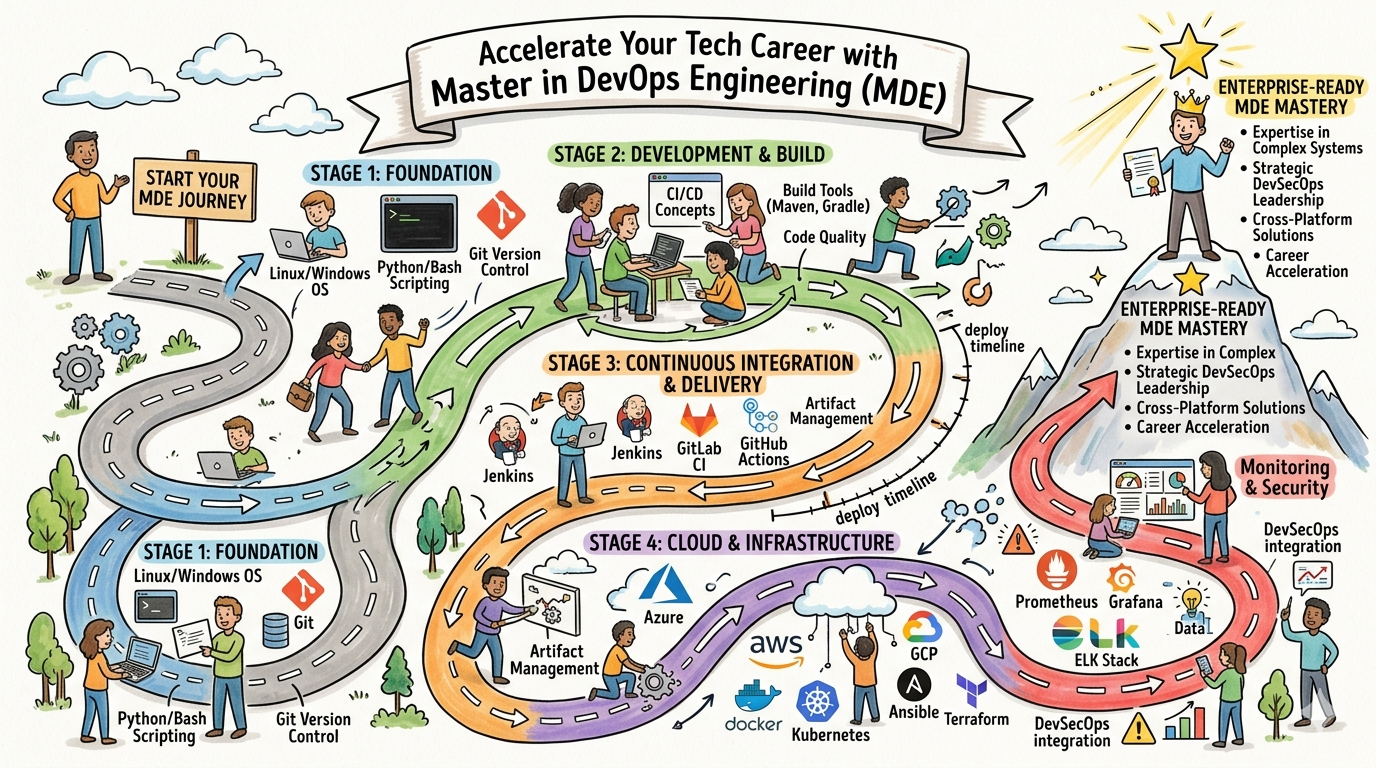
The MDE framework is organized into three primary levels: Foundation, Professional, and Advanced. The Foundation level focuses on the “DevOps Mindset” and core tooling like Git and Docker, while the Professional level dives into CI/CD pipelines and Kubernetes orchestration. The Advanced level is where specialization occurs, allowing engineers to pivot into focused tracks such as SRE, FinOps, or DevSecOps. This tiered progression allows professionals to build their credentials incrementally, matching their learning speed with their actual workplace experience and career goals.
Complete Master in DevOps Engineering (MDE) Certification Table
| Track | Level | Who it’s for | Prerequisites | Skills Covered | Recommended Order |
| Core DevOps | Foundation | Aspiring DevOps Engineers | Basic Linux/Scripting | Git, Docker, CI Basics | 1st |
| SRE Track | Professional | Cloud & Ops Engineers | 2+ years IT Experience | Reliability, Monitoring | 2nd |
| Security | Advanced | Security Analysts | MDE Professional | SAST/DAST, Vault, Compliance | 3rd |
| FinOps | Advanced | Managers & Leads | Cloud Architecture | Cost Optimization, Reporting | 3rd |
| DataOps | Advanced | Data Engineers | SQL/Python Basics | Data Pipelines, Airflow | 3rd |
Detailed Guide for Each Master in DevOps Engineering (MDE) Certification
Master in DevOps Engineering (MDE) – Foundation Level
What it is
This certification validates a professional’s understanding of the core DevOps philosophy and the basic toolchain required for modern software delivery. It ensures you have the baseline technical competency to participate in an automated environment.
Who should take it
It is designed for junior engineers, developers, and traditional system admins who are new to the DevOps ecosystem and want to establish a strong technical foundation.
Skills you’ll gain
- Version control management with Git.
- Containerization fundamentals using Docker.
- Basic automation scripting and Linux administration.
Real-world projects you should be able to do
- Containerize a simple web application.
- Manage a local code repository with branching strategies.
Preparation plan
- 7–14 Days: Focus on Linux commands and Git workflows; use online documentation for quick syntax checks.
- 30 Days: Complete hands-on Docker labs and set up basic Jenkins pipelines on a local machine.
- 60 Days: Build a multi-stage project that integrates code, build, and containerization into a single flow.
Common mistakes
- Ignoring the “culture” aspect and focusing only on tools.
- Skipping Linux command-line fundamentals in favor of GUI tools.
Best next certification after this
- Same-track: MDE Professional Level.
- Cross-track: MDE Cloud Fundamentals.
- Leadership: DevOps Team Lead Foundation.
Master in DevOps Engineering (MDE) – Professional Level
What it is
This level validates your ability to design and implement complex CI/CD pipelines and manage container orchestration at scale. It focuses on the “engine” of the DevOps lifecycle.
Who should take it
Current DevOps engineers and SREs who have at least one year of experience and want to master high-level orchestration and automation strategies.
Skills you’ll gain
- Advanced Kubernetes (K8s) management.
- Complex CI/CD orchestration with Jenkins/GitLab.
- Infrastructure as Code using Terraform or Ansible.
Real-world projects you should be able to do
- Deploy a highly available microservices app on a K8s cluster.
- Automate cloud infrastructure provisioning using Terraform.
Preparation plan
- 7–14 Days: Review YAML structures and Kubernetes architecture; practice kubectl commands daily.
- 30 Days: Build production-grade CI/CD pipelines that include automated testing and security gates.
- 60 Days: Design a disaster recovery plan and implement it using Infrastructure as Code (IaC) tools.
Common mistakes
- Not practicing enough in “broken” environments to learn troubleshooting.
- Over-complicating pipeline logic instead of following DRY principles.
Best next certification after this
- Same-track: MDE Advanced Level.
- Cross-track: MDE DevSecOps Specialist.
- Leadership: Platform Engineering Manager.
Choose Your Learning Path
DevOps Path
The DevOps path is the backbone of the MDE program, focusing on the seamless integration of development and operations. It teaches engineers how to build robust deployment pipelines that reduce time-to-market while maintaining high quality. You will master tools like Jenkins, GitLab CI, and Maven to create automated workflows. This path is perfect for those who enjoy building the “highways” that code travels on from a developer’s laptop to production.
DevSecOps Path
In this path, security is no longer an afterthought but is integrated into every stage of the pipeline. You will learn how to automate security scanning, manage secrets using tools like HashiCorp Vault, and ensure compliance as code. This is essential for organizations in regulated industries like finance or healthcare. Engineers following this path become the gatekeepers of digital integrity and safety.
SRE Path
The Site Reliability Engineering (SRE) path focuses on the scalability and reliability of large-scale systems. You will dive deep into observability, monitoring, and incident response frameworks to keep systems running smoothly. It emphasizes using software engineering principles to solve operational problems, such as automating “toil” out of the system. This path is for those who want to manage high-traffic, world-class digital platforms.
AIOps / MLOps Path
This cutting-edge path combines DevOps practices with Machine Learning and Artificial Intelligence. You will learn how to manage the lifecycle of ML models, including data versioning and automated model deployment. It addresses the unique challenges of non-deterministic code and massive data processing requirements. It is the ideal choice for engineers working in data-heavy or AI-driven organizations.
DataOps Path
DataOps focuses on improving the quality and reducing the cycle time of data analytics. You will learn to apply DevOps principles like versioning and automated testing to data pipelines and ETL processes. This ensures that data scientists and business analysts have access to reliable, fresh data at all times. It is a critical path for modern enterprises that rely on data-driven decision-making.
FinOps Path
The FinOps path addresses the financial side of the cloud, focusing on cost transparency and optimization. You will learn how to monitor cloud spending, identify waste, and implement automated scaling policies to save money. This path bridges the gap between engineering, finance, and business leadership. It is increasingly important as cloud bills become a significant portion of corporate expenses.
Role → Recommended (Topic name) Certifications
| Role | Recommended Certifications |
| DevOps Engineer | MDE Foundation + MDE Professional |
| SRE | MDE Professional + MDE SRE Specialist |
| Platform Engineer | MDE Professional + K8s Advanced |
| Cloud Engineer | MDE Foundation + Cloud Architect Track |
| Security Engineer | MDE Foundation + DevSecOps Specialist |
| Data Engineer | MDE Foundation + DataOps Specialist |
| FinOps Practitioner | MDE Foundation + FinOps Advanced |
| Engineering Manager | MDE Foundation + DevOps Leadership |
Next Certifications to Take After Master in DevOps Engineering (MDE)
Same Track Progression
Once you complete the MDE, the logical next step is deep specialization within your chosen domain. If you are on the DevOps track, this might mean pursuing “Expert” level certifications in specific tools like Kubernetes (CKA/CKAD) or specific cloud providers (AWS DevOps Pro). This deep dive ensures you are not just a generalist, but a subject matter expert who can solve the most difficult technical bottlenecks in your niche.
Cross-Track Expansion
For those looking to become “Principal” engineers, cross-track expansion is the best move. An MDE professional might choose to pick up a DevSecOps or FinOps certification to broaden their impact across the organization. Understanding how security and cost intersect with automation makes you an invaluable asset to the C-suite. This breadth of knowledge allows you to design systems that are not just fast, but also secure and cost-efficient.
Leadership & Management Track
If your goal is to move into people or project management, you should transition toward leadership certifications. These focus on team topology, value stream mapping, and the business ROI of technical decisions. You will learn how to manage technical debt and build a culture of continuous improvement. This path is designed for those who want to shape the strategy and direction of entire engineering departments.
Training & Certification Support Providers for Master in DevOps Engineering (MDE)
DevOpsSchool
As the primary provider for MDE, DevOpsSchool offers an extensive curriculum that covers everything from basics to advanced orchestration. Their trainers are industry veterans who bring real-world scenarios into the virtual classroom. They provide a robust lab environment that allows students to practice without the fear of breaking production systems. It is the go-to destination for comprehensive DevOps education.
Cotocus
Cotocus is known for its highly personalized training approach and its focus on enterprise-level cloud migrations. They specialize in helping professionals understand the nuances of hybrid cloud environments and complex architectural patterns. Their support system is geared toward helping candidates pass rigorous certification exams on the first attempt. They are a great choice for those needing extra mentorship.
Scmgalaxy
Scmgalaxy is a community-driven platform that offers a wealth of resources for those pursuing the MDE track. They provide a massive library of tutorials, interview questions, and practice sets that supplement the formal certification material. Their focus on “Supply Chain Management” in the context of DevOps is particularly useful for understanding modern CI/CD. It’s an excellent hub for continuous learning.
BestDevOps
BestDevOps focuses on the practical “how-to” of the industry, offering bite-sized learning modules that fit into a busy professional’s schedule. Their training for MDE emphasizes tool integration and the elimination of manual silos. They are highly regarded for their updated content that reflects the very latest versions of popular DevOps tools. This provider is perfect for engineers who need up-to-date, actionable knowledge.
devsecopsschool
This provider specializes exclusively in the security aspect of the MDE framework. They offer deep-dive courses into automated security testing, container security, and cloud compliance. Their goal is to turn standard DevOps engineers into security champions who can protect the entire pipeline. If you are targeting the DevSecOps track, this is your primary specialized resource.
sreschool
Sreschool is dedicated to the principles of Site Reliability Engineering and system availability. Their support for the MDE program focuses on observability, error budgets, and post-mortem analysis. They teach engineers how to build systems that heal themselves and scale gracefully under pressure. It is the ideal place for those who want to master the operational side of the “Master” track.
aiopsschool
Aiopsschool provides the bridge between traditional operations and artificial intelligence. Their curriculum covers how to use machine learning to predict outages and automate incident response. They are at the forefront of the AIOps movement, making them a key partner for MDE candidates looking at the future of tech. Their labs involve real data sets and predictive modeling tools.
dataopsschool
Dataopsschool focuses on the intersection of big data and DevOps automation. They provide the specific training needed to manage high-velocity data pipelines and ensure data integrity. Their support for MDE candidates includes hands-on experience with tools like Airflow and Snowflake. This is the best resource for data engineers who want to adopt an agile, automated mindset.
finopsschool
Finopsschool addresses the growing need for cloud financial management within the MDE program. They offer specialized modules on cloud billing APIs, tagging strategies, and unit economics. Their training helps engineers speak the language of finance, ensuring that technical scaling doesn’t lead to financial ruin. It is an essential stop for any future engineering lead or manager.
Frequently Asked Questions (General)
How difficult is the Master in DevOps Engineering (MDE)?
The difficulty is moderate to high because it requires a mix of coding, networking, and system design knowledge. It is designed to be challenging to ensure that the certification carries real weight in the industry.
What are the prerequisites for starting the MDE?
A basic understanding of Linux and at least one programming language is highly recommended. However, the Foundation level is designed to help beginners build these skills from the ground up.
How long does it typically take to complete the MDE?
Most professionals complete the full master track in 4 to 6 months, depending on their existing experience and the amount of time they can dedicate to hands-on labs.
Is there a high ROI for this certification in India?
Yes, DevOps is one of the highest-paying roles in the Indian tech market. Certified MDE professionals often see significant salary hikes and better job opportunities in top-tier MNCs.
Can I take the exams online?
Yes, the certification exams are typically proctored online, allowing you to take them from anywhere in the world.
Do I need a computer science degree for MDE?
While helpful, it is not strictly necessary. Many successful MDE professionals come from diverse backgrounds and use the certification to prove their technical competence.
How often does the MDE curriculum get updated?
The curriculum is reviewed and updated at least twice a year to ensure it reflects the latest tool versions and industry best practices.
Is there a community for MDE students?
Yes, there are several active forums and Slack channels where students and alumni share knowledge and job leads.
Does the certification expire?
Most professional certifications require renewal every 2-3 years or proof of continuing education to ensure your skills stay sharp.
What is the passing score for the MDE exams?
Typically, you need a score of 70% or higher to pass, though this can vary slightly depending on the specific track.
Are there lab-based questions in the exam?
Yes, the Professional and Advanced levels include lab scenarios where you must solve real-world problems in a live environment.
How do I verify my MDE certification?
You will receive a digital badge and a unique ID that employers can use to verify your credentials on the official portal.
FAQs on Master in DevOps Engineering (MDE)
How does MDE differ from a standard AWS or Azure certification?
Which MDE track is best for a developer?
Is Kubernetes included in the MDE Foundation?
Do I need to know Python for MDE?
How does the MDE help with career growth?
Can a manager benefit from MDE?
Is there a discount for bulk team certifications?
Does MDE cover AI and Machine Learning?
The MDE is tool-agnostic, meaning it teaches you the principles that apply to any cloud provider, whereas AWS/Azure certs are platform-specific. Developers should usually start with the Core DevOps path to learn how to automate their own workflows. Kubernetes is introduced in the Foundation level but explored deeply in the Professional level. While Python is not mandatory, it is highly recommended for automation. MDE qualifies you for lead roles by proving you understand the full delivery lifecycle. Managers gain the technical literacy needed to lead high-performing teams effectively. Bulk discounts are often available for corporate teams. Finally, AIOps and MLOps are specialized tracks available for advanced students.
Final Thoughts: Is Master in DevOps Engineering (MDE) Worth It?
From a mentor’s perspective, the Master in DevOps Engineering (MDE) is more than just a certificate; it is a rigorous career pivot. In an industry where “DevOps” is often used as a buzzword, having a structured, master-level validation of your skills sets you apart from the crowd. It forces you to move beyond the tools you use every day and understand the architectural “why” behind them. If you are committed to the long-term path of becoming a technical lead or architect, the MDE provides the map and the tools to get there. It requires effort and discipline, but the clarity and career confidence you gain are well worth the investment.
