Introduction
The cloud-native landscape requires robust protection mechanisms at every layer of the modern deployment pipeline. The Azure Security Engineer Associate (AZ-500) certification serves as a definitive technical benchmark for professionals aiming to validate their cloud security engineering expertise. This guide is crafted for engineers, architects, and technical managers looking to navigate the complexities of cloud defense strategies within enterprise frameworks. By aligning security principles with platform engineering and DevOps paradigms, this comprehensive analysis helps professionals make highly informed career decisions. To accelerate your preparation, you can explore the specialized training modules available through the official Azure Security Technologies AZ-500 Course framework. Additionally, modern organizations looking to integrate intelligent automation with cloud infrastructure can discover cross-functional security strategies at aiopsschool to enhance overall system resilience.
What is the Azure Security Engineer Associate (AZ-500)?
The Azure Security Engineer Associate (AZ-500) designation represents a comprehensive validation of an engineer’s capability to implement enterprise-grade security controls. It exists because theoretical knowledge is insufficient when protecting multi-tenant, cloud-native enterprise environments from sophisticated attack vectors. This program focuses heavily on production-ready configurations, identity management, threat protection, and data encryption practices. It aligns directly with modern automated workflows, continuous integration pipelines, and strict infrastructure-as-code principles. By mastering this blueprint, engineers shift from reactive troubleshooting to building proactive, resilient cloud architectures.
Who Should Pursue Azure Security Engineer Associate (AZ-500)?
This certification path is designed for systems engineers, cloud architects, site reliability engineers, and dedicated security operations professionals. Beginners looking for a structured entry into cloud defense will find a clear technical roadmap, while senior engineers can formalize their production experience. Engineering managers and technical leaders benefit by gaining the precision required to govern compliance, risk, and architectural standards. On both a global scale and within the rapidly expanding technology hubs of India, the demand for certified security professionals remains exceptionally high. Organizations across sectors require qualified talent to safeguard sensitive workloads and navigate complex compliance landscapes.
Why Azure Security Engineer Associate (AZ-500)
Enterprise adoption of multi-cloud and hybrid architectures ensures that security engineering remains a core, recession-proof technology discipline. The skills verified by this track do not deprecate when individual software tools change, as they cover foundational defense-in-depth methodologies. Investing time into this certification offers a substantial return on effort by positioning professionals for high-impact platform roles. It provides the deep architectural insight needed to control access, manage cryptographic keys, and respond to incidents effectively. Ultimately, it equips engineers with the long-term credibility required to lead major enterprise cloud transformations securely.
Azure Security Engineer Associate (AZ-500) Certification Overview
The training program for this track is delivered comprehensively via the official course options and hosted on the devopsschool platform. The assessment approach focuses on practical, scenario-based performance testing alongside rigorous technical multiple-choice questions. Ownership of the certification rests with Microsoft, ensuring that the curriculum evolves continuously with real-world security updates. The operational structure evaluates a candidate’s mastery across identity governance, network defense, security posture management, and data protection. This ensures that a certified professional can instantly manage enterprise security infrastructure without requiring extensive organizational hand-holding.
Azure Security Engineer Associate (AZ-500) Certification Tracks & Levels
The learning framework progresses systematically from foundational concepts to advanced, enterprise-grade engineering practices. At the foundational level, candidates learn core identity boundaries, basic networking policies, and cloud governance frameworks. The professional level incorporates deep implementation strategies for threat detection, container security, and hybrid network architectures. Advanced specializations branch out into integrating security tightly with automated DevOps pipelines, platform engineering, and financial cloud optimization. This clear delineation of levels allows professionals to align their continuous upskilling path directly with long-term career progression goals.
Complete Azure Security Engineer Associate (AZ-500) Certification Table
| Track | Level | Who it’s for | Prerequisites | Skills Covered | Recommended Order |
| Cloud Security Foundation | Baseline | Junior Engineers & Admins | Basic Cloud Knowledge | Identity Management, RBAC, Core Networking | 1st |
| Azure Security Engineer | Associate (AZ-500) | DevOps, SRE, Security Engineers | Cloud Admin Skills | Threat Protection, Data Encryption, App Security | 2nd |
| Advanced Cloud Security | Expert Architecture | Senior Architects & Leads | AZ-500 or Equivalent | Enterprise Governance, DevSecOps, Hybrid Architecture | 3rd |
Detailed Guide for Each Azure Security Engineer Associate (AZ-500) Certification
Azure Security Engineer Associate (AZ-500) – Associate Level
What it is
This certification validates an engineer’s ability to implement secure controls, maintain a strong corporate security posture, and manage identity and access across complex Azure environments.
Who should take it
Cloud engineers, DevOps practitioners, SREs, and security analysts who want to specialize in safeguarding enterprise Microsoft Azure environments.
Skills you’ll gain
- Configuring Microsoft Entra ID and managing secure enterprise identities.
- Implementing advanced platform protection, including NSGs, Azure Firewall, and Front Door.
- Securing data repositories, configuring storage encryption, and managing Azure Key Vault.
- Configuring Microsoft Defender for Cloud and orchestrating automated security alerts.
Real-world projects you should be able to do
- Build a secure zero-trust hybrid network architecture using hub-and-spoke models.
- Automate continuous compliance monitoring and threat detection for Kubernetes clusters.
- Architect an enterprise-wide key rotation policy using Azure Key Vault and managed identities.
Preparation plan
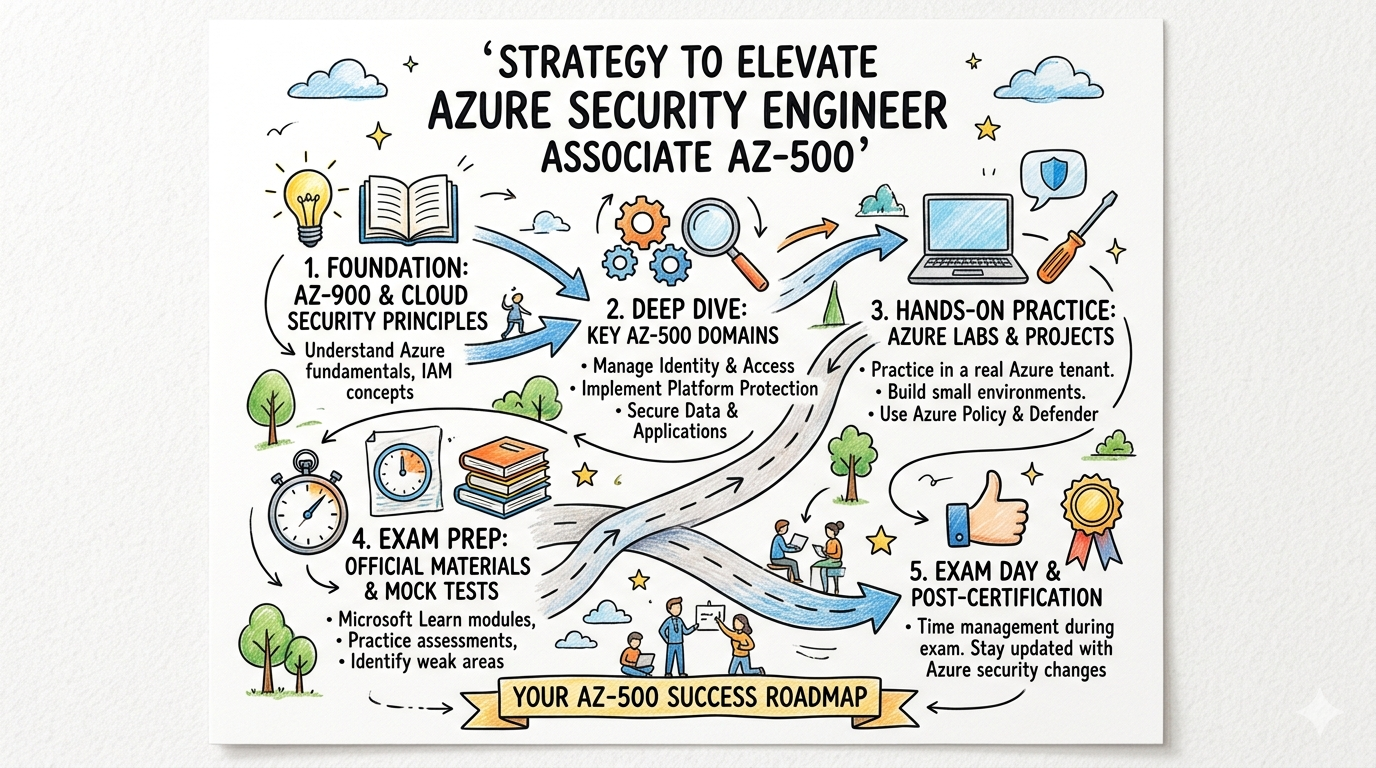
- 7-14 days: Focus on a comprehensive review of core exam domains, take initial practice exams, identify immediate knowledge gaps, and study official learn documentation.
- 30 days: Deep dive into setting up practical sandbox labs for identity management, network security policies, and storage access controls while reviewing architectural best practices.
- 60 days: Conduct exhaustive simulated mock exams, build end-to-end production-grade security implementations, refine automation scripts, and thoroughly review case study patterns.
Common mistakes
- Over-relying on theoretical studying without configuring hands-on sandbox lab environments.
- Neglecting a deep understanding of Microsoft Entra ID governance and hybrid identity synchronization.
- Misunderstanding the shared responsibility model regarding cloud data protection boundaries.
Best next certification after this
- Same-track option: Microsoft Certified: Cybersecurity Architect Expert (SC-100)
- Cross-track option: Azure Solutions Architect Expert (AZ-305)
- Leadership option: Certified Information Systems Security Professional (CISSP)
Choose Your Learning Path
DevOps Path
Focus on integrating automated testing, policy-as-code, and identity controls into continuous deployment models. Engineers learn to enforce security rules during infrastructure provisioning using automated pipelines. This ensures zero-drift configuration across all environments without manual human intervention. It builds a fast, secure, and reliable deployment culture that minimizes human error.
DevSecOps Path
This pathway places security directly into the heart of the software development lifecycle. Professionals master shifting security left by embedding vulnerability scanning, secrets management, and compliance checks directly into build pipelines. It eliminates silos between security teams and development squads entirely. This approach establishes a continuous, automated posture of defense throughout production lifecycles.
SRE Path
Focuses on combining platform reliability with robust defensive mechanisms to handle infrastructure failures gracefully. Site reliability engineers use these skills to build highly fault-tolerant architectures that resist external denial-of-service vectors. They monitor security telemetries alongside system performance metrics to ensure continuous application uptime. This creates an unshakeable operational baseline for the enterprise.
AIOps Path
Focuses on using artificial intelligence to automate incident response and system telemetry monitoring. Engineers leverage machine learning models to detect anomalies in infrastructure behavior and flag security breaches in real-time. This pathway reduces the time to remediate complex infrastructure failures through smart automation. It shifts operations from manual tracking to predictive management.
MLOps Path
This specialized route secures the lifecycle of machine learning pipelines, model training datasets, and production endpoints. Professionals implement data governance, protect training environments from tampering, and secure model inference APIs. It prevents unauthorized access to proprietary corporate algorithms and sensitive underlying datasets. This pathway bridges the gap between data science and enterprise defense.
DataOps Path
Tailored for professionals who govern, manage, and protect enterprise data pipelines and analytics platforms. It emphasizes implementing cell-level encryption, masking sensitive user data, and managing access to large-scale data lakes. Engineers ensure compliance with strict data protection acts while maintaining pipeline agility. This enables secure, high-speed data delivery across the enterprise.
FinOps Path
Merges security architecture optimization with financial accountability and cloud cost management. Professionals ensure that security controls, logging mechanisms, and threat monitoring do not cause budget overruns. They design cost-effective data retention policies for compliance audits without sacrificing system visibility. This establishes a highly optimized, lean, and secure cloud footprint.
Role → Recommended Azure Security Engineer Associate (AZ-500) Certifications
| Role | Recommended Certifications |
| DevOps Engineer | Azure Security Engineer Associate (AZ-500), Azure DevOps Engineer Expert |
| SRE | Azure Security Engineer Associate (AZ-500), Azure Administrator Associate |
| Platform Engineer | Azure Security Engineer Associate (AZ-500), Azure Solutions Architect Expert |
| Cloud Engineer | Azure Security Engineer Associate (AZ-500), Azure Network Engineer Associate |
| Security Engineer | Azure Security Engineer Associate (AZ-500), Cybersecurity Architect Expert |
| Data Engineer | Azure Security Engineer Associate (AZ-500), Azure Data Engineer Associate |
| FinOps Practitioner | Azure Security Engineer Associate (AZ-500), Cloud Digital Leader Baseline |
| Engineering Manager | Azure Security Engineer Associate (AZ-500), Azure Fundamentals Baseline |
Next Certifications to Take After Azure Security Engineer Associate (AZ-500)
Same Track Progression
Focuses on deep specialization within the cloud security paradigm. Engineers typically advance toward the Microsoft Certified: Cybersecurity Architect Expert credential to design holistic corporate blueprints. This pathway ensures mastery over enterprise-wide zero-trust architectures, threat modeling, and compliance strategies.
Cross-Track Expansion
Encures broadening skills across alternative operational domains like platform engineering or multi-cloud administration. Professionals often target the Azure Solutions Architect Expert or advanced Kubernetes certification paths. This creates a versatile engineer capable of designing infrastructure that is both scalable and fundamentally secure.
Leadership & Management Track
Designed for those transitioning from hands-on engineering to strategic technical leadership roles. Professionals focus on corporate governance frameworks, risk management, and security team alignment strategies. Attaining credentials like CISSP helps validate an engineer’s ability to manage large budgets and technical security operations.
Training & Certification Support Providers for Azure Security Engineer Associate (AZ-500)
DevOpsSchool
DevOpsSchool provides a highly comprehensive training ecosystem tailored explicitly for the Azure Security Engineer Associate (AZ-500) exam. Their production-focused approach combines extensive theoretical concepts with rigorous, hands-on laboratory environments. The enterprise-grade curriculum ensures that working professionals master real-world cloud defense, identity governance, and advanced infrastructure protection techniques. Led by senior industry practitioners, the interactive training sessions offer deep insights into modern enterprise security workflows and automated continuous deployment pipelines. Students receive access to rich study materials, recorded sessions, and realistic simulated mock exams that closely mimic the official assessment. This robust educational framework effectively bridges the gap between foundational security theories and practical, real-world deployment scenarios.
Cotocus
Cotocus stands out as a premier technology training provider specializing in delivering specialized cloud security and infrastructure masterclasses. Their instructional model focuses heavily on practical implementation strategies, enabling engineers to deploy robust defense mechanisms across corporate cloud environments. For the AZ-500 track, they offer an immersive learning path that covers Microsoft Entra ID, network architecture defense, and data encryption. The curriculum is regularly updated to reflect the latest engineering shifts and real-world security challenges faced by global organizations. By providing structured mentorship and extensive sandbox environments, they ensure that candidates gain the confidence required to pass the exam and manage complex production architectures seamlessly.
Scmgalaxy
Scmgalaxy is a widely recognized community and training hub deeply rooted in software configuration management, DevOps, and cloud security practices. They provide extensive learning resources, technical tutorials, and expert-led bootcamps designed to help candidates conquer the AZ-500 certification. Their training philosophy emphasizes the integration of security directly into automation pipelines, making it ideal for modern platform engineers. Through comprehensive study guides, practical lab exercises, and active community forums, they assist professionals in mastering threat protection and compliance monitoring. Their structured programs ensure that learners understand how to implement security controls without hindering development velocity or continuous delivery workflows.
BestDevOps
BestDevOps offers specialized, high-impact instructional bootcamps engineered to help technical professionals master cloud infrastructure security. Their tailored curriculum for the Azure Security Engineer track strips away unnecessary marketing fluff, focusing entirely on core engineering principles. Students dive deep into configuring advanced firewalls, managing cryptographic keys, and setting up centralized security monitoring solutions. The platform provides interactive, mentor-led environments where professionals can practice resolving real-world security incidents. This direct, practical training format ensures that candidates develop the actual troubleshooting skills needed in enterprise environments while preparing efficiently for the rigorous certification exam.
devsecopsschool
devsecopsschool focuses exclusively on the critical intersection of software development, operations automation, and advanced infrastructure security. Their training programs are perfectly aligned with the AZ-500 blueprint, emphasizing a shift-left security methodology across cloud-native platforms. Learners are taught how to automate compliance audits, embed vulnerability scanners into code pipelines, and protect distributed applications. The platform provides a rich selection of engineering labs that challenge students to secure cloud environments from real-world threat vectors. This continuous focus on automated security workflows prepares engineers to assume specialized DevSecOps roles within modern corporate engineering teams.
sreschool
sreschool approaches cloud security through the unique lens of system reliability, operational resilience, and automated platform engineering. Their specialized curriculum helps engineers understand that security breaches are fundamental threats to overall system availability and performance. For the AZ-500 certification, they provide deep technical insights into building fault-tolerant access structures and monitoring security telemetry alerts. The training emphasizes constructing robust defensive architectures that can withstand sophisticated distributed attacks while maintaining operational uptime. Through practical engineering scenarios, they guide professionals to develop a proactive, resilience-focused mindset essential for modern site reliability engineering roles.
aiopsschool
aiopsschool delivers cutting-edge training focused on leveraging artificial intelligence and machine learning to optimize modern cloud infrastructure operations. Their unique security programs explain how to utilize intelligent automation to detect anomalies, analyze threat patterns, and automate incident response. For candidates pursuing the AZ-500 track, they show how to integrate smart alerting systems with Microsoft Defender for Cloud. This specialized training allows engineers to move beyond static security rules and embrace predictive, data-driven security operations. Their masterclasses ensure that professionals are fully prepared to manage next-generation, AI-assisted security frameworks within enterprise cloud environments.
dataopsschool
dataopsschool provides elite training paths designed specifically for professionals tasked with managing, processing, and safeguarding large-scale enterprise data. Their security modules align directly with the data protection requirements of the AZ-500 certification blueprint. Learners discover how to implement granular access controls, configure storage encryption, and secure complex distributed data analytics pipelines. The comprehensive curriculum addresses real-world compliance challenges, ensuring that data engineers can protect sensitive information without compromising velocity. By mastering these secure data operations, professionals become invaluable assets to organizations navigating strict global data governance frameworks and privacy regulations.
finopsschool
finopsschool is a pioneer in educating cloud professionals on the critical balance between financial accountability, architecture optimization, and security infrastructure. Their specialized courses teach engineers how to build highly secure environments without causing massive cloud budget inflation. For the AZ-500 curriculum, they provide practical guidance on optimizing the costs of log retention, security information management, and continuous monitoring tools. Students learn to evaluate the financial return on security investments and choose cost-effective defensive configurations. This specialized training produces well-rounded professionals who can protect enterprise assets while maintaining an exceptionally lean cloud budget footprint.
Frequently Asked Questions (General – 12 questions, “bold all questions”)
- How difficult is the Azure Security Engineer Associate (AZ-500) exam compared to other cloud certifications?The exam is widely considered moderately difficult to advanced because it requires a profound understanding of deep technical implementations rather than just broad theoretical concepts. Candidates must possess practical experience in configuring networking, access management, and logging systems to pass successfully.
- What is the recommended time required to prepare for this security certification?For working engineers with baseline cloud administration experience, a timeline of 30 to 60 days of consistent study is highly recommended. Dedicating roughly 10 to 12 hours per week allows sufficient time to cover all core domains and complete practical labs.
- Are there any mandatory prerequisites before registering for the AZ-500 exam?There are no strict formal prerequisite certifications required by Microsoft before sitting for the exam. However, having a solid foundational knowledge of core Azure administration concepts or holding the AZ-104 credential is highly beneficial for candidate success.
- What is the measurable return on investment for obtaining this specific credential?Professionals holding this certification frequently witness a substantial increase in career opportunities and marketability within platform engineering and DevSecOps domains. It serves as verified proof to enterprise employers that you can safeguard complex cloud infrastructure against modern threat vectors.
- In what sequence should I take Azure certifications to build a strong security career?A highly effective sequence begins with the AZ-104 certification to master core administration. Following that baseline, completing the AZ-500 certification establishes deep security competence, which prepares you perfectly for the expert-level SC-100 cybersecurity architecture track.
- Does the AZ-500 certification hold long-term value for engineering managers?Yes, it provides engineering leaders with the precise technical vocabulary and framework knowledge needed to govern engineering teams effectively. It allows managers to make strategic risk management decisions and align infrastructure deployments with global compliance standards.
- How long does the Azure Security Engineer Associate credential remain active?The certification remains valid for exactly one year from the date of passing the exam. Microsoft provides a free, unproctored online renewal assessment through their learn platform annually to keep your skills updated with emerging cloud features.
- What types of questions should candidates expect during the official exam?The assessment utilizes a diverse mix of multiple-choice questions, drag-and-drop scenarios, case studies, and performance-based multi-step problem-solving tasks. This comprehensive testing structure ensures that candidates understand how to apply theoretical frameworks to complex production environments.
- Can I pass the AZ-500 examination relying solely on practice test dumps?Relying exclusively on exam dumps is a high-risk approach that frequently leads to failure during the actual test. The exam incorporates detailed case studies and situational problems that require deep analytical skills and actual hands-on configuration experience.
- How does this certification align with global and regional compliance standards?The curriculum covers the implementation of governance baselines that align with major global frameworks such as GDPR, HIPAA, and ISO standards. It teaches engineers how to utilize built-in cloud compliance tools to automate continuous auditing across enterprise resources.
- Is hands-on sandbox laboratory experience absolutely critical to passing?Yes, hands-on lab practice is completely indispensable for mastering the practical domains of the exam blueprint. Configuring real policies, managing key vaults, and setting up firewalls in a sandbox environment reinforces the operational skills tested during the exam.
- What is the passing score required to achieve this technical associate title?Candidates must achieve a minimum scaled score of 700 out of 1000 to pass the certification examination. Any score equal to or above this threshold demonstrates sufficient competence to manage and secure enterprise Azure deployments.
FAQs on Azure Security Engineer Associate (AZ-500) (8 Focused Q&A in 100 words “bold all questions” )
- What are the primary technical domains evaluated within the official AZ-500 certification blueprint?The certification framework focuses heavily on four distinct operational domains distributed across cloud infrastructure security. It evaluates your capacity to manage identity and access management solutions, which comprises roughly thirty percent of the exam content. Following identity governance, candidates are tested on implementing advanced platform protection strategies including network security and container isolation frameworks. The remaining portions of the exam thoroughly assess your ability to secure data repositories, manage cryptographic keys, and configure advanced threat protection mechanisms using cloud monitoring suites. Mastering all four areas ensures a complete defensive baseline.
- How does Microsoft Entra ID feature within the identity governance portion of the exam?Microsoft Entra ID forms the absolute backbone of the identity management domain within this certification path. Candidates must demonstrate an advanced ability to configure multi-tenant environments, manage hybrid identity synchronization, and enforce conditional access policies. The exam heavily tests your understanding of role-based access control strategies and administrative units to ensure least privilege principles. Additionally, you must master setting up identity protection tools, configuring privileged identity management workflows, and evaluating access reviews. Understanding these components is critical because identity serves as the primary security perimeter in modern cloud-native architectures.
- What specific network defense mechanisms must an engineer master for this certification?The platform protection domain requires engineers to possess a deep understanding of multi-tiered network isolation strategies. You must be highly proficient in configuring and managing network security groups, application security groups, and enterprise-grade Azure Firewalls. The exam also assesses your practical capability to deploy secure web application firewalls, manage front door services, and configure private endpoints. Candidates need to understand how to establish secure hybrid connectivity using virtual private networks and dedicated ExpressRoute connections. Mastering these elements allows you to design robust perimeter defenses that prevent unauthorized lateral movement across environments.
- How are cryptographic keys and data encryption strategies evaluated during the test?Data security is a major pillar of the assessment, requiring candidates to secure both structured and unstructured storage services. You must know how to configure double encryption, manage storage access keys, and implement shared access signatures securely. A large portion of this domain focuses on the configuration, management, and governance of Azure Key Vault systems. This includes orchestrating automated key rotation schedules, managing cryptographic secrets, and implementing hardware security module options. Certified engineers must ensure that data remains encrypted at rest, in transit, and during processing across all corporate assets.
- What role does Microsoft Defender for Cloud play in managing security posture?Microsoft Defender for Cloud serves as the central operational hub for continuous security posture management and advanced threat detection. The certification requires you to understand how to configure security policies, interpret secure scores, and remediate automated recommendations. Candidates must demonstrate proficiency in setting up advanced threat alerts for virtual machines, container registries, and SQL databases. You will also learn to integrate log repositories with centralized security information and event management solutions like Microsoft Sentinel. This ensures that an engineer can build a unified monitoring ecosystem to triage real-time alerts.
- How does the AZ-500 blueprint address container security and Kubernetes workloads?With the rapid rise of cloud-native computing, container security has become an essential component of the certification curriculum. Engineers must know how to safeguard Azure Kubernetes Service clusters by enforcing network isolation policies and managing cluster access. The exam evaluates your knowledge of scanning container images within container registries to detect software vulnerabilities before production deployment. You must also understand how to apply automated azure policies directly to Kubernetes clusters to ensure governance compliance. This ensures that microservice architectures remain highly secure against internal misconfigurations and external security threats.
- What is the practical difference between the AZ-104 and the AZ-500 examinations?While both certifications focus on the same cloud ecosystem, their underlying operational objectives and technical lenses differ significantly. The AZ-104 certification validates an administrator’s ability to provision, scale, monitor, and maintain general infrastructure components. In contrast, the AZ-500 certification focuses entirely on hardening that infrastructure, enforcing zero-trust architectures, and mitigating advanced vulnerabilities. The security exam requires a much deeper dive into access control mechanisms, encryption standards, and continuous compliance auditing. Essentially, administration builds the infrastructure, while security engineering ensures that the built infrastructure is fully protected.
- How can professionals leverage this certification to successfully transition into a DevSecOps career track?Obtaining this certification is an exceptional catalyst for entering the DevSecOps domain because it bridges security with automation. It provides you with the foundational knowledge required to translate manual compliance rules into automated infrastructure-as-code scripts. You learn to handle secrets securely using key vaults, which prevents hardcoded credentials from entering version control systems. This expertise enables you to collaborate effectively with development teams to embed automated scanning and vulnerability checks into continuous integration pipelines. Consequently, you transition from a traditional security analyst to an automated cloud infrastructure security engineer.
Final Thoughts: Is Azure Security Engineer Associate (AZ-500) Worth It?
Achieving the Azure Security Engineer Associate (AZ-500) credential requires genuine technical discipline and dedication, but its long-term value to your career is clear. In an era where data breaches can disrupt global operations instantly, organizations do not need theoretical compliance officers; they require engineers who can build secure systems. This certification provides you with a structured, verified framework to handle complex identity, networking, and data challenges under pressure. It is not a golden ticket that guarantees immediate promotion, but it acts as a strong professional foundational pillar. If you are committed to mastering the actual mechanics of cloud defense, this certification is legacy-building and undeniably worth the investment of your time.
