



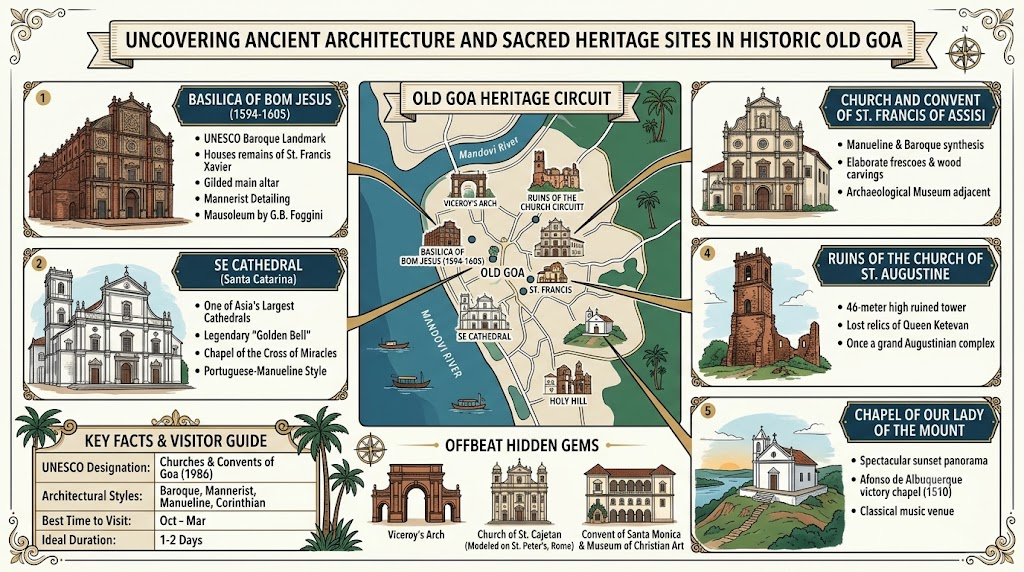
Introduction
While millions of travelers flock to coastal party hubs and sun-drenched beach shacks, a profoundly different Goa waits just a few kilometers inland along the banks of the Mandovi River. Old Goa—known historically as Velha Goa—stands as a monumental testament to a golden age when it was celebrated as the “Rome of the Orient.” Stripping away the commercial surface noise of modern tourism reveals a tranquil sanctuary where towering 16th-century basilicas, weathered laterite arches, and cobblestone plazas tell stories of empire, faith, and artistic fusion.
Stepping into Old Goa offers an authentic cultural anchor for travelers seeking depth beyond the shorelines. Here, Iberian Renaissance and Mannerist architecture merge seamlessly with the indigenous craft of Konkani stonemasons. Whether you are walking through silent vaulted naves or watching the sun set over riverside ruins, Old Goa offers an unforgettable encounter with living history.
Why Old Goa is a must-visit city
Old Goa holds exceptional historical and architectural weight as the former capital of Portuguese India from 1510 until pestilence forced its abandonment in the 18th century. Recognized globally as a UNESCO World Heritage site, this compact historic enclave houses one of the densest collections of Renaissance, Baroque, and Manueline religious monuments in Asia. Its strategic position along the Mandovi River estuary allowed it to serve as the beating heart of global spice trade routes linking Lisbon, Mozambique, Ormuz, and Macau.
The travel circuit within Old Goa is remarkably navigable and pedestrian-friendly. Situated just 10 kilometers east of Goa’s current capital, Panaji, the area connects smoothly via four-lane highways, frequent local public buses, and scenic riverways. It provides an essential bridge between the high-energy beach sectors of North Goa and the tranquil inland ecotourism circuits of the Western Ghats.
| Travel Attribute | Key Fact / Detail |
| UNESCO Designation | Churches and Convents of Goa (Inscribed 1986) |
| Primary Architectural Styles | Baroque, Mannerist, Manueline, and Corinthian |
| Closest Transit Hubs | Karmali Railway Station (3 km), Panaji Bus Stand (10 km) |
| Ideal Visit Duration | 1 Full Day (or 2 Days for deep architectural exploration) |
| Best Travel Season | October through March (Cool, pleasant weather) |
Best Places or Experiences
Basilica of Bom Jesus
Constructed between 1594 and 1605, the Basilica of Bom Jesus represents one of the finest examples of Jesuit architecture in South Asia. Unlike many colonial structures in the region finished with white lime plaster, the Basilica’s exterior displays exposed dark red laterite stone, giving it a weathered and majestic appearance. Inside, delicate marble floors lead toward an extraordinarily carved gilt altar that towers over the nave, showcasing intricate Mannerist detailing crafted by master European and Indian artisans.
The Basilica is world-renowned for housing the sacred, preserved mortal remains of St. Francis Xavier, co-founder of the Society of Jesus. The saint’s body rests inside a silver casket commissioned by the Grand Duke of Tuscany, elevated within a mausoleum designed by the 17th-century Florentine sculptor Giovanni Battista Foggini. Walking through the quiet side chapels reveals an astounding collection of religious paintings and relics that illuminate the spiritual and political history of colonial Goa.
- Location: Central Old Goa heritage complex, Tiswadi district; 10 km east of Panaji.
- Why it is worth visiting: Houses the preserved remains of St. Francis Xavier inside a 400-year-old UNESCO Baroque landmark.
- Best things to do: Admire the gilded main altar, view the silver casket from the upper choir gallery, and visit the modern art gallery upstairs.
- Best time to visit: Early morning between 8:00 AM and 10:00 AM to beat tour group crowds.
- Ideal for whom: History buffs, architecture lovers, and spiritual pilgrims.
- Travel tip: Strict modesty rules apply; ensure shoulders and knees are covered prior to entry.
Se Cathedral
Standing directly across from the Basilica of Bom Jesus, Se Cathedral (Cathedral of Santa Catarina) is one of the largest churches in Asia. Commissioned to commemorate the Portuguese victory under Afonso de Albuquerque in 1510, construction spanned nearly eight decades from 1562 to 1640. Built in the Portuguese-Manueline style with a Tuscan exterior and a Corinthian interior, its vast white facade originally featured two majestic bell towers until a lightning strike collapsed the southern tower in 1776.
The remaining northern tower houses the legendary “Golden Bell,” celebrated globally for its rich, resonant tone that carries across miles of the surrounding countryside. Inside, the grand nave stretches over 250 feet, flanked by eight side chapels dedicated to various saints. Among them, the Chapel of the Cross of Miracles attracts visitors due to a wooden cross where miraculous apparitions were reported in the early 17th century.
- Location: Directly opposite the Basilica of Bom Jesus on the main heritage square, Old Goa.
- Why it is worth visiting: Among the largest cathedrals in Asia, famous for its grand scale and the legendary Golden Bell.
- Best things to do: Listen to the acoustics inside the nave, inspect the gilded retable of St. Catherine, and explore the quiet side chapels.
- Best time to visit: Mid-morning around 10:30 AM when natural light illuminates the interior altars.
- Ideal for whom: Architecture enthusiasts, solo travelers, and culture seekers.
- Travel tip: Flash photography is prohibited inside the main altar area; keep camera settings silent.
Church and Convent of St. Francis of Assisi
Established by Franciscan friars in 1517 and rebuilt in 1661, the Church of St. Francis of Assisi showcases a captivating synthesis of Manueline and Baroque design elements. Its distinctive three-tiered facade features circular towers and an ornate carved portal that served as the original entrance to the earlier 16th-century chapel. The interior walls are adorned with elaborate frescoes, floral wood carvings, and painted canvas panels depicting key moments from the life of St. Francis.
Adjacent to the sanctuary, the historic convent quarters have been converted into the Archaeological Museum of Old Goa. Walking through the quiet cloistered courtyard, visitors encounter stone sculptures dating back to the pre-Portuguese Kadamba dynasty, hero stones, coins, and life-sized portrait oil paintings of former Portuguese viceroys and governors.
- Location: Adjacent to Se Cathedral on the northern edge of the central heritage plaza.
- Why it is worth visiting: Exceptional Manueline door carving coupled with an adjacent world-class archaeological museum.
- Best things to do: View the painted floral murals in the nave, explore the convent cloisters, and inspect ancient Hindu sculptures in the museum.
- Best time to visit: 11:30 AM to 1:30 PM, pairing church exploration with a walk through the air-conditioned museum galleries.
- Ideal for whom: History scholars, art lovers, and heritage photographers.
- Travel tip: The museum requires a small entry ticket; carry cash or digital payment options.
Ruins of the Church of St. Augustine
Perched atop Holy Hill (Monte Santo), the desolate ruins of the Church of St. Augustine evoke a haunting, romantic splendor. Built in 1602 by Augustinian friars, this vast complex once featured a grand four-story facade, eight chapels, a expansive convent, and a majestic 46-meter-high bell tower. Following the expulsion of religious orders in 1835, the church fell into neglect, leading to the dramatic collapse of its vault in 1842 and the eventual fall of its facade in 1931.
Today, the solitary remaining tower stands like a silent sentinel overlooking the jungle-draped laterite foundations. Archaeological excavations at the site made international headlines when scientists confirmed the discovery of the lost relics of Queen Ketevan of Georgia, who was martyred in 1624. Walking through the open-air floor plans allows visitors to trace the enormous scale of what was once one of the grandest buildings in the Portuguese Empire.
- Location: Holy Hill (Monte Santo), Old Goa; approximately 1.5 km west of the Basilica of Bom Jesus.
- Why it is worth visiting: Dramatic 46-meter ruined bell tower offering an atmospheric look at lost colonial grandiosity.
- Best things to do: Photograph the towering ruined structure, read the excavation panels about Queen Ketevan, and explore the overgrown convent grounds.
- Best time to visit: Late afternoon around 4:30 PM for warm golden lighting against the ruined stone walls.
- Ideal for whom: Photographers, adventure travelers, and historical mystery enthusiasts.
- Travel tip: Wear sturdy walking shoes; the ground across the excavation zone is uneven and rocky.
Chapel of Our Lady of the Mount
Situated high above the surrounding palm groves on a secluded hilltop, the Chapel of Our Lady of the Mount offers the most spectacular panoramic view in all of Old Goa. Constructed in 1510 on the orders of Afonso de Albuquerque following his victory over the Bijapur Sultanate, the simple white Mannerist chapel stands far removed from tourist traffic. Its pristine whitewashed walls and elegant staircase create a serene, minimalist architectural aesthetic.
From the grassy vantage point in front of the chapel, travelers enjoy sweeping views stretching across the Mandovi River, the green canopy of Chorao and Divar islands, and the distant spires of Old Goa’s cathedrals. The chapel gained widespread cultural recognition as the host venue for annual classical music festivals due to its extraordinary hilltop natural acoustics.
- Location: Monte de São Pedro, Old Goa; roughly 2.5 km east of the central church plaza.
- Why it is worth visiting: The finest sunset viewpoint in Old Goa, offering breathtaking vistas of the Mandovi River.
- Best things to do: Watch the sunset over the river estuary, photograph the minimalist white facade, and enjoy quiet reflection.
- Best time to visit: 5:00 PM to 6:15 PM to capture golden hour light and sunset.
- Ideal for whom: Couples, photographers, and travelers seeking peace away from crowds.
- Travel tip: The road leading up the hill is narrow and steep; navigate carefully if driving a scooter or car.
Offbeat Exploration: Hidden Gems Tourists Miss
Viceroy’s Arch and the Mandovi Riverside Ramparts
Erected in 1597 by Viceroy Francisco da Gama (the great-grandson of Vasco da Gama), this imposing laterite stone archway served as the ceremonial gateway to Old Goa for arriving dignitaries. The riverward facade features a bronze statue of Vasco da Gama dressed in full armor, while the landward side displays a statue of a helmeted woman stepping on a defeated adversary. Walking through the arch brings you to the peaceful riverside docks where traditional wooden fishing boats sway on the river currents.
Church of Our Lady of Divine Providence (St. Cajetan)
Modeled directly after St. Peter’s Basilica in Rome, this exquisite church was built by Italian Theatine priests in 1661. Tucked away near the riverbank away from main tourist crowds, St. Cajetan features a dramatic Corinthian facade, a striking central dome, and an altar decorated with rich baroque carvings. Underneath the main altar lies a secret subterranean crypt where embalmed bodies of Portuguese nobles were kept prior to shipment to Lisbon.
Convent of Santa Monica and the Museum of Christian Art
Located on Holy Hill, the Convent of Santa Monica was the first and largest nunnery built in Asia, completed in 1627. Today, its restored cloisters house the Museum of Christian Art, a world-class institution showcasing rare ivory carvings, silver processional crosses, embroidered vestments, and Indo-Portuguese statues. The collection highlights the unique artistic synthesis where Hindu craftsmen infused traditional motifs into Catholic devotional art.
Detailed Practical Guidance for Travelers
| Destination | Standard Entry Fee | General Timings | Best Local Food Options Nearby | Recommended Nearby Attractions |
| Basilica of Bom Jesus | Free | 8:00 AM – 6:30 PM (Sun from 10:30 AM) | Goan Pork Sorpotel at Riverlinks Cafe | Se Cathedral, Archaeological Museum |
| Se Cathedral | Free | 7:30 AM – 6:00 PM | Fish Thali & Sol Kadi at Hotel River View | Church of St. Francis of Assisi |
| St. Francis & Museum | ₹25 (Museum) | 9:00 AM – 5:00 PM (Closed Fridays) | Traditional snacks at local heritage kiosks | Viceroy’s Arch, St. Cajetan Church |
| St. Augustine Ruins | Free | 8:00 AM – 6:00 PM | Fresh Poi bread & coffee near Holy Hill | Convent of Santa Monica |
| Our Lady of the Mount | Free | 9:00 AM – 7:00 PM | Riverside seafood at Pomburpa Dhaba | Divar Island Ferry Point |
Logistics & On-Ground Navigation
Local Transport Options
- Local Passenger Buses: High-frequency, low-cost shuttle buses operate continuously between the main Panaji KADAMBA Bus Stand and the Old Goa Central Bus Stop (₹15–₹25 per seat).
- Self-Drive Scooters & Cars: Renting a scooter (₹300–₹500/day) or a self-drive car (₹1,200–₹2,200/day) provides maximum freedom to navigate Holy Hill and riverside detours.
- Auto-Rickshaws & App Taxis: Taxis booked via the official state-backed GoaMiles app offer regulated pricing, whereas local auto-rickshaws require strict fare negotiation before setting off.
- River Ferries: Free public car and passenger ferry boats run every 15 minutes from the nearby Ribandar and Old Goa ramps across to Divar and Chorao islands.
Budget Planning
- Backpacker / Low-Budget Tier: ₹800 – ₹1,500 per day (Utilizing public bus transport, enjoying street-side fish thalis, and exploring free-entry church monuments).
- Mid-Range / Comfort Tier: ₹2,500 – ₹5,500 per day (Renting a scooter or app-taxi, dining at heritage Goan taverns, and paying museum entry fees).
Safety and Inclusivity Tips
- General Safety: Old Goa is exceptionally safe, quiet, and welcoming. Standard vigilance regarding personal belongings inside crowded church plazas is recommended.
- Family Comfort: Broad paved walkways around Se Cathedral and Bom Jesus make stroller navigation easy, though shade can be scarce during afternoon hours.
- Solo & Female Travelers: The area is peaceful and highly respectful. Keep a lightweight shawl in your bag for quick coverage inside sacred places.
Strategic Travel Planning Guardrails
Travel Planning Tips for Old Goa
- Start Early: Begin your walking tour by 8:00 AM to explore the main basilicas before heavy tourist buses arrive around mid-morning.
- Carry Cash for Small Kiosks: While digital UPI payments work at restaurants, small coconut vendors and local transport options prefer physical cash.
- Dress Modestly: Respect religious guidelines by wearing clothing that covers shoulders, chests, and knees.
- Hydrate Constantly: The coastal tropical sun reflects off stone plazas; carry a reusable water bottle and sun protection.
- Combine with Divar Island: Plan your afternoon to board the free river ferry to nearby Divar Island for a peaceful countryside drive.
Common Mistakes to Avoid
- Visiting Museums on Fridays: The ASI Archaeological Museum inside the Convent of St. Francis is closed every Friday; plan around this closure.
- Rushing Through in One Hour: Treating Old Goa as a 30-minute photo stop deprives you of exploring Holy Hill, St. Cajetan, and riverside arches.
- Wearing Uncomfortable Footwear: Footwear must be removed at specific chapels, and paths between monuments require significant walking. Wear comfortable slip-on shoes.
- Skipping Local Goan Cuisine: Avoid fast-food outlets; taste authentic Goan-Portuguese dishes like Xacuti or Ambot Tik at local heritage taverns.
- Ignoring Photography Rules: Respect signs prohibiting flash photography near delicate centuries-old frescoes and gilt altars.
Suggested Itinerary Blueprints
1. Day Quick Dash (Heritage Heart Express)
- Target Audience: Travelers on a tight schedule seeking key highlights.
- 08:30 AM – 10:00 AM: Explore the Basilica of Bom Jesus and view the casket of St. Francis Xavier.
- 10:00 AM – 11:30 AM: Cross the main plaza to tour Se Cathedral and the Church of St. Francis of Assisi.
- 11:30 AM – 01:00 PM: Walk to the Ruins of the Church of St. Augustine before heading back for a classic Goan fish thali lunch.
2. Day Deep-Dive (Colonial & Architectural Immersion)
- Day 1 (Central Sacred Monuments): Spend the morning touring Bom Jesus, Se Cathedral, and St. Francis Church. Dedicate the afternoon to the Archaeological Museum and Viceroy’s Arch, concluding with a sunset view from St. Cajetan Church.
- Day 2 (Holy Hill & Riverine Islands): Explore the St. Augustine ruins, Convent of Santa Monica, and the Museum of Christian Art. In the afternoon, take the ferry to Divar Island for a scenic countryside loop, returning for sunset at the Chapel of Our Lady of the Mount.
3. Complete Weekend Travel Plan (Old Goa & Riverine Loop)
- Friday: Arrive in Panaji, explore the historic Fontainhas Latin Quarter, and take an evening Mandovi river cruise.
- Saturday: Complete the full Old Goa heritage circuit (Bom Jesus, Se Cathedral, St. Augustine Ruins, and Chapel of Our Lady of the Mount). Enjoy dinner at a classic Goan tavern.
- Sunday: Board the morning ferry to Chorao Island to visit the Salim Ali Bird Sanctuary, followed by a relaxing afternoon at a local spice plantation near Ponda.
Common Tourist Mistakes to Avoid
Geographic Blunders: Trying to combine Old Goa sightseeing with distant southern beach sectors like Palolem on the exact same morning causes unnecessary stress and hours trapped in coastal traffic jams.
Commercial Traps: Spending prime daylight hours inside modern shopping centers in Panaji instead of wandering through the atmospheric, tree-lined heritage plazas of Velha Goa.
Neglecting Modern/Alternative Zones: Forgetting to explore the quiet residential artist villages and riverside walkways along the Ribandar causeway adjacent to Old Goa.
Transport Overpayment: Accepting unmetered taxi quotes at church parking lots without cross-referencing prices on the official GoaMiles government app.
Luxury Dining Bias: Eating only inside air-conditioned international hotel dining rooms, which misses out on authentic, family-run Goan eateries serving freshly baked Poee bread and spiced seafood.
Frequently Asked Questions
- What is the significance of Old Goa in history?
Old Goa served as the magnificent capital of Portuguese India from 1510 until the 18th century. It was known as the “Rome of the Orient” due to its magnificent churches, vast maritime commerce, and global religious influence.
- Are there any entry fees for visiting the churches in Old Goa?
No, entry to all active churches and basilicas—including the Basilica of Bom Jesus and Se Cathedral—is completely free for all visitors.
- What is the dress code required when visiting Old Goa churches?
Visitors must wear modest clothing that covers their shoulders and knees. Sleeveless tops, short shorts, and beachwear are strictly prohibited inside sanctuary grounds.
- How far is Old Goa from the capital city of Panaji?
Old Goa is located approximately 10 kilometers east of Panaji. It takes about 15 to 20 minutes to reach by car, scooter, or local passenger bus along the NH744 highway.
- When is the best time of day to visit the Basilica of Bom Jesus?
Early morning between 8:00 AM and 10:00 AM is the best time to visit to avoid crowds and experience peaceful morning prayers.
- Is Old Goa wheelchair accessible for travelers with mobility needs?
The main plazas and ground floors of the Basilica of Bom Jesus and Se Cathedral feature ramp access, though some historic ruins on Holy Hill have uneven laterite steps.
- How do I reach Old Goa from the nearest railway station?
The nearest rail hub is Karmali Railway Station (KRMI), located just 3 kilometers away. Taxis and auto-rickshaws are readily available outside the station terminal.
- Are photography and videography allowed inside the monuments?
Photography is permitted in most open areas, but flash photography and commercial filming are strictly prohibited near main altars and sacred relic shrines.
- What are the operating hours for the Archaeological Museum of Old Goa?
The museum is open daily from 9:00 AM to 5:00 PM, but remains closed every Friday.
- Can visitors attend Holy Mass inside the churches?
Yes, daily services are held in Konkani and English at both the Basilica of Bom Jesus and Se Cathedral. Timings are displayed at the main church entrances.
- Where can visitors find authentic local Goan food near Old Goa?
Several heritage taverns and local eateries along the main road toward Ribandar and Panaji serve traditional Goan fish thalis, prawn curry rice, and pork sorpotel.
- Is it worth taking a guided tour of Old Goa?
Hiring an official Goa Tourism guide or using a verified audio tour app adds immense value by providing historical context about the architecture, relics, and trade routes.
Conclusion
A journey through Old Goa is far more than a simple sightseeing stop—it is a soul-stirring voyage into the heart of Asia’s colonial history. Standing beneath the soaring vaults of Se Cathedral, listening to the quiet rustle of palms against the ruined tower of St. Augustine, or gazing out over the Mandovi River from Holy Hill offers an intellectual and spiritual reward that no commercial beach resort can replicate. By slowing down to appreciate the craftsmanship, resilience, and serene beauty of Velha Goa, you discover a timeless destination that lingers in your memory long after your journey ends.

Leave a Reply
You must be logged in to post a comment.