



Introduction
Managing business finances requires precision, speed, and absolute clarity at every stage of the billing lifecycle. As companies scale, relying on fragmented tools, manual data entries, and scattered spreadsheets quickly creates severe bottlenecks in cash flow management. This is where modern solutions come into play. Investing in dedicated PayManagerPro helps finance teams consolidate their operational workflows into a single, cohesive hub.
By unifying invoicing, payment link generation, gateway transaction tracking, and reconciliation activities, organizations can eliminate operational friction entirely. A centralized system provides complete real-time visibility into incoming revenue streams. This modern informational guide explores how automated platforms streamline financial operations, improve collection efficiency, and empower growing enterprises to scale effortlessly.
Why Businesses Need Better Invoice and Payment Management
Disconnected billing systems create massive administrative overhead for growing organizations. When sales, accounting, and collection teams operate in silos, critical payment details frequently slip through the cracks. Manual record-keeping leads to delayed invoice dispatch, misplaced payment receipts, and frustrating communication breakdowns with clients. Consequently, your financial operations become slow, error-prone, and increasingly difficult to audit as transaction volumes increase daily.
Adopting an integrated invoice and payment management software eliminates these operational hurdles by creating a unified workflow. Businesses can easily monitor open invoices, track real-time payment statuses, and ensure that every incoming transaction maps directly to its corresponding account record. Streamlining these core tasks drastically reduces manual intervention, minimizes administrative expenses, and allows finance professionals to focus on high-value strategic planning rather than tedious bookkeeping.
Modern organizations must maintain steady cash flow to support continuous growth and cover operational expenses seamlessly. Delayed collections restrict working capital, hindering your ability to invest in new opportunities or meet immediate liability deadlines. A structured payment platform establishes clear collection timelines, automates balance tracking, and ensures your team maintains consistent, polite follow-ups across all active accounts without wasting valuable hours.
Understanding Invoice and Payment Management Software
At its core, financial management software serves as the central command hub for an organization’s incoming revenue streams. It bridges the gap between issuing billing documents and receiving settled funds in your bank account. By centralizing these distinct financial operations, teams gain immediate control over customer accounts, outstanding balances, and historical transaction logs through an intuitive dashboard interface.
A robust enterprise payment management platform offers comprehensive capabilities tailored to support multi-branch operations and enterprise scale. Features such as maker-checker controls, role-based user permissions, and custom approval workflows safeguard sensitive operational data. Moreover, robust API endpoints allow seamless integration with existing enterprise resource planning (ERP) architectures, ensuring continuous data synchronization across your entire tech stack.
Replacing legacy spreadsheets with automated software reduces human error while dramatically improving overall data integrity. Centralized systems log every modification, invoice download, and payment attempt, constructing an immutable audit trail. This level of system transparency simplifies internal audits, strengthens operational compliance, and equips department heads with accurate, up-to-date financial data needed for confident, data-driven decision-making.
The Importance of GST-Compliant Invoicing
Tax compliance is a fundamental requirement for companies operating within dynamic regulatory environments. Generating non-compliant invoices can lead to severe penalties, delayed client clearances, and disputed tax credits. Utilizing dedicated GST invoice software India businesses trust ensures that every document issued fully adheres to established statutory norms, including proper tax breakdowns and detailed itemization.
Modern invoicing tools automatically calculate CGST, SGST, and IGST rates based on the specific transaction type and geographic location of the buyer. This precise calculation eliminates costly math errors and ensures that item-level discounts apply correctly across all line items. Furthermore, automated sequential invoice numbering maintains immaculate record continuity required by tax authorities during routine audits.
Beyond legal compliance, professionally formatted, tax-compliant invoices instill trust and build confidence among your client base. Clean digital layouts complete with official corporate branding, detailed line items, and clear payment terms reduce customer confusion. Clear formatting speeds up internal approval cycles on the client side, ensuring your business receives payments significantly faster.
Simplifying Customer Payments with Payment Links
Traditional payment collection methods, such as manual wire transfers or paper checks, often introduce unnecessary friction into the buyer experience. Customers must manually input bank details, verify account numbers, and email physical receipts back to your billing department. Transitioning to a payment link management platform eliminates these tedious steps by offering direct, one-click payment experiences.
Digital payment links can be generated instantly for specific invoice amounts or created as reusable links for recurring billing schedules. Finance teams can share these secure payment links through popular communication channels including email, WhatsApp, and SMS text messages. Providing clients with direct, mobile-friendly payment options dramatically speeds up turnaround times and improves overall collection success rates.
- Flexible Payment Options: Support partial payments, milestone billing, and customizable balance options.
- Expirations & Rules: Set automatic expiry rules to ensure time-sensitive quotes and invoices remain valid.
- Smart Reminders: Send automated notification prompts to clients prior to due dates.
- Real-Time Statuses: Track live updates showing whether links are pending, viewed, paid, failed, or expired.
Why Payment Collection Visibility Matters
Lacking clear insight into daily payment collections compromises leadership’s ability to manage liquidity effectively. Without real-time transaction updates, accounting teams spend hours manually cross-referencing bank deposits with open account balances. Operating with fragmented payment records leaves executive management blind to immediate cash positions and emerging balance trends across customer segments.
Deploying comprehensive payment collection management software provides an instant, clear view of all incoming funds as they arrive. Finance leaders can monitor payments collected across various methods, including UPI apps, credit cards, debit cards, net banking, and digital wallets. Centralizing these data streams gives teams actionable insights into overall collection performance, daily settlement totals, and customer payment preferences.
Enhanced payment visibility empowers finance departments to identify bottlenecks in the collection lifecycle before they turn into severe bad debt risks. Identifying underperforming customer accounts early allows credit teams to adjust payment terms proactively. Ultimately, clear visualization of collection metrics supports accurate short-term cash forecasting and fosters stronger financial stability across the entire enterprise.
Managing Multiple Payment Gateways Efficiently
Many growing enterprises rely on multiple payment gateways—such as Paytm, Razorpay, and Cashfree—to maximize checkout conversion rates and accommodate diverse customer preferences. However, managing separate gateway dashboards creates fragmented financial reporting. Finance staff must repeatedly log into individual portals to aggregate daily collection reports, reconcile batch transactions, and track gateway-specific processing charges.
A multi gateway payment dashboard solves this operational headache by consolidating disparate gateway feeds into a single unified view. Teams can monitor total processing volumes, analyze failure rates, and review settlement timelines across all connected payment providers without switching tools. Unifying gateway data saves valuable time while ensuring comprehensive top-level oversight of all payment processing infrastructure.
- Gateway Consolidation: Unify processing feeds from Paytm, Razorpay, Cashfree, and others without altering bank relationships.
- Cost Optimization: Compare transaction fee structures across gateways to negotiate better processing rates.
- Transaction Resilience: Automatically reroute payments or offer secondary checkout options if a primary gateway fails.
- Centralized Reporting: Export unified transaction logs for simplified end-of-month financial consolidation.
Tracking Every Invoice Throughout Its Lifecycle
Managing billing successfully requires complete oversight of an invoice from creation to final bank settlement. Without dedicated tracking tools, accounting teams struggle to verify whether a customer received, viewed, or ignored an issued invoice. This lack of transparency leads to missed payment deadlines and awkward, reactive collection communications between accounts payable and receivable teams.
Integrated invoice payment tracking software provides granular visibility into every step of the billing lifecycle. Every single invoice links directly to its associated customer account, payment link, gateway transaction, and bank settlement record. Automatic status updates notify teams the moment an invoice transitions from draft to sent, viewed, partially paid, or fully settled.
Detailed tracking capabilities simplify customer account management by instantly highlighting overdue accounts and unpaid balances. Finance teams can organize collection efforts based on aging schedules rather than guessing which accounts require immediate attention. Maintaining clear, documented activity histories prevents billing disputes, improves client relationship management, and ensures predictable revenue collection cycles.
The Growing Need for Financial Automation
Manual financial management workflows become increasingly difficult to sustain as transaction volume grows. Entering invoice data manually, copying payment references, and manually checking bank statements consume countless administrative hours every week. These repetitive manual processes divert skilled accounting professionals away from strategic financial analysis, risk mitigation, and value-adding advisory roles.
Adopting full accounts receivable automation software enables organizations to scale their operations effortlessly without continuously expanding administrative headcounts. Automated workflows handle routine operational tasks, such as generating recurring invoices, calculating tax line items, sending payment reminders, and updating account balances. Systems execute these operations seamlessly in the background with maximum accuracy and speed.
Eliminating repetitive human tasks reduces operational error rates dramatically and accelerates overall turnaround times across your finance department. Automated platforms ensure consistent enforcement of company credit policies, payment terms, and approval workflows across every department. Transitioning to a modern automated environment empowers modern businesses to build resilient, agile financial operations prepared for long-term growth.
Automated Payment Reconciliation: Eliminating Manual Matching
Reconciling incoming bank deposits against open customer invoices is traditionally one of the most tedious tasks for accounting teams. Finance staff must manually match bulk gateway settlement payouts against hundreds of individual line-item invoices. This manual matching process is inherently slow, susceptible to human error, and prone to costly oversight, especially during high-volume periods.
Deploying automated payment reconciliation software streamlines this entire workflow by automatically importing gateway settlement files and bank feeds. The software cross-checks payment reference numbers, amounts, and fees against open invoice records in real time. Transactions that match perfectly clear automatically, freeing accounting staff to focus exclusively on resolving flagged exceptions or mismatched payment entries.
Automated reconciliation provides immediate visibility into payment exceptions, partial payments, unauthorized deductions, and unexpected gateway processing fees. Complete digital audit trails record every step of the creation, approval, payment, and settlement journey. Maintaining pristine audit logs ensures full financial accountability, simplifies internal and external regulatory audits, and guarantees absolute accuracy across your primary general ledger accounts.
Improving Cash Flow with Accounts Receivable Automation
Healthy operational cash flow is the fundamental lifeblood of any growing enterprise. Uncollected balances sitting in outstanding accounts receivable tie up vital working capital, limiting investment in inventory, talent, and expansion initiatives. Implementing systematic receivables management strategies helps businesses accelerate cash collection cycles and minimize bad debt exposure across all accounts.
Robust accounts receivable automation software transforms collection workflows from reactive efforts into proactive, organized systems. The platform monitors account age in real time and automatically triggers polite payment reminders based on pre-set schedules. By removing friction from customer payment processes, businesses shorten their Days Sales Outstanding (DSO) and maintain healthier cash balances.
Establishing structured, automated collection paths improves overall client relationships by providing clear, consistent communication regarding upcoming due dates. Customers appreciate well-timed reminders accompanied by direct digital payment links, allowing them to settle balances instantly. Systematic collections build professional accountability, minimize past-due accounts, and optimize incoming working capital.
Understanding Invoice-to-Cash Automation
The invoice-to-cash process encompasses every operational action required to convert a completed sale into realized cash in your bank account. This extensive cycle includes invoice generation, distribution, credit management, payment processing, cash application, and final reconciliation. Bottlenecks at any point along this chain delay cash realization and increase administrative costs significantly.
Implementing end-to-end invoice to cash automation software connects these fragmented steps into one seamless digital workflow. From the moment a sales order converts into a tax invoice, the platform automatically generates associated payment links, monitors delivery statuses, updates ledger balances upon payment receipt, and matches final settlement files. This end-to-end integration eliminates data handoff errors between departments entirely.
Streamlining the complete invoice-to-cash lifecycle provides significant operational benefits, including reduced administrative overhead, faster cash collection, and precise balance tracking. Organizations gain real-time visibility into customer payment habits and working capital trends. Automating the entire revenue lifecycle ensures operational efficiency, enhances data accuracy, and drives predictable financial outcomes.
Building a Centralized Enterprise Payment Environment
Large enterprise organizations with complex operational structures face unique payment management challenges. Managing operations across multiple business units, subsidiary brands, regional branches, and diverse revenue channels often leads to fragmented data silos. Centralizing these complex payment workflows is essential for maintaining financial governance, security, and unified leadership reporting.
A centralized enterprise payment management platform offers the structural framework needed to harmonize complex enterprise operations. Customizable maker-checker workflows ensure that critical actions, such as invoice cancellations or refund issuances, require appropriate dual-level authorizations. Role-based permissions restrict data access based on user duties, maintaining strict administrative security across all departments.
Centralization provides corporate leadership with consolidated visibility into enterprise-wide financial performance while offering individual branch teams localized operational views. Secure REST APIs facilitate seamless integration with existing core enterprise systems, CRM platforms, and legacy ERP architectures. Building a single source of financial truth empowers enterprise organizations to enforce consistent operational policies everywhere.
The Importance of Real-Time Payment Visibility
In fast-paced commercial markets, relying on delayed or end-of-month financial reports hinders responsive decision-making. Executive management requires immediate access to live financial metrics to manage cash reserves, allocate operational budgets, and adjust business strategies dynamically. Real-time visibility into incoming payments transforms financial planning from a reactive chore into a strategic advantage.
Live payment analytics dashboards track critical indicators, such as incoming daily collections, outstanding invoice totals, gateway performance stats, and collection aging trends. Finance leaders can monitor cash inflows as they occur across various payment gateways, branches, and client categories. Having real-time access to accurate operational data enables prompt detection of emerging cash flow bottlenecks.
Real-time visibility also improves operational coordination between finance and customer-facing service teams. Account managers can immediately verify payment receipts before approving pending shipments or fulfilling service deliverables, preventing unnecessary operational delays. Providing real-time transparency across departments fosters internal alignment, elevates customer service levels, and optimizes financial workflows.
Security and Compliance in Payment Management
Handling sensitive customer financial information and high-volume corporate transactions requires strict adherence to security protocols. Data breaches, fraudulent payment link generation, and unauthorized account modifications pose serious financial and legal risks to organizations. Modern financial software platforms must incorporate enterprise-grade security measures to protect critical financial infrastructure.
Advanced payment platforms employ rigorous end-to-end data encryption standards for sensitive information, both in transit and at rest. Multi-factor authentication (MFA) safeguards administrative portal logins, preventing unauthorized system access. In addition, automated logging protocols maintain detailed, immutable records of all user activities, status changes, and data modifications for audit verification.
Adhering to strict industry regulatory compliance frameworks—such as local GST directives and international data protection standards—safeguards organizations from costly regulatory penalties. Implementing secure maker-checker authorization policies ensures that financial transactions pass through required verification layers. Prioritizing system security and compliance protects corporate reputation while building lasting customer trust.
Reporting and Analytics for Better Financial Decisions
Data-driven decision-making requires access to comprehensive financial reporting tools and clear analytical visualizations. Static spreadsheets fail to deliver dynamic analytical perspectives needed to evaluate underlying business performance, customer payment habits, and operational efficiency trends. Advanced analytics tools translate raw payment data into actionable business intelligence.
Automated reporting tools generate customized financial summaries, including receivable aging reports, payment gateway performance metrics, cash flow forecasts, and collection trends over time. Scheduled reports can be delivered automatically to key leadership stakeholders daily, weekly, or monthly. Having automated analytical oversight ensures management stays fully informed regarding overall financial health.
Analyzing historical payment patterns enables credit teams to identify consistently slow-paying client accounts and adjust credit limits or payment terms proactively. Furthermore, evaluating processing fee metrics across payment gateways helps identify cost-saving routing strategies. Utilizing deep financial analytics empowers organizations to optimize cash flow, control operating expenses, and support sustainable business growth.
Real-World Applications Across Industries
Flexible payment management platforms provide significant operational advantages to diverse commercial sectors, tailored to meet unique industry billing requirements:
| Industry Sector | Core Payment Challenge | Software Solution |
| B2B Enterprises | Extended credit cycles and complex multi-line invoicing. | Automated milestone payment links and structured aging schedules. |
| SaaS & Subscriptions | Managing recurring billing models and high transaction volumes. | Reusable payment links combined with automated status notifications. |
| E-Commerce & Retail | Fragmented gateway reporting and high payment failure rates. | Consolidated multi-gateway dashboards for real-time collection tracking. |
| Professional Services | Manual invoice creation and delayed client payment approvals. | Branded GST-compliant invoicing linked directly to instant payment links. |
Best Practices for Successful Payment Management
Establishing efficient invoicing and payment collection operations requires combining modern software tools with disciplined operational policies. Without standardized workflows, even advanced software tools cannot deliver maximum return on investment. Organizations should adopt proven industry best practices to build an optimized payment management system.
First, standardise payment terms and billing schedules across all customer accounts to set clear expectations from day one. Secondly, automate payment reminders to notify clients gently prior to invoice due dates, reducing past-due accounts significantly. Additionally, offer diverse, digital payment methods through direct payment links to make settling balances as simple as possible for clients.
Regularly auditing account balances, gateway processing fees, and reconciliation logs ensures ongoing data integrity and operational transparency. Establishing strict role-based access controls and double-check approval workflows protects sensitive financial operations from internal errors or unauthorized modifications. Following these strategic best practices enables finance teams to build scalable, secure, and efficient financial operations.
How PayManagerPro Simplifies Modern Invoice and Payment Management
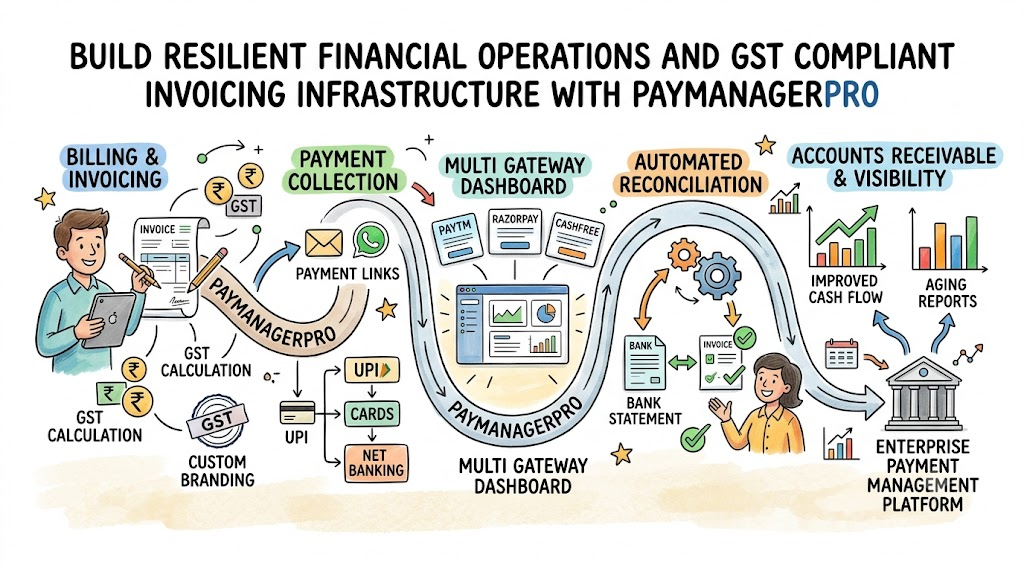
PayManagerPro delivers a complete, unified solution designed to modernize corporate invoicing, payment link distribution, collection tracking, and reconciliation workflows. By consolidating these disparate finance functions into one intuitive cloud portal, the platform helps businesses eliminate operational complexity, replace disconnected spreadsheets, and maintain complete control over incoming revenue streams.
As a versatile platform, PayManagerPro enables teams to generate fully branded, GST-compliant invoices complete with automatic itemized tax calculations and custom line-item discounts. These digital invoices can be downloaded securely as PDFs or linked directly to one-time or reusable payment requests. Flexible payment links feature custom expiry parameters, automated reminder schedules, and real-time status tracking across email, WhatsApp, and SMS channels.
- Unified Dashboard: Consolidates live collections from UPI, credit/debit cards, net banking, and wallets across multiple gateways like Paytm, Razorpay, and Cashfree.
- End-to-End Tracking: Connects every payment directly to the associated customer, invoice, business unit, and bank settlement file.
- Automated Reconciliation: Imports gateway payout records automatically, matches settlements with open invoices, and flags exceptions instantly.
- Enterprise Control: Features built-in maker-checker approval controls, customizable user roles, scheduled reporting, and secure API integrations.
Choosing the Right Payment Management Platform
Selecting an appropriate financial management platform requires carefully evaluating your organization’s specific operational needs, existing software infrastructure, and long-term expansion plans. A suitable solution must resolve current collection bottlenecks while offering scalable architecture capable of supporting future growth. Key stakeholders must assess platforms against critical operational criteria before committing to deployment.
Prioritize solutions that offer seamless integration options via robust APIs to connect smoothly with your existing CRM and ERP architectures. Ensure the software supports full tax compliance, offers multi-gateway consolidation, and provides automated payment reconciliation tools to save administrative time. Furthermore, evaluate platform security frameworks, administrative access permissions, and support for automated audit trail logging.
Evaluating vendor support responsiveness, user interface simplicity, and overall platform reliability ensures smooth organizational adoption. Investing in a comprehensive platform equips your finance team with modern operational tools that drive efficiency, accelerate collections, and safeguard corporate liquidity. Making an informed technology selection sets a strong foundation for ongoing operational success.
Frequently Asked Questions About PayManagerPro
What is PayManagerPro and how does it help finance teams?
PayManagerPro is a modern software platform designed to centralize invoicing, payment link management, multi-gateway tracking, and automated reconciliation into a single unified workspace.
Does PayManagerPro support GST-compliant invoicing for Indian businesses?
Yes, the platform enables teams to generate fully branded, tax-compliant invoices featuring automatic CGST, SGST, and IGST calculations, sequential numbering, and detailed itemization.
How does the multi-gateway payment dashboard work?
The dashboard consolidates live payment feeds and transaction logs from multiple processing gateways, such as Paytm, Razorpay, and Cashfree, into one centralized view without altering existing banking setups.
Can businesses share payment links through communication channels like WhatsApp?
Yes, payment links can be generated instantly with custom expiry rules and shared directly with customers via email, WhatsApp, and SMS, or embedded within existing business applications.
How does automated payment reconciliation function within the platform?
The software automatically imports payout records from connected payment gateways, cross-references transaction references against open invoices, matches completed settlements, and flags unmatched discrepancies for review.
What level of tracking visibility does the software provide for outstanding invoices?
PayManagerPro tracks every invoice throughout its complete lifecycle, linking payments to specific customer profiles, business units, payment links, and final settlement records with real-time status updates.
Does the platform support enterprise-grade administrative security and permissions?
Yes, the platform includes role-based user access controls, maker-checker authorization workflows, multi-factor authentication, and immutable audit logs to secure sensitive operational data across multiple branches.
Can PayManagerPro integrate with existing ERP and CRM accounting software?
Yes, the platform offers secure, well-documented REST APIs that allow seamless data synchronization with external business systems, accounting tools, and custom software architectures.
What payment methods can customers use when settling invoices through payment links?
Customers can complete payments using a wide variety of popular digital payment options, including UPI applications, credit cards, debit cards, net banking, and digital wallets.
How does PayManagerPro help improve overall company cash flow?
By automating routine payment reminders, simplifying client payments via direct links, and streamlining reconciliation, the software reduces past-due accounts, speeds up collection cycles, and optimizes cash flow.
Conclusion
Modernizing financial operations is essential for businesses seeking to maintain financial control, accelerate collection cycles, and scale efficiency. Relying on manual spreadsheets and disconnected payment gateways wastes valuable administrative hours and exposes organizations to unnecessary financial errors. Unifying invoicing, payment link generation, collection tracking, and reconciliation into a single centralized hub establishes a reliable, error-free revenue pipeline. Implementing integrated solutions like PayManagerPro empowers finance teams with real-time operational visibility, robust security, and automated workflows—ensuring long-term stability and sustainable business growth.

Leave a Reply
You must be logged in to post a comment.