



Introduction
Digital marketing operations have evolved into a complex ecosystem requiring constant coordination across numerous channels. Modern marketing teams often rely on dozens of separate software applications to manage search engine optimization, content creation, client approvals, and performance tracking. Managing these isolated systems introduces operational friction, duplicates effort, and fragments critical performance data across disconnected dashboards.
When information lives in isolated siloes, team members waste valuable hours transferring data manually rather than executing strategic growth initiatives. Adopting an all-in-one digital marketing platform offers a clear path out of this fragmentation by centralizing daily tasks, asset management, and reporting within a unified workspace.
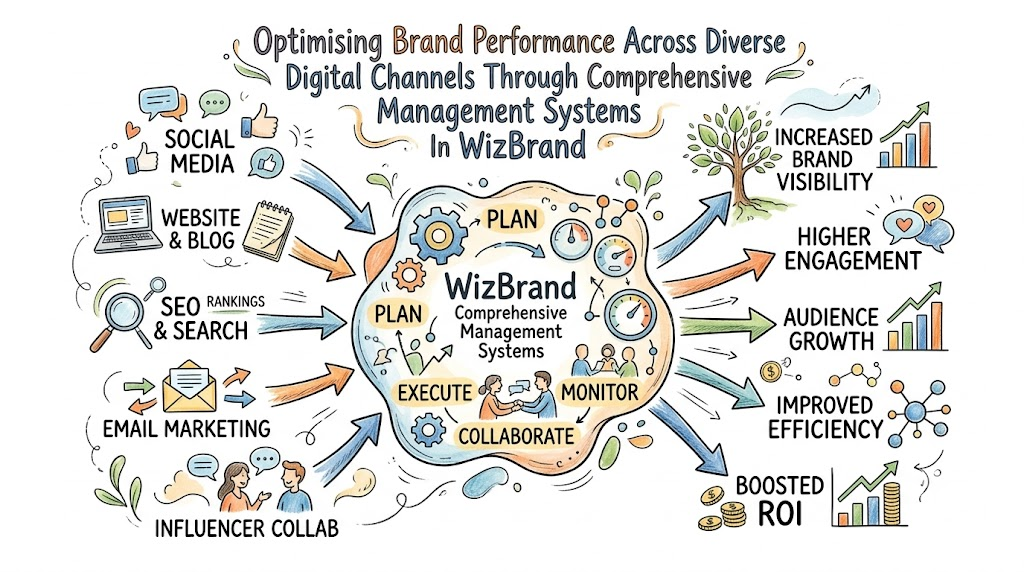
In this comprehensive guide, you will learn how consolidating your software stack improves productivity, streamlines campaign execution, and drives sustainable organic results. We will explore essential capabilities ranging from keyword management and technical site audits to backlink tracking, asset organization, and influencer collaborations. You will also discover how solutions like WizBrand can bridge the gap between strategic marketing planning and efficient day-to-day execution.
Why Digital Marketing Operations Become Difficult to Manage
As organizations expand their online presence, the sheer volume of marketing channels creates significant operational complexity. Marketing teams routinely split their attention between search engines, social networks, paid advertising platforms, email distribution systems, and creator partnerships. Without a single source of truth, campaign assets and client deliverables quickly become scattered across different cloud storage drives, email threads, and messaging apps.
This environment forces specialists to spend hours on repetitive data entry, manually copying information between project boards and performance spreadsheets. Frequent tool switching breaks creative focus and wastes valuable time that could be spent on strategic analysis. Communication gaps naturally form when content creators, technical developers, and marketing managers operate in separate software environments.
These disconnects slow down campaign approvals, limit overall cross-team visibility, and make it difficult to manage multiple client accounts or websites efficiently.
- Managing fragmented client communications across multiple inbox threads
- Transferring campaign data manually between isolated analytics tools
- Tracking project updates through outdated and disconnected spreadsheets
- Searching for approved creative assets across disparate storage drives
- Resolving client approval delays caused by broken communication loops
What Is an All-in-One Digital Marketing Platform?
An all-in-one digital marketing platform is a centralized software solution designed to combine essential marketing operations, strategies, and analytical tools into a single connected workspace. Rather than requiring teams to subscribe to and navigate multiple single-purpose tools, a unified platform provides built-in capabilities for technical SEO, content management, workflow automation, and reporting.
By bringing these functions together, the platform links high-level strategic planning directly with daily execution tasks. Centralization ensures that keyword research directly informs content creation tasks, technical audit findings convert into assigned development tickets, and promotional assets remain accessible to all team members.
True platform integration is far more valuable than simply having access to a long list of standalone software features. A fully unified system breaks down operational siloes, eliminates duplicate data entry, and allows cross-functional marketing teams to collaborate seamlessly while monitoring overall growth from one central control panel.
Standalone Tools Versus Integrated Marketing Platforms
| Marketing Area | Disconnected Tool Approach | Integrated Platform Approach |
|---|---|---|
| Keyword Management | Stored in isolated spreadsheets across local drives | Centralized, linked to campaigns, and updated live |
| Technical Audits | Exported as static CSV files needing manual task creation | Converted directly into actionable project tasks |
| Backlink Analysis | Tracked in separate software with manual reporting | Integrated with rank tracking and content workflows |
| Project Management | Handled in standalone apps disconnected from SEO data | Built directly into marketing and campaign workflows |
| Asset Management | Scattered across various cloud drives without tags | Centralized with version control and granular permissions |
| Reporting | Manually assembled by pulling metrics from multiple sites | Automatically generated using consolidated live data |
| Collaboration | Fragmented across external chat apps and email chains | Unified around specific tasks, assets, and projects |
The Role of SEO Management Software
Comprehensive SEO management software provides the foundational framework necessary for teams to organize, execute, and monitor search engine optimization strategies efficiently. Rather than viewing search optimization as an isolated checklist, robust management tools help teams coordinate keyword research, technical site health monitoring, content optimization, and backlink analysis within a single continuous process.
Centralized software ensures that every team member—from content writers to technical developers—works from the same data set and understands how their individual tasks contribute to overall organic search visibility.
Search algorithms and user search behaviors evolve continuously, making search engine optimization an ongoing operational commitment rather than a static, one-time setup. Dedicated management software allows organizations to track ranking movements, identify technical crawl errors, evaluate competitor tactics, and review performance reports over extended periods.
Organising Keywords More Effectively
Effective keyword management requires a strategic approach to organizing search terms based on topic relevance, audience intent, and campaign goals. Marketers must move beyond basic lists and organize keywords into clear thematic clusters that align directly with specific landing pages and content assets.
Categorizing search terms by intent—such as informational, commercial, or transactional—helps teams map content accurately and prevents keyword cannibalization, where multiple pages compete against each other for the same search queries.
Organizing keywords within targeted campaign groups allows SEO specialists to evaluate high-priority search terms against competitor visibility and assign content creation tasks with clarity.
Target Keyword: "SEO Management Software"
├── Search Intent: Commercial / Informational
├── Mapped Page: /solutions/seo-software
├── Priority: High
└── Associated Content Assets: Product Overview, Comparison Guide, Video Tour
Understanding an SEO Rank Tracking Tool
An SEO rank tracking tool gives marketing teams visibility into search engine performance by constantly monitoring target keyword positions across various search engines. Search rankings fluctuate naturally due to algorithm updates, search engine adjustments, competitor activity, and fresh content updates across the web.
Interpreting these movements correctly requires looking past daily rank changes and evaluating long-term performance trends alongside actual organic traffic, content updates, and lead conversions. Modern tracking software provides detailed segmentation capabilities, allowing teams to analyze performance across desktop and mobile devices, compare hyper-local regional search results, monitor competitor rank shifts, and receive automated alerts whenever critical search positions experience major changes.
Platforms like WizBrand integrate these rank-tracking capabilities into broader marketing workflows, enabling teams to correlate ranking changes directly with recent site updates, new backlink acquisition, and ongoing campaign activities without jumping between disconnected tools.
Why Technical SEO Audits Matter
A reliable technical SEO site audit tool evaluates website architecture to uncover hidden technical barriers that prevent search engine crawlers from indexing site content efficiently. Technical audit software examines critical structural elements including broken links, missing metadata, duplicate content, canonical tag configurations, slow page load speeds, mobile usability errors, and XML sitemap discrepancies.
Identifying these issues is vital because even exceptional content will fail to rank if search engines encounter crawlability barriers, server errors, or indexing problems.
However, an audit report only delivers real value when teams convert those analytical findings into swift corrective action. Identifying site speed bottlenecks or redirect chains is simply the first step; sustainable search growth requires a clear system for translating diagnostic data into technical fixes.
Turning Audit Findings Into Action
Converting complex technical audit reports into measurable search improvements requires prioritizing diagnostic data based on severity and operational impact. Organizing audit results into clear action tiers helps web developers and SEO specialists address critical crawl barriers before turning their attention to minor formatting adjustments.
Critical Issues
Critical issues represent severe technical errors that actively prevent search engines from crawling, rendering, or indexing vital web pages, including site-wide server errors, incorrect noindex tags, blocked pages in robots.txt files, and major crawlability failures.
High-Priority Issues
High-priority issues degrade user experience and search performance on key landing pages, including widespread broken internal links, duplicate title tags, extensive redirect chains, missing canonical tags, and exceptionally slow page load times.
Improvement Opportunities
Improvement opportunities focus on minor technical refinements that enhance overall site quality, such as adding missing image alt text, expanding weak internal link connections, compressing oversized media files, and fixing inconsistent heading tag structures.
Using SEO project management software enables teams to convert these prioritized diagnostic findings into discrete developer tickets, assign explicit deadlines, and track resolution progress directly within their primary campaign workspace.
How a Backlink Analysis Tool Supports Off-Page SEO
An integrated backlink analysis tool provides essential visibility into a website’s external link profile, helping teams evaluate link quality, domain authority, and overall referral traffic patterns. Off-page search engine optimization relies heavily on earning high-quality backlinks from authoritative, topically relevant websites that signal credibility to search engines.
Analyzing referring domains, target landing pages, new and lost backlinks, and anchor text distribution helps SEO specialists identify healthy link growth while spotting toxic or manipulative link networks that could trigger search penalties.
Evaluating competitor link profiles highlights valuable outreach opportunities, enabling content teams to discover industry publications, resource directories, and editorial sites that regularly feature content within their niche.
Using Competitor Backlink Information Responsibly
Analyzing competitor backlink profiles offers strategic insights into industry link trends, but teams must avoid blindly replicating every link their competitors acquire. Instead of chasing low-quality web directory listings or participating in link schemes, organizations should evaluate competitor data to uncover genuine content gaps and strategic partnership opportunities.
Discovering that competitors frequently earn links through original research, industry surveys, or detailed infographics indicates a strong market demand for data-backed content assets.
Teams can leverage these insights to produce superior educational content, execute targeted digital public relations outreach, pitch guest contributions to reputable trade publications, and claim unlinked brand mentions across relevant digital spaces.
Connecting SEO With Project Management
Executing successful search engine optimization strategies requires seamless coordination across multi-disciplinary teams, including SEO specialists, content creators, web developers, graphic designers, marketing managers, and external clients. Without central coordination, critical tasks like content updates, meta tag revisions, and site speed optimizations frequently fall through the cracks or stall during the review stage.
Integrating project management capabilities directly into marketing operations ensures clear task ownership, manageable deadlines, real-time status tracking, and central comment threads for every optimization project.
Utilizing SEO project management software allows managers to set project milestones, manage team file permissions, and view real-time progress dashboards, ensuring that search strategies move smoothly from initial keyword research to final technical deployment.
Building a Repeatable SEO Workflow
| Workflow Stage | Main Activities | Typical Responsibility |
|---|---|---|
| Research | Conducting keyword research, search intent mapping, and competitor analysis | SEO Specialist |
| Planning | Content outline creation, keyword placement strategy, and target page mapping | Content Strategist |
| Production | Article drafting, graphic asset design, and metadata copywriting | Copywriter / Designer |
| Technical Review | Checking internal links, schema markup, canonical tags, and page speed | Technical SEO Lead |
| Approval | Editorial review, brand consistency verification, and client sign-off | Marketing Manager |
| Publishing | Staging content, setting canonical URLs, and launching live pages | Webmaster / Developer |
| Promotion | Digital PR outreach, social media distribution, and influencer sharing | Outreach Specialist |
| Measurement | Tracking rank movements, monitoring organic traffic, and indexing status | Analytics Specialist |
| Improvement | Refreshing underperforming content, updating links, and fixing errors | SEO Specialist |
Digital Marketing Workflow Management Software
Dedicated digital marketing workflow management software expands structured operational controls beyond search engine optimization to encompass all digital marketing initiatives. Modern marketing departments run complex campaigns simultaneously across content marketing, social media publishing, paid search advertising, email newsletters, influencer outreach, and corporate website management.
Standardizing workflows across these channels ensures that every creative asset, promotional email, and campaign launch follows a strict quality assurance process before going live.
- Define campaign goals, target audience segments, key performance indicators, budget parameters, and primary promotional channels during initial strategy planning.
- Outline specific content deliverables, assign creative briefs to copywriters and designers, set internal deadlines, and allocate resources across the project lifecycle.
- Produce creative assets, write promotional copy, build custom landing pages, and prepare technical tracking links using standardized brand guidelines.
- Route draft assets through automated internal and client approval channels, collect feedback, and implement required revisions within a single workspace.
- Publish approved content across targeted digital channels, activate advertising campaigns, distribute email newsletters, and trigger influencer collaborations.
- Gather real-time campaign performance data, generate consolidated client reports, analyze key engagement metrics, and optimize ongoing marketing operations based on actionable insights.
Managing Marketing Assets From One Location
Utilizing digital asset management software for marketing teams eliminates the chaos of searching through disorganized cloud folders, local desktop drives, and old email threads for approved creative files. A centralized asset repository provides a single location for storing brand logos, high-resolution images, video files, marketing presentations, client brand guides, keyword lists, backlink reports, and campaign media kits.
Centralized digital asset management allows team members to tag, search, filter, and preview creative files instantly, ensuring brand consistency across every marketing touchpoint.
Granular access controls, file permissions, and secure sharing options protect sensitive client assets while allowing external freelancers, agency partners, and influencer networks to access approved campaign materials efficiently.
Why Version Control Matters
Without strict version control, marketing teams risk publishing outdated brand logos, unapproved campaign graphics, incorrect pricing tables, or obsolete promotional messaging across client channels. Imagine a scenario where a design team updates corporate brand colors and creates a revised product logo for an upcoming campaign launch.
If designers save those files in fragmented storage folders alongside older creative assets, remote writers and web developers might accidentally use outdated graphics on live landing pages and social campaigns.
Implementing digital asset management software with built-in version control ensures that team members only access, share, and publish approved file versions, eliminating embarrassing public marketing errors and saving countless hours spent correcting brand inconsistencies.
How an Influencer Marketing Marketplace Works
An integrated influencer marketing marketplace connects brands directly with content creators, streamlining creator discovery, campaign management, performance tracking, and relationship building within one platform. Brands can search creator databases, evaluate audience demographic data, review historical engagement rates, clarify content expectations, set deliverable deadlines, and track post analytics.
Simultaneously, influencers utilize the marketplace to build detailed professional profiles, showcase their primary content categories, highlight portfolio pieces, connect with advertisers, and secure paid collaboration opportunities.
Marketing teams should look beyond surface-level follower counts when selecting creators, focusing instead on topical audience alignment, genuine engagement rates, audience authenticity, and the creator’s ability to produce compelling brand stories.
Brand Brief Creation ──> Creator Discovery & Vetting ──> Proposal & Agreement
                                                                 │
Campaign Analytics <── Deliverable Submission <── Content Creation
What Agencies Need From SEO Software
Marketing agencies face unique operational challenges that require robust, multi-tenant software environments designed to manage multiple client accounts simultaneously. Selecting specialized SEO software for agencies ensures that account managers can create isolated workspaces for each client while managing granular staff permissions, client access portals, and project assignments from a single administrative dashboard.
Agencies require access to automated rank tracking, historical site audit records, comprehensive backlink reports, campaign workflow templates, and customizable white-label client reporting features.
Centralizing client management, asset distribution, and strategic project tracking within a single software environment provides agency leaders with full operational visibility over staff workloads, client campaign progress, and overall operational efficiency.
Choosing the Right Digital Marketing Platform
Selecting the right integrated software platform requires a careful evaluation of your organization’s operational workflows, current software stack, long-term business goals, and team size.
Business Requirements
Identify specific operational pain points, channel priorities, and client management needs to determine whether your team requires specialized search management or a broad marketing stack.
Team Size
Choose a software solution that accommodates your current staff, remote freelancers, agency partners, and client users with flexible user seats and customizable role management.
Core Features
Verify that the platform provides robust built-in tools for keyword research, rank tracking, technical auditing, backlink analysis, project management, and asset storage without forcing reliance on external plugins.
Workflow Flexibility
Ensure the platform supports fully customizable workflow stages, task templates, assignment rules, and milestone tracking that match your team’s established operational processes.
Ease of Use
Select software with an intuitive, clean user interface that minimizes onboarding friction, reduces learning curves, and encourages daily software adoption across all team departments.
Collaboration
Confirm that the platform supports inline task comments, file attachments, automated notifications, role permissions, and direct task assignments to maintain smooth communication across remote teams.
Reporting
Ensure the system offers robust, customizable reporting tools that pull real-time data across SEO, campaign tasks, and asset usage into presentable client-ready dashboards.
Scalability
Select a platform capable of handling expanding campaign volumes, additional domain tracking, larger digital asset libraries, and growing client portfolios without performance degradation.
Common Mistakes to Avoid
- Subscribing to multiple overlapping single-purpose software tools without evaluating platform consolidation options
- Operating search engine optimization campaigns in complete isolation from content creation and project management workflows
- Ignoring technical site audit warnings until search engine crawlers penalize site visibility and drop keyword rankings
- Storing creative brand assets, keyword data, and backlink research across disorganized personal drives and local folders
- Selecting influencer partners based solely on high follower counts rather than audience engagement and brand relevance
- Failing to establish standardized naming conventions, task approval hierarchies, and version controls across digital asset libraries
- Relying on manual, time-consuming spreadsheet data assembly to build monthly performance reports for clients or stakeholders
How WizBrand Fits Into an Integrated Marketing Model
WizBrand is designed to address the challenges of tool fragmentation by combining essential digital marketing tools into a single platform. Rather than requiring marketing teams to jump between separate applications for search optimization, project management, asset storage, and influencer outreach, the platform provides a connected workspace that unifies daily strategy with campaign execution.
The platform connects built-in keyword management, rank tracking, technical site auditing, and backlink analysis tools directly into customizable project management boards and workflow management features.
┌────────────────────────────────────────────────────────────────────────┐
│                          WIZBRAND PLATFORM                             │
├─────────────────┬──────────────────┬──────────────────┬────────────────┤
│    SEO SUITE    │  WORKFLOW & PM   │  ASSET STORAGE   │   INFLUENCER   │
│  Rank Tracking  │ Task Assignments │ Version Control  │ Creator Search │
│ Site Auditing   │ Custom Stages    │ Permissions      │ Analytics      │
│ Backlinks       │ Milestones       │ Media Libraries  │ Campaigns      │
└─────────────────┴──────────────────┴──────────────────┴────────────────┘
Its integrated digital asset repository ensures that approved creative files, keyword lists, and campaign resources remain easily accessible to team members, remote freelancers, and agency partners.
Additionally, WizBrand includes an integrated influencer marketing marketplace, allowing brands to discover creators, manage campaign deliverables, and track outreach performance within the same environment used for primary SEO operations.
By consolidating data management, asset organization, team collaboration, and client reporting, WizBrand offers marketing departments and digital agencies a practical framework for reducing operational complexity and managing digital growth from one central hub.
Steps for Implementing an Integrated Marketing Platform
- Audit your current marketing software subscriptions, identifying recurring tool costs, feature overlaps, and disconnected data silos across departments.
- Identify duplicate manual tasks, repeated data entry steps, and communication bottlenecks that currently slow down campaign execution.
- Document existing team workflows, approval stages, and file-sharing practices to understand how tasks move from initial strategy to deployment.
- Clean and organize existing marketing assets, keyword lists, backlink data, and account records before transferring information into the new platform.
- Assign primary platform administrators responsible for setting up account workspaces, user permissions, and master workflow templates.
- Launch a pilot project using a single campaign or client account to test workflow configurations, task assignments, and reporting setups.
- Train team members according to their specific roles, ensuring copywriters, technical SEOs, and managers understand their daily software interactions.
- Establish clear, platform-wide naming conventions, file tagging structures, and task status protocols to maintain workspace organization over time.
- Monitor initial platform adoption across teams, gathering feedback from specialists to refine task templates, custom fields, and dashboard views.
- Gradually expand platform usage across all active marketing campaigns, client accounts, asset libraries, and external creator collaborations.
Measuring the Impact of a Centralised Platform
Evaluating the return on investment of a centralized marketing platform requires tracking operational efficiency metrics alongside primary search engine performance goals. Standardizing tools across departments yields immediate operational benefits, including reduced tool switching, faster content approvals, fewer duplicate project tasks, improved milestone completion rates, and accelerated issue resolution during technical site fixes.
Centralized digital asset management improves media reuse, eliminates time wasted searching for lost creative files, and drastically reduces relying on static spreadsheets for reporting.
These internal operational improvements directly impact business outcomes by empowering teams to execute high-quality SEO campaigns faster, leading to improved organic search rankings, higher traffic volume, increased lead generation, lower customer acquisition costs, and predictable revenue growth over time.
FAQ Section
1. Could you define the concept of an all-in-one digital marketing platform?
An all-in-one digital marketing platform is a centralized software system that consolidates multiple marketing operations into a single workspace. It connects essential capabilities like SEO keyword research, rank tracking, technical site audits, backlink analysis, project management, asset storage, and campaign reporting, eliminating the need to manage disconnected single-purpose software tools.
2. How does SEO software improve team collaboration?
SEO management software improves cross-team collaboration by establishing a single source of truth for all optimization activities. It allows SEO specialists, copywriters, developers, and project managers to assign tasks, set deadlines, share keyword data, discuss technical updates inline, and monitor campaign milestones within a central, accessible workspace.
3. Why is an SEO rank tracking tool necessary?
An SEO rank tracking tool is essential for monitoring organic search performance across targeted keywords over time. It provides critical insights into ranking fluctuations across desktop and mobile devices, tracks regional search trends, compares competitor performance, and helps teams evaluate whether their content and technical optimizations are driving search visibility.
4. What issues does a technical SEO audit tool detect?
A technical SEO site audit tool scans website architecture to detect issues that hinder search engine crawling and indexing. It identifies broken links, missing or duplicate metadata, slow page load speeds, mobile usability errors, canonical tag mistakes, redirect chains, XML sitemap errors, and crawlability barriers that negatively affect organic performance.
5. How does a backlink analysis tool help off-page SEO?
A backlink analysis tool evaluates a website’s backlink profile by tracking referring domains, link quality, anchor text distribution, and acquired or lost links. It helps SEO teams spot spammy links that could cause search penalties while discovering valuable backlink opportunities by analyzing competitor link profiles and relevant industry sites.
6. Why is project management essential for SEO campaigns?
Project management is critical for SEO campaigns because search optimization involves multiple interconnected tasks spanning strategy, content creation, web development, and outreach. Utilizing project management tools ensures clear task ownership, manageable deadlines, real-time status tracking, and seamless communication, preventing critical site optimizations and content updates from getting stalled.
7. What is the role of digital asset management software?
Digital asset management software provides a secure, centralized repository for storing, organizing, tagging, and retrieving creative marketing files. It helps marketing teams manage logos, campaign images, video assets, brand guidelines, presentations, and documents, using file tagging, search filters, permission controls, and version tracking to ensure brand consistency across channels.
8. How does version control prevent marketing errors?
Version control prevents marketing errors by ensuring that team members only access and publish approved, up-to-date creative assets. It maintains a documented history of file updates, preventing staff from accidentally deploying outdated logos, unapproved marketing graphics, incorrect pricing tables, or draft copy on live customer-facing channels or client campaigns.
9. What are the benefits of an influencer marketplace?
An influencer marketing marketplace streamlines creator discovery, collaboration management, and campaign tracking. It allows brands to analyze creator profile metrics, evaluate audience demographic data, outline campaign expectations, manage deliverable timelines, and track post analytics, while giving influencers a direct platform to connect with relevant advertisers.
10. Why do marketing agencies need specialized SEO software?
Marketing agencies require specialized SEO software to manage multiple client accounts efficiently from a unified administrative hub. Agency-focused platforms provide multi-tenant workspaces, granular user permissions, automated rank tracking, customizable white-label client reporting, asset management, and integrated project workflows designed to handle expanding client portfolios securely and efficiently.
11. How does platform consolidation lower operational costs?
Consolidating your marketing stack onto a unified platform lowers operational costs by eliminating redundant software subscription fees across single-purpose tools. Additionally, it drastically reduces time wasted on manual data entry, tool switching, file searching, and broken communication channels, allowing staff to spend more time on high-value strategic tasks.
12. Can a unified platform guarantee top search engine rankings?
No software platform can guarantee specific search engine rankings, as search algorithms consider hundreds of dynamic ranking factors. However, an integrated platform provides the essential analytical tools, workflow capabilities, data visibility, and operational structure required to execute, monitor, and scale effective, high-performing search engine optimization strategies consistently over time.
Conclusion
Managing modern digital marketing operations requires balancing technical search optimization, content creation, asset distribution, and creator partnerships across constantly evolving digital channels. Relying on fragmented software stacks creates operational bottlenecks, duplicates effort, and obscures performance metrics across disconnected dashboards. Transitioning to a centralized platform streamlines these processes by aligning strategic planning directly with daily execution tasks. By unifying keyword management, rank tracking, technical audits, backlink analysis, workflow management, and digital asset storage within a single workspace, marketing teams and agencies can eliminate administrative friction and improve cross-department collaboration. Solutions like WizBrand demonstrate how consolidating core marketing operations, project tracking, and influencer management into one workspace enables organizations to execute campaigns faster, maintain strong brand consistency, and drive scalable, sustainable organic growth. Investing in the right integrated marketing platform empowers your team to build efficient, repeatable workflows that turn strategic marketing goals into measurable long-term business success.

Leave a Reply
You must be logged in to post a comment.