



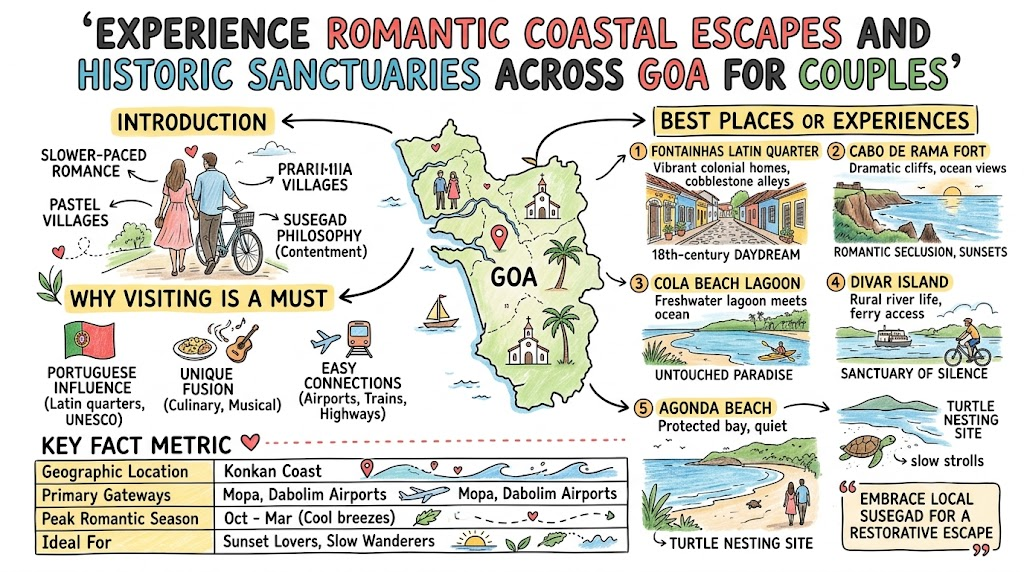
Introduction
Most travelers envision Goa as an overcrowded reel of neon-lit beach clubs, congested highway strips, and hurried tourist corridors. Yet, beyond the relentless commercial roar lies an intimately slow-paced, profoundly romantic coastal civilization shaped by red laterite soil and ancient tides. For couples seeking deep connection rather than manufactured distraction, Goa unfolds as a tapestry of whispering coconut groves, baroque architectural sanctuaries, and quiet rivers that slip into the Arabian Sea under rose-gold skies.
Here, romance is found in the languid rhythm of local susegad—the deep-rooted Goan philosophy of contentment and unhurried living. Wandering beneath pastel-washed colonial balcões, drifting along bioluminescent backwaters, or sharing an earthen pot of spiced curry in a secluded family-run taverna offers couples a rare sensory intimacy. This is not a holiday of checklist exhaustion; it is an invitation to inhabit a sanctuary where authentic culture and coastal serenity reign supreme.
Why Goa is a must-visit city
Goa represents a singularly unique geopolitical and cultural chapter in the Indian narrative. Formed by four centuries of Portuguese influence layered atop rich Konkani coastal roots, its regional identity resonates through UNESCO-recognized Latin quarters, spice plantations nestled against the Western Ghats, and a maritime legacy that has drawn global seafarers for generations. It is this exact fusion that grants the coastal state a distinct culinary heritage, musical soul, and architectural presence found nowhere else in South Asia.
The travel circuit effortlessly accommodates varied romantic archetypes, seamlessly connected by two modern airports (Manohar International Airport at Mopa in the north and Dabolim Airport in central Goa), extensive Konkani railway spans, and smooth coastal national highways. Couples can easily transition from the artistic, heritage-steeped hillsides of Bardez to the tranquil, palm-fringed arcs of Canacona in the deep south. World-class boutique hospitality, eco-conscious river lodges, and discreet beachside hideaways ensure every pair finds their ideal balance between wild solitude and refined comfort.
| Key Fact Metric | Destination Specification |
|---|---|
| Geographic Location | Konkan Coast, South-Western India along the Arabian Sea |
| Ideal Circuit For Couples | Central Heritage (Panaji) down to Coastal South Goa (Canacona) |
| Primary Transit Gateways | GOX (Mopa Airport), GOI (Dabolim Airport), Madgaon Railway Hub |
| Peak Romantic Season | Late October through March (Cool sea breezes, dry evenings) |
| Monsoon Romantic Season | July to September (Emerald landscapes, mist-covered ghats) |
| Average Daytime Temperature | 28°C to 32°C (Pleasantly tropical) |
| Local Culinary Identity | Saraswat and Indo-Portuguese coastal seafood traditions |
Best Places or Experiences
Fontainhas Latin Quarter
Wandering hand-in-hand through the labyrinthine streets of Fontainhas feels like stepping directly into an 18th-century Mediterranean daydream. Framed against the lush slopes of Altinho hill in Panaji, this heritage quarter remains Asia’s only conserved Latin enclave. Here, traditional Indo-Portuguese manor homes painted in vibrant hues of canary yellow, pale cobalt, burnt terracotta, and sea green showcase delicate wrought-iron balconies and grand overhanging tiled eaves.
The morning light filters through ancient avenues as church bells ring out across the nearby Ourem Creek. For couples, the magic lies in unscripted strolls past hand-painted azulejo ceramic tiles, pausing at antique timber bakeries where the aroma of warm pastéis de nata and artisanal bread drifts into the cobblestone alleys.
- Location: Central Goa, Panaji city center; approximately 28 km north of Dabolim Airport and 32 km south of Mopa Airport.
- Why it is worth visiting: It is an impeccably preserved architectural masterpiece offering old-world European charm without leaving the Konkan coast.
- Best things to do: Commission a custom hand-painted azulejo tile together, share vintage pastries inside a century-old heritage bakery, and take private golden-hour portraits against vivid architectural walls.
- Best time to visit: Early morning between 7:30 AM and 9:30 AM before the heat and delivery traffic build up.
- Ideal for whom: Couples who appreciate vintage architecture, photography enthusiasts, and slow-paced wanderers.
- Travel tip: Wear flat, comfortable leather shoes as the aged flagstones and heritage steps can be slippery when damp.
Cabo de Rama Fort and Cliff Point
Perched majestically above the turquoise waters of southern Goa, Cabo de Rama is steeped in grand mythology and colonial maritime warfare. Legend holds that Lord Rama, Sita, and Lakshmana took shelter here during their 14-year exile, long before the Soonda rulers and later the Portuguese raised massive ramparts over the promontory. The fort’s sheer cliffs drop steeply into the churning ocean, providing an awe-inspiring wildness seldom found in commercial northern beaches.
Walking alongside the weathered laterite stone walls leads you to the immaculate whitewashed Church of Santo Antonio, still proudly standing amidst the wild coastal overgrowth. Couples can escape to the edge of the southern bastion, where unobstructed panoramic views stretch to the far ocean horizon, creating one of the most private coastal sunset experiences in India.
- Location: Canacona district, South Goa; approximately 60 km south of Panaji and 28 km from Margao.
- Why it is worth visiting: Unmatched romantic seclusion paired with dramatic ocean clifftop vistas and centuries of untouched military history.
- Best things to do: Trace the ancient moat perimeter on foot, sit beneath the lighthouse promontory to watch migrating dolphins, and follow the hidden goat trail down to the secluded pebble cove below.
- Best time to visit: Late afternoon from 4:30 PM until sunset when the evening breeze cools the exposed laterite stones.
- Ideal for whom: Intrepid couples, sunset lovers, and travelers seeking quiet dramatic landscapes.
- Travel tip: There are no safety railings along the high cliff perimeters; maintain a cautious footing and avoid the steep drop-offs during gusty winds.
Cola Beach Lagoon
Cola Beach is a breathtaking geological phenomenon tucked discreetly between coastal headlands, virtually invisible to travelers speeding down the main Canacona highway. What makes this haven extraordinary is a pristine emerald freshwater lagoon that runs parallel to the ocean, separated from the crashing surf by only a narrow sand spit. Ancient basalt and laterite rocks flank the entrance, giving the lagoon the feel of an untouched, forgotten island paradise.
Couples can divide their afternoon between swimming in the refreshing, calm freshwater stream and strolling across the golden sand to watch oceanic waves break against coastal boulders. Lined with swaying coconut palms and rustic luxury safari tents, Cola offers an intimate setting entirely insulated from the commercial buzz of conventional resort towns.
- Location: South Goa coastline; roughly 32 km from Margao and 10 km north of Agonda Beach.
- Why it is worth visiting: The only natural spot in Goa where an emerald freshwater lagoon directly touches a raw, wave-swept oceanic beach.
- Best things to do: Paddle a two-person kayak up the quiet, mangrove-fringed river channel, read books under shaded palm canopies, and watch the waves break while sitting in the still fresh water.
- Best time to visit: November through February; arrive around 11:00 AM to enjoy calm lagoon currents and full sunlight.
- Ideal for whom: Nature-focused couples, romantic honeymooners, and wild swimmers.
- Travel tip: The access path involves an unpaved, rutted dirt track followed by a steep rock stair descent; negotiate carefully if riding a two-wheeler.
Divar Island and Backwater Channels
Floating serenely within the broad Mandovi River, Divar Island is an enchanting world frozen in time. Cut off from direct mainland bridges, access is granted exclusively by rustic roll-on roll-off vehicular ferries, which immediately filters out tourist buses. Once ashore, the landscape opens into rolling paddy fields, ancient sluice gates (manos), and quaint settlements where time-worn Konkani-Portuguese homes sit behind decorative boundary walls.
Pedaling tandem or cruising on an electric cycle through the quiet lanes of Piedade village reveals centuries of community living untouched by modern high-rises. Couples can drift along the outer waterways in traditional wooden canoes at sunset, listening to river birds call as fishermen check their traditional crab traps against the mangrove banks.
- Location: Ilhas region, Central Goa; 10 km east of Panaji, accessible via ferry from Old Goa, Ribandar, or Narva.
- Why it is worth visiting: An authentic sanctuary of silence, rural river landscapes, and classical Goan village life isolated from mainland bustle.
- Best things to do: Climb the hilltop to Our Lady of Compassion Church for panoramic river views, take a guided evening canoe ride through silent mangroves, and dine on traditional fish curry at an authentic village home.
- Best time to visit: Sunrise to 10:00 AM for birdlife, or from 4:00 PM to 6:30 PM for evocative river sunset light.
- Ideal for whom: Couples craving peace, heritage enthusiasts, and birdwatchers.
- Travel tip: Keep small cash notes ready for local ferry operations; although passenger transit is free, vehicles carry a nominal crossing fee.
Agonda Beach Crescent
Agonda is a pristine three-kilometer expanse of golden sand where high-density commercial activities, loud motorized water sports, and beach hawkers are actively barred by local conservation regulations. As an officially protected nesting site for the endangered Olive Ridley sea turtle, this quiet bay retains an expansive, tranquil atmosphere that North Goa lost decades ago.
The soothing, uniform rumble of crashing waves creates a natural soundtrack for couples who appreciate slow beach strolls. Wooden, open-air cafes dot the tree-shaded margins, offering candlelit seaside dining where you can enjoy locally caught red snapper with the surf washing right up to the sand spit.
- Location: Canacona region, Deep South Goa; roughly 70 km south of Panaji and 37 km from Margao.
- Why it is worth visiting: An uncommercialized, wide coastal arc renowned for privacy, nesting turtles, and quiet romantic evenings.
- Best things to do: Walk the uncrowded northern headland rocks at low tide, unwind with holistic couples’ Ayurvedic massages, and enjoy candlelit dinners on the sand under clear night skies.
- Best time to visit: Mid-November to late February, specifically at sunset when the tide recedes to reveal mirror-flat sand.
- Ideal for whom: Honeymooners, privacy seekers, and slow-travel couples.
- Travel tip: Strictly avoid shining flashlights or using phone torches along the southern beach perimeter at night during the winter turtle-nesting season.
Offbeat Exploration: Hidden Gems Tourists Miss
The Mangrove Sanctuary of Chorão Island
While mass tourism crowds nearby river casinos, the tranquil mangrove channels surrounding Chorão Island remain one of the Konkan’s most vital ecological sanctuaries. Named after the famed ornithologist, the Salim Ali Bird Sanctuary can be explored via small non-motorized wooden boats during morning high tides. Gliding together through narrow, canopy-covered saltwater creeks allows couples to spot rare kingfishers, resting marsh crocodiles, and mudskippers in absolute silence.
The Hidden Freshwater Springs of Pilerne
Tucked inside the dense semi-evergreen canopy of the Pilerne village forest lies a series of natural freshwater springs and century-old stone tanks known locally as zor. Long revered by local villagers for their crystal-clear, mineral-rich mountain water, these shaded forest alcoves remain untouched by the typical tourist path. It provides a peaceful setting for couples to read, listen to forest sounds, and experience an authentic slice of Goa’s protected bio-corridors.
Betul Lighthouse and River Estuary Viewpoint
Where the Sal River empties into the deep blue expanse of the Arabian Sea lies the isolated fishing hamlet of Betul. A short, shaded trail past wild coastal shrubs leads up to the crimson-and-white banded Betul Lighthouse. Standing together atop this cliff edge offers a breathtaking bird’s-eye perspective of traditional wooden trawlers navigating the treacherous river mouth against sweeping ocean breakers.
Detailed Practical Guidance for Travelers
| Destination | Standard Entry Fee | General Timings | Best Local Food Options Nearby | Recommended Nearby Attractions |
|---|---|---|---|---|
| Fontainhas Latin Quarter | Free (Open access public heritage zone) | Best experienced 07:00 AM – 07:00 PM | Viva Panjim (Pork Vindalho), Confeitaria 31 De Janeiro | Church of Our Lady of the Immaculate Conception, Panaji waterfront |
| Cabo de Rama Fort | Free admission | 06:00 AM – 06:00 PM (Gates lock at sunset) | The Cape Goa Restaurant (cliffside dining), roadside tender coconut stands | Kakolem Beach, secluded pebble beach |
| Cola Beach Lagoon | Free (Parking ₹50 for two-wheelers, ₹100 for cars) | 07:00 AM – 06:30 PM | Blue Lagoon Shack (Grilled prawns, fresh fruit juices) | Agonda Beach, coastal sea caves |
| Divar Island | Free passenger ferry (Vehicles ₹10 – ₹20) | Ferry runs 24 hours (Hourly intervals after midnight) | Island House Café, roadside local tavernas serving fish thalis | Our Lady of Compassion Church, Chorao Island |
| Agonda Beach Crescent | Free admission (Public shoreline) | Open 24 hours (Lifeguards patrol 07:30 AM – 06:30 PM) | Zest Café (Vegan delicacies), Fatima Corner (Classic Goan fish curry) | Butterfly Beach, Rock Formations at North Agonda |
Logistics & On-Ground Navigation
Local Transport Options
- Self-Drive Scooters & Motorbikes: The classic choice for independent travelers. Reliable scooters (Honda Activa) cost approximately ₹350–₹500 per day; premium Royal Enfield motorcycles average ₹800–₹1,200 per day. Ensure the vehicle carries an official yellow-on-black commercial rental registration plate.
- Self-Drive Rental Cars: Highly recommended for long transit days between North and South districts. Rates run between ₹1,500 and ₹3,500 daily depending on the vehicle class (hatchback vs. compact SUV).
- GoaMiles App & Local Taxis: The state-backed GoaMiles app provides transparent, regulated taxi pricing from airports and railway hubs. When hiring unmetered village taxis, negotiate and fix the full fare upfront before loading your luggage.
- Konkani Railway Passenger Trains: Fast, scenic, and affordable transit connecting Pernem/Thivim in the north to Madgaon in the south for less than ₹50 per person.
- River Ferry Services: Government-operated vehicular and passenger barges run regularly throughout the backwaters; passenger walk-ons cross free of charge.
Budget Planning
- Budget / Romantic Backpacking Tier (₹3,000 – ₹5,000 per day for two):
- Stay: Charming heritage homestays, inland eco-huts, or quiet guesthouses.
- Food: Authentic family-run dining spots, bakeries, and traditional fish curry beach thalis.
- Transport: Fuel and a daily rental scooter.
- Mid-Range / Romantic Comfort Tier (₹8,000 – ₹16,000 per day for two):
- Stay: Independent boutique villas, converted Portuguese estates, or beachfront luxury cottages.
- Food: Chef-led heritage restaurants, clifftop dining, and artisanal bistros with local cocktails.
- Transport: Self-drive air-conditioned car, sunset canoe rentals, and private airport transfers.
Safety and Inclusivity Tips
- For Couples: While Goa is one of the most progressive states in India, display of intimate physical affection is best reserved for private spaces. Respect local village boundaries, especially around religious landmarks and inland waterways.
- For Families & Solo Travelers: Stick to certified, active-lifeguard zones when swimming in the ocean. The undercurrents along shelf drops can be dangerous even for seasoned swimmers.
- General Night Safety: Roads through jungle belts and remote backwaters frequently lack streetlights; drive cautiously after dusk to watch for wandering livestock and sharp unbanked curves.
Strategic Travel Planning Guardrails
Travel Planning Tips for Goa
- Plan Seasonally: Visit between late October and mid-December for clear skies and lower crowds, or February through early April for serene beaches and lower hotel tariffs.
- Balance Digital and Cash Payments: While UPI (Google Pay, PhonePe) is widely accepted across urban cafes, rural backwater shacks and small parking spots often face spotty mobile network coverage—always carry ₹2,000–₹3,000 in cash.
- Respect Sacred Dress Codes: When entering historic places of worship like the Basilica of Bom Jesus or Shri Mangueshi Temple, keep shoulders and knees covered; avoid entering in swimwear.
- Pick Up an International Driving Permit: Foreign travelers must carry a valid International Driving Permit alongside their domestic driver’s license to avoid heavy fines at police checkpoints.
- Sun & Salt Prep: The coastal humidity requires ample mineral hydration; carry rehydration salts, high-SPF reef-safe sunscreen, and organic mosquito repellent for evening dining.
Common Mistakes to Avoid
- Over-packing the Itinerary: Trying to hop between Calangute and Palolem in a single afternoon burns precious romantic time in bumper-to-bumper transit.
- Assuming Goa is Merely Beaches: Overlooking the rich spice plantations, heritage architecture, and tranquil backwaters deprives you of the region’s true cultural soul.
- Renting Non-Commercial Vehicles: Renting a car or scooter with private white-on-black number plates is illegal; traffic authorities actively fine drivers using uncertified rentals.
- Ignoring Rip Current Flags: Disregarding red warning flags posted by Drishti Marine lifesavers on the beach leads to preventable ocean emergencies every season.
- Skipping Regional Fare for Continental Menus: Choosing generic cafe burgers over regional delights like fresh kingfish recheado or slow-simmered pork balchão misses out on one of India’s most celebrated regional cuisines.
Suggested Itinerary Blueprints
1-Day Quick Dash (Heritage Heart & Romantic Sunset)
- Morning: Arrive early in Panaji. Walk the cobblestone lanes of Fontainhas by 8:00 AM, enjoying freshly baked bolo de arroz and warm coffee at Confeitaria 31 De Janeiro.
- Midday: Take a private boat or short ferry to Divar Island; cycle through the peaceful lanes of Piedade village and savor an authentic Goan fish thali at a local family taverna.
- Late Afternoon to Evening: Drive south to Cabo de Rama Fort. Trace the ancient ramparts, look for sea dolphins from the cliff edge, and celebrate sunset with an early dinner overlooking the waves.
2-Day Deep-Dive (Colonial History to Coastal Solitude)
- Day 1: Latin Soul & Backwater Calm
- 08:30 AM: Explore the quiet chapels and heritage houses of Fontainhas; visit the local azulejo ceramic workshops.
- 12:30 PM: Drive to an inland riverside heritage home on Chorao Island for an authentic Saraswat-style lunch.
- 04:30 PM: Enjoy a quiet sunset wooden-boat cruise along the mangrove river channels of the Mandovi River.
- 08:00 PM: Candlelit dinner in Panaji featuring modern Indo-Portuguese dining.
- Day 2: Untouched Southern Horizons
- 08:30 AM: Drive south through scenic palm corridors to the hidden freshwater lagoon of Cola Beach.
- 11:30 AM: Kayak down the quiet freshwater stream, followed by an ocean swim along the secluded beach.
- 03:30 PM: Move to Agonda Beach; take a restorative couples’ Ayurvedic massage under the swaying coconut trees.
- 06:00 PM: Sunset beach stroll along the turtle-nesting sands, followed by fresh seafood by the shoreline.
Complete Weekend Travel Plan (The Definitive Couples Circuit)
- Friday: The Northern Heritage Edge
- Check into a converted heritage home in the quiet village of Aldona or Assagao.
- Spend the afternoon exploring the scenic ruins of Corjuem Fort.
- Dine on slow-cooked regional dishes at an intimate garden bistro.
- Saturday: Coastal Cliffs & Serene Waters
- Drive south through Margao, stopping briefly for fresh morning pav and coffee.
- Settle into a beachside luxury cottage along the serene sands of Agonda.
- Spend the late afternoon hiking along the panoramic laterite cliffs of Cabo de Rama Fort for a private sunset.
- Relax with an open-air candlelit beach dinner listening to the rolling waves.
- Sunday: River Islands & Tranquil Departure
- Take an early morning ferry across to Divar Island; enjoy a quiet breakfast while overlooking the river channels.
- Explore the historic ruins of the Church of St. Augustine in Old Goa without the midday tour crowds.
- Finish your journey with a fresh-caught seafood lunch overlooking the tranquil Mandovi River before heading to the airport.
Common Tourist Mistakes to Avoid
Geographic Blunders
The most frequent mistake couples make is treating Goa as a single compact city. Crossing from Arambol in the north to Palolem in the south spans nearly 90 kilometers and can easily consume three to four hours in heavy coastal traffic. Booking stays in the north while planning sunset dinners in the south results in frustrating, exhausting transit days. Choose your preferred hub—North for energetic village cafes, South for peaceful natural isolation—and explore locally.
Commercial Traps
Many first-time visitors spend their entire holiday trapped on the crowded party stretches of Calangute, Baga, and Candolim. These areas are heavily commercialized, crowded with loud groups, and feature repetitive tourist stalls. Moving just 20 minutes inland to quiet villages like Aldona, Moira, or down to the untouched sands of Canacona reveals the peaceful, romantic Goa you originally set out to discover.
Neglecting Modern/Alternative Zones
Focusing solely on the sand often means missing Goa’s thriving artistic and culinary Renaissance. Inland villages like Assagao and Saligao house lovingly restored Indo-Portuguese villas that now function as independent design studios, craft cocktail bars, and artisanal coffee roasteries. Spending a day wandering through these shaded heritage avenues offers an intimate, design-forward cultural dimension that perfectly complements your beach time.
Transport Overpayment
Relying on unregulated roadside private taxis without prior price agreements leads to inflated fares. Regular transfers between North and South districts can easily run up to ₹3,000–₹4,000 per one-way ride. Instead, use the app-based GoaMiles service at major transit hubs, rent a verified self-drive commercial car, or arrange your transport through your boutique accommodation well in advance.
Luxury Dining Bias
While Goa boasts several exceptional fine-dining venues, sticking exclusively to high-end resort restaurants cuts you off from the region’s true culinary soul. The real magic of Goan cuisine lives inside unpretentious village anandashrams and family-run coastal tavernas. Savoring an earthen pot of slow-cooked mackerel recheado or a fiery prawn balchão at a roadside eatery delivers culinary memories that luxury hotel buffets simply cannot replicate.
Frequently Asked Questions
1. Which part of Goa is best suited for couples seeking a quiet romantic getaway?
South Goa, specifically the areas surrounding Agonda, Cola, and Palolem, is best for couples looking for peaceful surroundings. Unlike the bustling north, South Goa is defined by low-rise development, quiet palm groves, and strictly regulated beach stretches. It offers couples the privacy, pristine natural beauty, and calm waters ideal for an unhurried, intimate holiday together.
2. What is the most scenic way for couples to travel from North to South Goa?
The most scenic route is driving down the coastal interior road via Old Goa, continuing through the historic villages of Raia and Curtorim, and heading into Canacona. This route bypasses the congested main highway stretches, winding past centuries-old village churches, vibrant emerald paddy fields, and historic Portuguese mansions nestled under shaded palm canopies.
3. Is it safe for couples to rent and ride scooters across Goa at night?
Riding scooters during daylight is generally safe and enjoyable, but nighttime travel requires extra caution. Many rural village roads and backwater corridors lack adequate streetlights and have sharp, unbanked curves alongside wandering cattle. For long-distance evening trips, renting a self-drive car or booking a verified taxi offers far greater comfort and safety.
4. How much should a couple budget for a 4-day romantic trip to Goa?
A comfortable mid-range four-day trip for a couple typically ranges between ₹32,000 and ₹60,000. This estimate covers boutique heritage or beachfront accommodations, daily scooter or rental car expenses, fuel, and meals at a mix of authentic local tavernas and upscale coastal dining spots.
5. What is the protocol for visiting churches and temples in Old Goa?
When entering sacred monuments such as the Basilica of Bom Jesus or Shri Mangueshi Temple, modest attire covering both shoulders and knees is strictly required. Sleeveless tops, short skirts, and swimwear are prohibited. Visitors must remove hats and footwear where indicated, and remain quiet inside the active prayer halls.
6. Are drone cameras permitted for capturing couple photography on Goan beaches?
Recreational drone usage is strictly prohibited across many parts of Goa without prior written permission from local administrative and police authorities. Flying drones near naval installations around Dabolim Airport, coastal defense locations, and wildlife sanctuaries is illegal and can lead to heavy fines or equipment confiscation.
7. What makes Cola Beach unique compared to other coastal spots in Goa?
Cola Beach features a stunning emerald freshwater lagoon that runs directly parallel to the crashing Arabian Sea, separated only by a narrow sandbar. This natural layout allows couples to enjoy calm, sheltered freshwater kayaking and swimming just steps away from the untamed oceanic surf, all surrounded by dramatic laterite cliffs.
8. Is the monsoon season a good time for a romantic couple’s trip to Goa?
The monsoon season from July to September is deeply romantic for couples who appreciate lush landscapes, dramatic rain, and peaceful solitude. While the rough seas make ocean swimming impossible and beach shacks are dismantled, the countryside transforms into an emerald paradise filled with misty hills, vibrant waterfalls, and attractive off-season resort rates.
9. How do you distinguish between legal and illegal vehicle rentals in Goa?
Legal commercial rental vehicles in Goa are identifiable by their black number plates with bright yellow registration lettering. Renting a vehicle that carries standard private white-and-black plates is illegal; traffic police regularly check vehicles, and travelers driving private rentals risk vehicle impoundment and significant fines.
10. What are the best authentic souvenirs for couples to take home from Goa?
Authentic souvenirs include hand-painted Goan ceramic tiles (azulejos) from Fontainhas, locally harvested organic cashew nuts, and small-batch feni or artisanal coconut vinegars. You can also pick up traditional Goan pork choris sausages from the Mapusa market, or rich layers of traditional bebinca cake from local heritage bakeries.
11. How can couples arrange a private backwater boat ride without large tourist crowds?
To avoid large commercial party boats on the Mandovi River, head inland to the peaceful river channels of Divar Island, Chorao, or the upper Chapora River. Local community-based eco-operators provide private wooden canoe and electric boat excursions, allowing you to glide quietly through mangrove ecosystems without noisy diesel engines or loudspeakers.
12. Can couples legally drink wine or beer on the public beaches of Goa?
Drinking alcohol in public spaces, including open public beaches and roadsides, is strictly banned by the Goa Tourism Development Corporation and local law enforcement. Travelers caught drinking outside licensed beach shacks and bars face immediate spot fines. Always enjoy your drinks within permitted beachside restaurants and private resort spaces.
Conclusion
Choosing to experience Goa as an intimate couple’s sanctuary reveals a world far removed from typical vacation clichés. Beyond the crowded tourist strips, the coastal state welcomes you into a tranquil rhythm shaped by golden river light, quiet village lanes, and the gentle roar of the Arabian Sea. By slowing your pace and embracing the timeless charm of local susegad, your journey becomes more than a simple holiday—it transforms into an inspiring, deeply restorative escape that will linger in your shared memories long after the sea salt has washed away.

Leave a Reply
You must be logged in to post a comment.