



Introduction
Most travelers know Goa only after twilight, when neon lights flicker across crowded shacks, bass notes vibrate through humid air, and dense traffic clogs narrow coastal junctions. Yet the real soul of this coastal state wakes up hours before the holidaymakers stir. At dawn, a quiet stillness rolls over the palm groves, mist settles across the backwaters, and the salty breeze smells cleanly of wet sand and fresh mangrove leaves.
Stepping out at dawn reveals an authentic, deeply rooted Goa that typical vacations miss entirely. You encounter elderly residents sharing warm greetings along ancient cobblestone paths, fishermen pulling their hand-woven nets onto virgin sandbars, and kingfishers diving into calm estuarine currents. Walking Goa in the early hours connects you to its true cultural heritage, granting an unhurried perspective that turns an ordinary beach trip into a grounding personal retreat.
Why Goa is a must-visit city
Goa holds an extraordinary place in Indian geography and history, shaped by over 450 years of Portuguese rule merged seamlessly with ancient Konkani traditions. This unique heritage is carved into its coastal villages, grand cathedrals, riverside promenades, and serene mangrove wetlands. Beyond the commercial tourism facade lies a delicate ecosystem framed by the lush Western Ghats to the east and the expansive Arabian Sea to the west.
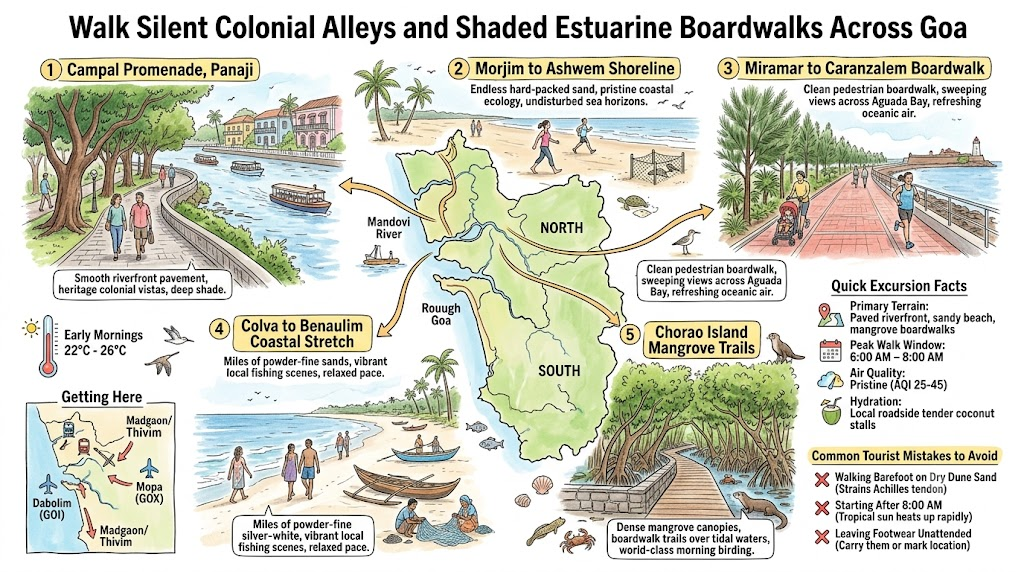
Getting here is seamless for fitness travelers, families, and solo wanderers alike. Two international airports—Dabolim Airport (GOI) in central Goa and Manohar International Airport at Mopa (GOX) in the north—connect the state to major metropolitan areas. Broad railway corridors like Madgaon and Thivim stations, alongside the four-lane NH66 highway, make traveling between serene inland villages and coastal strips efficient and straightforward.
The morning travel circuit transitions naturally between coastal sandbars, tidal river boardwalks, and shaded colonial lanes. Here is a high-level summary of the essential facts you need to plan your walking excursions:
| Regional Trait | Walking Detail |
|---|---|
| Primary Terrain | Compact sand flats, paved riverfront boardwalks, and laterite trails |
| Peak Walk Window | 6:00 AM – 8:00 AM (Cool temperatures and quiet paths) |
| Average Temperature | 22°C to 26°C during early mornings from November to March |
| Air Quality Index | Consistently pristine (AQI 25–45) along coastal belts |
| Top Walking Zones | Panaji riverfront, Chapora estuary, Salcete beach stretch |
| Hydration Source | Local roadside tender coconut stalls open from 6:30 AM |
Best Places or Experiences
Paved riverfront path along Campal Promenade.
Sunrise stroll across Morjim Beach shores.
Coastal walking trail at Miramar Beach.
Jungle trails on Chorao Island.
Campal Promenade & DB Marg, Panaji
Stretching gracefully along the Mandovi River, the Campal Promenade offers one of the most culturally atmospheric and impeccably maintained urban walking tracks in India. Developed during the Portuguese era as an aristocratic boulevard, the broad walkway is shaded by towering, centuries-old mahogany and rain trees that keep the pavement pleasantly cool even after sunrise.
Walking here pairs sweeping river vistas with elegant architecture. On one side, fishing boats glide toward the Arabian Sea; on the other, pastel-colored heritage bungalows showcase intricate wrought-iron railings and red-tiled roofs. The wide, barrier-free pavement provides clean footing, making it a beloved morning staple for local residents, visiting joggers, and thoughtful strollers.
- Location: Panaji, North Goa (approx. 28 km from Dabolim Airport; 33 km from Mopa Airport).
- Why it is worth visiting: Smooth riverfront pavement, heritage colonial vistas, and deep shade beneath historic rain trees.
- Best things to do: Watch traditional passenger ferries cross to Betim, admire colonial villas along the Campal Heritage Precinct, and observe seabirds hunting in the Mandovi estuary.
- Best time to visit: 6:15 AM to 7:45 AM for cool river breezes and soft golden-hour light.
- Ideal for whom: Elderly walkers, casual strollers, architecture enthusiasts, and urban joggers.
- Travel tip: Park near Kala Academy where free parking slots are plentiful before 7:30 AM.
Morjim to Ashwem Beach Shoreline
While daytime crowds flock to northern beaches, the unbroken 4-kilometer stretch linking Morjim to Ashwem remains an exceptional sanctuary at dawn. The shoreline is exceptionally broad, offering a massive expanse of hard-packed, damp sand that provides firm joint support for barefoot walks or brisk distance power walks.
This coastal zone is celebrated for its thriving marine ecology, serving as a protected nesting ground for Olive Ridley sea turtles. In the morning quiet, the only sounds are the rhythmic crash of low tide waves and the piping calls of migratory plovers, sanderlings, and gulls skimming over the shallows.
- Location: Pernem taluka, North Goa (approx. 28 km from Panaji; 26 km from Mopa Airport).
- Why it is worth visiting: Endless hard-packed sand flats, pristine coastal ecology, and uninterrupted sea horizons.
- Best things to do: Spot winter migratory shorebirds feeding at low tide, discover delicate sand-dollar shells, and walk barefoot along the Chapora River mouth.
- Best time to visit: October to March, particularly at low tide between 6:00 AM and 7:30 AM.
- Ideal for whom: Fitness runners, solo mindful walkers, birdwatchers, and barefoot hiking enthusiasts.
- Travel tip: Steer clear of fenced-off turtle conservation enclosures marked by the Forest Department to avoid disturbing turtle nests.
Miramar Beach to Caranzalem Boardwalk
Connecting Panaji’s urban edge to the cliffs of Dona Paula, the coastal path along Miramar Beach and Caranzalem features dedicated walking lanes overlooking the Mandovi estuary. The path is landscaped with native casuarina pines and sturdy sea palms that rustle gently in the morning sea breeze.
The promenade features wide red paving stones and dedicated pedestrian zones set back from the main roadway. Walking toward Caranzalem offers stunning views of Aguada Fort across the bay, while local fishermen can often be seen hauling shore-seine nets right from the water’s edge.
- Location: Miramar, Panaji (approx. 3 km from Panaji city center; 29 km from Dabolim Airport).
- Why it is worth visiting: Clean pedestrian boardwalk, sweeping views across Aguada Bay, and refreshing oceanic air.
- Best things to do: Watch traditional shore fishermen draw their morning catch, jog the continuous 2.5 km paved strip, and view the historical lighthouse across the bay.
- Best time to visit: 6:00 AM to 7:15 AM before urban traffic begins along the adjacent avenue.
- Ideal for whom: Families with strollers, power walkers, couples, and health-focused vacationers.
- Travel tip: Walk all the way down to the Caranzalem stretch where the path opens up with fewer parked cars and wider sea vistas.
Colva to Benaulim Coastal Stretch
South Goa is famous for its silver-white sand, and nowhere is this more evident at sunrise than the tranquil stretch between Colva and Benaulim. The sand here has a powder-fine texture, yet forms a smooth, firm walking surface near the receding water line.
This walking route offers an authentic look into local Goan coastal life. You will cross wooden outrigger boats resting on the dunes, watch fishing families mending nylon nets, and enjoy an open expanse of sea with almost no commercial shack noise during early morning hours.
- Location: Salcete district, South Goa (approx. 8 km from Margao Railway Station; 24 km from Dabolim Airport).
- Why it is worth visiting: Powder-soft silver sands, vibrant local fishing scenes, and a relaxed, unhurried pace.
- Best things to do: Photograph traditional wooden fishing trawlers, walk barefoot along the wave break, and collect sea glass washed up by the night tide.
- Best time to visit: 6:30 AM to 8:00 AM for mild sun and active fishing operations.
- Ideal for whom: Long-distance beach walkers, active seniors, peaceful couples, and morning photographers.
- Travel tip: Start your walk from the Benaulim access road rather than main Colva circle to bypass tour-bus parking zones completely.
Chorao Island Mangrove Trails
For walkers who prefer jungle paths over coastal sands, the river island of Chorao provides an unmatched nature walk. Reached by a quick five-minute government car ferry from Ribandar, the island feels like a lush botanical world far removed from modern development.
Chorao is home to the Salim Ali Bird Sanctuary, crisscrossed by raised stone pathways and wooden boardwalks that cut directly through dense mangrove canopies. In the early morning mist, walking under the tangled root arches reveals mudskippers, fiddler crabs, and rare river otters feeding in quiet tidal creeks.
- Location: Tiswadi taluka, Central Goa (approx. 5 km east of Panaji via Ribandar ferry).
- Why it is worth visiting: Dense mangrove canopies, boardwalk trails over tidal waters, and world-class morning birding.
- Best things to do: Spot western reef egrets and kingfishers from the wooden watchtower, listen to the morning canopy chorus, and stroll past old Portuguese manors.
- Best time to visit: November through February, arriving right at the 6:00 AM sanctuary opening gate.
- Ideal for whom: Eco-tourists, bird lovers, nature photographers, and solitude seekers.
- Travel tip: Bring natural insect repellent; mangrove habitats have active sandflies and mosquitoes during damp dawn hours.
Offbeat Exploration: Hidden Gems Tourists Miss
The Cansaulim Church Hill Loop (Monte Caxias)
Tucked behind the coastal villages of South Goa, the isolated Three Kings Chapel sits atop Cansaulim Hill. The paved winding road leading up the hill offers a quiet 1.8-kilometer uphill morning walk through dense teak trees. At the summit, walkers are rewarded with a panoramic 360-degree sunrise view stretching from coastal coconut canopies to distant inland hills.
Raitur (Rachol) Seminary Pathways
Situated along the banks of the Zuari River, the village of Rachol feels frozen in the 17th century. Walking the quiet roads around the Rachol Seminary passes grand stone archways, historic moat systems, and quiet agricultural plots. The route is exceptionally peaceful, shaded by jackfruit and mango trees with barely any vehicular traffic.
Guirim Paddy Field Dikes
Hidden away between Mapusa and Porvorim, the vast Guirim agricultural basin features narrow raised earthen dikes separating green rice paddies. Walking these earthen paths at sunrise places you right in the middle of shallow waters that reflect the morning sky, surrounded by white egrets and grazing cattle.
Detailed Practical Guidance for Travelers
| Destination | Standard Entry Fee | General Timings | Best Local Food Options Nearby | Recommended Nearby Attractions |
|---|---|---|---|---|
| Campal Promenade | Free | Open 24 Hours | Confeitaria 31 De Janeiro (Fresh Poee & Coffee), Café Tato | Fontainhas Latin Quarter, Miramar Beach |
| Morjim to Ashwem | Free | Open 24 Hours | Blue Tao (Herbal Teas & Sourdough), Sunset Point Cafe | Chapora Fort, Mandrem River Creek |
| Miramar to Caranzalem | Free | Open 24 Hours | Miramar Bakery (Hot Pav & Tea), Darya Sangam Canteen | Dona Paula Viewpoint, Goa Science Centre |
| Colva to Benaulim | Free | Open 24 Hours | Pedro’s Shack (Breakfast Omelette), Blue Corner Benaulim | Our Lady of Merces Church, Sernabatim Beach |
| Chorao Island Trails | ₹20 (Sanctuary entry) | 6:00 AM – 6:00 PM | Local ferry dock tea stalls (Mirchi Bhajji & Chai) | Ribandar Causeway, Ilhas Village Manors |
Logistics & On-Ground Navigation
Local Transport Options
- Self-Drive Scooters: Renting a scooter (₹350 to ₹500/day) is the most flexible way to reach sunrise spots before public transport starts.
- Bicycle Rentals: Towns like Panaji, Assagao, and Benaulim offer geared and electric cycle rentals (₹200–₹400/day) that are great for quiet village roads.
- Auto-Rickshaws: Available at major town stands, though they rarely operate on meters for early morning runs; agree on fares the evening before.
- Government River Ferries: Completely free for pedestrians and cyclists, connecting Panaji and Old Goa seamlessly to Divar and Chorao islands every 15–30 minutes starting at dawn.
Budget Planning
- Budget / Self-Guided Tier (₹600 – ₹1,200 / day): Dorm bed in a local hostel, self-drive scooter with fuel, local bakery breakfasts (warm poee, tea, and ros omelette).
- Mid-Range / Comfort Tier (₹2,500 – ₹5,500 / day): Boutique heritage guesthouse room, app-based taxi drop-offs, artisanal organic cafe breakfasts, and guided morning heritage walks.
Safety and Inclusivity Tips
- For Families: Stick to the paved Campal Promenade or Miramar boardwalk, both of which are flat, barrier-free, and safe for strollers and young children.
- For Couples & Solo Walkers: Beach stretches like Morjim and Benaulim offer well-lit, open horizons. Avoid unlit, isolated headlands before full civil twilight (6:15 AM).
- General Canine Safety: Coastal beach stray dogs can be territorial in packs around dawn. Carry a light walking stick or simply walk along the water’s edge where dogs rarely loiter.
Strategic Travel Planning Guardrails
Travel Planning Tips for Goa
- Time with the Tides: Always check local tide tables before planning a beach walk; low tide provides wide, hard-packed sand, while spring high tides submerge walking tracks.
- Carry Small Cash Denominations: Roadside tender coconut sellers and local village bakeries rarely take card payments or QR scans before 7:00 AM due to network resets.
- Equip Minimalist Footwear: Bring breathable trail running shoes for gravel paths and easily removable slip-ons or sandals for beach sectors.
- Pack Quick Hydration: Bring a reusable insulated water bottle filled with electrolytes to handle the coastal humidity once the sun breaks the horizon.
- Respect Local Village Routines: Keep music and voices low when walking through heritage residential districts like Fontainhas or Campal.
Common Mistakes to Avoid
- Walking Barefoot on Dry Dune Sand: Dry sand strains the Achilles tendon; stick to firm, damp sand near the receding tide line for safe biomechanics.
- Ignoring Stray Cattle: Cattle frequently sleep on warm morning sand; give them a wide berth to avoid startling them.
- Starting After 8:00 AM: The tropical coastal sun heats up rapidly; starting late turns a peaceful walk into an uncomfortably hot hike.
- Wearing Heavy Synthetics: Thick polyester workout clothes trap moisture; choose ultra-lightweight cotton, linen, or technical moisture-wicking gear.
- Leaving Footwear Unattended: Do not leave your shoes on random dunes while swimming; mark their location or carry them in a lightweight sling bag.
Suggested Itinerary Blueprints
1. Day Quick Dash (The Estuary & Latin Promenade)
- Target: Travelers with just 24 hours in the capital seeking a refined morning loop.
- Route: Begin at 6:15 AM at the Old Secretariat in Panaji. Walk along the Mandovi riverfront through the Campal Promenade to Kala Academy and back (4.5 km round trip). Finish by 8:00 AM with freshly baked pão and coffee inside Fontainhas.
2. Day Deep-Dive (North-South Coastal Contrast)
- Day 1 (Wild North): Start at 6:15 AM at Morjim Beach turtle point. Walk north along the damp sand past Ashwem rocks (5 km). Cool down with fresh coconut water and a dip in the surf.
- Day 2 (Historic South): Head to Benaulim Beach at 6:30 AM. Stroll southward toward Sernabatim along the wide silver flats, watching local fishing trawlers haul their morning nets.
3. Complete Weekend Travel Plan (The Tri-Valley Nature Circuit)
- Friday: Arrive and settle in Panaji. Take an easy evening orientation stroll along Miramar Beach.
- Saturday: Take the 6:00 AM Ribandar ferry to Chorao Island. Walk the 3-kilometer mangrove boardwalk inside Salim Ali Bird Sanctuary, followed by a leisurely village stroll through quiet island lanes.
- Sunday: Drive south to Cansaulim Hill at 6:15 AM. Walk up the hillside to Three Kings Chapel for sunrise, then descend to Arossim Beach for a barefoot stroll along the sand.
Common Tourist Mistakes to Avoid
- Geographic Blunders: Don’t book a hotel in Candolim and plan a 6:00 AM walk in Palolem; the 80-kilometer cross-state drive takes over two hours and ruins the dawn experience.
- Commercial Traps: Visiting busy party hubs like Baga or Calangute for morning walks; these beaches are often cluttered with late-night litter and active vehicle deliveries at sunrise.
- Neglecting Modern/Alternative Zones: Overlooking planned community walkways in Porvorim and the lush interior road networks of Aldona, which offer some of Goa’s quietest tree-canopied paths.
- Transport Overpayment: Paying ₹1,500 for a waiting taxi; rent a self-drive scooter or bicycle the evening before to reach your walking spot independently.
- Luxury Dining Bias: Rushing to hotel buffet breakfasts and missing traditional local bakeries (padarias), where warm, crusty bread rolls come right out of wood-fired ovens at 6:30 AM.
Frequently Asked Questions
1. Which beach in Goa is the best for a flat, low-impact morning jog?
Morjim Beach and the Benaulim-to-Varca stretch provide the best low-impact footing in the state. At low tide, the receding waters leave wide expanses of firm, level sand that absorb joint impact far better than concrete promenades, making them ideal for both barefoot strolls and long runs.
2. Are early morning walks in Goa safe from stray dogs?
Most beach dogs in Goa are non-aggressive, but they can be territorial in packs around dawn. To walk safely, stay close to the wet shoreline where dogs rarely sleep, carry a light walking stick for peace of mind, avoid carrying open food, and walk past calmly without making direct eye contact.
3. What time does the sunrise occur in Goa for morning walkers?
Sunrise in Goa generally ranges between 6:05 AM in summer and 6:45 AM in winter. The best time to step onto your chosen trail is civil twilight, roughly 20 minutes before official sunrise. This window lets you enjoy cool, breezy conditions and soft dawn colors while avoiding daytime heat.
4. Can you walk along the beaches in Goa during high tide?
High tide significantly narrows most Goan beaches, forcing walkers up into soft, dry, sloping sand that strains leg muscles. Rocky headlands between coves can also become impassable. Always consult a free daily tide chart online, aiming to start your morning walk two hours before or after low tide.
5. Are there dedicated pedestrian walking promenades in Panaji?
Yes, Panaji features Goa’s best urban pedestrian infrastructure. The Campal Promenade along the Mandovi River provides an uninterrupted, paved, tree-shaded walking path over two kilometers long. The Miramar-to-Caranzalem boardwalk also offers a clean coastal pathway complete with park benches, ocean breezes, and lighting.
6. Do I need tickets or permits to walk through Chorao Island?
Walking along the public village roads of Chorao Island is completely free. However, if you enter the Salim Ali Bird Sanctuary to use the mangrove boardwalks, there is an entry fee of approximately ₹20 for Indian nationals. The ferry ride to the island from Ribandar is free for pedestrians.
7. What should I wear for morning walks in Goa?
Wear lightweight, loose-fitting cotton, linen, or moisture-wicking athletic gear. Goa remains humid even at dawn, making heavy synthetics uncomfortable. For beach routes, bring breathable shoes that slip off easily for barefoot walking, along with a sun cap and UV-blocking sunglasses for the journey back.
8. Are historical heritage walks self-guided or do I need a guide?
You can easily explore heritage areas like Fontainhas and Campal on your own using simple mobile navigation. That said, booking a licensed local heritage storyteller adds immense value, helping you unpack the 18th-century architecture, family histories, and hidden azulejo tile panels you might otherwise stroll right past.
9. Can I access hotel private beaches for my morning walk?
Under Indian maritime law, all beaches up to the high-tide line are public land. While private luxury resorts own their adjacent gardens and sun-lounger zones, the actual shoreline, intertidal sand, and water’s edge remain completely free and accessible to all morning walkers across the state.
10. What local morning breakfast should I look for after my walk?
Skip the generic hotel breakfast and head to an authentic village tea stall or padaria. Order a hot ros omelette—a fluffy masala omelette submerged in rich, spicy chicken or vegetarian xacuti gravy—served with fresh, crusty Goan poee or pão bread right out of wood-fired ovens.
11. Is it safe for solo female travelers to walk alone at dawn in Goa?
Yes, Goa is widely considered one of India’s safest travel destinations for solo women. Popular trails such as the Campal Promenade, Miramar beachfront, and Benaulim shore are frequented by local families and daily fitness walkers. Simply stick to open, well-lit spaces and avoid isolated headlands before daybreak.
12. Are motorized vehicles banned from Goan beach shores during walking hours?
Yes, driving private cars, jeeps, or two-wheelers on the beaches of Goa is strictly illegal and subject to heavy police fines and vehicle confiscation. Aside from official lifesaving patrols and small fishing tractors launching wooden boats, the beach corridors remain exclusively reserved for pedestrians.
Conclusion
Choosing to experience Goa in the early hours completely transforms your perspective on this coastal haven. Long before music systems start up and daytime crowds arrive, the coastline belongs entirely to the elements: the rhythmic wash of the waves, the calls of sea eagles riding coastal thermals, and the warm smiles of locals out on their daily strolls. Making time for a morning walk across these paths is more than just good exercise; it is an intimate encounter with the authentic, peaceful soul of Goa that few visitors ever slow down enough to discover.

Leave a Reply
You must be logged in to post a comment.