Introduction
Mainstream travel brochures often reduce North Goa to overcrowded neon strips, overpriced beachfront resorts, and cacophonous party crowds. Yet just behind those commercialized corridors lies an authentic, deeply rooted coastal paradise accessible to any mindful traveler on a sensible budget.
Centuries of Portuguese-Goan domestic architecture, dense cashew groves, and resilient fishing hamlets shape the authentic soul of this coastal belt. Choosing to explore its affordable guesthouses, bohemian dorms, and village homestays unlocks an intimate world of quiet morning markets, warm local hospitality, and unhurried coastal living that luxury packages simply cannot replicate.
Why Goa is a must-visit city
North Goa functions as an open-air cultural crossroads where pre-colonial Konkani traditions blend seamlessly with Mediterranean baroque architecture and an enduring global counterculture. Bordered by the Chapora and Mandovi rivers, this historic landscape holds profound architectural and natural weight.
Arriving here has never been more practical for budget backpackers, digital nomads, and indie explorers. Manohar International Airport at Mopa (GOX) delivers visitors right into the northern hinterlands, while the Konkan Railway halts at Thivim and Karmali, linking travelers directly to key coastal belts via affordable public transport and scooter rentals.
| Key Fact | Specification |
|---|---|
| Primary Region | Bardez & Pernem Talukas, North Goa |
| Nearest Railhead | Thivim Railway Station (15–25 km from coastal hubs) |
| Nearest Airport | Manohar International Airport, Mopa (GOX: 20–35 km) |
| Best Budget Season | October to November & February to April (Shoulder months) |
| Average Hostel Bed | ₹500 – ₹1,000 per night |
| Average Private Room | ₹1,200 – ₹2,500 per night |
| Primary Transit | Self-drive geared motorcycles / automatic scooters |
Best Places or Experiences
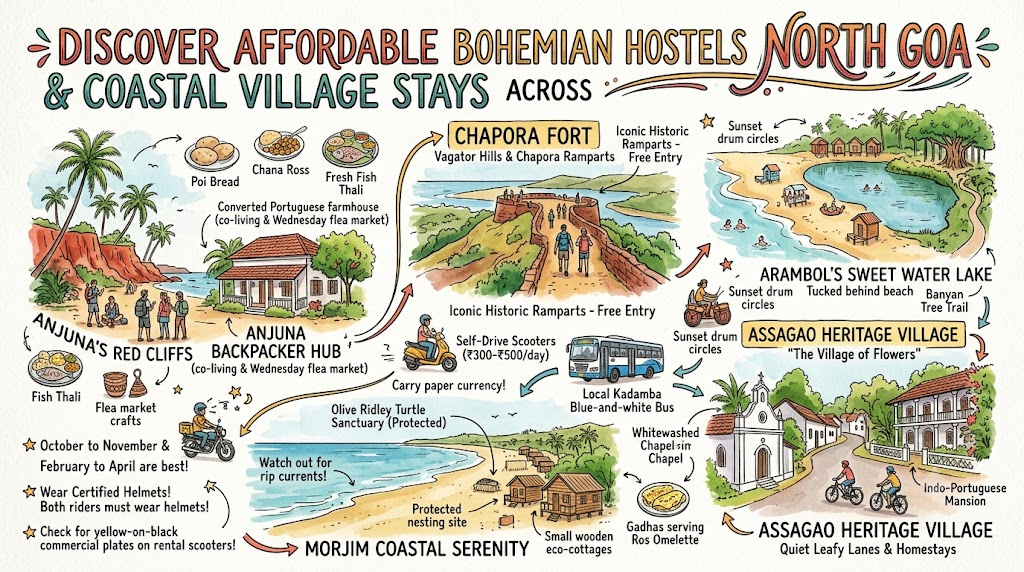
Rugged cliffs and shores along Anjuna.
Chapora Fort ramparts overlooking Vagator.
Sweet Water Lake beside Arambol.
Heritage architecture in verdant Assagao.
Protected sandy stretches of Morjim.
Anjuna Backpacker Hub and Flea Market
Anjuna’s distinct red laterite cliffs and swaying palms served as the cradle of the 1960s international overland trail. Today, it remains the epicentre of budget travel, dotted with converted Portuguese farmhouses, lively backpacker hostels, and vibrant co-living spaces tucked beneath sprawling banyan trees.
The settlement carries an easygoing, communal charm where independent travelers gather over acoustic music and communal kitchen tables. Its historic Wednesday flea market and rocky coves offer an authentic taste of North Goa’s free-spirited counterculture without demanding expensive resort tariffs.
- Location: Bardez Taluka, approximately 18 km north of state capital Panaji.
- Why it is worth visiting: Renowned for pioneering youth hostels, bohemian beach shacks, and rich countercultural heritage.
- Best things to do: Browse handmade crafts at the historic flea market, catch sunset cliffside acoustic sets, and stay in converted 19th-century Goan houses.
- Best time to visit: November to February; late afternoons (4:00 PM – 7:00 PM) for sunset gatherings.
- Ideal for whom: Solo backpackers, budget digital nomads, and artistic souls.
- Travel tip: Book hostels one street back from the beach along De Mello Vaddo to cut accommodation costs by up to 40%.
Vagator Hills and Chapora Ramparts
Perched above the sweep of Big and Little Vagator, Chapora Fort commands sweeping 360-degree views across the Chapora River estuary and the Arabian Sea. The village below maintains a laid-back, rustic appeal, featuring family-run guesthouses, artful garden hostels, and affordable bakeries nestled inside coconut groves.
The surrounding red-earth headlands invite travelers to wander ancient fortification lines free of commercial ticket gates. Down on the sand, dramatic black volcanic rock formations create secluded coves, providing a serene escape from conventional crowded resort strips.
- Location: Bardez Taluka, 22 km from Panaji and 9 km from Mapusa market.
- Why it is worth visiting: Iconic historical ramparts, affordable hillside stays, and striking red laterite topography.
- Best things to do: Hike the fort ramparts for panoramic sunset views, explore secluded Ozran cove, and dine at rustic open-air cafes.
- Best time to visit: October to March; early morning (6:30 AM – 8:30 AM) to beat the afternoon heat.
- Ideal for whom: History lovers, budget couples, and landscape photographers.
- Travel tip: Wear sturdy footwear when climbing the fort’s western ridge; loose laterite pebbles make the descent slippery.
Arambol Bohemian Enclave and Sweet Water Lake
Arambol represents the northern frontier of unhurried, budget-friendly coastal travel in Goa. Tucked beneath dramatic coastal headlands, this expansive sandy stretch is famous for its simple beach huts, rooftop yoga spaces, and vibrant global community of creative artists.
Just past the northern rocky headland lies Kalacha Beach, home to a tranquil freshwater lake fed by natural hillside springs. Travelers can take a refreshing dip in the lake, paint themselves with mineral-rich clay, and return to shore for impromptu drum circles at dusk.
- Location: Pernem Taluka, roughly 32 km north of Panaji.
- Why it is worth visiting: Affordable bamboo beach shacks, holistic wellness workshops, and freshwater lakeside swimming.
- Best things to do: Swim in the calm Sweet Water Lake, attend an open sunset drum circle, and take affordable yoga classes.
- Best time to visit: December to February; late afternoon for sunset music circles and beach gatherings.
- Ideal for whom: Budget travelers, wellness seekers, musicians, and long-term digital nomads.
- Travel tip: Ocean currents near the northern cliff face can be deceptively strong; swim only in designated flag zones.
Assagao Heritage Village and Creative Valley
Nestled in a verdant inland valley flanked by forested hills, Assagao earned the historic moniker “The Village of Flowers.” Unlike the bustling coastal belts, Assagao is defined by quiet winding lanes, centuries-old Indo-Portuguese mansions, and whitewashed village chapels.
While luxury boutique hotels inhabit some grand estates, the village also shelters charming family-run homestays and heritage hostels. Walking or cycling its shaded lanes offers an intimate window into everyday Goan susegad, accompanied by cozy garden bakeries and indie bookshops.
- Location: Bardez Taluka, 4 km inland from Anjuna and 15 km from Panaji.
- Why it is worth visiting: Majestic Portuguese architecture, quiet leafy lanes, and authentic village culture.
- Best things to do: Photograph vintage Goan villas along Badem Road, browse independent bookstores, and sample fresh poi bread at local bakeries.
- Best time to visit: All year round, especially early mornings or cool winter evenings.
- Ideal for whom: Architecture enthusiasts, slow travelers, writers, and heritage lovers.
- Travel tip: Rent a bicycle to explore the village; the narrow rural lanes are best experienced at a relaxed, unhurried pace.
Morjim Coastal Serenity and Olive Ridley Sanctuary
Morjim sits across the Chapora River as the tranquil gateway to Pernem’s northern coastline. Renowned for its broad, golden shoreline and gentle surf, the southern end of the beach is a legally protected nesting sanctuary for endangered Olive Ridley sea turtles.
Because large-scale commercial development is strictly regulated to protect wildlife, Morjim has maintained a calm, eco-conscious profile. Budget travelers can settle into quiet wooden cottages and family homestays set back among the pine and palm groves, just steps from the quiet surf.
- Location: Pernem Taluka, 28 km from Panaji and 18 km from Thivim Railway Station.
- Why it is worth visiting: Protected wildlife sanctuary, uncrowded sands, and a peaceful, eco-friendly atmosphere.
- Best things to do: Spot nesting Olive Ridley turtles (seasonal), walk along the quiet estuary, and enjoy wholesome beach shack dining.
- Best time to visit: November to March for clear skies and turtle nesting season.
- Ideal for whom: Eco-tourists, budget travelers seeking solitude, couples, and bird watchers.
- Travel tip: Respect all conservation barriers on the southern beach spit; avoid using flash photography or white torches after dark.
Offbeat Exploration: Hidden Gems Tourists Miss
Keri (Querim) Beach and Tiracol River Estuary
Situated at the northernmost tip of Goa, Keri Beach remains untouched by mainstream commercial tourism. A dense grove of casuarina trees frames its clean shoreline, where the Tiracol River meets the Arabian Sea. A brief ride on the free government ferry takes you across the river to the clifftop ramparts of Fort Tiracol.
Corjuem Island and Fort
Just 4 km east of Aldona village in the Goan hinterland, Corjuem is an inland island surrounded by the peaceful Mapusa River. It houses a small, well-preserved 18th-century laterite fort that provides panoramic views over emerald paddy fields, river channels, and mangrove ecosystems far away from the coast.
Harvalem Caves and Waterfall
Tucked near Sanquelim, the ancient rock-cut Harvalem (Arvalem) Caves date back to the 6th century, carved from solid laterite stone with distinct Buddhist and Brahminical architectural influences. A short walk through the trees leads to the seasonal Harvalem Waterfall, offering a refreshing inland natural escape.
Detailed Practical Guidance for Travelers
| Destination | Standard Entry Fee | General Timings | Best Local Food Options Nearby | Recommended Nearby Attractions |
|---|---|---|---|---|
| Anjuna Flea Market | Free | Wednesdays, 9:00 AM – 7:00 PM | Baba Au Rhum, Shore Bar, Anand Seafood | Curlies Cove, Starco Junction |
| Chapora Fort | Free | 6:00 AM – 6:30 PM | Scarlet Juice Centre, Mango Tree Bar | Vagator Beach, Ozran Rocky Cove |
| Arambol Sweet Water Lake | Free | Sunrise to Sunset | Double Dutch Cafe, Falafel Corner | Kalacha Beach, Banyan Tree Trail |
| Assagao Heritage Village | Free | Open 24 Hours (Respect private homes) | Gunpowder, GShot Coffee Roastery | St. Cajetan Church, Badem Viewpoint |
| Morjim Turtle Sanctuary | Free | 6:00 AM – 6:00 PM | Divine Wave Shack, Fish Mongers Hub | Ashwem Beach, Chapora River Mouth |
Logistics & On-Ground Navigation
Local Transport Options
- Self-Drive Two-Wheelers: Renting an automatic scooter (Activa) or motorcycle is the most flexible, cost-effective way to get around. Daily rentals range from ₹300 to ₹500, excluding fuel.
- Local Kadamba & Private Buses: Blue-and-white regional buses connect major hubs like Panaji, Mapusa, Calangute, and Arambol. Fares are remarkably affordable, typically ₹15 to ₹40 per ride.
- Pilot Motorcycle Taxis: Unique to Goa, licensed “Pilots” carry a single passenger on a motorcycle for roughly half the cost of an auto-rickshaw.
- Auto-Rickshaws and Taxis: Rickshaws are handy for short rides from bus depots, while taxis suit group transfers. Always negotiate and fix the price before setting off, as meters are rarely used.
Budget Planning
- Backpacker / Shoestring Tier (₹1,200 – ₹2,000 / day): Dorm bed in a quality social hostel (₹500–₹900), self-drive scooter rental (₹350), local fish thalis and street food (₹400–₹600).
- Mid-Range / Comfort Tier (₹3,500 – ₹6,000 / day): Private room in an authentic heritage homestay (₹2,000–₹3,500), scooter or shared cab transit (₹500–₹1,000), meals at garden cafes and seafood shacks (₹1,000–₹1,500).
Safety and Inclusivity Tips
- For Solo Travelers and Women: North Goa is generally very safe and welcoming. Stick to well-lit roads at night, save local emergency numbers, and arrange nighttime transport through trusted hostel desks.
- For Couples: Guesthouse hosts in authentic villages like Assagao and Aldona are warm and hospitable. Respect local neighborhood norms regarding noise and beachwear inside village streets.
- General Health & Water Safety: Stay hydrated in the tropical humidity. Always swim within designated lifeguard zones, and avoid entering the water after consuming alcohol.
Strategic Travel Planning Guardrails
Travel Planning Tips for North Goa
- Travel in the Shoulder Seasons: Visit in late October, November, or February to March to enjoy pleasant weather and lower lodging rates.
- Carry Paper Currency: While UPI QR payments work in most towns, small village bakeries, beach shacks, and parking attendants often require cash.
- Wear Certified Helmets: Local police actively inspect two-wheeler riders; both riders must wear helmets to avoid heavy fines.
- Rent from Licensed Providers: Choose rental bikes with yellow-on-black commercial number plates to steer clear of insurance and licensing disputes.
- Carry Sun Protection: Bring high-SPF reef-safe sunscreen, polarized sunglasses, and a reusable water bottle to reduce single-use plastic waste.
Common Mistakes to Avoid
- Overcrowding Daily Schedules: Trying to cover four beaches in a single afternoon burns precious fuel and energy. Pick one pocket and explore it deeply.
- Assuming All Coastal Belts Are Alike: Baga is lively and commercial, whereas Morjim and Mandrem are quiet and nature-focused. Match your stay to your preferred travel style.
- Overlooking Village Eateries: Don’t stick solely to beachfront cafes; family-run village taverns serve the freshest, most flavorful Goan fish thalis at modest prices.
- Renting Bikes Without Prior Inspection: Always take photos or a short video of existing dents and scratches on rental scooters before riding away.
- Ignoring Tide and Current Warnings: Never ignore red lifeguard flags posted on the beaches—rip currents can be deceptively strong.
Suggested Itinerary Blueprints
1-Day Quick Dash (The Northern Ramparts Loop)
- Morning: Arrive at Mapusa market for a hearty breakfast of spicy chana ross and poi, then ride to Chapora Fort for quiet morning views over the estuary.
- Afternoon: Head down to Anjuna for lunch at a local fish thali eatery, followed by an afternoon coffee in the leafy lanes of Assagao.
- Evening: Ride to Vagator to watch the sunset from the red cliffs, finishing with a relaxed dinner at a garden hostel cafe.
2-Day Deep-Dive (Bohemian Coastline & Heritage Villages)
- Day 1 (The Heritage Valley): Spend your morning cycling past colonial manors in Assagao. In the afternoon, explore Corjuem Island Fort and enjoy an authentic village fish curry in Aldona.
- Day 2 (The Northern Shore): Head north across the Siolim bridge to Arambol. Spend your afternoon swimming in Sweet Water Lake, catch the sunset drum circle, and enjoy live music at an evening beach shack.
Complete Weekend Travel Plan (The North Goa Explorer)
- Friday: Check into a heritage backpacker hostel in Anjuna, spend a relaxing afternoon on the sands of Ozran, and enjoy fresh seafood at a local beach shack.
- Saturday: Explore the vibrant flea market or community craft hubs, take an afternoon trip to Chapora Fort, and spend the evening enjoying live music in Vagator.
- Sunday: Ride up to Morjim Beach to spot native birdlife, take a ferry ride across to Fort Tiracol, and wind down with a quiet sunset dinner in Mandrem.
Common Tourist Mistakes to Avoid
- Geographic Blunders: Trying to stay in North Goa while scheduling day trips down to Palolem or Agonda. The 2.5-hour one-way journey through city traffic eats up half your day.
- Commercial Traps: Spending entire afternoons in congested, high-markup souvenir markets in Calangute instead of browsing authentic artisan stalls in Mapusa and Anjuna.
- Neglecting Modern/Alternative Zones: Focusing strictly on beachfront roads while overlooking charming inland neighborhoods like Assagao, Saligao, and Aldona with their bakeries and art galleries.
- Transport Overpayment: Hiring unmetered tourist cabs at airport exits without checking government prepaid taxi counters or regional bus schedules first.
- Luxury Dining Bias: Missing out on local street-side gadhas serving piping hot ros omelette, which offer unmatched regional flavor for a fraction of restaurant prices.
Frequently Asked Questions
1. What is the average price for a budget stay in North Goa?
Hostel dorm beds typically cost between ₹500 and ₹1,000 per night, depending on whether you choose air conditioning. Private rooms in local guesthouses and budget homestays range from ₹1,200 to ₹2,500 per night, offering great value during the shoulder seasons.
2. Which area in North Goa is best for budget backpackers?
Anjuna and Arambol are the premier hubs for budget travelers. Both offer a wide range of social hostels, affordable beach shacks, scooter rentals, and inexpensive dining options, making it easy to meet fellow travelers while keeping daily expenses low.
3. Is it possible to explore North Goa without renting a scooter?
Yes, you can easily use public buses running between Mapusa, Panaji, and the coastal villages for ₹15 to ₹40 per trip. Licensed motorcycle pilots and auto-rickshaws provide affordable local rides for shorter distances between beaches.
4. When can I find the cheapest accommodation rates in North Goa?
The most affordable rates appear during the monsoon months from June to September, followed by the shoulder seasons in October and March. During these periods, guesthouses and boutique hostels often cut their peak winter prices by up to 50 percent.
5. Are budget stays in North Goa safe for solo female travelers?
Yes, established backpacker hostels in Anjuna, Vagator, and Assagao provide secure, welcoming environments with 24-hour reception, keycard lockers, and female-only dorms. It is always wise to read recent guest reviews and arrange evening transport through your stay.
6. Do I need an International Driving Permit to rent a scooter in Goa?
Indian travelers simply need a valid permanent national driving license. Foreign visitors must carry a valid domestic driving license alongside an International Driving Permit (IDP) to legally rent and operate two-wheelers on public roads.
7. Can I find authentic local Goan food near budget hostels?
Yes, most village junctions in North Goa feature local family-run eateries serving traditional fish curry thalis, sorpotel, and poi for ₹150 to ₹250. Small street carts also serve fresh ros omelette and vegetable patties throughout the evening.
8. What should I look for before renting a scooter in North Goa?
Ensure the vehicle carries a valid yellow-on-black commercial rental registration plate. Take clear photos or a short video of any existing scratches, test the brakes and headlights, and verify that registration and insurance documents are inside the storage compartment.
9. Are beach shacks cheaper to stay in than inland village homestays?
Simple bamboo shacks right on the sand can be affordable early in the season, but their rates often surge during peak winter months. Inland homestays in villages like Assagao and Siolim provide more consistent pricing, better amenities, and peaceful surroundings.
10. How far in advance should I book budget stays for December?
For travel during the peak holiday weeks between mid-December and early January, book your hostel dorm or guesthouse at least two to three months ahead. Walk-in rates can triple, and popular properties fill up entirely.
11. Do digital payments work everywhere across North Goa?
UPI payments via Google Pay and PhonePe are widely accepted across cafes, hotels, and retail shops. However, carrying ₹1,000 to ₹2,000 in cash is essential for paying roadside vendors, village bus conductors, and beach parking attendants.
12. What is the most convenient way to reach North Goa stays from Mopa Airport?
Manohar International Airport at Mopa is conveniently located just 25 to 35 km from North Goa beaches. You can take an official electric state bus directly to Mapusa or Calangute, or book a prepaid taxi at the terminal exit.
Conclusion
Choosing affordable stays across North Goa offers far more than just monetary savings—it connects you directly with the authentic heart and soul of the sunshine state. Trading sterile, high-walled luxury enclaves for charming village guesthouses, bohemian coastal dorms, and historic leafy lanes opens the door to genuine local hospitality, enduring community spirit, and the timeless, restorative magic of true Goan susegad.
