Introduction
Data engineering and infrastructure management are rapidly converging in the modern enterprise. Navigating this landscape requires structured, production-focused knowledge rather than just theoretical understanding. This guide explores the DataOps Certified Professional (DOCP) to help professionals understand its true value and practical application.
By mapping out the exact skills, tracks, and career trajectories, this breakdown will help you make informed decisions about your technical growth. Whether you are learning through established enterprise channels or exploring specialized platforms like aiopsschool, establishing a strong foundation in data operations is critical. This mentor-driven overview strips away the marketing noise to focus purely on what works in real-world systems.
What is the DataOps Certified Professional (DOCP)?
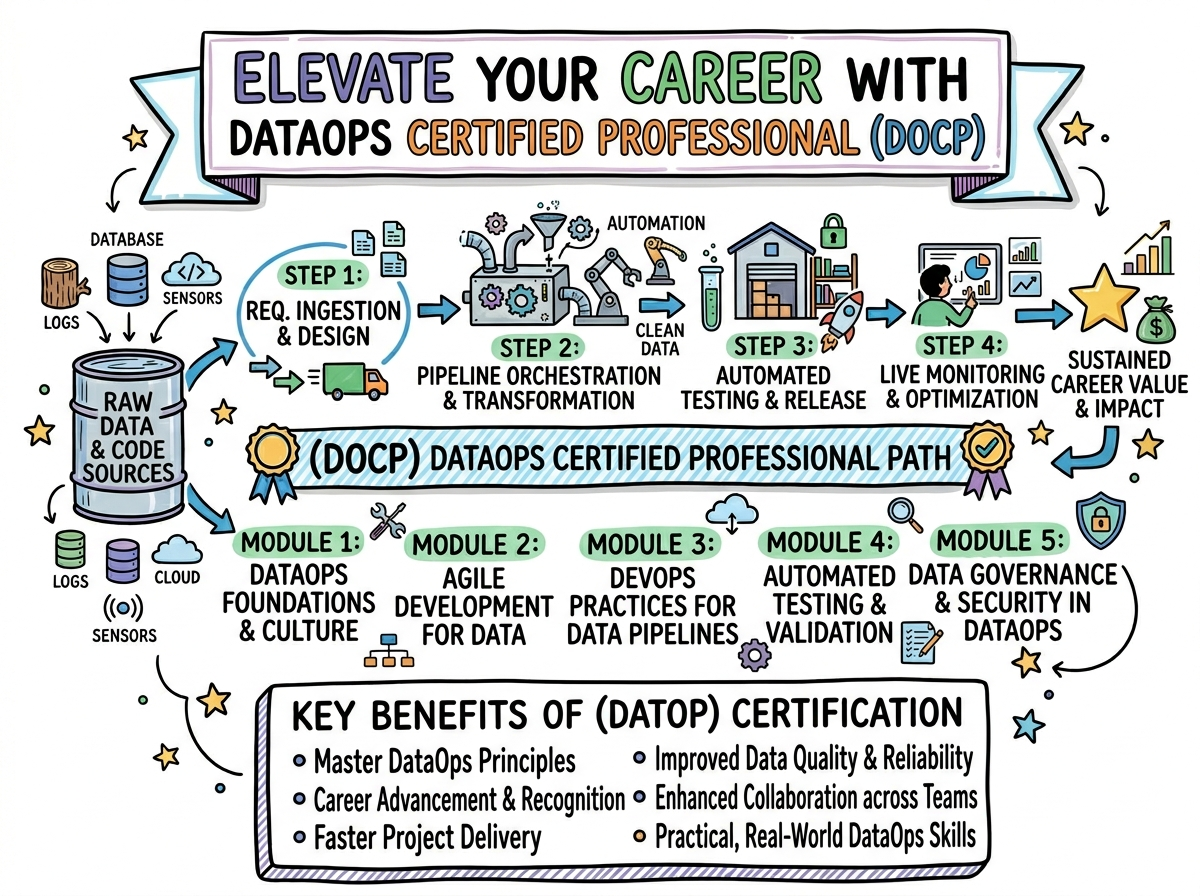
The DataOps Certified Professional (DOCP) represents a formalized approach to managing data pipelines, infrastructure automation, and data reliability at scale. It exists to bridge the persistent gap between software engineering, data engineering, and operational stability. Rather than focusing on a single tool, it emphasizes the architectural patterns required to keep data systems highly available and secure.
This certification focuses heavily on real-world, production-focused learning. It forces engineers to think about continuous integration, deployment, and monitoring specifically through the lens of data workloads. By aligning with modern engineering workflows, it ensures that technical teams can deploy data models and pipelines with the same rigor used in traditional software delivery.
Who Should Pursue DataOps Certified Professional (DOCP)?
This certification provides significant value across multiple roles within an engineering organization. Software engineers looking to understand data infrastructure will find it highly practical. Site Reliability Engineers (SREs) who are increasingly tasked with maintainWho Should Pursue DataOps Certified Professional (DOCP)?ing massive data clusters will gain the specific operational context they need to ensure uptime and performance.
It is highly relevant for professionals at all stages of their careers, offering a solid framework for building core fundamentals while scaling up to complex, distributed environments. Engineering managers and technical leaders also benefit immensely, as it provides the architectural vocabulary needed to guide teams effectively. Furthermore, the principles taught are universally applicable, offering immense relevance to engineering hubs in India as well as the broader global market.
Why DataOps Certified Professional (DOCP)
Enterprise adoption of data-driven decision-making has created a massive demand for infrastructure that does not fail under pressure. This certification proves that an engineer understands how to treat data as a highly available product rather than a fragile byproduct. This underlying demand ensures the longevity of the skills acquired through the program.
Furthermore, because the focus remains on core engineering principles rather than fleeting industry trends, professionals stay relevant regardless of which specific vendor tools are currently popular. Investing time in this path yields a high return on investment. It transforms engineers from passive system maintainers into proactive architects who can drive significant business value through stable, scalable pipelines.
DataOps Certified Professional (DOCP) Certification Overview
The program is formally delivered via the DataOps Certified Professional (DOCP) framework and is officially hosted on devopsschool. The certification is structured to validate practical competency rather than simple memorization, ensuring that credential holders can actually perform the work in a live environment.
Assessment approaches typically involve scenario-based problem solving and architectural design validation. The ownership and structure of the curriculum reflect the daily realities of production outages, deployment bottlenecks, and security audits. It is built by engineers, for engineers, maintaining a strict focus on utility and operational readiness.
DataOps Certified Professional (DOCP) Certification Tracks & Levels
The certification is systematically broken down into distinct proficiency levels to match career progression. The Foundation level establishes the baseline vocabulary and core concepts of data orchestration and version control. It ensures all candidates share a unified understanding of operational principles before touching complex systems.
The Professional level moves into pipeline architecture, security implementations, and heavy automation. Finally, the Advanced level tackles multi-region deployments, disaster recovery, and organizational scaling. Specialized tracks branch out from these core levels, allowing candidates to map their learning directly to enterprise roles like SRE, cloud architecture, or financial operations.
Complete DataOps Certified Professional (DOCP) Certification Table
| Track | Level | Who it’s for | Prerequisites | Skills Covered | Recommended Order |
| DataOps Core | Foundation | All Engineering Roles | Basic Linux/Cloud knowledge | Data versioning, CI/CD basics, Observability | 1 |
| DataOps Engineering | Professional | Data & DevOps Engineers | Foundation Level | Pipeline automation, Data security, Terraform | 2 |
| Data Reliability | Professional | SREs & Platform Engineers | Foundation Level | SLIs/SLOs for data, Incident response, Scaling | 2 |
| Enterprise DataOps | Advanced | Architects & Managers | Professional Level | Multi-cloud architecture, Cost optimization, Governance | 3 |
Detailed Guide for Each DataOps Certified Professional (DOCP) Certification
DataOps Certified Professional (DOCP) – Foundation
What it is
This validates your grasp of core principles combining data engineering with operational rigor. It proves you understand how code, data, and infrastructure interact.
Who should take it
Ideal for software engineers, junior operators, and technical managers. It sets the baseline for anyone transitioning into heavy data infrastructure roles.
Skills you’ll gain
- Fundamental understanding of CI/CD applied to data systems.
- Basic implementation of monitoring and alerting for pipelines.
- Version control strategies for data schemas and configurations.
- Introduction to automated testing for data quality.
Real-world projects you should be able to do
- Set up a basic automated deployment pipeline for a database schema.
- Configure standard alerting thresholds for pipeline failures.
- Implement version control for a small set of data transformation scripts.
Preparation plan
- 7-14 days: Focus entirely on the core terminology and understanding the architectural differences between standard DevOps and DataOps.
- 30 days: Begin hands-on practice with version control systems and basic CI/CD runners using mock data sets.
- 60 days: Build end-to-end sandbox environments. Document your pipeline workflows and test them against common failure scenarios.
Common mistakes
Candidates often focus too much on learning a specific tool rather than understanding the underlying workflow pattern. Rushing through the testing phase of data pipelines is also a frequent error.
Best next certification after this
- Same-track option: DataOps Certified Professional (DOCP) – Professional
- Cross-track option: A base-level cloud provider certification (AWS/GCP/Azure)
- Leadership option: Agile or Scrum frameworks for data teams
DataOps Certified Professional (DOCP) – Professional
What it is
This validates your ability to actually build, secure, and maintain complex data pipelines in production. It moves beyond theory into heavy automation and infrastructure as code.
Who should take it
Working DevOps engineers, data engineers, and SREs responsible for daily operations. It is built for those who spend their time in the terminal and deployment consoles.
Skills you’ll gain
- Advanced Infrastructure as Code (IaC) for data environments.
- Implementation of strict data security and compliance guardrails.
- Orchestration of complex, multi-stage data workflows.
- Advanced performance tuning for distributed systems.
Real-world projects you should be able to do
- Provision complete data clusters purely through code.
- Build automated rollback mechanisms for corrupted data deployments.
- Integrate security scanning directly into the pipeline execution.
Preparation plan
- 7-14 days: Map out the gaps in your current infrastructure knowledge, particularly around networking and security.
- 30 days: Deep dive into orchestration frameworks and write complex deployment scripts. Focus heavily on state management.
- 60 days: Simulate production outages in a lab environment and script the automated recovery processes without manual intervention.
Common mistakes
Over-engineering simple pipelines with unnecessary microservices. Ignoring the financial impact of poorly optimized queries and data storage patterns.
Best next certification after this
- Same-track option: DataOps Certified Professional (DOCP) – Advanced
- Cross-track option: Certified Kubernetes Administrator (CKA)
- Leadership option: Cloud Architecture certifications
DataOps Certified Professional (DOCP) – Advanced
What it is
This is the architectural tier, validating your ability to design resilient, multi-region data platforms. It focuses on organizational scale, governance, and disaster recovery.
Who should take it
Principal engineers, senior SREs, and enterprise architects. It is for those who design systems that entire companies rely upon for survival.
Skills you’ll gain
- Designing zero-downtime migration strategies for massive data stores.
- Implementing enterprise-wide governance and cost-control frameworks.
- Architecting multi-cloud or hybrid data synchronization.
- Building self-service data platforms for internal developer use.
Real-world projects you should be able to do
- Architect a failover system for a critical production database across regions.
- Design and implement a cross-team, internal developer platform for data.
- Execute a complete security and compliance audit of a global infrastructure.
Preparation plan
- 7-14 days: Review advanced architectural design patterns and enterprise networking structures.
- 30 days: Focus on designing cross-region deployments and testing data latency under heavy load.
- 60 days: Develop comprehensive runbooks, architecture diagrams, and cost-benefit analyses for large-scale migrations.
Common mistakes
Failing to account for data gravity and network egress costs in multi-cloud designs. Designing systems that are technically impressive but too complex for the team to maintain.
Best next certification after this
- Same-track option: Specialized vendor-specific data architecture tracks.
- Cross-track option: FinOps Practitioner certifications.
- Leadership option: Executive tech management or enterprise architecture programs.
Choose Your Learning Path
DevOps Path
The DevOps path focuses on bridging traditional software delivery with data infrastructure. You will learn to treat data configurations exactly like application code. The emphasis is on continuous integration, automated testing of data models, and deployment reliability. This path ensures that the tooling and culture of standard software engineering are successfully transplanted into the data ecosystem.
DevSecOps Path
Security cannot be an afterthought when dealing with sensitive data pipelines. This path integrates continuous security and compliance checks directly into the operational workflow. You will master identity management, encryption at rest and in transit, and automated vulnerability scanning. It teaches you to build systems where security acts as a programmatic guardrail rather than a manual blocker.
SRE Path
Site Reliability Engineering for data focuses on keeping massive clusters highly available. This path dives deep into Service Level Indicators (SLIs), fault tolerance, and incident response for databases and event streams. You will learn how to instrument pipelines for total observability and build self-healing mechanisms. The goal is to eliminate operational toil and ensure the reliability of the data platform.
AIOps Path
This path focuses on using artificial intelligence and machine learning to automate IT operations and incident management. You will learn to ingest massive amounts of telemetry and log data to predict system failures before they happen. The training covers anomaly detection, automated root cause analysis, and intelligent alerting. It is designed to reduce alert fatigue and automate repetitive operational responses.
MLOps Path
The MLOps path is distinct, focusing on the deployment, monitoring, and lifecycle management of machine learning models in production. You will learn to build automated pipelines for model training, testing, and serving. This covers tracking model drift, managing feature stores, and ensuring reproducibility of experiments. It bridges the gap between data scientists creating models and engineers maintaining them.
DataOps Path
This is the core discipline of streamlining data integration, transformation, and delivery. It focuses heavily on the speed and accuracy of analytics and data processing workflows. You will learn orchestration, data quality testing, and schema management. The objective is to drastically reduce the cycle time of deploying new data analytics while maintaining high confidence in data accuracy.
FinOps Path
Cloud data operations can easily spiral out of financial control. This path teaches the intersection of engineering and financial accountability. You will learn to optimize storage costs, monitor compute expenses in real-time, and build cost-aware pipeline architectures. It empowers engineers to make technical decisions that align directly with business budgets and profitability.
Role → Recommended DataOps Certified Professional (DOCP) Certifications
| Role | Recommended Certifications |
| DevOps Engineer | DOCP Foundation, DOCP Professional |
| SRE | DOCP Professional, Data Reliability Track |
| Platform Engineer | DOCP Professional, Enterprise DataOps |
| Cloud Engineer | DOCP Foundation, DOCP Professional |
| Security Engineer | DOCP Professional (DevSecOps focus) |
| Data Engineer | DOCP Foundation, DOCP Professional |
| FinOps Practitioner | Enterprise DataOps, FinOps Specialized |
| Engineering Manager | DOCP Foundation, Enterprise DataOps |
Next Certifications to Take After DataOps Certified Professional (DOCP)
Same Track Progression
Continuing down the same track involves pursuing the advanced and expert-level tiers of the certification. This deepens your technical authority over enterprise-grade data platforms. You will move from building single pipelines to architecting global, multi-region operational frameworks. It cements your status as a principal-level contributor within the specific domain of data infrastructure.
Cross-Track Expansion
Broadening your skill set makes you a more versatile engineer. Moving into Kubernetes administration, cloud security, or specialized machine learning infrastructure provides excellent synergy. This cross-pollination allows you to understand the complete technology stack, enabling you to design systems that account for application layers, security, and data storage simultaneously.
Leadership & Management Track
For those looking to step back from the terminal, leadership tracks focus on strategy and scaling teams. Certifications in enterprise architecture, agile service management, or engineering leadership are the logical next steps. This transitions your focus from technical implementation to optimizing human workflows, budget management, and long-term technological vision for the organization.
Training & Certification Support Providers for DataOps Certified Professional (DOCP)
DevOpsSchool
DevOpsSchool operates as a highly respected technical training institution that focuses strictly on real-world engineering practices. They provide structured, instructor-led training designed to mimic actual production environments rather than simple sandbox exercises. Their approach to the DataOps framework emphasizes hands-on pipeline building, infrastructure automation, and rigorous testing methodologies. The trainers are typically working professionals who bring current industry challenges directly into the classroom. This ensures that the curriculum remains aligned with what enterprise employers actually demand. By avoiding purely theoretical lectures, they equip engineers with the practical muscle memory required to deploy, secure, and maintain complex systems immediately upon completing the program.
Cotocus
Cotocus is widely recognized for its specialized consulting and technical education services, particularly in the realm of automation and cloud infrastructure. Their training methodology heavily leans on architectural design and problem-solving at scale. When approaching operational training, they focus on how disparate tools integrate to form a cohesive, resilient platform. They provide extensive labs that force students to troubleshoot broken configurations and optimize poorly performing pipelines. This specific focus on debugging and system integration makes their training highly valuable for engineers looking to move into senior or principal roles. Cotocus ensures that professionals understand the “why” behind the technology, not just the “how.”
Scmgalaxy
Scmgalaxy has built a strong reputation as a community-driven learning hub that excels in configuration management, continuous integration, and build automation. Their material is deeply rooted in the daily realities of software delivery and infrastructure management. They provide a wealth of practical tutorials, forums, and structured courses that demystify complex operational workflows. For professionals entering the data operations space, Scmgalaxy offers excellent foundational training on version control, artifact management, and deployment scripting. Their approach is highly pragmatic, focusing on open-source tooling and standard enterprise practices, making it an excellent resource for engineers who need to build reliable systems on a strict budget.
BestDevOps
BestDevOps focuses on delivering high-impact, accelerated learning paths for IT professionals needing to upgrade their skills rapidly. Their curriculum is highly targeted, cutting out unnecessary filler to focus directly on the core competencies required for certification and job performance. They utilize a mix of practical labs, intensive bootcamps, and direct mentorship to push engineers beyond their comfort zones. Their training environments are designed to simulate high-pressure deployment scenarios, teaching students how to maintain operational discipline under stress. This makes BestDevOps particularly suited for experienced administrators and developers who want to transition quickly into specialized operational roles without spending months on theory.
devsecopsschool
This provider focuses explicitly on the intersection of infrastructure, automation, and rigorous security practices. They train engineers to embed security controls directly into the deployment pipeline from day one. Their curriculum covers vulnerability scanning, automated compliance checks, and secure infrastructure as code. For data professionals, they provide crucial knowledge on how to protect sensitive information at rest and in transit without slowing down delivery times. By treating security as a programmable construct rather than a manual audit process, devsecopsschool prepares professionals to build robust platforms that satisfy both engineering requirements and strict enterprise compliance mandates.
sreschool
This platform is dedicated entirely to the discipline of Site Reliability Engineering, focusing on system availability, performance monitoring, and incident response. They teach engineers how to define Service Level Objectives (SLOs) and build automated, self-healing infrastructure. Their training involves deep dives into observability platforms, distributed tracing, and capacity planning. For those managing massive data workloads, sreschool provides the exact methodologies needed to prevent outages and handle failure gracefully. Their rigorous, metrics-driven approach ensures that professionals know how to balance the speed of new feature delivery with the absolute necessity of maintaining a stable production environment.
aiopsschool
Dedicated to the automation of IT operations through machine learning, this provider trains professionals to build intelligent infrastructure. They focus on deploying systems that can ingest massive log data, detect anomalies, and trigger automated remediation without human intervention. Their curriculum covers the integration of predictive analytics into daily operations, effectively teaching engineers how to reduce alert fatigue. By focusing on smart monitoring and automated root cause analysis, they prepare technical teams to handle the massive scale of modern cloud environments. The training bridges the gap between traditional system administration and advanced data science applications for operations.
dataopsschool
This institution focuses purely on the methodologies required to streamline and secure data engineering workflows. They teach professionals how to apply continuous integration and continuous deployment principles specifically to data pipelines and warehouse schemas. Their training covers data versioning, automated quality testing, and pipeline orchestration. By treating data as a first-class product, they ensure engineers know how to deliver accurate analytics faster and more reliably. The curriculum strips away standard software development practices that do not apply to data, providing a highly tailored, deeply technical education for those responsible for the enterprise data lifecycle.
finopsschool
Focusing on cloud financial management, this provider trains engineers and managers to bring financial accountability to technical architecture. They teach professionals how to design highly efficient infrastructure that maximizes performance while minimizing cloud spend. Their curriculum covers automated cost tracking, resource tagging, and budgeting integration within deployment pipelines. For data professionals dealing with massive compute and storage costs, finopsschool provides the critical skills needed to optimize queries and storage tiers. They empower engineering teams to make intelligent, cost-aware decisions, ensuring that technical scaling aligns perfectly with corporate financial objectives.
Frequently Asked Questions
- What is the primary focus of this career track?
It focuses on integrating software engineering practices, automation, and reliability specifically into data management and infrastructure pipelines. - Do I need to be a programmer to start?
While deep software development is not strictly required, a strong understanding of scripting, version control, and command-line operations is absolutely necessary. - How much time does it take to prepare for the foundation level?
Most professionals with a working IT background can comfortably prepare for the foundation level with 30 to 45 days of consistent, hands-on study. - Will this help me secure a management position?
Yes. Understanding system architecture and operational pipelines is critical for engineering managers who need to oversee complex technical teams and budgets. - Is it better to learn cloud-native tools or open-source first?
Always learn the underlying concepts using open-source tools first. Vendor-specific cloud tools are simply abstractions of these foundational open-source principles. - How does this differ from traditional data engineering?
Traditional data engineering focuses heavily on writing the transformation logic, while this operational approach focuses on how that logic is reliably deployed, tested, and maintained. - Do employers actually value these operational skills?
Highly. Companies lose massive amounts of money to pipeline downtime and data corruption, making professionals who can stabilize these systems extremely valuable. - Can I transition from standard system administration into this field?
Yes. System administrators already possess the fundamental troubleshooting and infrastructure mindset required; they simply need to learn modern automation and orchestration tooling. - Does this cover database administration (DBA) tasks?
It covers the automation and deployment of databases, but it does not typically focus on the deep, internal query optimization that a traditional DBA might perform. - What is the most difficult concept to master in this path?
State management and handling automated rollbacks in distributed systems usually present the steepest learning curve for new practitioners. - Do I need to pay for expensive enterprise tools to practice?
No. Almost all practical learning can be accomplished using free, open-source tools and the free tiers of major cloud service providers. - Should I focus on security or reliability first?
They are deeply intertwined. However, building reliable, version-controlled pipelines is generally the necessary first step before you can effectively automate security checks.
FAQs on DataOps Certified Professional (DOCP)
- What specifically does the DataOps Certified Professional (DOCP) validate?
This certification strictly validates your practical ability to design, build, secure, and maintain automated data pipelines in a production environment. It proves to employers that you understand how to treat data systems with the exact same engineering rigor, testing, and continuous deployment practices used in modern software delivery. It moves beyond theoretical knowledge, demanding that candidates demonstrate real-world competency in version control, continuous integration, and infrastructure automation tailored for data. - Is the DataOps Certified Professional (DOCP) practical or multiple-choice based?
The assessment heavily prioritizes practical, scenario-based problem solving. While foundational theory is tested, the core value of the credential comes from proving you can actually execute tasks. Candidates are expected to understand how to write deployment scripts, troubleshoot broken pipeline configurations, and implement security guardrails. This hands-on focus ensures that anyone holding the credential can immediately contribute to an engineering team without needing months of onboarding to understand modern deployment workflows. - How does the DOCP differentiate from standard cloud certifications?
Standard cloud certifications focus on how to operate a specific vendor’s platform (like AWS or Azure). The DOCP is vendor-agnostic and focuses on the architectural methodologies of data operations. It teaches the “why” and “how” of pipeline automation and reliability, regardless of where the infrastructure is hosted. This ensures your skills remain highly portable and relevant even if your organization migrates to a different cloud provider or moves back to on-premise hardware. - What are the prerequisites for the Professional tier of the DOCP?
Before attempting the Professional tier, candidates must have passed the Foundation level and should possess strong scripting skills (like Python or Bash). Additionally, you need hands-on experience with version control (Git), a solid understanding of basic networking, and familiarity with containerization. It is highly recommended that you have spent at least several months actively working with infrastructure automation and continuous integration tools in a live or highly simulated environment. - How does holding the DOCP impact salary and career growth?
Because the industry faces a severe shortage of engineers who can reliably manage data at scale, professionals with proven operational skills command significant leverage. Holding this credential signals to hiring managers that you can prevent costly outages and accelerate delivery times. This directly translates to faster promotions into senior engineering or architectural roles, as you are solving high-level business problems rather than just maintaining legacy systems. - What is the best way to study for the DOCP exams?
The absolute best way to study is by building lab environments. Do not rely solely on reading documentation. Set up a local cluster, configure a continuous integration runner, and write scripts to automate the deployment of dummy data. Intentionally break your pipelines and practice troubleshooting the errors. Utilizing structured training providers to guide these labs can accelerate the process, but the core focus must remain on keyboard time and practical implementation. - How frequently should I expect to recertify or update my DOCP knowledge?
The core principles of automation and reliability change slowly, but the specific tooling evolves rapidly. While formal recertification requirements vary by level, a professional should realistically expect to update their practical knowledge continuously. Keeping up with industry standards regarding infrastructure as code and orchestration frameworks is a daily requirement, making continuous learning a fundamental part of holding the credential. - Can an engineering manager benefit from taking the DOCP?
Absolutely. Managers cannot effectively guide a team, estimate project timelines, or advocate for technical budgets if they do not understand modern operational workflows. The DOCP provides managers with the exact vocabulary and architectural understanding needed to align engineering efforts with business goals. It helps leaders identify technical debt in their data pipelines and make informed decisions about hiring, tooling, and organizational structure.
Final Thoughts: Is DataOps Certified Professional (DOCP) Worth It?
Making the decision to pursue a specialized technical credential requires looking past the industry hype and evaluating the raw utility of the knowledge. The reality of modern engineering is that building a machine learning model or a complex application is only half the battle; the real challenge lies in keeping that system running flawlessly in production.
The DataOps Certified Professional (DOCP) is highly valuable because it tackles this exact problem. It forces you to adopt a disciplined, engineering-first mindset toward data. It is not a magic bullet for your career, nor will it replace the necessity of hands-on experience. However, it provides a rigorous, structured framework that accelerates your understanding of complex systems. If you are willing to put in the hours at the terminal, build the lab environments, and truly internalize the principles of automation and reliability, this credential will serve as a robust foundation for long-term technical leadership.
