Introduction
When most people think of Goa, their minds instantly drift to the booming basslines of Anjuna, the overcrowded sands of Calangute, or the chaotic beach shacks that define mainstream tourism. Yet, tucked away along the banks of the serene Mandovi River lies an entirely different universe. Panjim (also known as Panaji), the state capital, rejects the transient, commercialized rush of the coastal party strips. Instead, it invites travelers to slow down and immerse themselves in a world where history has left an indelible, vibrant mark. It is a city of deep roots, old-world Mediterranean charm, and quiet, sun-dappled lanes. Choosing Panjim over generic beach resorts means exchanging plastic souvenir stands for authentic cultural connection, striking architectural heritage, and an unhurried lifestyle that local residents call susegad.
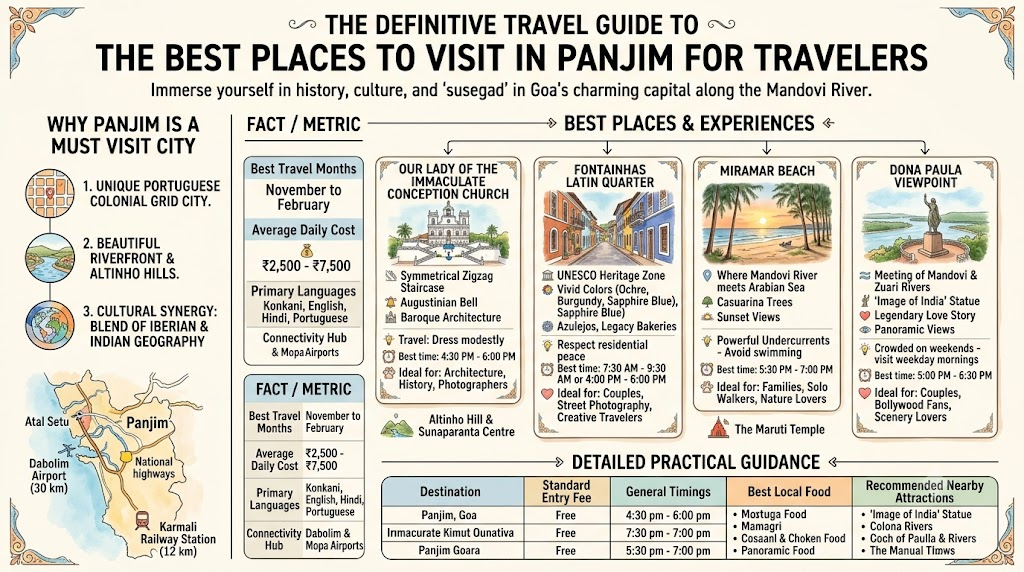
Why Panjim is a Must Visit City
Panjim occupies an essential chapter in the subcontinent’s geopolitical and cultural history. Serving as the capital of Portuguese India for over a century after Old Goa was abandoned due to devastating epidemics, this city represents a unique, syncretic blend of Iberian and Western Indian geography. Architecturally, it is one of the finest surviving examples of a Portuguese colonial grid city in Asia, punctuated by red-tiled roofs, overhanging wrought-iron balconies, and white-washed churches that catch the stark tropical sun. Geographically, its positioning creates a stunning riverfront promenade that transitions gently into the rolling topography of the Altinho hills.
For modern travelers, Panjim serves as the ultimate structural pivot point for any Goan itinerary. The city is exceptionally accessible, connected seamlessly by the magnificent Atal Setu bridge to the north and well-maintained national highways to the south. The Karmali railway station rests just 12 kilometers away, and the city’s central Kadam Bus Stand acts as a primary nerve center for local transport. Whether you are a solo backpacker looking for heritage hostels, a couple searching for intimate riverside dining, or a family exploring regional history, Panjim offers premium infrastructure, safe neighborhoods, and a walkable urban footprint.
| Fact / Metric | Detail Specification |
| Best Travel Months | November to February (cool, dry post-monsoon breeze) |
| Average Daily Cost | ₹2,500 (Budget) to ₹7,500 (Mid-Range Comfort) |
| Primary Languages | Konkani, English, Hindi, Portuguese (spoken by elders) |
| Connectivity Hub | Dabolim Airport (30 km) / Mopa Manohar International Airport (35 km) |
Best Places or Experiences
Our Lady of the Immaculate Conception Church
Rising majestically over the central municipal garden square, this iconic house of worship looks like a multi-tiered wedding cake carved entirely from white stone. Originally built as a small chapel in 1541 to greet Portuguese sailors arriving from Lisbon, the structure underwent massive expansions in the early 17th century. The church features a highly distinctive, symmetrical zigzag staircase that climbs up the face of the hillock, drawing the eyes of every passerby directly toward its central pediment.
The interior of the church is beautifully restrained yet architecturally grand, housing the ancient Augustinian bell—the second-largest church bell in all of Goa. Taken from the ruined Church of St. Augustine in Old Goa, its resonant strikes have echoed across the capital’s rooftops for generations. The main altar is dedicated to Mary Immaculate, flanked by deeply intricate, gold-gilded woodwork that frames the statues of St. Peter and St. Paul.
- Location: Church Square, Central Panjim, 0 km from the city center.
- Why it is worth visiting: It stands as the definitive visual anchor of Panjim, showcasing textbook Portuguese Baroque architecture and housing a massive, historic 19th-century bell.
- Best things to do: Climb the 78 zigzagging stone steps for a panoramic view of the square, photograph the spotless white façade during the late afternoon “golden hour,” and step quietly inside to view the gold-gilded altars.
- Best time to visit: 4:30 PM to 6:00 PM for optimal soft photography lighting before the exterior floodlights turn on at dusk.
- Ideal for whom: Architecture enthusiasts, history buffs, and amateur photographers.
- Travel tip: Dress modestly out of respect for active worshippers; sleeveless tops and short skirts or shorts are strictly discouraged inside the main prayer hall.
Fontainhas Latin Quarter
Stepping past the Ourem Creek into the historic neighborhood of Fontainhas feels less like exploring an Indian city and more like being magically transported into a coastal village in Portugal or southern Europe. Developed in the late 18th and 19th centuries, this UNESCO-recognized heritage zone boasts narrow, labyrinthine streets lined with ancestral homes painted in vivid shades of ochre yellow, deep burgundy, and sapphire blue. A strict colonial law mandated that every resident repaint their house annually after the monsoons, a tradition that keeps the neighborhood remarkably vibrant today.
The architecture here is defined by hand-painted azulejos (blue ceramic nameplates), traditional tiled roofs, and heavy wooden windows designed to block out the harsh tropical heat. As you stroll, the faint sounds of acoustic guitars or elderly residents conversing in fluent Portuguese drift through the open shutter windows. The quarter is a living museum, where cozy independent art galleries sit comfortably alongside legacy bakeries that have used wood-fired ovens for nearly a century.
- Location: Eastern Panjim, bordered by Ourem Creek and Altinho Hill, 1 km from the central square.
- Why it is worth visiting: It is the only surviving, fully functional Latin Quarter in Asia, offering unmatched visual charm, historic architecture, and rich, old-world lifestyle traits.
- Best things to do: Book a morning walking tour to uncover the hidden water springs, buy fresh pasteis de nata (custard tarts) at Confeitaria 31 de Janeiro, and admire the local contemporary art displayed inside Gitanjali Art Gallery.
- Best time to visit: 7:30 AM to 9:30 AM for quiet, uncrowded streets, or 4:00 PM to 6:00 PM for a lively café culture experience.
- Ideal for whom: Couples looking for romantic walks, street photographers, and creative travelers.
- Travel tip: Remember that Fontainhas is a quiet, residential neighborhood; avoid standing directly on private doorsteps, blocking house entrances, or shouting while taking photos.
Miramar Beach
Where the vast Mandovi River completes its long journey and officially empties into the deep blue waters of the Arabian Sea, you will find Miramar Beach. Spanning a wide, two-kilometer stretch of soft, silvery sand, this coastal line is lined with tall, swaying casuarina trees that hiss softly in the ocean breeze. Unlike the commercialized party beaches located further north, Miramar acts as a vast civic living room for the people of Panjim, who gather here to unwind after the sun sets.
The beach offers an expansive view across the mouth of the river, looking out toward the historic fortifications of Aguada Fort perched on the rocky northern headland. While the currents here are generally too unpredictable and dangerous for safe recreational swimming, the soft sand flats are perfect for long, barefoot strolls. Local children fly kites in the evening sky, and groups of families gather on blankets to share home-cooked snacks as the sun dips below the ocean horizon.
- Location: Dayanand Bandodkar Marg, 3 km west of central Panjim.
- Why it is worth visiting: It provides a peaceful coastal escape right within the city limits, offering great sunset views over the historic Aguada headland.
- Best things to do: Take an evening walk along the broad shoreline, enjoy local street food snacks like sev puri from the beachside kiosks, and spot passing dolphins on an eco-friendly boat cruise.
- Best time to visit: 5:30 PM to 7:00 PM to catch the striking ocean sunset.
- Ideal for whom: Families traveling with children, solo walkers, and nature lovers.
- Travel tip: Avoid swimming past your waist here; the mixing waters of the Mandovi River and the Arabian Sea create powerful undercurrents that can easily catch you off guard.
Dona Paula Viewpoint
Perched prominently on a rocky, wind-swept headland where two of Goa’s greatest rivers—the Mandovi and the Zuari—meet the sea, Dona Paula is steeped in local romance and maritime history. The area is named after Dona Paula Menezes, the daughter of a Portuguese Viceroy, who according to passionate local legend, leapt from the cliffs after being forbidden to marry a humble local fisherman. Today, a striking, whitewashed stone statue called “Image of India,” sculpted by artist Yana Berndt, sits atop the rocks, looking out over the water.
The viewpoint features a well-constructed, elevated concrete jetty that extends deep into the bay, providing clean, sweeping views of the bustling Mormugao Harbour across the water. The surrounding area hums with energy, lined with bustling local stalls that sell inexpensive straw hats, seashell jewelry, and light snacks. The dramatic, rocky backdrop has also caught the eye of Bollywood, serving as the filming location for several famous action sequences over the years.
- Location: Dona Paula Suburb, 7 km southwest of central Panjim.
- Why it is worth visiting: It offers unparalleled panoramic views of the Arabian Sea and Mormugao Harbour, wrapped in a legendary local love story.
- Best things to do: Walk out to the end of the jetty to feel the sea spray, photograph the iconic “Image of India” statue against the water, and try low-impact water sports like kayaking in the sheltered bay.
- Best time to visit: 5:00 PM to 6:30 PM for a front-row seat to the sunset over the harbor.
- Ideal for whom: Couples, Bollywood fans, and scenery lovers.
- Travel tip: The jetty walkway can become very crowded with tour buses on weekend afternoons; try visiting on a weekday morning if you prefer a quieter, more peaceful experience.
Offbeat Exploration: Hidden Gems Tourists Miss
Altinho Hill & Sunaparanta Centre
While crowds flock to the riverfront, the quiet, upscale residential hill of Altinho remains largely untouched by mainstream tourism. Winding canopy-lined roads lead past elegant government bungalows and the grand Archbishop’s Palace to Sunaparanta, Goa Centre for the Arts. Housed in a beautifully restored, colonial-era villa, this non-profit arts cluster features rotating contemporary exhibitions, a charming open-air courtyard café named Cafe Bodega, and a wonderfully serene atmosphere.
The Maruti Temple
Perched on the eastern edge of Altinho hill overlooking the Fontainhas district, this striking temple is dedicated to Lord Hanuman. The structure features a vibrant orange façade designed to resemble a royal chariot, complete with beautifully carved wheels. Visitors can climb up the historic stone steps starting from the ancient Phoenix Spring below. Reaching the top rewards you with an incredible view over the red-tiled roofs of the Latin Quarter and the winding Ourem creek.
Detailed Practical Guidance for Travelers
The following logistical matrix provides a quick breakdown of structural entry rules, operating hours, and local culinary pairings for Panjim’s key landmarks:
| Destination | Standard Entry Fee | General Timings | Best Local Food Options Nearby | Recommended Nearby Attractions |
| Immaculate Conception Church | Free Admission | 9:00 AM – 12:30 PM & 3:30 PM – 7:30 PM | Traditional samosas and hot tea at Jila Bakery | George Bar & Restaurant, Fontainhas |
| Fontainhas Quarter | Free (Walking Streets) | 24 Hours Open | Traditional pork vindaloo at Viva Panjim or Goan choris bread at Joseph Bar | St. Sebastian Chapel, Altinho Hill |
| Miramar Beach | Free Public Access | 24 Hours Open | Fresh prawn rissois at the Miramar Residency restaurant | Kala Academy, Campal Gardens |
| Dona Paula Viewpoint | ₹20 per adult | 9:00 AM – 7:00 PM | Authentic Goan fish thali at The Fisherman’s Wharf | Caranzalem Beach, Cabo Raj Bhavan |
Logistics & On-Ground Navigation
Local Transport Options
- Two-Wheeler Pilots & Scooter Rentals: Renting an automatic scooter (₹400–₹600 per day) gives you the ultimate freedom to navigate Panjim’s tight, historic alleys. For a uniquely Goan experience, you can also flag down licensed motorcycle taxi “pilots” for quick, inexpensive single-passenger rides.
- Auto-Rickshaws & E-Rickshaws: Bright yellow-and-black rickshaws are easily found near the city squares and the main bus terminal. Always confirm a fixed price with the driver before stepping inside, as standard mechanical meters are rarely used.
- Chauffeur Taxis & Ridesharing: Traditional app services like Uber and Ola do not operate in Goa. Instead, you can download the local Goa Miles app to book government-regulated rides, or hire a private taxi directly from stands outside major hotels.
Budget Planning
- Backpacker Tier (₹1,800 – ₹2,500/day): Includes a bed in a heritage hostel dormitory in Fontainhas, renting a shared scooter, eating local fish thalis at casual neighborhood eateries, and exploring free entry monuments.
- Mid-Range Comfort Tier (₹5,000 – ₹8,500/day): Includes a private, air-conditioned room in a restored Portuguese boutique guest house, relying on app-based private taxis, dining at upscale fusion restaurants, and enjoying a scenic evening river cruise.
Safety and Inclusivity Tips
- For Families: Panjim’s municipal parks, like the Campal Gardens, offer clean, wide sidewalks that are very safe for strollers and young children.
- For Couples: The city is exceptionally progressive and safe. Enjoy romantic nighttime strolls along the well-lit Mandovi River Promenade without any worry.
- General Safety: Panjim maintains some of the lowest crime rates among urban state capitals in India. Keep emergency contact numbers saved on your phone, and make sure to carry a physical cash reserve, as smaller street-side vendors rarely accept credit cards.
Strategic Travel Planning Guardrails
Travel Planning Tips for Panjim
- Book Accommodations Early: If you plan to stay in a boutique heritage villa in Fontainhas between December and January, secure your room at least three months in advance.
- Carry Cash for Daily Expenses: While most established shops accept digital UPI payments, smaller vendors, auto drivers, and local bakeries still prefer physical cash.
- Pack Light, Breathable Fabrics: Panjim stays warm and humid year-round; pack light cottons, comfortable walking shoes for cobblestone streets, and a sturdy umbrella if you visit during the monsoon.
- Respect Local Religious Rules: Always cover your shoulders and knees before entering any active place of worship, whether it is a historic church or a neighborhood temple.
- Download Local Transport Apps: Install the Goa Miles application on your phone before arriving to quickly reference fair taxi pricing across the city.
Common Mistakes to Avoid
- Treating Panjim as a Short Pitstop: Do not relegate the capital to a hurried two-hour window; it deserves at least two full days to truly appreciate its history and culinary scene.
- Forgetting Bug Repellent: The proximity to the river and old stone drainage channels means mosquitoes can be active during outdoor evening dining.
- Assuming Meters are Always Used: Never hop into an auto-rickshaw or taxi without explicitly agreeing on the final fare first.
- Skipping Traditional Local Bakeries: Passing up legacy spots like Confeitaria 31 de Janeiro for generic, modern coffee chains means missing out on Goa’s true baking heritage.
- Walking in the Blazing Midday Sun: Avoid exploring the open, unshaded heritage streets between 12:00 PM and 3:00 PM, when the tropical heat peaks.
Suggested Itinerary Blueprints
1-Day Quick Dash (The Heritage & Horizon Route)
Designed for time-pressed travelers. Start at 8:00 AM with a quiet walking tour through the colorful streets of Fontainhas, stopping for breakfast at a local bakery. By 10:30 AM, head over to admire the pristine architecture of the Immaculate Conception Church. Spend your afternoon shopping for authentic local souvenirs along 18th June Road, followed by a late afternoon trip down to the breezy viewpoints at Dona Paula. Finish your evening with a relaxing sunset stroll along the shores of Miramar Beach.
2-Day Deep-Dive (The Culture & Canvas Circuit)
- Day 1: Dedicate your entire morning to exploring the historic architecture of Fontainhas and Mala. Enjoy a traditional lunch at Viva Panjim, spend your afternoon viewing contemporary art at the Sunaparanta Centre on Altinho Hill, and finish the day watching the sunset from the Maruti Temple.
- Day 2: Start your morning along the scenic Mandovi Riverfront Promenade, visiting the historic Old Secretariat building. Head out to the peaceful sands of Miramar Beach for the afternoon, and wrap up your trip with an evening cultural performance at the Kala Academy.
Complete Weekend Travel Plan (The Ultimate Susegad Loop)
- Friday: Arrive and check into a charming heritage inn within the Latin Quarter. Spend the evening enjoying local feni cocktails and live music at a neighborhood tavern like The Joseph Bar.
- Saturday: Take a morning photography walk through Fontainhas, followed by a lunch of fresh seafood thalis. In the afternoon, catch a local ferry across to the quiet, natural trails of Chorao Island, and return to the city for a scenic evening river cruise.
- Sunday: Climb up Altinho Hill for early morning city views, explore the bustling local produce stalls at the Panjim Market, and spend a relaxing afternoon at the Dona Paula Viewpoint before heading home.
Common Tourist Mistakes to Avoid
Geographic Blunders
A very common mistake is trying to explore the historic core of Panjim and the far northern beaches of Arambol or Morjim on the exact same afternoon. The heavy traffic along the connecting bridges can add hours to your travel time, leaving you exhausted and missing the sunset entirely. Keep your itineraries focused within distinct regional zones.
Commercial Traps
Many travelers spend their limited vacation hours trapped inside the air-conditioned, generic shopping centers along 18th June Road. While convenient, these modern complexes offer the same brands you can find anywhere else, cutting into time better spent exploring the authentic, centuries-old local shops and art galleries nearby.
Neglecting Alternative Zones
Tourists often completely overlook the peaceful, tree-lined residential neighborhoods of Campal and Altinho. These quieter districts host beautiful, historic parks and thriving contemporary cultural centers that offer a fascinating window into real, modern Goan life away from the typical tourist crowds.
Transport Overpayment
Avoid walking up to casual private taxi drivers parked directly outside major tourist hubs without checking prices first. They frequently quote inflated rates to unsuspecting travelers. Always cross-reference your route on the Goa Miles app to ensure you are paying a fair, government-approved fare.
Luxury Dining Bias
Spending all your dining budgets at high-end resort buffets completely misses the culinary soul of the city. Panjim’s best flavors are found in its unpretentious corner eateries, where family recipes for spicy Goan sausages, prawn rissois, and rich coconut fish curries have been perfected over decades.
Frequently Asked Questions
1. Is Panjim a good base for exploring both North and South Goa?
Yes, Panjim is the absolute geographical pivot point of the state. It allows you to drive north to the beaches of Vagator or south to the heritage mansions of Margao within 45 to 60 minutes, making it a highly convenient, centralized base camp.
2. Can we explore the Fontainhas Latin Quarter on a rented scooter?
While legally permitted, it is highly discouraged. The historic alleys are exceptionally narrow, and the noise from scooters disturbs the local residents. The best way to experience the neighborhood’s intricate architecture and quiet charm is by walking.
3. Are there entry fees for the major churches and viewpoints in Panjim?
Public entry to Our Lady of the Immaculate Conception Church and Miramar Beach is completely free. The Dona Paula Viewpoint charges a nominal entry fee of ₹20 per adult to help maintain the jetty infrastructure.
4. What should I buy when shopping for authentic souvenirs in Panjim?
Look for hand-painted azulejos (Portuguese ceramic tiles) from specialty galleries, locally grown premium cashews, traditional Goan port wine, and authentic spices from the main municipal market.
5. How far is Panjim from the main railway stations in Goa?
The closest railway station is Karmali, located just 12 kilometers (a 20-minute drive) to the east. The larger Madgaon station in the south is roughly 38 kilometers away and can be reached in about an hour via the highway.
6. Is it safe for solo female travelers to walk around Panjim at night?
Panjim is widely regarded as one of the safest city environments for solo female travelers across India. The streets along the river promenade and central squares stay well-lit, active, and welcoming late into the evening.
7. Where can I try authentic, old-school Goan-Portuguese food?
Highly recommended legacy spots include Viva Panjim and Hotel Venite for traditional mains, while Confeitaria 31 de Janeiro is unmatched for wood-fired sweets and pastries.
8. Can you swim safely at Miramar Beach?
No, swimming is not recommended at Miramar Beach. The mouth of the Mandovi River creates powerful, unpredictable undercurrents and shifting sands that can be very dangerous even for experienced swimmers.
9. What is the signature local drink I should try in Panjim?
You should try cashew feni or coconut feni, a traditional spirit native to Goa. For an easy introduction, order a classic feni cocktail mixed with Limca, salt, and fresh green chilies at a local tavern.
10. How many days are needed to see the best of Panjim?
Two full days are perfect. This gives you plenty of time to explore the historic Latin Quarter, visit the main churches and viewpoints, sample the local food scene, and enjoy a relaxed river cruise without rushing.
11. Do local shops and transport options accept credit cards?
Most upscale hotels and restaurants accept major credit cards. However, local auto-rickshaws, street food stalls, and small heritage bakeries deal exclusively in physical cash or domestic digital UPI payments.
12. What unique festivals take place in Panjim during the year?
The city comes alive during the feast of Our Lady of the Immaculate Conception in early December, featuring beautiful light displays and street markets. The vibrant, multi-colored floats of the annual Goa Carnival also march through the main riverfront avenues every February.
Conclusion
Choosing to explore Panjim means discovering the authentic, soulful heart of Goa that most beachbound tourists completely miss. Walking beneath the brightly colored balconies of Fontainhas, listening to old church bells ring out over the city squares, and watching the sunset where the river meets the sea offers a deeply rewarding travel experience. It is a journey that connects you with centuries of living history, incredible architecture, and a warm, welcoming community. Long after the tan lines from the crowded beaches fade, the quiet, colorful charm and relaxed pace of Panjim will stay with you, reminding you of what makes this corner of India truly special.
