



Introduction
While the northern shores of Goa buzz with thumping beach clubs, commercial watersports lines, and neon flea markets, the southern coast hums to an entirely different, hypnotic rhythm. Tucked away in Canacona, Palolem stands apart from stereotypical party hubs, trading sensory overload for sweeping crescent sands, forested headlands, and slow living.
This coastal haven preserves an organic connection between traditional coastal lifestyles and conscious modern travel. Here, fishing trawlers still set out at dawn alongside solitary sea kayakers, while pastel-painted wooden beach shacks blend seamlessly into thick groves of coconut palms. Exploring Palolem and its neighboring shores offers travelers a rare balance of restorative peace, pristine natural beauty, and rich Goan heritage.
Why Palolem Goa is a must-visit city
Palolem anchors South Goa’s Canacona taluka, serving as the cultural and geographical heartbeat of the state’s deep south. Historically a quiet fishing settlement protected from harsh open seas by two rocky promontories, it has preserved its warm, village-first hospitality while evolving into an internationally favored sanctuary for slow travel, yoga retreats, and coastal exploration. The towering Western Ghats create an emerald backdrop right against the Arabian Sea, fostering unique microclimates and untouched natural reserves nearby.
Reaching this sanctuary is remarkably seamless despite its peaceful seclusion. Well-maintained coastal highways link Canacona smoothly to Madgaon Railway Station, while the Manohar International Airport (Mopa) and Dabolim Airport connect the region to domestic and international flights. Whether you arrive by motorcycle along coastal backroads or by scenic train through Konkan tunnels, Palolem welcomes budget backpackers, families, and luxury seekers alike with open arms.
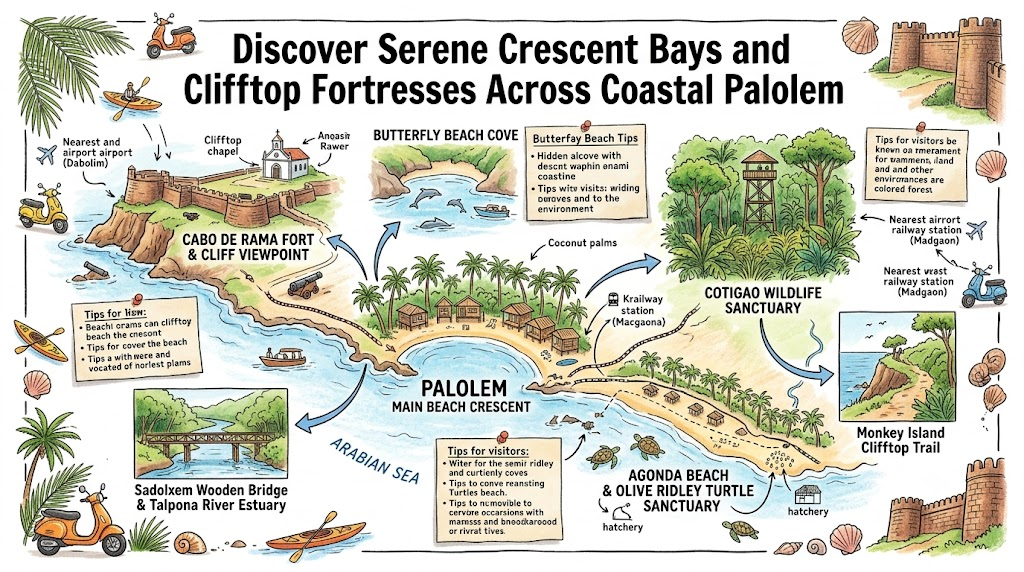
The greater Canacona travel circuit forms an uninterrupted chain of diverse coastal ecosystems and forested hills. Travelers can effortlessly pivot between quiet dolphin coves, dramatic 18th-century clifftop fortresses, serene backwater estuaries, and dense wildlife sanctuaries within a 20-minute scooter radius.
| Key Fact | Regional Detail |
|---|---|
| Geographic Location | Canacona Taluka, South Goa District |
| Nearest Railway Hub | Canacona Station (3 km) / Madgaon Junction (38 km) |
| Nearest Airport | Dabolim Airport (GOI – 61 km) / Mopa Airport (GOX – 115 km) |
| Peak Season | November to March (Mild weather, operational wooden shacks) |
| Ideal Trip Duration | 3 to 5 Days for full circuit exploration |
| Atmospheric Character | Crescent cove, swimmable calm waters, eco-conscious shacks |
Best Places or Experiences
Crescent sands of Palolem Beach.
Secluded cove at Butterfly Beach.
Clifftop ramparts at Cabo de Rama Fort.
Canopy trails of Cotigao Sanctuary.
Palolem Main Beach Crescent
Palolem Beach is celebrated globally for its natural geological geometry, forming a near-perfect semi-circular arc framed by rugged headlands that buffer the shoreline against aggressive Arabian Sea surf. Long rows of leaning coconut palms cast soothing daytime shade over fine, soft white sand, creating one of the safest and most picturesque natural swimming pools anywhere on the Indian subcontinent.
Every autumn following the monsoon rains, local craftsmen construct eco-friendly temporary timber and bamboo cottages directly along the high-tide line. As twilight falls, these waterfront shacks light up with warm fairy lights and candlelit tables, providing an intimate setting where travelers dine to the gentle sound of rhythmic, lap-and-recede waves.
- Location: Central Canacona Taluka, 38 km south of Madgaon Junction and 67 km from Panaji.
- Why it is worth visiting: Uniquely calm, swimmable coastal waters shielded from rough swells, complemented by a vibrant, walkable shack culture.
- Best things to do: Rent a sit-on-top kayak at dawn to paddle glassy waters, practice beachfront yoga at sunrise, and stroll barefoot from end to end under ambient evening lights.
- Best time to visit: November to March for clear skies; early morning (6:30 AM to 9:00 AM) offers optimal glassy water conditions.
- Ideal for whom: Solo travelers seeking community, romantic couples, and families with young children desiring safe swimming.
- Travel tip: Rent your ocean kayak from the northern corner near Monkey Island, where the water is calmest and rental operators offer better hourly rates.
Butterfly Beach Cove
Hidden in an amphitheater of dense forest and steep rock headlands immediately north of Palolem, Butterfly Beach is one of the most secluded coastal alcoves in all of Goa. Its poetic name stems not only from the native winged insects that congregate in the surrounding hilltop forest canopy, but also from the graceful winged shape of the sandy cove itself when seen from above.
Because no motorable paved roads lead directly into the cove, Butterfly Beach has retained its untamed natural beauty. The cove’s turquoise waters serve as a favored feeding ground for wild Indo-Pacific humpback dolphins, giving early morning boat visitors front-row views of playful pods surfacing just yards from the prow.
- Location: 4 km north of Palolem Beach, accessible primarily by local boat or a rugged forest footpath from Leopard Valley.
- Why it is worth visiting: Complete geographic isolation, absence of commercial shacks, and frequent morning dolphin sightings in crystal-clear waters.
- Best things to do: Spot wild dolphins feeding near the cove entrance, snorkel around the underwater rock outcroppings, and beachcomb for unique coastal cowrie shells.
- Best time to visit: October to April; plan an early morning departure (7:00 AM to 8:30 AM) to beat tourist boat arrivals and catch calm seas.
- Ideal for whom: Adventure enthusiasts, romantic couples, wildlife photographers, and nature seekers.
- Travel tip: If arriving via the jungle hike from Palolem, wear closed-toe hiking shoes rather than beach flip-flops to safely navigate loose scree and tree roots.
Cabo de Rama Fort & Cliff Viewpoint
Perched dramatically atop a sheer sea cliff rising high above the ocean swells, Cabo de Rama is steeped in mythological legend and maritime military history. Local lore suggests Lord Rama and Sita sought refuge here during their fourteen-year epic exile, earning the promontory its name before Portuguese forces seized and heavily fortified the bastion in 1763.
Today, rustic ruined laterite ramparts, ancient defensive bastions, and iron cannons stand as silent sentinels over endless ocean horizons. Within its weathered perimeter walls stands the functioning Church of Santo Antonio, an immaculate white chapel that contrasts starkly with the dark red stone and wild tropical greenery.
- Location: Cola Village, Canacona; 24 km northwest of Palolem Beach along the scenic coastal route.
- Why it is worth visiting: Sweeping 270-degree clifftop views of the Arabian Sea paired with profound centuries-old military and colonial heritage.
- Best things to do: Walk the westernmost battlements to watch ocean currents collide, explore the preserved Church of Santo Antonio, and photograph pristine coastal panoramas from the old watchtowers.
- Best time to visit: 4:00 PM to 6:30 PM for softer golden sunlight and uninterrupted, panoramic coastal sunsets.
- Ideal for whom: History enthusiasts, architectural explorers, road trippers, and landscape photographers.
- Travel tip: Bring your own bottled water and hats; the open stone bastions offer very little natural shade against the midday tropical heat.
Agonda Beach & Olive Ridley Turtle Sanctuary
Stretching for three wide, quiet kilometers, Agonda Beach presents a striking, open-horizon contrast to the sheltered enclosure of Palolem. Celebrated for its tranquil, noise-free ambiance, this expansive coastline is fiercely protected as a designated nesting habitat for endangered Olive Ridley sea turtles.
The local forestry department maintains guarded nesting hatcheries on the northern shore during winter months, ensuring that wild nests remain undisturbed by human activity. Free of blaring commercial beach music, motorized watercraft, or persistent hawkers, Agonda stands as a model for quiet, eco-conscious coastal stewardship.
- Location: Canacona Taluka, 9 km north of Palolem Beach along the interior coastal connector road.
- Why it is worth visiting: Peaceful shoreline free from loud motorized watersports, framed by dramatic rocky bluffs and active wildlife conservation.
- Best things to do: Meditate along the sweeping shoreline, support ethical turtle conservation centers, and unwind in stylish open-air vegetarian garden cafes.
- Best time to visit: November through March; late afternoons provide soothing ocean breezes and dramatic, fiery sunsets.
- Ideal for whom: Peace-seekers, slow-travel writers, eco-tourists, and travelers prioritizing wellness and mindfulness.
- Travel tip: Respect beach conservation ordinances strictly—bright flash photography, loud music, and beachfront fires are prohibited to protect nesting sea turtles.
Cotigao Wildlife Sanctuary
Established in 1968 to safeguard an essential corridor of the Western Ghats mountain biome, Cotigao Wildlife Sanctuary spans over 86 square kilometers of dense moist deciduous and semi-evergreen forest. Towering trees reach heights of up to thirty meters, interlocking their branches to form a thick, multi-tiered canopy that rarely allows midday sunshine to pierce through to the jungle floor.
The sanctuary features a 25-meter-high treetop watchtower built securely above a natural watering hole, reachable via a rustic rope and wooden ladder. Patient nature lovers sitting atop the platform can observe native wildlife in their undisturbed habitat, from flying lizards and Malabar pit vipers to troops of langurs and rare four-horned antelopes.
- Location: Southeastern Canacona border near Poinguinim, 23 km southeast of Palolem Beach via NH 66.
- Why it is worth visiting: Pristine multi-story tropical forest canopy and authentic Western Ghats biodiversity just minutes away from the coast.
- Best things to do: Climb the 25-meter treetop observation platform over the waterhole, trek the marked Nature Trail, and observe vibrant endemic butterfly species.
- Best time to visit: October to March; arrive promptly between 7:00 AM and 9:30 AM when jungle wildlife and canopy birds are most active.
- Ideal for whom: Birdwatchers, botanical researchers, wilderness hikers, and nature photographers.
- Travel tip: Wear lightweight long pants and apply natural insect repellent to guard against ground leeches and mosquitoes along the unpaved jungle footpaths.
Offbeat Exploration: Hidden Gems Tourists Miss
Sadolxem Wooden Bridge & Talpona River Estuary
A short ride south of Palolem reveals the charming village of Sadolxem, home to a narrow, single-lane bridge spanning the serene Talpona River. The surrounding brackish backwaters are lined with mangroves and oyster beds, where local fishermen hand-cast nets from handcrafted canoes. Riding along this route exposes visitors to traditional Goan village life completely untouched by commercial mass tourism.
The Hidden Canaguinim Beach Coves
Tucked beyond the village of Cabo de Rama lies Canaguinim, a wild shoreline strewn with red laterite boulders and dramatic rock pools. Divided into two small coves by a small freshwater stream emptying into the sea, this spot is rarely frequented by mainstream travelers. The natural pools are ideal for peaceful wading, sea glass foraging, and taking in rugged seaside landscapes.
Monkey Island Clifftop Trail at Low Tide
At the extreme northern tip of Palolem Beach lies Canacona Island, affectionately dubbed Monkey Island by locals. During daily low tide cycles, the sea recedes sufficiently to reveal a natural causeway made of rounded stones and hard sand. Crossing this land bridge brings you to a winding footpath leading up to high panoramic rocks overlooking the open sea, making it an idyllic, quiet retreat for meditation.
Detailed Practical Guidance for Travelers
| Destination | Standard Entry Fee | General Timings | Best Local Food Options Nearby | Recommended Nearby Attractions |
|---|---|---|---|---|
| Palolem Beach | Free Public Access | Open 24 Hours (Shacks operate 7:30 AM – 11:30 PM) | Dropadi (Butter Garlic Crab), Magic Bus (Fresh Smoothies) | Colomb Bay, Patnem Beach |
| Butterfly Beach | Free (Boats charge ₹1,200–₹2,000 return) | Sunrise to Sunset (No night entry) | Carry own trail snacks and drinking water | Leopard Valley, Honeymoon Beach |
| Cabo de Rama Fort | Free Public Entry | 9:00 AM – 5:30 PM Daily | The Cape Goa Restaurant (Fine Continental & Cocktails) | Cabo de Rama Beach, Cola Lagoon |
| Agonda Beach | Free Public Access | Open 24 Hours (Turtle zone protected after dark) | Fatima Corner (Goan Fish Curry Thali), Zest Café | Rock Formations, Cola Beach |
| Cotigao Sanctuary | ₹20 per Adult (₹30 for Camera) | 7:00 AM – 5:30 PM Daily | Simple local dhabas along Poinguinim highway junction | Tree Top Tower, Bela Falls |
Logistics & On-Ground Navigation
Local Transport Options
- Self-Drive Scooters: The undisputed best way to navigate Canacona. Daily rentals cost between ₹350 and ₹500 depending on the season. Always check brakes, tire treads, and confirm insurance papers before riding.
- Auto-Rickshaws: Stationed permanently at Palolem Junction and the Canacona bus depot. Always agree on your fare before getting in, as drivers rarely use mechanical meters for point-to-point journeys.
- Private Tourist Taxis: Best suited for station or airport transfers. A transfer to Dabolim Airport typically costs ₹2,000 to ₹2,500, whereas trips to Mopa Airport run between ₹3,800 and ₹4,500.
- State Kadamba & Private Buses: Inexpensive coastal shuttle buses operate every 30 minutes along the main road connecting Palolem with Margao and Karwar for nominal fares of ₹30 to ₹60.
Budget Planning
- Budget / Backpacker Tier (₹1,800 – ₹2,800 per day):
- Stay in a social hostel dorm or simple inland brick room (₹700–₹1,200).
- Eat at authentic village bakeries and family-run fish thali dhabas (₹500–₹800).
- Scooter rental, fuel, and municipal parking fees (₹400–₹500).
- Mid-Range / Comfort Tier (₹5,000 – ₹9,500 per day):
- Stay in an oceanfront wooden cottage directly on Palolem or Agonda sand (₹3,000–₹6,500).
- Dine on fresh tandoori seafood and cocktails at premier shacks (₹1,500–₹2,500).
- Private taxi legs or guided kayak/boat excursions to hidden coves (₹1,000–₹1,800).
Safety and Inclusivity Tips
- For Solo Travelers & Couples: Palolem is widely recognized as one of the safest travel districts in coastal India. Locals are hospitable and community-oriented, while the absence of aggressive nightlife venues ensures a calm, respectful street atmosphere after dark.
- For Families Traveling with Children: Palolem’s northern bay waters have virtually zero undertow, making them ideal for kids to swim safely under supervision.
- General Ocean & Road Safety:Pay close attention to red flags posted by the Drishti marine lifesavers. While Palolem is protected, nearby open shores like Agonda feature sudden sandbank drop-offs and strong rip currents that demand cautious swimming.
Strategic Travel Planning Guardrails
Travel Planning Tips for Palolem
- Book Wooden Shacks Early: Prime oceanfront bamboo cottages on Palolem’s shoreline sell out months ahead for December and January.
- Carry Paper Currency: While major beachfront restaurants accept UPI digital scans, small boat captains, scooter mechanics, and village fruit stalls rely on cash.
- Pack Lightweight Modest Coverings: Carry a lightweight linen scarf or shirt to cover bare shoulders and knees when exploring historical churches and interior Hindu temples.
- Equip Reef-Safe Sunscreen: Protect Palolem’s fragile marine biodiversity by choosing mineral-based sun lotions free of harmful oxybenzone chemicals.
- Prepare for Spotty Cell Coverage in the Hills: Mobile phone data signals drop dramatically inside Cotigao Sanctuary and along the winding roads to Cabo de Rama; download offline navigation maps ahead of time.
Common Mistakes to Avoid
- Packing Heavy Hard-Shell Rolling Luggage: Wheeled suitcases are nearly impossible to roll across deep beach sand to reach waterfront cottages; pack a versatile travel backpack instead.
- Assuming South Goa Parties Like North Goa: Do not visit Palolem expecting loud open-air nightclubs; nightlife here centers around acoustic fireside dinners and headphone silent discos.
- Ignoring Low/High Tide Charts: Renting a sea kayak during strong outgoing tides can lead to exhausting open-water paddles; plan your water excursions during slack morning tides.
- Skipping Local Village Cuisine: Do not settle solely for generic continental fare served at resorts; seek out traditional bakeries for fresh morning poee bread and coconut fish curries.
- Riding Scooters Without Protective Helmets: Police checkpoints operate regularly along the Chaudi junction and highway connectors, strictly ticketing unhelmeted riders.
Suggested Itinerary Blueprints
1. Day Quick Dash (The Canacona Coastal Sampler)
- Morning: Arrive at Palolem Beach by 7:30 AM; hire a sea kayak to paddle around Monkey Island, followed by fresh fruit smoothie bowls on the sand.
- Afternoon: Take a scenic 35-minute scooter ride through coastal backroads to Cabo de Rama Fort; wander the historic ramparts and admire the cliffside view.
- Evening: Return toward Agonda Beach for a serene beachfront sunset, finishing with dinner featuring fresh seafood at a candlelit shack.
2. Day Deep-Dive (Heritage, Wilderness & Secret Coves)
- Day 1: Explore Palolem’s main bay, hike the low-tide trail over Monkey Island, and take an afternoon dolphin boat to Butterfly Beach. Dine at Dropadi for fresh butter-garlic tiger prawns.
- Day 2: Rise early for a wildlife hike through the dense forest canopies of Cotigao Wildlife Sanctuary. In the afternoon, head to Sadolxem to see the historic wooden bridge, concluding with sunset drinks overlooking Cola Lagoon.
3. Complete Weekend Travel Plan (The Ultimate South Goa Loop)
- Friday: Check into your beachfront wooden cottage on Palolem Beach. Spend a lazy afternoon wading through the gentle surf, followed by dinner and a fun headphone silent disco experience at Neptune Point.
- Saturday: Spend the morning exploring Cabo de Rama Fort and its secluded wild beach. Stop for an open-air clifftop lunch, spend a tranquil afternoon on Agonda’s turtle beach, and browse the bohemian clothing boutiques along Palolem’s main lane.
- Sunday: Wake up early for a guided river cruise through the Talpona mangrove estuaries. Spend the afternoon reading and unwinding beneath the coconut palms on quiet Patnem Beach before your departure.
Common Tourist Mistakes to Avoid
- Geographic Blunders: Trying to stay in Palolem while planning daytime party hopping in Baga, Anjuna, or Candolim. The 2.5-hour one-way drive through heavy city traffic ruins an otherwise relaxing day.
- Commercial Traps: Booking crowded, overpriced boat tours from aggressive beach touts. Instead, book directly with registered local fishermen stationed at the northern bank for better rates and respectful wildlife viewing distances.
- Neglecting Modern/Alternative Zones: Forgetting to explore the emerging, eco-conscious interior spots around Colomb Bay and Patnem, which host world-class sourdough bakeries, sound healing centers, and organic tea lounges.
- Transport Overpayment: Taking unnegotiated private taxis parked outside resort entrances without first inquiring about standard local rates at the Chaudi Auto-Rickshaw Stand.
- Luxury Dining Bias: Spending every meal inside enclosed, upscale hotel dining rooms. Overlooking local street-side carts deprives you of authentic Goan ros omelette—a fluffy egg omelette submerged in fragrant, spicy xacuti gravy served with crusty poee.
Frequently Asked Questions
1. Is Palolem Beach safe for non-swimmers and young children?
Yes, Palolem is widely regarded as one of the safest beaches for swimming along the entire western coast of India. The headlands flanking both ends of the bay naturally break ocean swells, resulting in minimal undertow and shallow, calm waters ideal for families with children and beginner swimmers.
2. How do I travel to Palolem from Goa International Airport?
From Dabolim Airport (GOI), Palolem is roughly 61 km away, taking about 90 minutes by prepaid airport taxi costing between ₹2,000 and ₹2,500. From Mopa Airport (GOX) in North Goa, the distance is around 115 km, requiring a 2.5 to 3-hour taxi ride costing roughly ₹3,800 to ₹4,500.
3. When do the iconic beachfront wooden shacks open in Palolem?
The famous temporary bamboo and wood beach cottages begin construction each year in late October after the southwest monsoon concludes. They remain fully operational throughout the dry winter months and are completely dismantled by late May to protect the fragile shoreline from seasonal ocean storms.
4. Can I see wild dolphins at Palolem Beach?
Yes, wild Indo-Pacific humpback dolphins inhabit the waters right outside the bay. Local fishermen operate motorboat excursions early in the morning, departing from the northern shore to take visitors past Butterfly Beach where dolphin pods surface to feed in calm seas.
5. Is the nightlife in Palolem as wild as North Goa?
No, Palolem deliberately focuses on a more laid-back, low-decibel evening atmosphere. Because local regulations prohibit loud outdoor music after 10:00 PM to protect peaceful surroundings, Palolem is famous for its unique silent headphone discos, cozy beach shack bonfires, and intimate live acoustic music sessions.
6. What is the difference between Palolem Beach and Patnem Beach?
Palolem and Patnem sit just one kilometer apart, separated by the scenic headland of Colomb Bay. Palolem features a lively crescent cove lined with vibrant cafes, whereas Patnem is quieter, smaller, and appeals to travelers looking for deep relaxation, yoga retreats, and fewer crowds.
7. How can I reach Butterfly Beach from Palolem?
The most popular route is taking a ten-minute motorized boat trip from the north end of Palolem Beach. Adventurous travelers can also hike a marked two-hour wilderness footpath winding through the coastal forests starting near Leopard Valley, which requires sturdy closed-toe walking shoes.
8. Are digital UPI payments accepted across Palolem?
Most sit-down beachfront restaurants, registered boutique hotels, and retail shops across Palolem readily accept UPI apps like Google Pay and PhonePe. However, carrying some physical cash is necessary for renting sit-on-top kayaks, buying fruit from roadside vendors, and paying scooter parking attendants.
9. Can I visit Cabo de Rama Fort without a private vehicle?
While you can negotiate a round-trip fare with a private taxi or auto-rickshaw from Palolem, hiring a self-drive scooter or rental car provides the best flexibility. Public state buses run irregularly to the fort, making them less reliable for tight travel schedules.
10. What local Goan delicacies should I eat while staying in Palolem?
You should try an authentic Goan fish curry thali paired with red rice, spicy rava-fried kingfish, and calamari in butter garlic sauce. In the evenings, visit local village carts for a ros omelette served with traditional, crusty Goan poee bread.
11. Is Cotigao Wildlife Sanctuary accessible for a half-day trip?
Yes, Cotigao is located just 23 km southeast of Palolem, making it an easy 35-minute drive along the scenic NH 66 highway. Visitors can comfortably hike the designated Nature Trail, climb the treetop observation tower, and return to the beach in time for a late seafood lunch.
12. Do I need an international permit to rent a scooter in Palolem?
Indian citizens must show an active national driver’s license with a two-wheeler endorsement. International travelers must present a valid national driver’s license alongside a recognized International Driving Permit (IDP) to legally rent and operate scooters along Goan roads.
Conclusion
Choosing to travel to Palolem and the untamed reaches of South Goa is an invitation to experience coastal travel at a more mindful, restorative pace. Beyond the postcard-perfect arc of golden sand and swaying coconut palms, the real gift of this sanctuary lies in its tranquil everyday rhythm—the quiet paddle through morning mist, the historic stillness of cliffside fortresses, and the warmth of a community that honors its land and sea. Leaving Palolem, you carry away far more than sun-kissed memories; you return with a refreshed spirit, renewed perspective, and an enduring connection to the authentic soul of coastal Goa.

Leave a Reply
You must be logged in to post a comment.