



Introduction
Step off the over-trodden path of noisy, commercial beach strips where blaring music drowns out the ocean surf and hawkers peddle cheap plastic trinkets. While mainstream tourist swarms flock to generic party belts, the real soul of Goa breathes quietly in its moss-draped laterite alleys, ancient riverine estuaries, and dense hinterland forests.
Here, authentic living is an art form rooted in centuries of cultural dialogue between the Konkan coast and Portuguese explorers. Backpacking solo across this coastal paradise lets you uncover sleepy river islands, centuries-old Indo-Portuguese manors, quiet cliff paths, and spice-infused village taverns where time slows down to a restful coastal breeze.
Why Goa is a must-visit city
Goa commands a unique historical and geographic stature along India’s southwestern coastline. Carved between the azure expanse of the Arabian Sea and the lush biodiverse ridge of the Western Ghats, this land served for centuries as a bustling naval trading hub and the historic heart of Portuguese India. This confluence created an enduring legacy of syncretic Konkani culture, visible in everything from Roman Catholic baroque cathedrals and ancient Kadamba shrines to hand-painted azulejo ceramic tiles.
Modern transport infrastructure makes navigating Goa surprisingly seamless for the independent explorer. Twin international airports at Dabolim in the center and Manohar International Airport at Mopa in the far north welcome flights from every major hub, while Konkan Railway stations like Madgaon and Thivim slice through verdant coastal paddy fields. A mature network of shared passenger ferries, state-run Kadamba buses, and budget-friendly rental vehicles ensures that solo backpackers can effortlessly transition between the buzzing creative communities of the north and the untouched wilderness of the south.
The travel circuit splits cleanly into three distinct zones: the bohemian, artistic cliffside hubs of North Goa, the cultural and administrative heartland of the Central Tiswadi basin, and the tranquil, emerald coconut groves of South Goa.
| Region Fact Sheet | Key Traveler Metric |
|---|---|
| Geographic Coordinates | 15.2993° N, 74.1240° E (Konkan Coast) |
| Backpacker Gateway Stations | Thivim (North), Madgaon (South), Karmali (Central) |
| Airport Access Hubs | Mopa (GOX) for North Goa, Dabolim (GOI) for Central/South |
| Peak Season Window | November to February (Dry, breezy, daytime temps 28°C–32°C) |
| Monsoon Shoulder Season | June to September (Emerald landscapes, low room tariffs) |
| Local Linguistic Palette | Konkani (Official), English, Hindi, Marathi, Portuguese |
| State Scooter Hire Benchmark | ₹300 to ₹500 per day (Standard gearless scooter) |
Best Places or Experiences
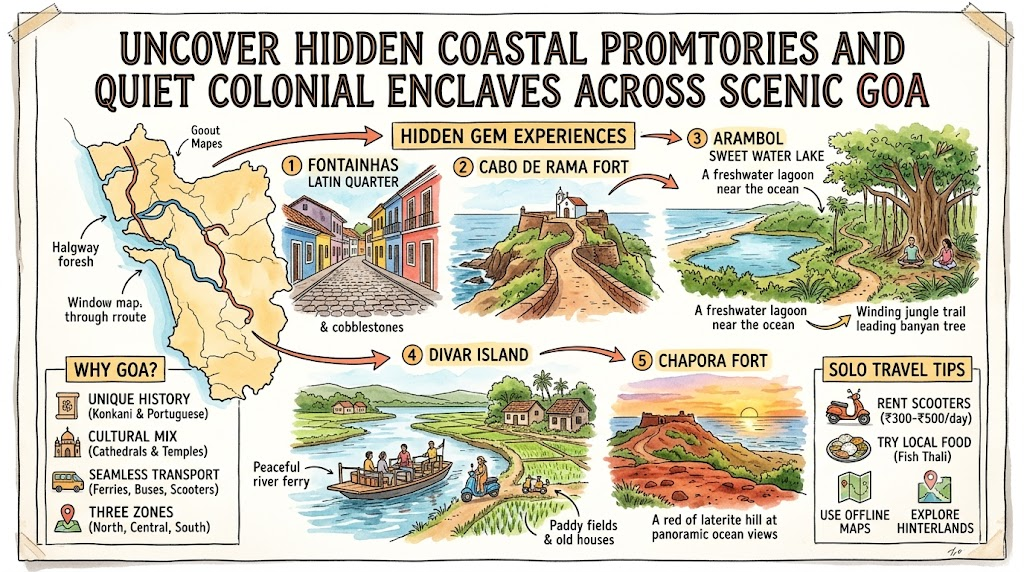
Fontainhas Latin Quarter
Tucked alongside the calm waters of the Ourem Creek beneath Altinho Hill, Fontainhas stands as Asia’s only recognized Latin Quarter. Established in the late eighteenth century when the colonial capital moved from plague-ridden Old Goa to Panaji, this heritage quarter remains a living, breathing testament to Portuguese town planning, featuring cobblestone alleys lined with vibrant homes painted in ochre yellow, indigo blue, and terracotta red.
Every morning, sunlight filters through intricately carved wooden eaves and overhanging balconies adorned with wrought iron railings and glazed ceramic rooster motifs. Walking these narrow lanes alone allows you to soak in quiet architectural details, listen to classical Portuguese Fado melodies floating out of open colonial windows, and exchange warm morning greetings with neighborhood elders setting out to collect crusty local bread.
- Location: Panaji, Tiswadi taluka; roughly 28 km north of Dabolim Airport and 32 km south of Mopa Airport.
- Why it is worth visiting: It is India’s most evocative enclave of Portuguese colonial town architecture, completely pedestrian-friendly and brimming with neighborhood charm.
- Best things to do: Photograph the hand-painted ceramic house numbers on Rua 31 de Janeiro, sample warm custard tarts (Pastéis de Nata) at a centuries-old heritage bakery, and admire local oil paintings inside community art galleries.
- Best time to visit: 7:00 AM to 9:30 AM for quiet morning light and pedestrian-free lanes, or 4:30 PM for golden-hour photography.
- Ideal for whom: Solo backpackers, architecture photographers, culture hounds, and slow travelers.
- Travel tip: Wear silent rubber-soled footwear and refrain from speaking loudly or shooting photos directly inside open residential living rooms, as this remains a private, inhabited residential community.
Cabo de Rama Fort & Secluded Cape
Perched high on a steep, wind-swept laterite bluff in the southernmost tip of Goa, Cabo de Rama is one of the state’s oldest defensive bastions. Named after Lord Rama, who legend says took refuge here with Sita during his mythical fourteen-year forest exile, the fort was held successively by Hindu dynastic rulers, the Sultans of Bijapur, and ultimately occupied by the Portuguese in 1763 to secure maritime entry to the Sal River.
Today, rustic ruined ramparts draped in wild salt-tolerant flora look out over panoramic 180-degree vistas of the sparkling Arabian Sea. Wandering among the weathered stone parapets and the pristine, whitewashed Church of Santo Antonio situated inside the walls offers solo backpackers deep solitude and unforgettable sunset viewpoints untouched by commercial tourism.
- Location: Canacona Taluka, South Goa; approximately 30 km south of Madgaon Railway Station.
- Why it is worth visiting: It combines sweeping historical ruins, a functional heritage chapel, and dizzying cliffside sea drops with virtually zero commercial crowds.
- Best things to do: Trace the ancient stone watchtower perimeter, sit on the western ramparts to watch sea eagles hunting above ocean thermals, and hike the rugged foot trail down to the secret pebble beach at the base of the headland.
- Best time to visit: 4:00 PM to 6:30 PM to experience the late-afternoon maritime breeze and watch the sunset sink directly into the sea.
- Ideal for whom: Intrepid solo hikers, history buffs, landscape sketchers, and solitude seekers.
- Travel tip: Bring your own drinking water and a pocket flashlight; there are no commercial shops past the gate, and the uneven dirt trail back to your transport is pitch black after sundown.
Arambol Sweet Water Lake and Banyan Tree Trail
Tucked beyond the northern end of Arambol’s expansive coastline, a rocky coastal foot trail snakes along red stone cliffs to reveal Kalacha Cove. Inside this hidden ocean inlet sits a tranquil freshwater lagoon, fed directly by natural spring water bubbling up through subterranean aquifers. The lagoon’s golden sand bottom and warm, glassy surface sit just meters away from the crashing saltwater waves of the ocean.
Venturing further inland past the lagoon leads into a dense jungle river valley. The dirt footpath leads you under dense canopies of towering bamboo and wild cashew trees, culminating at an ancient, spreading sacred Banyan tree where bohemian travelers, musicians, and yogis gather to sit in silent forest meditation away from beachside revelry.
- Location: Arambol, Pernem Sub-District; roughly 38 km north of the state capital Panaji.
- Why it is worth visiting: It offers the rare natural spectacle of swimming in a calm freshwater jungle spring located within earshot of oceanic surf breaks.
- Best things to do: Take an invigorating freshwater swim in the clean lagoon, apply mineral-rich clay from the nearby stream banks, and hike the forest path to visit the jungle banyan tree.
- Best time to visit: 8:00 AM to 11:00 AM before afternoon sun warms the sand and before day-trippers arrive from neighboring beaches.
- Ideal for whom: Solo backpackers, budget travelers, nature lovers, and wild swimmers.
- Travel tip: Never hike the cliffside rocks alone after dusk when the tide rises, and keep all your electronics protected inside a waterproof dry bag when traversing wet tidal boulders.
Divar Island & Old Goa Ferry Route
Floating gracefully in the broad tidal estuary of the Mandovi River, Divar Island is a tranquil, agrarian haven that feels worlds away from Goa’s beach towns. Connected to the mainland exclusively by free government river ferries, this sleepy island avoided modern high-rise development, preserving its centuries-old network of emerald paddy wetlands, ancient sluice gates (khazans), and sprawling Portuguese village manors.
Cycling or walking along Divar’s raised asphalt bunds lets solo travelers soak in pure Konkani village life. Colorful churches like the hillside Church of Our Lady of Compassion look out across tidal marshes, where solitary fishermen cast handmade throw nets from wooden canoes as the afternoon river mist rolls in.
- Location: Tiswadi Basin; 10 km east of Panaji, accessed via vehicular ferry points at Old Goa, Ribandar, or Narva.
- Why it is worth visiting: It offers an authentic slice of riverine village life, zero commercial traffic, and unspoiled wetland scenery.
- Best things to do: Board the free river ferry from Old Goa, pedal rented bicycles along rural dikes to spot rare kingfishers, and climb to the top of Piedade hill for sprawling views of the Mandovi River.
- Best time to visit: 6:30 AM to 10:00 AM for birdwatching, or late afternoon around 4:30 PM to catch the sunset from the island ferry ramps.
- Ideal for whom: Solo cyclists, birdwatchers, landscape painters, and travelers seeking total peace.
- Travel tip: Ferries run continuously every 15 to 30 minutes free of charge for pedestrians and two-wheelers; carry small cash notes for local bakery bread and village tea stalls.
Chapora Fort & Vagator Cliffs
Rising majestically over the northern bank of the Chapora River mouth, Chapora Fort sits high on a stark laterite ridge commanding the coastline. Originally built by the Adil Shahi rulers of Bijapur and completely reconstructed by the Portuguese in 1717 as a border outpost, the fort’s jagged red walls wind around the contours of the hill like a crown of stone.
Though the inner barracks have weathered away under centuries of heavy monsoon rains, the outer stone parapets remain remarkably intact. For the solo backpacker, scrambling up the laterite path to the northern bastions offers panoramic views of the curving shores of Morjim Beach across the river estuary, alongside the dramatic crashing waves of Vagator Cove below.
- Location: Bardez Taluka, North Goa; roughly 22 km north of Panaji and 10 km from Mapusa.
- Why it is worth visiting: Striking military heritage combined with the most dramatic, elevated coastal sunset viewpoint in North Goa.
- Best things to do: Trace the ancient gun loops along the eastern red stone wall, capture panoramic photographs of the Chapora river sandbar, and relax on the seaward parapets.
- Best time to visit: 5:00 PM to 6:45 PM to take advantage of golden hour light and cooling sea breezes.
- Ideal for whom: Solo sunset watchers, photographers, backpackers, and history enthusiasts.
- Travel tip: The stone path climbing the hill is composed of loose gravel and polished laterite; wear shoes with reliable rubber tread to prevent slipping on the descent after dark.
Offbeat Exploration: Hidden Gems Tourists Miss
The Mangrove Caverns of Chorão Island
While mass tourists stay planted on sun loungers, solo explorers can take an early morning ferry to Chorão Island to discover the Salim Ali Bird Sanctuary. Rent a local wooden canoe with a boatman to glide silently into the dense network of tidal mangrove tunnels. Here, where roots hang down into brackish waters, you can spot rare migratory marsh birds, mudskippers, and even quiet mugger crocodiles basking on sunlit mudflats.
Tambdi Surla Mahadeva Temple & Jungle Trail
Tucked deep within the dense rainforests of the Bhagwan Mahavir Wildlife Sanctuary at the foot of the Western Ghats, this 12th-century Kadamba-era temple is the oldest surviving temple structure in Goa. Built from weathered black basalt stone and adorned with fine carvings of elephants, floral rosettes, and deities, it stands far from modern coastal settlements. The surrounding river trail provides an enchanting, cool jungle walk through virgin wilderness.
The Untamed Sands of Kakolem Beach (Tiger Beach)
Kakolem is a rugged, hidden beach tucked beneath steep cliffs in South Goa. Accessible only by scaling down a steep, unmarked natural dirt and rock trail running beside a fresh freshwater waterfall, this tiny cove rewards adventurers with golden sands, crashing surf, and absolute solitude away from all commercial beach setups.
Detailed Practical Guidance for Travelers
| Destination | Standard Entry Fee | General Timings | Best Local Food Options Nearby | Recommended Nearby Attractions |
|---|---|---|---|---|
| Fontainhas Latin Quarter | Free (Public Access) | Open 24 Hours (Best 7 AM – 7 PM) | Viva Panjim (Prawn Curry Thali), Confeitaria 31 De Janeiro | Church of Our Lady of the Immaculate Conception, Altinho Hill |
| Cabo de Rama Fort | Free | 9:00 AM – 5:30 PM Daily | The Cape Goa (Clifftop Cafe), roadside coconut vendors | Cabo de Rama Beach, Agonda Beach |
| Arambol Sweet Water Lake | Free | Sunrise to Sunset | This Is It (Konkani local thalis), Falafel Corner | Arambol Cliff Path, Mandrem Beach |
| Divar Island | Free (Ferry is free for pedestrians/bikes) | Ferries operate 5:30 AM – 10:30 PM | Small village bakeries, local Ros Omelette street carts | Salim Ali Bird Sanctuary, Old Goa Churches |
| Chapora Fort | Free | 6:00 AM – 6:30 PM Daily | Juice Center Chapora, local fish thali stalls in Chapora village | Little Vagator Beach, Ozran Cove |
Logistics & On-Ground Navigation
Local Transport Options
- Gearless Scooters & Motorcycles: The undisputed king of Goan solo travel. You can rent automatic scooters (Honda Activa) or motorcycles widely across the state for ₹300 to ₹500 per day. Ensure you carry your valid physical driving license, wear an ISI-marked helmet at all times, and always check tire pressure before driving away.
- State-Run Kadamba Transport Buses: The ultimate budget choice. Sturdy blue-and-white government buses connect all major transit hubs like Panaji, Mapusa, Margao, and Vasco da Gama for mere pocket change (₹15 to ₹50 per trip).
- Goa Tourism Electric & Pilot Taxis: “Pilots” are unique to Goa—these are licensed motorcycle taxis that carry a single passenger on the pillion seat for roughly half the cost of a car taxi. For standard cabs, download the government-backed GoaMiles smartphone app to avoid unmetered price markups.
- Inland River Ferries: Operated by the River Navigation Department, these flat-bottomed vessels transport passengers and two-wheelers across rivers like the Mandovi, Chapora, and Zuari. Foot passengers and bicycles ride completely free.
Budget Planning
- Backpacker / Bootstrapped Tier (₹1,000 – ₹1,800 / day): Includes a comfortable dorm bed in a certified backpacker hostel (₹400–₹800), shared meals of local Konkani fish curry thalis or vegetable meals at family-run bhojanalayas (₹300–₹500), and public bus transport mixed with light scooter rental days (₹300–₹500).
- Mid-Range / Comfort Solo Tier (₹3,000 – ₹5,500 / day): Includes a private AC room in a heritage Portuguese guesthouse or eco-cottage (₹1,800–₹3,200), dining at charming courtyard cafes and seafood bistros (₹800–₹1,500), and dedicated scooter or electric bike rentals with fuel (₹400–₹800).
Safety and Inclusivity Tips
- Solo Traveler Vigilance: Goa is celebrated across India as an exceptionally safe, progressive, and welcoming destination for independent travelers, including solo females. Stick to well-lit main coastal roads when riding scooters at night, and avoid lingering alone on deserted beach stretches past midnight.
- Rip Current & Water Safety: The Arabian Sea features fierce hidden undertows and steep sand drop-offs, especially between May and October. Always swim directly within designated lifeguard zones marked by red-and-yellow flags, and never enter the ocean after consuming alcohol.
- Emergency Networks: Save the local Tourist Police helpline (112) and keep offline maps downloaded on your smartphone, as mobile signals can cut out along deep hinterland roads and cliff bases.
Strategic Travel Planning Guardrails
Travel Planning Tips for Goa
- Target the Shoulder Months: Consider visiting during late October or early March to enjoy clear blue skies, lower hostel bed rates, and uncrowded beaches before the hot summer begins.
- Keep Physical Cash on Hand: While UPI smartphone payments are widely accepted in towns and restaurants, remote beach shacks, village ferry stands, and scooter fuel stalls often suffer from poor cellular network connections and accept cash only.
- Pack Essential Protective Gear: A breathable rain jacket or windbreaker, high-SPF ocean-safe mineral sunscreen, herbal insect repellent, and a sturdy 20-liter daypack with a rain cover are non-negotiable essentials.
- Respect Spiritual and Heritage Sanctuaries: Remove footwear, speak quietly, and cover your shoulders and knees when visiting historic places of worship like the Basilica of Bom Jesus or local village temples.
- Pre-Book Holiday Stays: If visiting during the peak Christmas and New Year festive period (December 20 to January 5), secure your hostel beds months in advance, as nightly rates can surge fourfold.
Common Mistakes to Avoid
- Overpacking the Daily Schedule: Trying to explore both North and South Goa in a single weekend burns precious daylight sitting in traffic across crowded river bridges.
- Ignoring the Hinterlands: Confining your entire itinerary to the beach shoreline causes you to miss Goa’s breathtaking waterfalls, spice plantations, and historic river islands.
- Uninspected Vehicle Rentals: Failing to photograph existing scratches and dents on rental scooters before handing over cash deposits can lead to stressful checkout disputes.
- Relying Exclusively on Continental Food: Eating only wood-fired pizzas and sandwiches cuts you off from Goa’s incredible culinary heritage—make time for authentic local delicacies like Chicken Xacuti, Bebinca, and Ambot Tik.
- Driving Recklessly on Coastal Roads: Goa’s winding village lanes are shared with stray cattle, pedestrians, and blind corners. Never speed, and never ride after drinking.
Suggested Itinerary Blueprints
1. Day Quick Dash (The Central Heritage Sprint)
- Target Audience: Solo backpackers with a short 24-hour layover looking for a blend of history and coastal views.
- Morning: Arrive early in Panaji, grab breakfast at a heritage bakery, and wander the colorful lanes of the Fontainhas Latin Quarter.
- Midday: Take a short local bus to Old Goa to explore the Basilica of Bom Jesus and Se Cathedral.
- Afternoon: Catch the free river ferry from Ribandar over to Divar Island for a peaceful countryside lunch.
- Evening: Travel north to Chapora Fort to watch the sunset over the Arabian Sea, ending the night with fresh fruit juices at the village center.
2. Day Deep-Dive (North-Coast Culture & Coastline)
- Target Audience: Solo travelers with 48 hours to explore northern creative hubs, cliff vistas, and beaches.
- Day 1 (Heritage & Sunset): Base yourself in a social hostel near Anjuna. Rent a scooter to explore the quiet village lanes of Assagao, visit the Saturday Night Market grounds, explore Chapora Fort, and watch the sunset from the Vagator cliffs.
- Day 2 (Wild Coastal Trails): Ride north to Arambol. Spend the morning swimming in the tranquil Sweet Water Lake and hiking the jungle trail to the ancient Banyan Tree. Spend the late afternoon sitting along the beach, taking in the lively drum circles and artisan markets at golden hour.
3. Complete Weekend Travel Plan (North-to-South Loop)
- Target Audience: Solo backpackers spending Friday to Sunday experiencing the full spectrum of Goa’s energy.
- Friday (The Cultural North): Check into a backpacker hub in Vagator. Spend the day exploring historical forts, visiting local art galleries, and enjoying an evening of acoustic music at an open-air cafe.
- Saturday (The Hinterland Transition): Ride south across the Mandovi River. Stop in Panaji for a traditional fish curry thali lunch, explore the Latin Quarter, and ride past the verdant paddy fields down toward the coastal haven of Palolem in the far south.
- Sunday (Untamed Southern Wilds): Rent a kayak at dawn to paddle the calm, glassy waters of Palolem Bay. In the afternoon, ride your scooter to explore the windswept ramparts of Cabo de Rama Fort before wrapping up your trip with a beachfront seafood dinner under the palms.
Common Tourist Mistakes to Avoid
Geographic Blunders
One of the most frequent mistakes made by first-time solo visitors is attempting to stay in North Goa while booking morning activities in South Goa. The two zones are separated by roughly 70 to 90 kilometers of busy roads. Commuting back and forth wastes hours in humid traffic. Anchor your stay in one specific region, or cleanly divide your trip into two separate accommodation bookings.
Backpacker Tip: If you have four days, book your first two nights in North Goa (Anjuna or Vagator) and your final two nights in South Goa (Palolem or Agonda) to eliminate exhausting cross-state round trips.
Commercial Traps
Many tourists spend their precious evenings stuck in the loud, neon-lit traffic jams of Calangute and Baga, where beach shacks blast pop music and serve overpriced, generic food. You can find a richer, more authentic experience by heading just a few kilometers inland to the peaceful village squares of Saligao, Aldona, or Raia, where historic chapels and quiet village taverns offer a welcoming, laid-back atmosphere.
Neglecting Modern/Alternative Zones
Fixating solely on the coastline means missing out on the creative modern revival happening across Goa’s interior villages. Neighborhoods like Assagao and Siolim are filled with restored heritage villas converted into independent bookstores, co-working garden cafes, art galleries, and modern dining spots. These creative spaces offer welcoming community environments where solo travelers can easily strike up conversations with artists, writers, and digital nomads.
Transport Overpayment
Hailing unmetered private taxis standing outside major transit terminals often results in inflated tourist prices. To keep your budget protected, install the government-backed GoaMiles app to check baseline trip costs, or head directly to the prepaid taxi counter inside the airport terminal. For daily travel, a rented scooter or public Kadamba buses will save you significant amounts of money over the course of a week.
Luxury Dining Bias
Confining your meals to air-conditioned resort dining rooms prevents you from tasting Goa’s authentic culinary soul. The real magic of coastal cuisine thrives in humble, family-run village eateries known as Amchem Ghor, where locals serve traditional fish curry thalis featuring freshly caught kingfish, mackerel, crab, and dried shrimp kishmur, paired with unpolished red rice and spicy kokum-infused curry (sol kadhi).
Frequently Asked Questions
1. Is Goa a safe destination for first-time solo female backpackers?
Yes, Goa is widely considered one of the safest and most progressive travel destinations in India for solo female backpackers. The local population is accustomed to independent travelers from around the world. As a standard safety practice, stick to well-lit beach strips, avoid walking alone on isolated shores late at night, and always rent vehicles from licensed, well-reviewed operators.
2. What is the most cost-effective way to get around Goa as a solo traveler?
Renting a gearless scooter for ₹300 to ₹500 per day is by far the most economical and flexible transportation option. If you prefer not to drive two-wheelers, combine public state-run Kadamba buses for long inter-city journeys with licensed motorcycle “pilot” taxis or the government-backed GoaMiles app for shorter local hops.
3. Which area is better for solo backpackers: North Goa or South Goa?
North Goa is best suited for solo travelers seeking vibrant social backpacker hostels, bustling cafes, live music, and creative communities. In contrast, South Goa is ideal for those who prioritize tranquil, uncrowded beaches, yoga retreats, unspoiled nature, and quiet coastal cliff hiking.
4. How much money does an average solo backpacker need per day in Goa?
A budget-conscious solo backpacker can comfortably explore Goa on ₹1,200 to ₹1,800 per day. This budget comfortably covers a dormitory bed in a reputable hostel, local bus travel and scooter rentals, two full traditional fish curry thali meals, and refreshing street-side snacks like fresh coconuts and Ros Omelettes.
5. Do I need an International Driving Permit to rent a scooter in Goa?
Yes, foreign travelers require a valid domestic driver’s license accompanied by an official International Driving Permit (IDP) to legally operate motorized two-wheelers in India. Indian domestic travelers need only carry their original, valid government-issued driver’s license. Traffic police checkpoints are common, and riding without a valid license carries steep fines.
6. Is it safe to swim in the sea along Goa’s beaches?
Swimming is generally safe during the dry season from November to April at beaches monitored by professional lifeguards, such as Palolem, Miramar, and Morjim. However, always remain between the red-and-yellow safety flags. Never enter the water during the monsoon season (June to September) when powerful rip currents and high surf make ocean swimming dangerous.
7. Can I pay with digital apps (UPI) everywhere in Goa, or should I carry cash?
While digital smartphone payments (UPI) are common across restaurants, cafes, and hotels, you should always carry ₹1,000 to ₹2,000 in physical cash. Remote beach shacks, village ferry ports, roadside coconut vendors, and rural fuel pumps often experience intermittent cellular connectivity and operate on a cash-only basis.
8. What are the best social backpacker hostels for meeting other travelers?
Areas like Anjuna, Vagator, and Arambol in the north, alongside Palolem in the south, host world-renowned backpacker hostel brands like Zostel, The Hosteller, and independent eco-hostels. These spaces organize daily community events, heritage walking tours, communal dinners, and sunset outings tailored specifically for solo backpackers to connect.
9. What local dish should every solo traveler try in Goa?
You must try an authentic Goan Fish Curry Thali at a local family-run eatery. This iconic platter includes hot steamed Goan red rice, a bowl of freshly caught fish stewed in ground coconut and sour kokum spices, fried rava-crusted fish fillets, spicy vegetable dishes, and a refreshing digestive shot of tangy sol kadhi.
10. What is the best mobile network provider for coverage across Goa?
Both Jio and Airtel offer reliable 4G and 5G mobile data coverage throughout major towns, coastal belts, and highway corridors. However, if you plan to venture deep into the dense forests of the Western Ghats or remote southern bays like Cabo de Rama, Airtel generally maintains a slightly stronger rural signal.
11. What should a solo backpacker pack for a trip to Goa?
Essential items include quick-drying cotton clothes, an ocean-friendly mineral sunscreen, a certified ISI-helmet (if you plan to rent scooters for long periods), a universal travel power adapter, a durable waterproof dry bag for beach outings, herbal mosquito repellent, and a sturdy pair of shoes with reliable grip for hiking slippery laterite cliffs.
12. When is the best time to visit Goa for a peaceful, uncrowded experience?
The shoulder months of October and late February to March offer the best balance of pleasant weather, low room rates, and tranquil beaches. During this window, you can enjoy sunny skies and fully open beach shacks without having to navigate the high holiday crowds of December and January.
Conclusion
Setting out on a solo backpacking journey across Goa reveals an authentic, multifaceted coastal world that casual vacationers rarely see. Shedding the distractions of group itineraries gives you the freedom to follow your own rhythm: whether that means watching the sunrise alone over the quiet canals of Divar Island, savoring a fiery home-cooked fish thali in a cozy family tavern, or sitting high atop the stone ramparts of Cabo de Rama watching the evening sky turn to gold. Here, the ocean breeze carries centuries of history, leaving you with a deep, lasting connection to this enchanting slice of the Konkan coast.

Leave a Reply
You must be logged in to post a comment.