



Introduction
Step past the neon-lit clatter of package resorts and crowded seaside strips to find the genuine pulse of the sunshine state. Goa’s true soul is woven into its backroads, where ancient banyan roots twist over crumbling laterite boundary walls and sea salt blends with damp clay.
Taking to the tarmac here means swapping hurried tourist checklists for the slow, unhurried cadence of local life. From the tranquil rhythm of inland river ferries to mist-covered ghat ascents, hitting the asphalt opens up an authentic encounter with an older, timeless coast.
Why Goa is a must-visit city
Goa stands apart as a rare historical crossroads where four centuries of Portuguese maritime rule integrated seamlessly with indigenous Konkani culture. Geographically, it bridges the Arabian Sea with the biodiversity of the Western Ghats, packing sweeping coastal highways, mangrove estuarine systems, and tropical rainforest foothills into an accessible corridor. Modern expressways, well-engineered bridges across the Zuari and Mandovi rivers, and access through Manohar International Airport at Mopa and Dabolim Airport make renting a vehicle simple for road trippers.
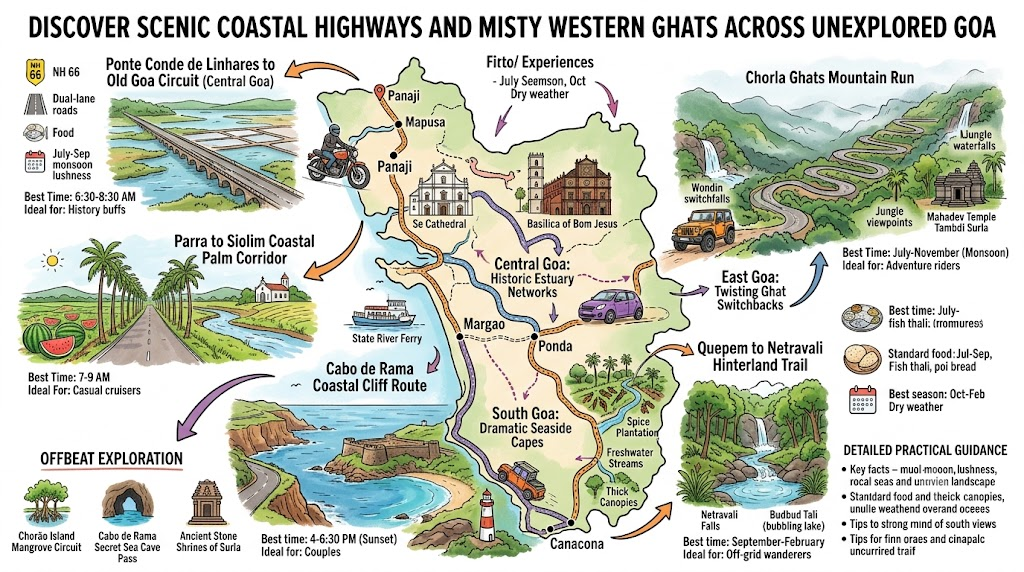
The ultimate driving routes trace three distinct corridors: the historic estuarine networks of Central Goa, the dramatic seaside capes of the far South, and the twisting ghat switchbacks that climb the eastern frontier. Each stretch reveals a landscape of architectural marvels, heritage villages, and quiet coastal vistas that most fly-in visitors never witness.
| Key Travel Dimension | Crucial Touring Fact |
| Primary Scenic Arteries | NH 66 (Pan-Goa spine), MDR 1 (Coastal North), SH 1 (Eastern Foothills) |
| Pivotal Driving Hubs | Panaji, Margao, Ponda, Mapusa, Canacona |
| Top Driving Season | July to September (Monsoon lushness) & October to February (Dry, breezy weather) |
| Standard Road Type | Dual-lane asphalt avenues, winding rural paths, and single-lane village roads |
| Ideal Vehicle Choice | 125cc+ Geared Motorcycles, Open-top Jeeps, or Compact Automatic Hatchbacks |
| Toll & Ferry Framework | State river passenger ferries are free; vehicular roll-on/roll-off fees apply (₹10–₹50) |
Best Places or Experiences
Ponte Conde de Linhares to Old Goa Circuit
The drive along the Ponte Conde de Linhares causeway is one of the most historic stretches of asphalt in Asia. Built in 1633 under the Portuguese viceroyalty, this three-kilometer bridge of laterite stone and timber piles cuts through the estuarine wetlands of the Mandovi River, linking Panaji directly to Ribandar. Driving here at dawn reveals traditional sluice gates (manos) and salt pans glistening under the morning light.
Continuing past Ribandar leads right into the heart of Old Goa, where the towering facades of the Basilica of Bom Jesus and Se Cathedral rise above green lawns. The straight, tree-lined avenue allows travelers to take in centuries of colonial architecture, ending among the fragrant spice hills and ancient stone shrines of Ponda.
- Location: Tiswadi Taluka, Central Goa; runs 10 km east from Panaji to Old Goa.
- Why it is worth visiting: A 400-year-old engineering marvel delivering open water views on both sides of the road.
- Best things to do: Stop near the salt pans for dawn photography, explore the vaulted nave of Se Cathedral, and sample traditional pao at a Ribandar bakery.
- Best time to visit: 6:30 AM to 8:30 AM for soft morning light and minimal commuter traffic.
- Ideal for whom: History buffs, architecture lovers, culture enthusiasts, and classic motoring fans.
- Travel tip: The road features tight vintage curbs with no modern shoulders; avoid parking on the causeway itself and use designated pull-ins near Ribandar.
Chorla Ghats Mountain Run
Leaving the coastal plain behind, the drive up the Chorla Ghats along State Highway 1 climbs into the dense jungle of the Western Ghats. This route winds through the Mhadei Wildlife Sanctuary, rising over 800 meters through misty hairpins and rain-carved laterite cliffs. The air cools quickly as sea breezes give way to tropical montane air.
The road features sweeping tarmac bordered by towering bamboo thickets, wild fig trees, and sudden gaps in the forest that overlook deep forested valleys. Driving this route during or just after the southwest monsoon reveals dozens of seasonal cascades spilling directly onto the road shoulders.
- Location: Sattari Taluka, North-East Goa border; roughly 55 km from Panaji.
- Why it is worth visiting: Dramatic mountain switchbacks, cooler highland microclimates, and rich biodiversity.
- Best things to do: Spot Malabar pied hornbills from jungle viewpoints, visit the historic 12th-century Mahadev Temple at Tambdi Surla, and pause at seasonal roadside waterfalls.
- Best time to visit: July to November for active waterfalls and lush green hills.
- Ideal for whom: Adventure riders, road-trip purists, wildlife photographers, and nature lovers.
- Travel tip: Heavy afternoon fog can drop visibility to less than five meters; drive with low-beam headlights and sound your horn around blind mountain curves.
Cabo de Rama Coastal Cliff Route
The southern coastal run through Betul, Agonda, and Canacona winds along cliff tops that rise high above the Arabian Sea. The route threads through sleepy fishing hamlets, groves of cashew trees, and open laterite plateaus before dead-ending at the weathered ramparts of Cabo de Rama Fort.
This headland offers striking maritime views. The ancient stone fortress, steeped in legends from the epic Ramayana and used by Portuguese garrisons, perches over an isolated blue bay framed by white foam and jagged black rocks. The coastal route leading here provides sweeping sea vistas without heavy commercial traffic.
- Location: Canacona Taluka, South Goa; 30 km south of Margao and 60 km from Panaji.
- Why it is worth visiting: Rugged ocean cliffs, panoramic sea views, and a sense of quiet isolation.
- Best things to do: Walk the outer fort ramparts out to the white lighthouse, hike down the steep trail to Cabo de Rama beach, and watch fishing trawlers head out at dusk.
- Best time to visit: 4:00 PM to 6:30 PM for sunset over the open ocean horizon.
- Ideal for whom: Couples, landscape photographers, solo riders, and travelers seeking quiet corners.
- Travel tip: Mobile connectivity drops off significantly along this southern stretch; download offline navigation maps before leaving Margao.
Parra to Siolim Coastal Palm Corridor
This northern cross-country run skirts around crowded coastal highways, connecting Parra, Assagao, and Siolim through open green countryside. The iconic Parra church road cuts through vibrant watermelon and paddy fields, framed on both sides by towering, arched coconut palms leading toward St. Anne’s Church.
Continuing toward Siolim, the route passes restored Indo-Portuguese mansions, deep garden cafes, and old whitewashed chapels before opening up at the Siolim bridge over the Chapora River. It offers a balance of rural village charm, quiet lanes, and sweeping river vistas.
- Location: Bardez Taluka, North Goa; roughly 15 km north of Panaji.
- Why it is worth visiting: Iconic palm-lined avenues, heritage residential architecture, and shaded backroads.
- Best things to do: Photograph the symmetrical tree lines at Parra, visit heritage boutiques in Assagao, and catch the sunset over the Chapora River at Siolim.
- Best time to visit: 7:00 AM to 9:00 AM for soft morning light and clear village lanes.
- Ideal for whom: Casual cruisers, design enthusiasts, slow travelers, and lifestyle photographers.
- Travel tip: Keep speeds low; local village councils actively enforce speed regulations and monitor street parking strictly along narrow village lanes.
Quepem to Netravali Hinterland Trail
The drive from Quepem into Netravali takes you deep into the agricultural and ecological heart of South-Eastern Goa. This route winds past historic country estates, through small spice plantations, and across broad freshwater streams that flow down from the inner hills. The pavement is framed by thick canopies of teak, betel nut, and wild mango trees.
The final stretch leads into the Netravali Wildlife Sanctuary, home to the curious bubbling lake of Budbudyanchi Tali and pristine forest waterfalls. It offers a glimpse of the state’s traditional agricultural way of life, untouched by beach tourism.
- Location: Sanguem and Quepem Talukas, South-East Goa; 45 km from Margao.
- Why it is worth visiting: Verdant spice plantations, cool mountain-fed streams, and peaceful rural communities.
- Best things to do: Observe the underwater methane bubbles at Budbudyanchi Tali, tour an organic spice plantation, and hike to the cool pool below Savari Waterfall.
- Best time to visit: September to February for clear, fresh running streams and active village harvests.
- Ideal for whom: Off-grid wanderers, botany lovers, families, and travelers seeking quiet nature.
- Travel tip: Fuel stations are sparse beyond Quepem town; fill up your fuel tank before turning onto the Netravali forest road.
Offbeat Exploration: Hidden Gems Tourists Miss
The Chorão Island Mangrove Circuit
Accessed via the flat-deck roll-on ferry from Raibandar, the island of Chorão is an estuarine maze of narrow tracks bounded by traditional khazan dykes. The route winds through the Salim Ali Bird Sanctuary, where low-tide mudflats host fiddler crabs, mudskippers, and migratory waterbirds. Riding slowly along these bund roads gives you a front-row view of an ancient wetland farming system that predates colonial rule.
Cabo de Rama Secret Sea Cave Pass
Just north of the main fort headland lies a discreet dirt road that leads down toward a rocky cove. At low tide, this trail reveals a natural sea cave carved directly into the laterite cliff by the pounding Arabian Sea. Visiting during a receding tide lets you step inside the cavern, framed by wave-worn basalt boulders and sea foam.
The Ancient Stone Shrines of Surla
Tucked away along the forested slopes of the eastern foothills stands the 12th-century Mahadev Temple at Tambdi Surla, Goa’s oldest surviving structural temple. Built from weather-resistant black basalt by Kadamba craftsmen, its intricate carvings of elephants and floral motifs stand in stark contrast to the whitewashed colonial chapels along the coast. The forest road leading to the site is shaded and serene.
Detailed Practical Guidance for Travelers
| Destination | Standard Entry Fee | General Timings | Best Local Food Options Nearby | Recommended Nearby Attractions |
| Ponte Conde de Linhares / Old Goa | Free (Museum: ₹25) | 7:30 AM – 6:00 PM | Viva Panjim (Fish Thali), Confeitaria 31 de Janeiro | Church of St. Cajetan, Viceroy’s Arch |
| Chorla Ghats | Free (Sanctuary checkpoint applies) | 24 Hours (Night driving not advised) | Wildernest Eco Resort Restaurant, roadside dhabas | Tambdi Surla Mahadev Temple, Anjunem Dam |
| Cabo de Rama Fort | Free | 9:00 AM – 5:30 PM | The Cape Goa Restaurant, Fisherman’s Wharf (Betul) | Agonda Beach, Betul Lighthouse |
| Parra to Siolim Strip | Free | Open 24 Hours | Gunpowder (Assagao), Vinayak Family Restaurant | St. Anthony’s Church Siolim, Chapora Fort |
| Netravali Sanctuary Trail | ₹50 per person, ₹100 vehicle pass | 8:30 AM – 4:30 PM | Tanshikar Spice Farm (Authentic traditional buffet) | Bubble Lake (Budbud Tali), Savari Falls |
Logistics & On-Ground Navigation
Local Transport Options
- Car Rentals: Self-drive vehicles with black-and-yellow commercial license plates are widely available for ₹1,200 to ₹3,500 per day, depending on vehicle class and season.
- Motorcycle & Scooter Rentals: The most popular choice for solo travelers and couples. Standard 125cc scooters run from ₹350 to ₹600 per day, while geared touring bikes range from ₹800 to ₹1,800.
- Automated App-Based Cabs: GoaMiles operates across airports, railway stations, and major towns, offering fixed app-based fares that avoid the need to haggle.
- State River Ferries: The River Navigation Department operates flat-bottom car ferries connecting island networks like Divar, Chorao, and St. Estevam. They are completely free for foot passengers and two-wheelers, with nominal fees for cars.
Budget Planning
- Budget / Backpacker Tier (₹1,500 – ₹2,800 per day): Standard scooter rental (₹400), shared fuel costs (₹300), hostel dorm bed (₹600–₹1,000), and fresh fish thalis from village taverns and roadside stalls (₹400–₹600).
- Mid-Range / Comfort Tier (₹4,500 – ₹9,000 per day): Compact air-conditioned rental car (₹1,800), fuel (₹800), boutique Portuguese heritage guesthouse (₹2,500–₹5,000), and dining at atmospheric garden bistros and coastal cafes (₹1,500–₹2,500).
Safety and Inclusivity Tips
- For Families: The southern coastal routes (Canacona, Cavelossim) offer wider roads, gentler traffic, and easy access to calm swimming bays. Keep a small emergency medical kit and motion-sickness remedies handy for winding ghat roads.
- For Couples: The scenic backroads around Divar Island, Assagao, and Cabo de Rama provide quiet, scenic driving corridors away from large tourist crowds.
- General Road Safety:Wear an ISI-marked helmet or fasten your seatbelt at all times. Goa Traffic Police maintain zero tolerance for driving under the influence, especially around coastal party belts, with immediate license confiscation and heavy spot fines.
Strategic Travel Planning Guardrails
Travel Planning Tips for Goa
- Secure Rentals in Advance for December: Peak holiday weeks see vehicle shortages and rental rates that often double or triple; book your wheels well ahead of time.
- Keep Physical Cash for Rural Stalls: While UPI and QR-code mobile payments work across most towns, deep forest checkpoints, rural ferries, and small village shops often need cash.
- Check Monsoonal Road Conditions: Landslides and fallen branches can temporarily block ghat routes like Chorla between July and August; check local updates before heading into the hills.
- Carry Valid Physical Documents: Always have your driver’s license, vehicle registration copy, insurance certificate, and Pollution Under Control (PUC) certificate ready for routine police checks.
- Respect Quiet Village Streets: Village lanes often lack sidewalks; keep your speed down, dim high beams at night, and avoid honking through quiet residential areas.
Common Mistakes to Avoid
- Relying Solely on Phone Navigation: Mobile data signals drop in the deep valleys of the Western Ghats and around Cabo de Rama; download offline map areas in advance.
- Crossing Solid White Centerlines: Winding village roads feature blind turns around chapel walls and banyan trees; stay strictly within your lane.
- Driving on Protected Sand Dunes: Driving any motor vehicle onto beaches is strictly illegal in Goa, carrying heavy fines, vehicle impoundment, and potential arrest.
- Overlooking Fuel Gauges in Forest Zones: Petrol pumps are scarce once you leave national highways; never enter the foothills or nature reserves with less than a third of a tank.
- Skipping Regional Cuisine for Familiar Menus: Avoid ordering generic resort dishes; look out for local lunch homes serving fresh fish curry thalis, poi bread, and vegetable caldin.
Suggested Itinerary Blueprints
1. Day Quick Dash (The Estuary & Heritage Loop)
- Target Audience: Short-stay travelers, cruise passengers, and weekend visitors.
- Route: Panaji → Ponte Conde de Linhares → Old Goa → Ponda Spice Belt → Divar Island Ferry → Panaji.
- Layout: Depart Panaji at 7:30 AM along the causeway, tour the Old Goa churches before tour buses arrive, enjoy an authentic spice plantation lunch in Ponda, and cross the river by car ferry via Divar Island as the sun dips over the Mandovi.
2. Day Deep-Dive (Coastlines to Cloud Forests)
- Target Audience: Road-trip lovers looking to experience both sea cliffs and jungle hills.
- Day 1 (Western Seaboard Run): Pick up your vehicle in Panaji, drive north through the palm corridors of Parra and Siolim, cross into Morjim and Arambol, and watch the sunset from the cliffside paths of Chapora.
- Day 2 (Mountain Ascent): Depart early toward Sanquelim and climb the Chorla Ghats into the Mhadei rainforest. Spend the afternoon exploring the 12th-century stone temple at Tambdi Surla before returning through the quiet backroads of Valpoi.
3. Complete Weekend Travel Plan (The Grand Trans-Goa Circuit)
- Target Audience: Travelers ready for an immersive three-day journey through the state’s diverse landscapes.
- Friday (The Cultural North): Explore the Latin Quarter of Fontainhas in Panaji, cross the backwaters to Chorao Island, and drive through the heritage home-lined streets of Aldona, spending the night in Assagao.
- Saturday (The Wild Ghats): Drive east along State Highway 1, climbing into the mist of Chorla Ghats for mountain viewpoints. Descend through Ponda for a traditional Saraswat-style lunch, and head south to base yourself in the quiet village of Agonda.
- Sunday (The Southern Capes): Take the coastal cliff road out to Cabo de Rama Fort for early morning sea views, explore the quiet lanes of Betul, and trace the smooth asphalt of NH 66 north past the Zuari River to wrap up your trip.
Common Tourist Mistakes to Avoid
- Geographic Blunders: Trying to drive from Arambol in the far north to Palolem in the far south for lunch and back in a single day. You will spend over five hours battling local traffic instead of enjoying the scenery.
- Commercial Traps: Spending hours in congested market streets and commercial beach lanes in Calangute instead of cruising the serene, tree-lined village roads of Saligao, Aldona, or Raia.
- Neglecting Modern/Alternative Zones: Focusing entirely on crowded beach fronts while missing the thriving food scene, contemporary art galleries, and restored architecture in inland villages like Moira and Assagao.
- Transport Overpayment: Agreeing to arbitrary roadside taxi quotes without checking standard GoaMiles app rates, or renting scooters without thoroughly photographing pre-existing scratches and testing the brakes first.
- Luxury Dining Bias: Eating exclusively at high-end resort restaurants. You miss the authentic flavors of Goan cooking found in small family-run matanhar eateries and street-side ros omelette carts.
Frequently Asked Questions
1. What driving license is required to rent a vehicle in Goa?
Indian nationals require an original, valid permanent driving license for light motor vehicles or motorcycles. International visitors must carry an International Driving Permit alongside their original national driver’s license. Digital copies on official government apps like DigiLocker are widely accepted across local checkpoints, though keeping a physical card is recommended when venturing into remote forested areas.
2. Are the river ferries safe for vehicles and what do they cost?
Yes, the flat-deck roll-on/roll-off ferries operated by the River Navigation Department are safe, well-maintained, and run on reliable schedules. They are completely free for pedestrians, cyclists, and two-wheelers. Four-wheelers pay a nominal fee of ₹10 to ₹50 depending on vehicle size, making them one of the most scenic and cost-effective travel experiences in the state.
3. Is driving through the Chorla Ghats safe during the monsoon?
Driving through the Chorla Ghats during the monsoon requires extra focus and experience with mountain roads. The route becomes misty and wet, with occasional loose rocks and reduced visibility. Drive during daylight hours, keep your headlights on low beam, and check weather alerts to avoid rare travel delays caused by fallen roadside branches.
4. How strict are the police regarding helmet and seatbelt laws in Goa?
Goa Traffic Police strictly enforce road safety laws across the state. Both the rider and pillion passenger on a two-wheeler must wear ISI-marked helmets with the chinstrap securely fastened. Car drivers and front-seat passengers must wear seatbelts at all times. Violations carry immediate computerized spot fines and potential court summonses.
5. Which route offers the most scenic coastal ocean views while driving?
The stretch from Betul down to Cabo de Rama and Agonda in South Goa delivers the most dramatic coastal ocean panoramas. Unlike northern highways that run slightly inland, this southern road winds along high laterite cliffs, offering open vistas of the Arabian Sea, quiet fishing bays, and coconut palm groves along the roadside.
6. Can I drive a rented Goa vehicle outside state borders into Karnataka or Maharashtra?
Most self-drive rental cars and bikes with black-and-yellow commercial plates are permitted to cross state borders, provided the vehicle holds a valid interstate permit. You must inform your rental operator beforehand to ensure the proper tax documentation is in order, and be prepared to pay state entry road taxes at the border checkpoints.
7. What is the average cost of fuel and are petrol pumps readily accessible?
Fuel prices in Goa are typically comparable to or slightly lower than neighboring states due to local tax structures. While fuel stations are frequent along major highways like NH 66, they are sparse in deep rural areas such as Netravali and the Chorla Ghats. Always top up your tank before venturing away from main towns.
8. What should I do in the event of a mechanical breakdown on rural backroads?
Contact your vehicle rental provider immediately; reputable agencies provide 24/7 roadside assistance across the state. Save the state emergency numbers (112 for all-round emergency services). Most local village mechanics (puncture-wallahs) can handle basic tire repairs and minor scooter fixes for modest, fair cash payments.
9. Are cows and stray animals a significant hazard on Goan roads?
Yes, free-roaming cattle often rest along warm asphalt lanes, especially on unlit stretches after dark and around blind curves in rural villages. Keep your speed moderate, use your vehicle’s horn gently when approaching animals near the roadside, and avoid using high-beam headlights that can temporarily blind and freeze animals in your path.
10. What is the best vehicle type for navigating small Goan village lanes?
A lightweight, automatic 125cc scooter or a compact hatchback car is ideal for navigating Goa’s narrow, winding village streets. Many rural lanes were originally laid out for bullock carts and foot travel, making wide luxury SUVs difficult to maneuver and park when encountering oncoming local buses or delivery trucks.
11. Is nighttime driving safe across Goan highways and rural stretches?
Major highways like NH 66 are generally safe and well-lit near towns, but rural backroads and mountain ghat passes often lack street lighting and feature sharp, unmarked turns. If you are unfamiliar with the terrain, stick to daytime journeys to avoid unlit speed breakers, stray animals, and narrow bridge crossings.
12. How do I avoid overpaying for self-drive vehicle rentals during peak season?
Book your rental vehicle at least four to six weeks in advance if traveling between mid-December and early January. Work with registered operators who provide clear, written rental agreements, verify that the vehicle carries commercial yellow-on-black registration plates, and carefully inspect and photograph any existing scratches or dents before driving away.
Conclusion
Steering away from crowded tourist enclaves and out onto Goa’s open coastal highways reveals a deeper, more rewarding side of the sunshine state. Whether you find yourself waiting for a wooden ferry on the quiet waters of the Mandovi, watching ocean waves crash beneath the ramparts of Cabo de Rama, or cruising through the palm-lined avenues of Parra at dawn, these roads offer a sense of discovery that static vacations simply cannot match. Grab your keys, keep your eyes on the road ahead, and let Goa’s scenic backroads guide your journey.

Leave a Reply
You must be logged in to post a comment.